

As fighting continued through Saturday afternoon, Iran’s Revolutionary Guard Corps (IRGC) claimed that two oil tankers transiting the Strait of Hormuz were impacted by exploding mines. However, U.S. Central Command (CENTCOM) quickly dismissed the claims as entirely false.
What the IRGC Claimed
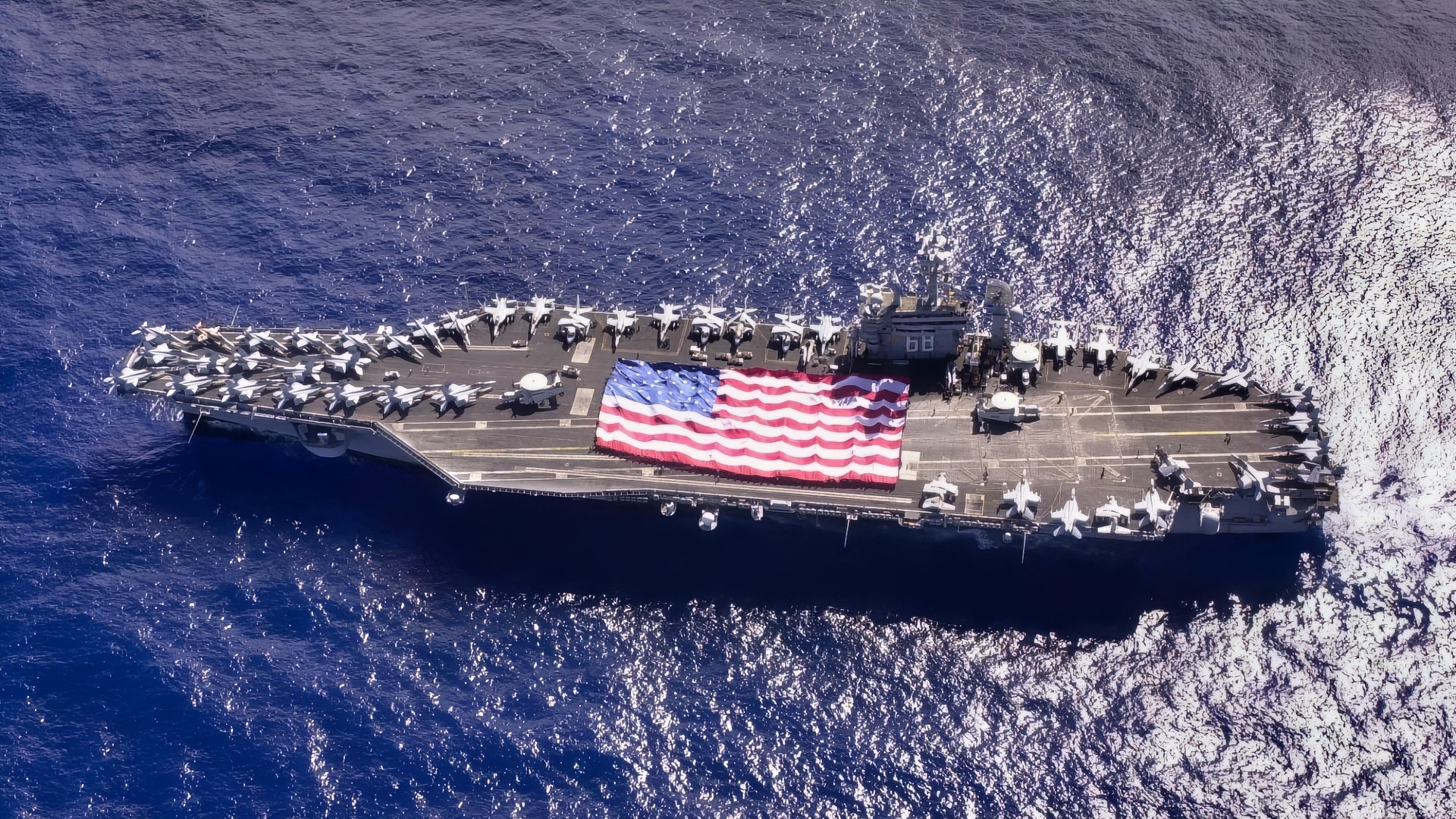
Pacific Ocean (Nov. 3, 2003) — USS Nimitz (CVN 68) crewmembers participate in a flag unfurling rehearsal with the help of family and friends on the ship’s flight deck during a Tiger Cruise. The Nimitz Carrier Strike Group and embarked Carrier Air Wing Eleven (CVW-11) are en route to San Diego, Calif., following an eight-month deployment to the Arabian Gulf in support of Operation Iraqi Freedom. U.S. Navy photo by Photographer’s Mate 3rd Class Elizabeth Thompson. (RELEASED)
“An hour ago, two oil tankers, which were trying to pass through the minefield south of the Strait of Hormuz by deceptive American intelligence agencies, exploded and caught fire,” a statement published by Iranian state news agency IRNA said.
The statement did not specify which tankers had been hit, but it did also include a warning to other sailors to avoid using the strait.
“To protect their capital and, more importantly, their lives, the sailors should not be deceived and enter the minefield,” the statement continued.
The comments seem to suggest that Iran wants shipping operators to believe that the United States is misleading them into believing that the Strait of Hormuz is open, and that U.S. forces in the region can guarantee the safety of ships passing through.
The Hormuz Letter reported that an IRGC statement added that sailors were “misled by US intelligence” and that it is “impossible to export even a single drop of chemical fertilizers or oil and gas from this region” until the United States ends its operation.

F-15EX Eagle II’s from the 40th Flight Test Squadron, 96th Test Wing, and the 85th Test and Evaluation Squadron, 53rd Wing, both out of Eglin Air Force Base, Florida, fly in formation during aerial refueling operations with a KC-135 Stratotanker from the 370th Flight Test Squadron out of Edwards Air Force Base, California, May 14. The Eagle II’s participated in the Northern Edge 21 exercise in Alaska earlier in May. (Air Force photo by Ethan Wagner)
In an additional statement also issued on Saturday, the IRGC claimed that it had stopped four ships attempting to transit the Strait of Hormuz.
“In the past hours, four violating ships with the support of the terrorist US army were trying to pass through the Strait of Hormuz, and all four ships were stopped in place during a combined missile and drone operation,” the statement reads.
How the U.S. Responded
CENTCOM immediately rejected the claims in a statement published on X. In a brief post, CENTCOM issued a “fact check,” noting, “Iran’s Islamic Revolutionary Guard Corps (IRGC) claims that two oil tankers have exploded in the Strait of Hormuz after hitting mines in the international waterway.”
“Like most IRGC claims, this is false,” the statement continued.
What It All Means
The war has expanded in recent days, with Iran striking targets across the Gulf – but the focus remains the same: control over the Strait of Hormuz. That battle, which the U.S. must win to secure global oil trade but that Iran cannot forfeit without losing all of its leverage, is the primary driver of global economic uncertainty right now.
Washington insists that the waterway is open, secured by U.S. naval forces in the region. The White House wants commercial shipping companies, ship owners, insurers, and even the sailors themselves to believe that it is possible to transit the Strait of Hormuz, safe in the knowledge that the U.S. military will protect them as they navigate through confirmed lanes. But sailors, it seems, just aren’t willing to take the risk – and that’s precisely what Iran is taking advantage of when the regime claims that tankers have been hit.
Maritime intelligence firm Kpler has shown that, since fighting resumed, traffic through the strait has fallen significantly, wiping out any steady gains made while the memorandum of understanding (MOU) was still in effect. Earlier this week, Kpler reported only 21 confirmed commodity vessel transits through the strait on July 14, noting a growing loss of confidence in the U.S.-backed southern shipping corridor near Oman.
Instead, the vessels that continued sailing overwhelmingly favored routes closer to Iranian waters after coordinating with Tehran, proving that even commercial operators are willing to trust Iranian officials as the U.S. pushes its own protected corridor. Kpler also found that three additional attacks off the coast of Oman in recent weeks had pushed the number of confirmed maritime security incidents there to 56, with 17 seafarers killed. It is no wonder, then, that sailors are increasingly conscious of the threats posed by moving through the Strait of Hormuz – even as Washington makes big promises.
The trend just keeps worsening, too. According to a Reuters report, by July 16, only three commodity vessels transited the Strait of Hormuz – the lowest daily total since May. And out of those vessels that did pass, none were very large crude carriers or LNG tankers, meaning very small quantities of oil passed through that waterway for a second consecutive day. Several ships were also reportedly stopped short of the strait or in the process of turning around, rather than continuing through the waterway.
This Is Bad for Washington
It’s bad news for Washington – and the rest of the world – because it comes only weeks after the White House assured the maritime industry that shipping could safely resume following the June MOU between Washington and Tehran. President Donald Trump made big promises about the waterway being “permanently toll-free” and safe to navigate, but that proved not to be the case even during the MOU phase, after Iran struck multiple commercial vessels with one-way naval attack drones.
Despite a slow but steady increase in traffic during that period, the repeated Iranian attacks and the subsequent return to warfare by the United States have meant that seafarers no longer trust that the waterway is safe to navigate.
About the Author: Jack Buckby
Jack Buckby is a British researcher and analyst specializing in defense and national security, based in New York. His work focuses on military capability, procurement, and strategic competition, producing and editing analysis for policy and defense audiences. He brings extensive editorial experience, with a career output spanning over 1,000 articles at 19FortyFive and National Security Journal, and has previously authored books and papers on extremism and deradicalization.


