


Summary and Key Points: France’s Charles de Gaulle remains one of the world’s most important aircraft carriers and the only operational nuclear-powered carrier outside the United States.
-Despite early delays and technical issues, the ship matured into a proven combat platform with deployments supporting operations in Afghanistan, Libya, and against ISIS.
-Its air wing, catapult system, and cross-deck interoperability with U.S. Navy aircraft make it a serious force multiplier.
-The carrier’s 2025 Pacific deployment also underscored France’s growing Indo-Pacific role alongside the United States, Japan, and India. With retirement expected in the late 2030s, France is already planning a much larger next-generation carrier.
Why France’s Charles de Gaulle Is Still Europe’s Most Important Aircraft Carrier
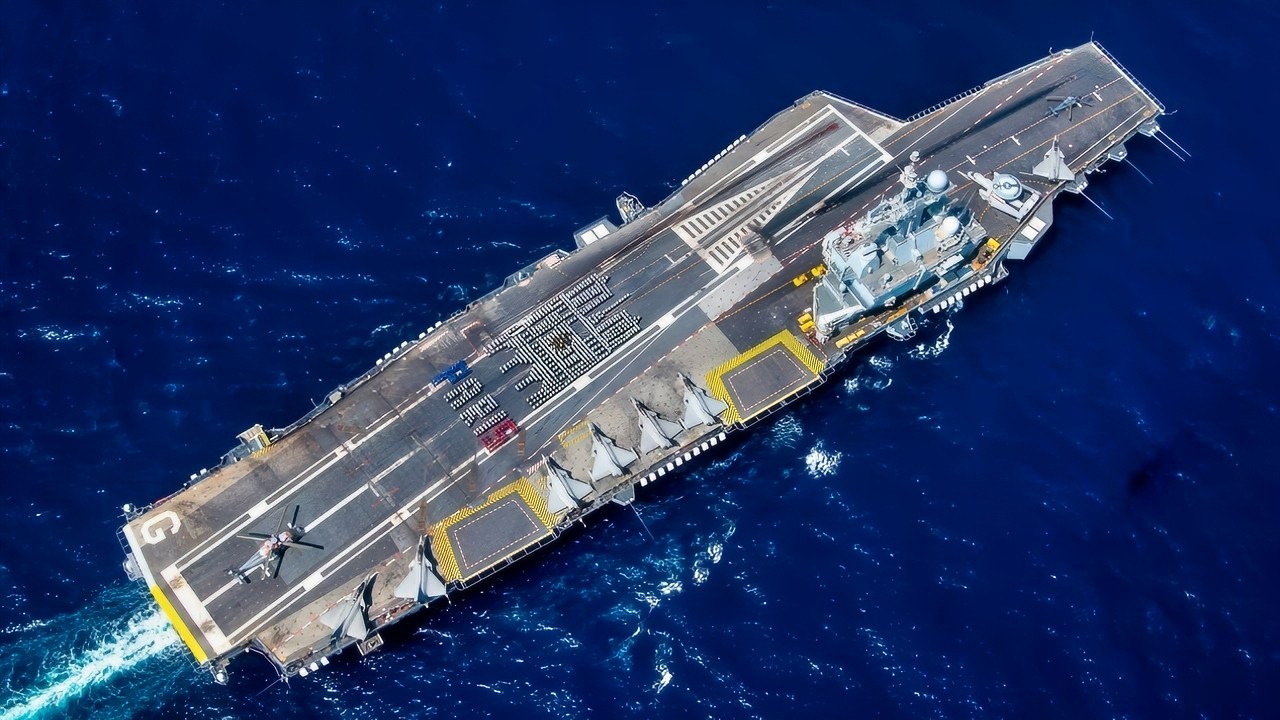
Charles de Gaulle Aircraft Carrier France. Image Credit: Creative Commons.
The naval battles of World War II marked the rise of the aircraft carrier, and the United States has led carrier development.
Today, with the supercarriers of the Nimitz and the Ford classes, that trend has continued. But the US isn’t the only country with outstanding nuclear-powered aircraft carriers.
France, which has built 10 aircraft carriers, has the nuclear-powered Charles de Gaulle (CDG). France is the only other country to have a nuclear-powered carrier. China is currently building its fourth carrier, which is reportedly nuclear-powered.
Though the CDG is slightly smaller than the Nimitz or Ford classes of the US Navy, the CDG is still a formidable warship. She boasts a steam catapult system only slightly smaller than those on US carriers, which is still capable of launching F/A-18E/F Super Hornets and C-2 Greyhounds if the situation called for it.
The FS Charles de Gaulle (R91)

The French Marine Nationale aircraft carrier FS Charles De Gaulle (R91), and the aircraft carrier USS John C. Stennis (CVN 74) are underway in formation in the Red Sea, April 15, 2019. The John C. Stennis Carrier Strike Group is deployed to the U.S. 5th Fleet area of operations in support of naval operations to ensure maritime stability and security in the Central Region, connecting the Mediterranean and the Pacific through the western Indian Ocean and three strategic choke points. (U.S. Navy photo by Mass Communication Specialist Seaman Joshua L. Leonard)
The carrier replaced the Foch, a conventionally powered aircraft carrier, in 2001. Clemenceau and Foch were completed in 1961 and 1963, respectively; the requirement for a replacement was identified in the mid-1970s.
The FS CDG was originally designed in the 1980s. The hull was laid down in April 1989 at the DCN Brest naval shipyard. The carrier was launched in May 1994 and, at 42,000 tons (full combat load), was the largest warship launched in Western Europe since HMS Ark Royal in 1950.
She was initially named Richelieu in 1986 by the French president at the time, François Mitterrand, after the famous French statesman Armand-Jean du Plessis, Cardinal Richelieu, made famous in Alexandre Dumas’s novel “The Three Musketeers.” However, on May 18, 1987, the ship’s name was changed to Charles de Gaulle by the Gaullist Prime Minister Jacques Chirac.
The CDG suffered many work stoppages due to budget constraints before finally being finished and commissioned in mid-May 2001, five years after its projected deadline.
The carrier experienced teething troubles during its first few years of service before all the bugs were worked out on a totally new warship. The carrier has a length of 857 feet with a beam of 211 feet, a draught of 30 feet, 11 inches, and a height of 218 feet.
The Charles De Gaulle Powerplant
The CDG is powered by two Areva K15 pressurized water reactors (PWRs), each with a thermal output of 150 MWt, and two Alstom steam turbines with a total shaft power of 61 MW (82,000 hp).
The top speed of the CDG is 27 knots, following upgrades in 2007. She went through her midlife refueling in 2017. Since these upgrades, the Charles de Gaulle has been an outstanding aircraft carrier.
Charles De Gaulle’s Armaments

190424-M-BP588-1005 U.S. 5TH FLEET AREA OF OPERATIONS (April 24, 2019) A U.S. Marine MV-22 Osprey assigned to the 22nd Marine Expeditionary Unit sits on the flight deck of France’s Marine Nationale aircraft carrier FS Charles De Gaulle (R 91). This was the second time that Ospreys have landed aboard the French vessel. Marines and Sailors assigned to the 22nd MEU and Kearsarge Amphibious Ready Group are currently deployed to the U.S. 5th Fleet area of operations in support of naval operations to ensure maritime stability and security in the Central region, connecting the Mediterranean and the Pacific through the western Indian Ocean and three strategic choke points. (U.S. Marine Corps photo by Maj. Joshua Smith/Released)
The CDG is equipped with numerous defensive armaments, including four eight-cell A-43 Sylver launchers that carry the MBDA Aster 15 surface-to-air missile. Two 6-cell Sadral launchers carrying Mistral short-range missiles
The carrier has 20mm autocannons for close-in air defense. Eight Giat 20F2 20 mm cannons (original armament), and three Nexter Narwhal (since 2019).
The CDG carries up to a full complement of 40 combat aircraft, consisting of 30 of the outstanding Rafale M fighters, two E-2C Hawkeye, two NFH Caïman Marine, one AS565 Panther ISR, and two AS365F Dauphin Pedro.
Combat History Of This French Navy Supercarrier
In November 2001, the French sent Task Force 473 in the waters off Afghanistan in support of Operation Enduring Freedom. The task force under the command of Contre-Amiral François Cluz comprised the Charles de Gaulle, frigates Lamotte-Picquet, Jean de Vienne, and Jean Bart, the nuclear attack submarine Rubis, the tanker Meuse, and the D’Estienne d’Orves-class aviso Commandant Ducuing.
The CDG carried out 770 sorties during her deployment. In February 2002, aircraft from the US carrier USS John Stennis and the CDG landed on each other’s carriers in a show of interoperability and the strength of the alliance.
At the end of the CDG’s deployment, US President George Bush complimented “our good ally, France, who has deployed nearly one-fourth of its navy to support Operation Enduring Freedom.”
The task force would complete another deployment in Afghanistan in support of Operation Enduring Freedom in 2005.
The CDG was involved in the no-fly zone over Libya in 2011 and was an integral part of the campaign to defeat the Islamic State in 2015. The CDG has proven to be a more than capable aircraft carrier, indicative of its status as the flagship of the French fleet.
The CDG’s First Pacific Deployment
In March of 2025, in a move to strengthen ties with both the United States and Japanese naval forces, the CDG completed its first Pacific deployment.
“This port visit marks the last stage of our mission in the Pacific before setting sail further west for the exercise Varuna with our Indian partner,” the CSG’s commander, Rear Adm. Jacques Mallard, said.
“All the exercises and interactions carried out on this new area for the French Carrier Strike Group have not only strengthened our interoperability but also demonstrated our commitment to promoting a free, open, safe, and peaceful Indo-Pacific region.”
The French carrier strike group includes Charles De Gaulle, destroyer FS Forbin (D620), frigates FS Provence (D652) and FS Alsace (D656), and fleet oiler FS Jacques Chevallier (A725).
With China acting more aggressively in the Pacific, the US has hardly been alone in trying to maintain freedom of navigation in the region. That was the purpose of the CDG’s deployment: to show NATO’s resolve.
Earlier last year, the CDG’s air group was deployed, working closely with the air and naval assets of the US and Japan, and showing just how far French naval aviation capabilities have grown since the Cold War.
At the conclusion of the exercises with the US and Japan, the CDG sailed to the ocean off of India to conduct joint exercises with Indian Navy units.
During the deployment, US F/A-18 Super Hornets from USS Carl Vinson (CVN-70) and Rafale-Ms from Charles de Gaulle conducted cross-deck landings, highlighting that the French carrier is highly interoperable with the US Navy aircraft, as its catapult and arresting gear equipment are from the US.
The CDG’s Landing Signal Officers (LSOs) train for 2 years in the US, making them familiar with directing US naval aircraft during landings.
PANG: Planning For the Next Generation Of French Carriers

PANG Aircraft Carrier from France. Image Credit: Creative Commons.
The French Navy is already planning for the next generation of carrier development. By the late 2030s, the CDG will be ready for retirement. And the future carrier will be bigger (305 meters long) and weigh 75,000 tons, while carrying a larger complement of aircraft and drones and utilizing an EMALS catapult system. It has already been named the PANG aircraft carrier.
It is already being billed as “Europe’s most advanced aircraft carrier.”
About the Author: Steve Balestrieri
Steve Balestrieri is a National Security Columnist. He served as a US Army Special Forces NCO and Warrant Officer. In addition to writing on defense, he covers the NFL for PatsFans.com and is a member of the Pro Football Writers of America (PFWA). His work was regularly featured in many military publications.


