


Key Points and Summary – Russia’s MiG-31 remains pivotal thanks to rugged steel/titanium airframes, periodic depot overhauls, and major upgrades.
-Variants like MiG-31BM add Zaslon-M radar and R-37M shots; MiG-31K carries the Kh-47M2 Kinzhal, turning a Cold War interceptor into a long-range strike host.
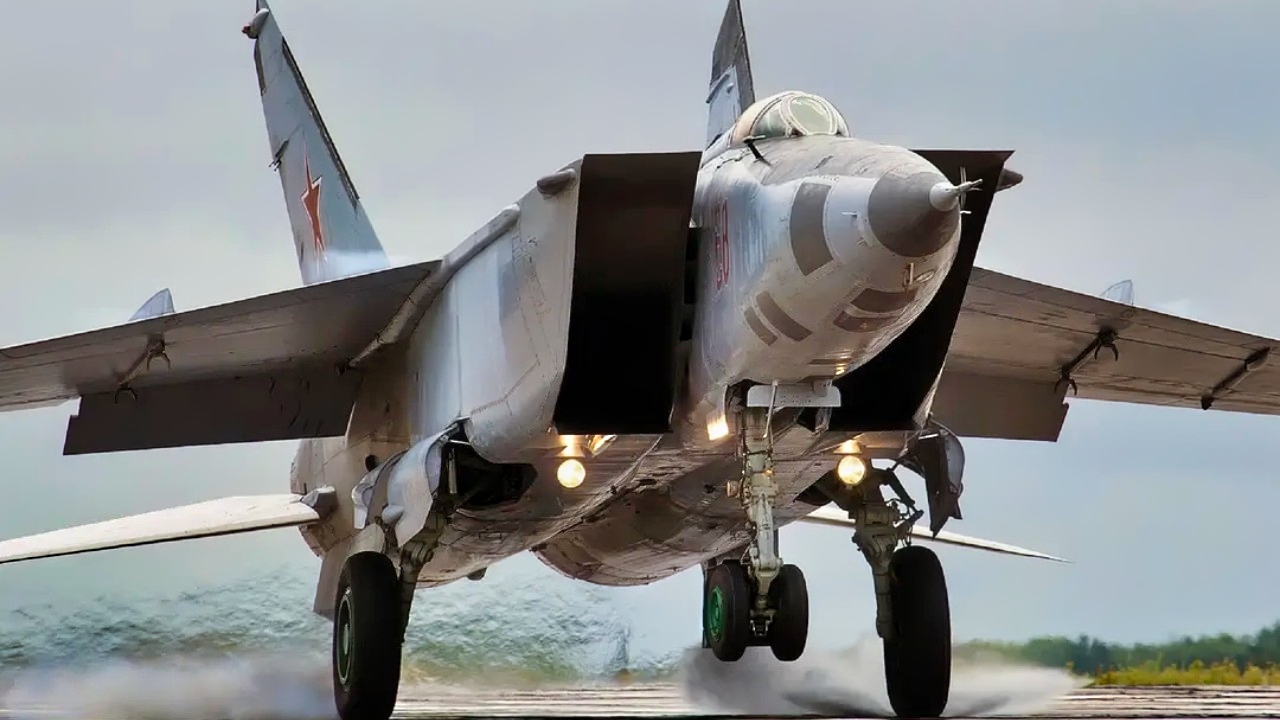
MiG-25 Foxbat Fighter. Image Credit: Creative Commons.
-A large mothballed inventory supplies spares, while the jet’s focused mission—high-altitude interception and Arctic/Far East patrols—limits dogfight wear.
-With Mach 2.8 speed, big sensors, and heavy missile loads, the MiG-31 fills a niche Russia can’t readily replace, evidenced by recent NATO-border incidents.
Bottom line: refurbishment, modernization, and finite storage spares keep this Soviet design operationally relevant.
MiG-31: Russia’s Soviet-era Interceptors in Flight
Keeping Russia’s MiG-31 airworthy has become strategically crucial for the Kremlin.
The MiG-31 is one of the oldest combat aircraft still flying in active service within the Russian military. A legacy Soviet aircraft, Russia has kept the MiG-31 airworthy, despite its vintage, thanks to a combination of refurbishment, modernization, and the replacement of some of the jet’s design features, which have collectively kept the platform viable.
The Original Design
The MiG-31 was originally designed in the late 1970s and early 1980s, during the height of Cold War tensions with the United States, as a high-speed interceptor. In this role, the jet’s high top speed would serve to shrink the enormous borders of the Soviet Union and ensure overflights from nosy NATO aircraft could be addressed if necessary—a quick-response jet able to respond to even very far away threats.
Although visually similar to the older MiG-25 Foxbat, another large interceptor aircraft, the MiG-31 utilizes a broader range of materials, including titanium, to reduce aircraft weight.
In contrast, the MiG-25 was primarily constructed from robust—but heavy—stainless steel and nickel alloys, capable of withstanding the extreme heat generated by its top speed of Mach 3.2.

MiG-25. Image Credit: Creative Commons.

MiG-25 Foxbat. Image Credit: Creative Commons.
The MiG-31 was, compared to its contemporaries, incredibly robust, boasting a greatly reinforced titanium and steel structure that could withstand the rigors of sustained supersonic flight and the taxing conditions of the Arctic, while also ensuring a long service life.
That material design choice gave the MiG-31 a stronger, more durable airframe than its lighter-weight Western fighter counterparts; however, it also made the MiG-31 a significantly heavier fighter jet.
Russia maintains its fleet of MiG-31 jets in part through periodic deep maintenance procedures.
These include stripping MiG-31 airframes of paint and protective coatings to check for stress fatigue and corrosion, replacing hydraulics and wiring, replacing cockpit equipment with modernized digital upgrades, re-engining or refurbishing the MiG-31’s D-30F6 turbojet engines, and other overhauls and checks that greatly extend the jet’s service life well beyond what its Soviet designers originally envisioned.
However, Russia has not only maintained and refurbished the MiG-31; there have also been significant modernization programs for the MiG, collectively resulting in substantial upgrades. The MiG-31BM featured an updated Zaslon-M radar, equipped with digital avionics, and the capability to fire modernized long-range missiles, such as the R-37M.
The MiG-31K was modified to carry the Kh-47M2 Kinzhal missiles, a hypersonic missile that turns those older MiG interceptors into mobile strategic strike platforms.
Another MiG upgrade standard, the MiG-31BSM, incorporated avionics and structural updates into the design to reduce pilot workload. Cumulatively, these updates have kept the MiG-31 not only airworthy but also operationally relevant, even today, decades after the interceptor first entered service with the Soviet Union.
Lots of Warplanes
Aside from the MiG-31’s physical strengths, however, is the composition of the MiG-31 fleet as a whole. With around 500 jets built, Russia has a larger number of airframes in storage, available for spare parts cannibalization.
Following the economic downturn of the 1990s, following the collapse of the Soviet Union, many MiG-31 and other aircraft—not to mention tanks, trucks, infantry fighting vehicles, and other platforms—were mothballed to conserve scarce defense resources.
This reserve fleet is a boon to maintenance personnel responsible for keeping the MiG-31 airworthy, although it is a finite resource.
What It Can Do…
Another factor that helps Russia’s MiG-31 fleet is that those jets have a somewhat limited mission profile.
Unlike some more flexible multi-role fighter aircraft, the MiG-31 is used for relatively specific operational tasks, including long-range interception, high-altitude patrolling, and, more recently, long-range missile carriage.
On the one hand, this type of operation is quite demanding; it requires a very high top speed and good endurance.
On the other hand, the kinds of airframe stress caused by dogfighting or other high-G maneuvers are uncommon, making the evaluation and repair of airframe stress more predictable and manageable.
Why Russia Needs This Plane
But the MiG-31’s value to Russia is also very high.
It is one of the few fighters that Moscow can call on to patrol the Arctic—an increasingly valuable and accessible area of the world—as well as Siberia, other parts of Russia’s Far East, and other locations in the Russian hinterlands.
There is, simply put, not a realistic alternative. Its unique capabilities, which include powerful radar, the ability to carry large and long-range missiles, and an incredibly fast 2.8 Mach sprint speed, are simply not replicable at present. These factors combine to ensure that the jet remains airworthy.
The value to Russia is reflected in the recent Russian overflight of Estonian airspace, a violation of that country’s sovereignty. The aircraft that were involved in penetrating NATO’s airspace? Three armed MiG-31 jets.
MiG-31: What Now?
In summary, Russia keeps the MiG-31 flying through its reliance on the jet’s robust titanium and steel airframe, extensive and periodic overhauls, a series of upgrades and deep modernizations, and the cannibalization of spare parts from mothballed aircraft. Perhaps most significantly among those factors is the simple fact that there is no clear, viable alternative to the MiG-31 in the Russian Air Force today. Absent a clear replacement, the impetus for keeping the existing fleet of MiG-31 airworthy is unlikely to change anytime soon.
About the Author: Caleb Larson
Caleb Larson is an American multiformat journalist based in Berlin, Germany. His work covers the intersection of conflict and society, focusing on American foreign policy and European security. He has reported from Germany, Russia, and the United States. Most recently, he covered the war in Ukraine, reporting extensively on the war’s shifting battle lines from Donbas and writing on the war’s civilian and humanitarian toll. Previously, he worked as a Defense Reporter for POLITICO Europe. You can follow his latest work on X.
More Military
The F/A-18 Hornet Fighter Has a Message for the U.S. Navy
F-15E Strike Eagle Has Just 1 Mission
Russia’s Su-27 Flanker Fighter: Moscow’s Best Warplane Ever? You Decide
Iowa-Class Battleship USS Wisconsin Has a Message for the U.S. Navy
The U.S. Navy’s USS Connecticut Seawolf-Class Nuclear Attack Submarine Summed Up in 4 Words


