


Key Points and Summary – The Soviet MiG-23 “Flogger” was a 1960s variable-sweep wing fighter designed to replace the MiG-21 by offering greater speed (Mach 2.3) and the agility for dogfighting—a capability its U.S. counterpart, the F-111, lacked.
-While its three-position swing-wings were innovative, they also proved to be a “maintenance and logistical burden.”
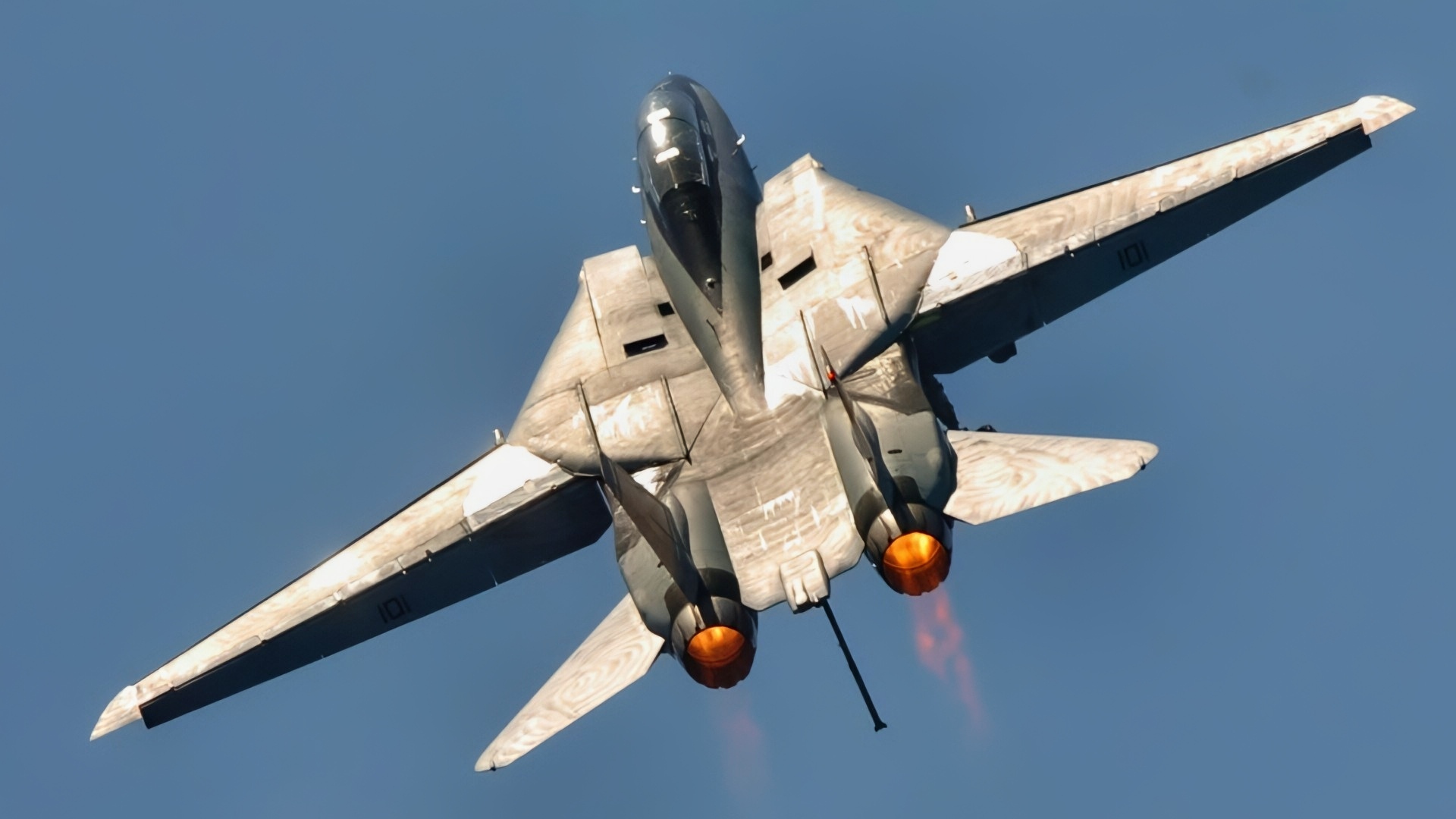
(June 19, 2006) – An F-14D Tomcat from Fighter Squadron Three One (VF-31), the “Tomcatters,” performs a fly by past the Nimitz-class aircraft carrier USS Dwight D. Eisenhower (CVN 69). For the past 30 years, the F-14 Tomcat has assured U.S. air superiority, playing a key role in ensuring victory and preserving peace around the world. The F-14 Tomcat will be removed from service and officially stricken from the inventory in September of 2006. U.S. Navy photo by Photographer’s Mate 2nd Class Miguel A. Contreras PH2 CONTRERAS MIGUEL
-The MiG-23’s avionics were inferior to Western jets, and it was “thoroughly outclassed” by the U.S. Teen Series fighters (F-14, F-15, F-16). Its greatest strength was not quality but “mass,” with over 5,000 built, designed to “saturate NATO airspace.”
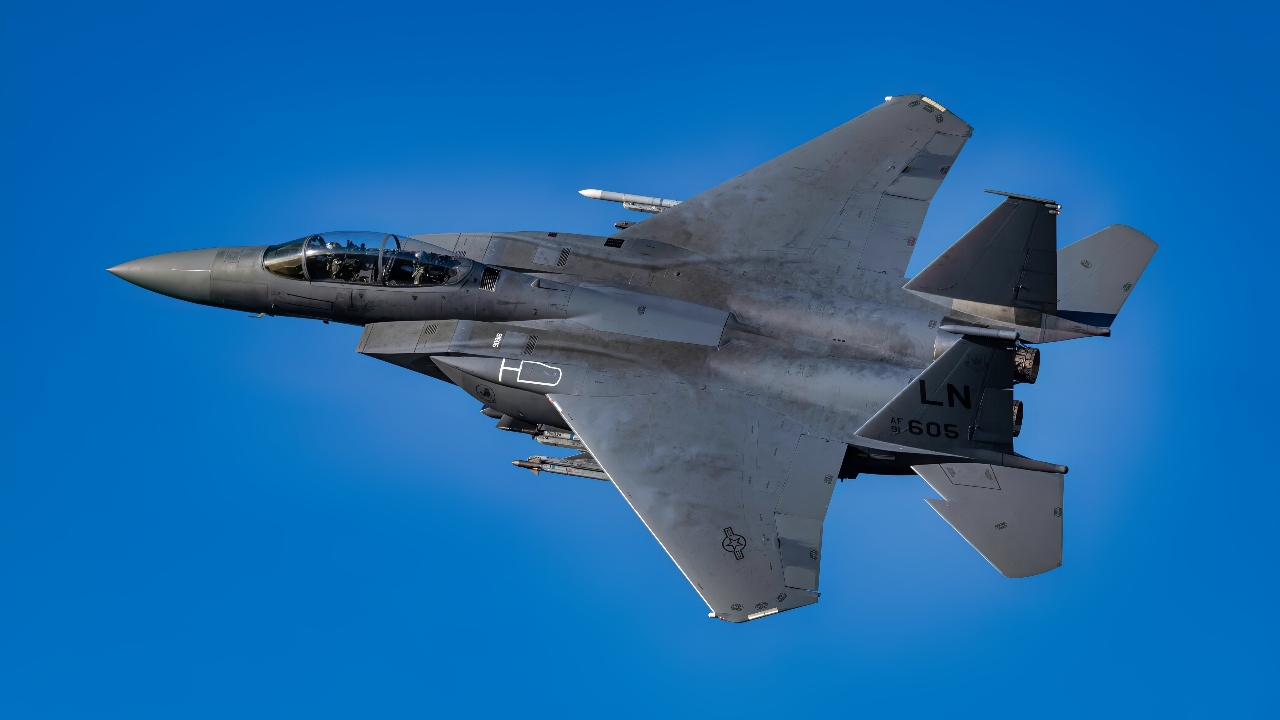
An F-15E Strike Eagle pulls out of a low approach and prepares to land at Royal Air Force Lakenheath, Jan. 5, 2022. The Strike Eagle is currently the second largest fighter aircraft in the U.S. Air Force’s inventory behind the new F-15EX. (U.S. Air Force photo by Senior Airman John Ennis)
MiG-23 Fighter Explained
The Soviet Union’s MiG-23 aircraft, known as “Flogger” by NATO, was a variable-sweep aircraft built to improve on the capabilities of the MiG-21.
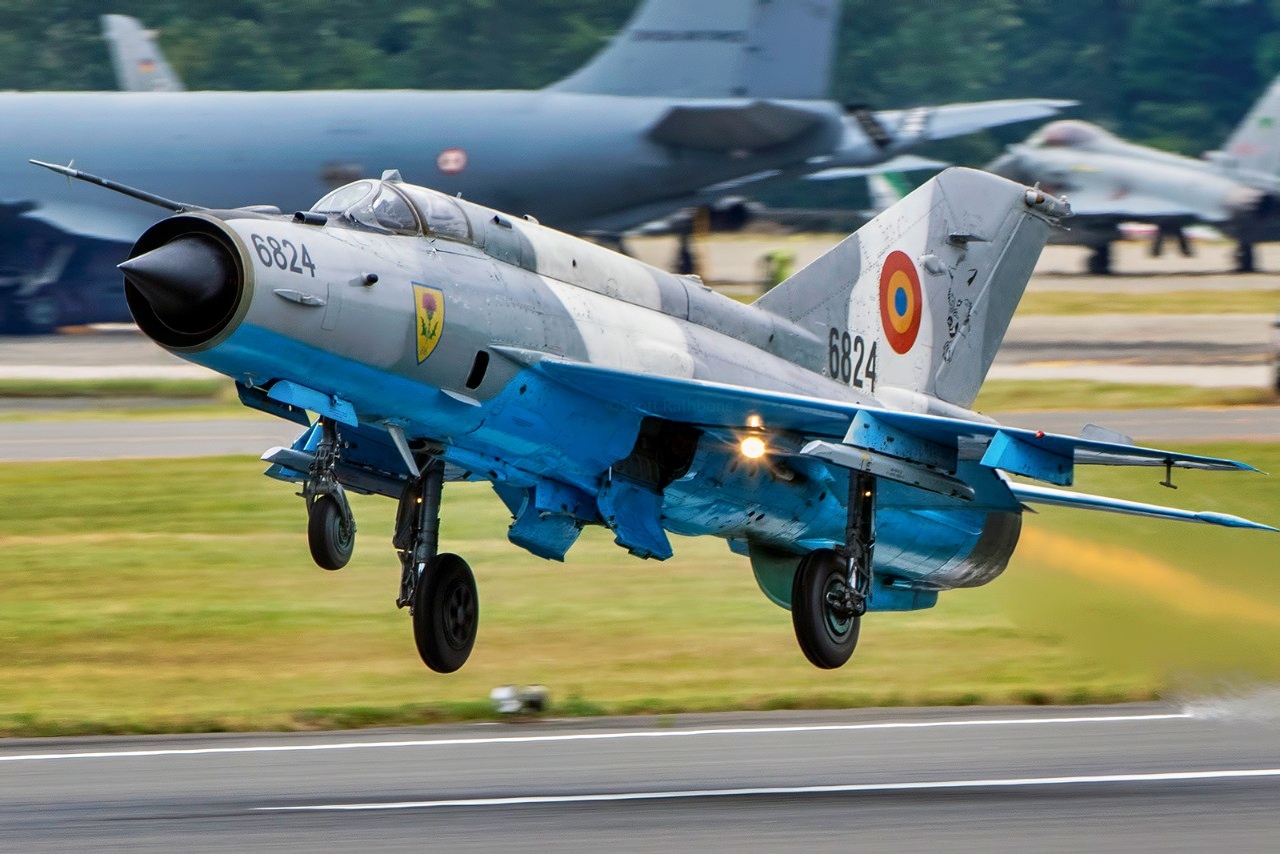
MiG-21 Fighter from Russia. Image Credit: Creative Commons.
Though that previous aircraft was noted for its speed and agility, its capabilities were hampered by an underpowered radar array, a modest weapons payload, and a relatively low combat radius.
Mikoyan, the Soviet aerospace group that designed the fighter, hoped to solve these shortcomings with the MiG-23 and its variable-sweep wings.
The MiG-23’s wings had three crucial wing sweeps, or angles, that gave the jet different flight and handling characteristics.
During take-off and landing, the MiG-23’s wings were widely splayed outward, allowing the jet to rapidly take off and quickly land, while also offering an efficient, low-speed cruise capability.
When cruising at higher speeds or when expecting to engage enemy aircraft, the MiG-23 tucked its wings in a bit more tightly to the fuselage.
But during high-altitude sprints as an interceptor, the MiG-23 pilot could tuck the jet’s wings in even further, giving it an extremely swept, aerodynamic profile.
Though visually similar to the American F-111, the Flogger was a different aircraft with a different operational role within the Soviet Air Force.
“The General Dynamics F-111 and McDonnell Douglas F-4 Phantom II were the main Western influences on the MiG-23. The Soviets, however, wanted a much lighter, single-engined fighter to maximize agility,” notes one source.
“Both the F-111 and the MiG-23 were designed as fighters, but the heavy weight and inherent stability of the F-111 turned it into a long-range interdictor and kept it out of the fighter role.The MiG-23’s designers kept the MiG-23 light and agile enough to dogfight with enemy fighters.”
In keeping with the Soviet Union’s nuclear deterrence doctrine, some MiG-23 variants could fly with a single nuclear bomb mounted to the jet’s fuselage—reportedly, a 10- or 30-kiloton device.
The MiG-23’s design was also used for a similar variant, the MiG-27.
During the Soviet invasion of Afghanistan, that aircraft was put into a ground attack role. Modestly capable in that role, the MiG-27 was never exported abroad.
Assessment of MiG-23
When compared with its contemporaries, the MiG-23’s biggest strength was arguably its speed.
At Mach 2.3, the jet could sprint faster than many other aircraft of the era, giving it an edge as an interceptor aircraft.
This was a very useful quality, given the Soviet Union’s incredibly long borders.
For other long-range applications, such as long-range reconnaissance flights, the MiG-23’s speed was an advantage.
Crucially, compared to the MiG-21, the MiG-23 offered significant capability advantages.
The MiG-23’s avionics, on the other hand, were perhaps one of its weaker aspects, as was often the case for Soviet Air Force aircraft compared to their adversaries flying for NATO air forces.
If production numbers are a measure of success, then the MiG-23 was a resounding success.
Mikoyan would produce more than 5,000 MiG-23s, and the jet would see service not only in the Soviet Air Forces, but also with the air forces of many Warsaw Pact countries.
It also flew for several African countries, and nations elsewhere that enjoyed friendly relations with the Soviet Union.
MiG-23: A Failure?
Though innovative within the context of Soviet aircraft, the MiG-23 suffered the expected gamut of problems encountered by similar variable-sweep aircraft.
The mechanical complexity inherent to the wings’ pivot joints, and the hydraulics needed to operate them, imposed greater maintenance and logistical burdens while also reducing fuel and weapons capacity.
While there are some notable examples of highly capable variable geometry aircraft—the U.S. Navy’s F-14 Tomcat comes to mind—the complexities associated with the design often outweigh the benefits.
Though later versions of the MiG-23 addressed some of the shortcomings, by the 1970s and early 1980s, the United States and NATO had made significant advances in their own aircraft. Jets in the Teen Series—the F-14, F-15, and F-16—had improved incrementally and thoroughly outclassed the MiG-23.
What the MiG-23 may have lacked in terms of raw capabilities, though, it made up for, in part, through its high production numbers.
And therein lay the MiG-23’s greatest strength: the ability to fly in concert with hundreds of other MiG-23s at very high speeds, saturating NATO airspace and securing air superiority thanks largely to mass, rather than technological sophistication.
Entering service in the late 1960s, the jet would be retired from Soviet service in the mid-1980s.
About the Author: Caleb Larson
Caleb Larson is an American multiformat journalist based in Berlin, Germany. His work covers the intersection of conflict and society, focusing on American foreign policy and European security. He has reported from Germany, Russia, and the United States. Most recently, he covered the war in Ukraine, reporting extensively on the war’s shifting battle lines from Donbas and writing on the war’s civilian and humanitarian toll. Previously, he worked as a Defense Reporter for POLITICO Europe. You can follow his latest work on X.
More Military
‘Long Way from Production’: China’s J-36 Might Be ‘Paper Tiger’ Stealth Fighter
‘Mach 2’ JAS 39 Gripen Is a Rocket Fighter Plane
New ‘Ferrari’ F-35 Stealth Fighter Is Aimed Right at Russia and China
Putin’s Poseidon Nuclear “Doomsday” Torpedo Looks Like a Bluff
The Air Force’s B-21 Raider Stealth Bomber Plan Doesn’t Make Any Sense


