

Bottom Line Up Front: The U.S. Army is aggressively fast-tracking the next-generation M1E3 Abrams, with pre-prototypes arriving by late 2025—years ahead of schedule.
The Shift: Moving away from heavy armor, the M1E3 targets a lighter 60-ton weight class for better mobility and transportability.
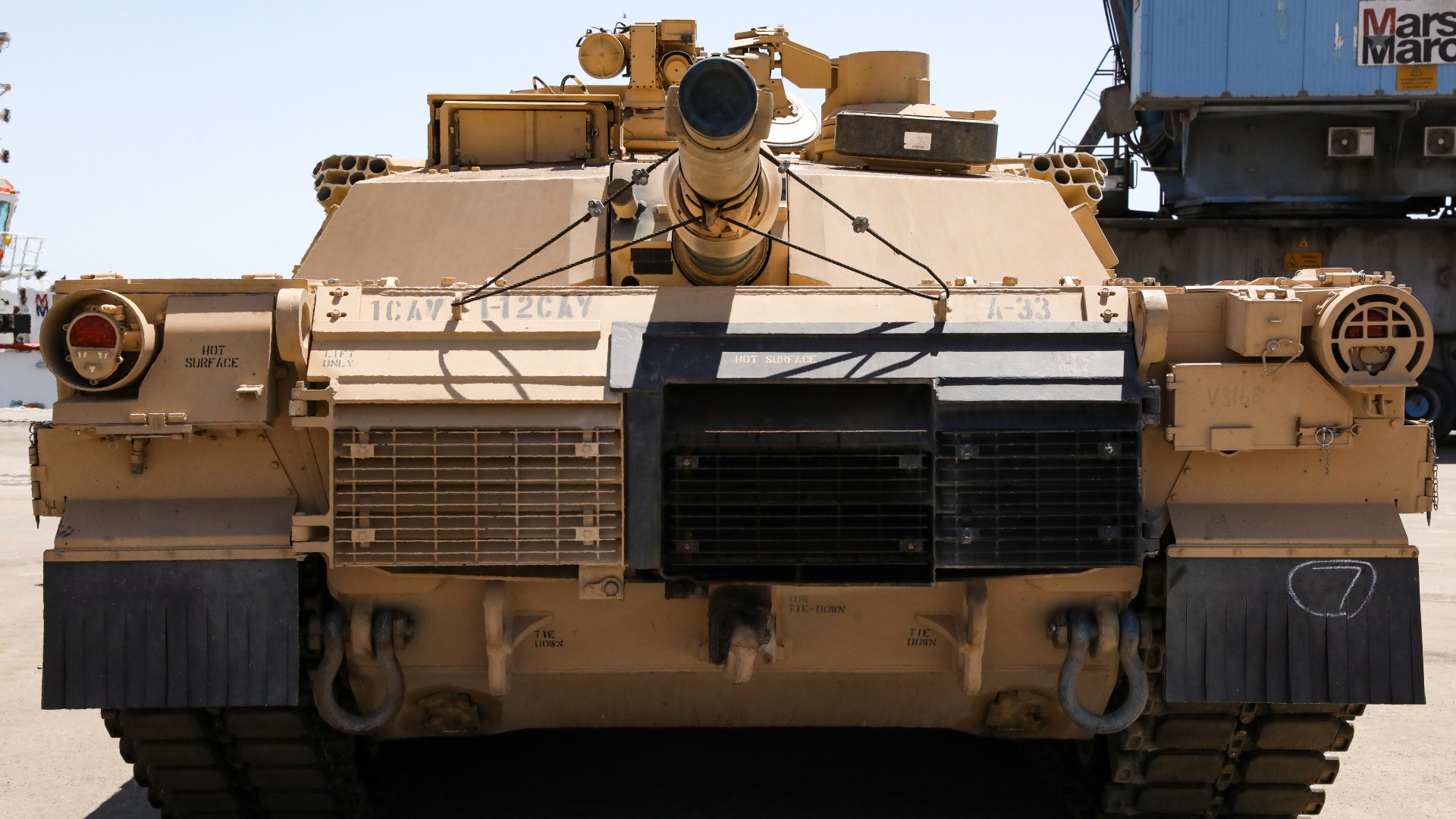
A U.S. Army M1A3 Abrams Tank from the 1-12 Cavalry Squadron, 1st Cavalry Division waiting to be guided onto a loading vehicle and secured for transport at the Port of Agadir, June 3, 2022, Agadir, Morocco. African Lion 2022 is U.S. Africa Command’s largest, premier, joint, annual exercise hosted by Morocco, Ghana, Senegal and Tunisia, June 6 – 30. More than 7,500 participants from 28 nations and NATO train together with a focus on enhancing readiness for U.S. and partner nation forces. AL22 is a joint all-domain, multi-component and multinational exercise, employing a full array of mission capabilities with the goal to strengthen interoperability among participants and set the theater for strategic access. (U.S. Army photo by PFC Donald Franklin)
The Tech: It features a hybrid-electric drivetrain for silent watch capability, reduced fuel consumption, and lower thermal signatures.
The Future: Design considerations include an unmanned turret, autoloader (reducing crew to three), and integrated Active Protection Systems (APS) to counter drone threats learned from the war in Ukraine.
U.S. Army Fast-Tracks Next-Gen M1E3 Abrams, With Prototypes Arriving Soon
The next generation of America’s most iconic main battle tank is arriving much sooner than many expected – which isn’t something we hear often in the defense hardware procurement space.
In October, the U.S. Army and contractor General Dynamics Land Systems (GDLS) confirmed that a pre-prototype of the M1 Abrams successor, the M1E3, is slated for delivery by the end of the year.
The decision is a pretty dramatic increase in pace compared to earlier plans that pushed a next-generation Abrams to the 2030s. Even though it’s a pre-prototype, it’s still somewhat remarkable and appears to reflect growing and evolving global threats. As modern warfare becomes increasingly complex, more pressure is being placed on America’s industrial base to roll out new hardware.
National Security Journal reported on the news earlier in the year. Still, as we approach the beginning of 2026, it’s worth taking a look at what we know so far about the M1E3 – from its capabilities and design philosophy to the risks involved with the new platform.
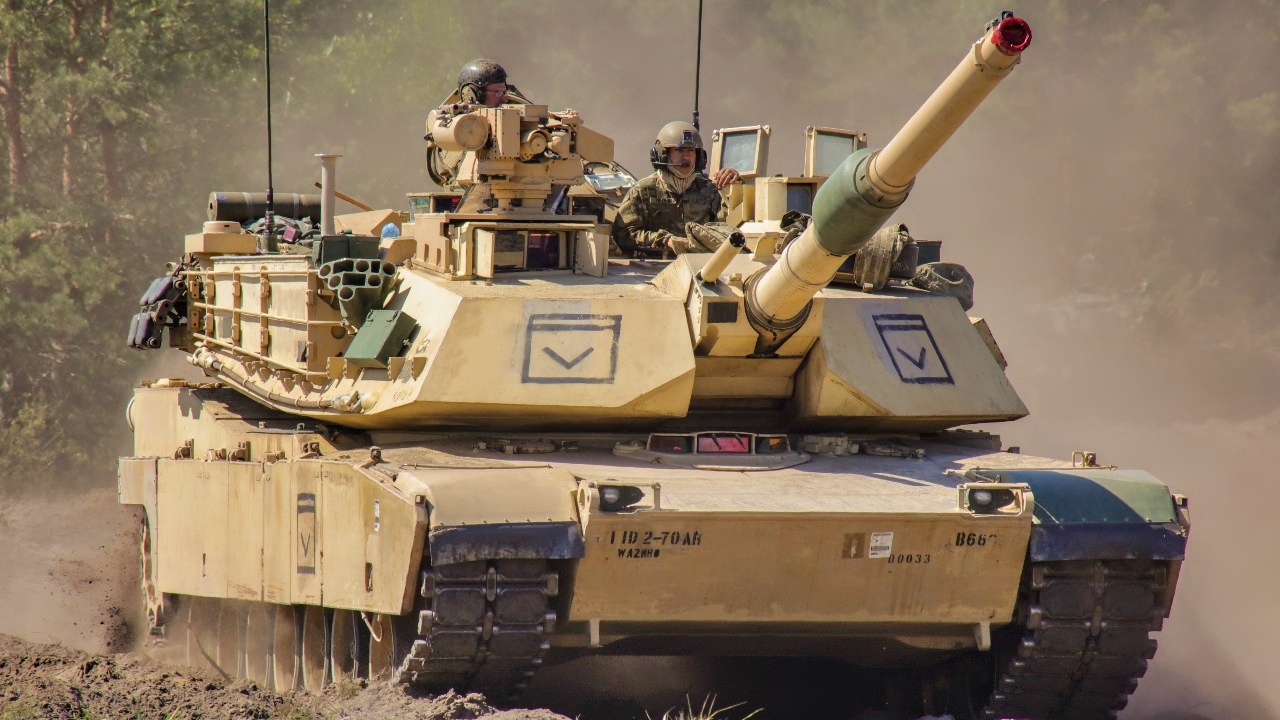
U.S. Soldiers assigned to 2nd Battalion, 70th Armor Regiment, 2nd Armored Brigade Combat Team, 1st Infantry Division supporting the 4th Infantry Division, maneuver an M1A2 Abrams tank while participating in a combined arms rehearsal during Anakonda23 at Nowa Deba, Poland, May 14, 2023. Anakonda23 is Poland’s premier national exercise that strives to train, integrate and maintain tactical readiness and increase interoperability in a joint multinational environment, complimenting the 4th Inf. Div.’s mission in Europe, which is to participate in multinational training and exercises across the continent while collaborating with NATO allies and regional security partners to provide combat-credible forces to V Corps, America’s Forward deployed corps in Europe. (U.S. Army National Guard photo by Sgt. 1st Class Theresa Gualdarama)
The M1E3’s New Design Philosophy
The M1E3 is by no means a minor upgrade to the Abrams line.
Instead, it’s a total rethinking of what a main battle tank needs to be – and what it might become in the coming decades. It has been redesigned, refitted, and prepared for future upgrades in a way that no system of its kind has ever been.
Where previous Abrams variants prioritized heavy armor and mass, the M1E3 is different: this tank is designed to enhance its mobility, adaptability, and modularity.
The target weight is around 60 tons – roughly 10-20 tons less than current heavy Abrams models – which enhances its maneuverability and transportability.
This is a tank that can be moved quickly.
As is seen in modern aircraft upgrades, the new tank’s architecture will also be open and software-driven, making upgrades easier as technology evolves. According to GDLS, this new modular system will be a significant break from the traditional, slow, bespoke procurement model.
It will allow for much quicker iteration and ensure the tank remains relevant for decades to come.
And then there are the power system upgrades, the reduction in crew size, and the new, active protection. The M1E3 is designed with a hybrid-electric drivetrain, which is a departure from the classic gas-turbine engine used in legacy Abrams variants. This change is expected to dramatically reduce gas consumption while also positively impacting its thermal and acoustic signatures, making it harder to detect on the battlefield.
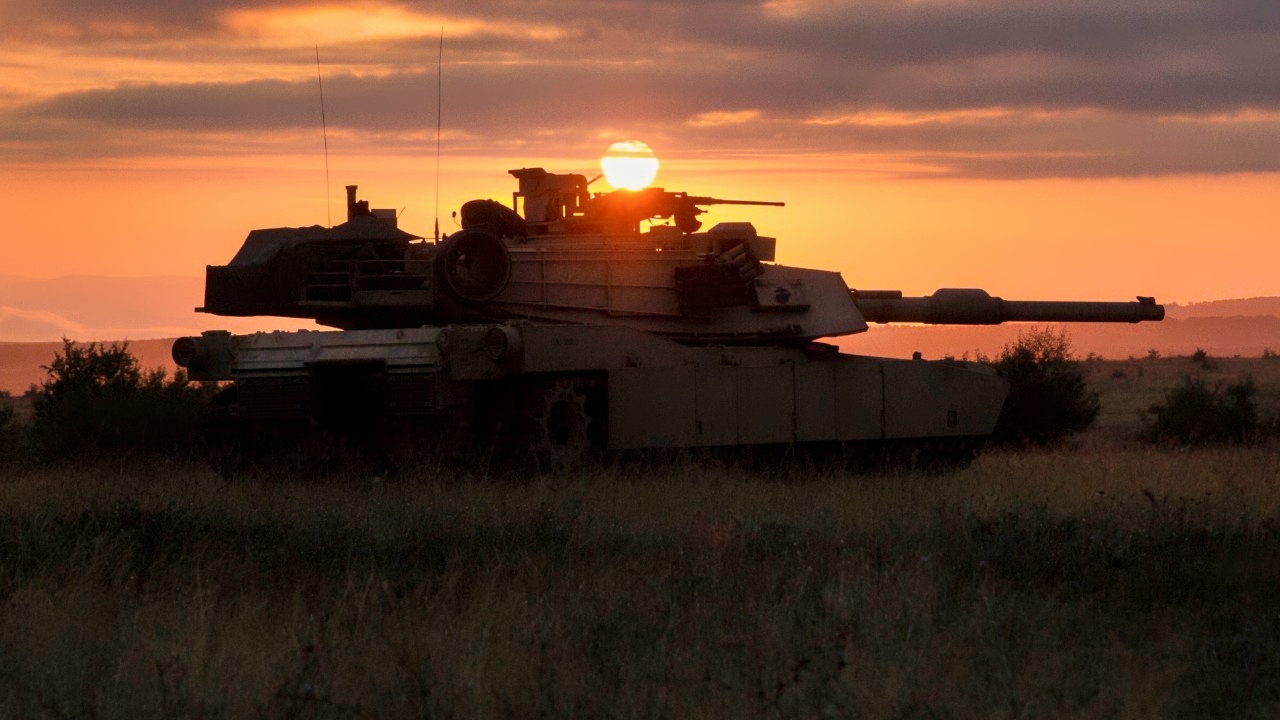
An M1 Abrams main battle tank provides security during the Combined Arms Company field exercise at Novo Selo Training Area, Bulgaria, Sept. 16, 2015. The CAC is a newly formed armor element supporting the Black Sea Rotational Force, which reassures our NATO allies and partners of our commitments and will enhance training exercises and operations with partners in the region. (U.S. Marine Corps photo by Cpl. Justin T. Updegraff/Released)
And, to adapt to evolving threats liek drones, guided missiles, and drone-launched munitions, the M1E3 will also integrate advanced active protection systems (APS), improved sensors and networking, and enhanced command-and-control capabilities that will enable better situational awareness.
The M1E3 may even adopt an autoloader and unmanned turret, potentially decreasing crew size from four to three – meaning more flexibility and improved survivability in high-intensity battlefield environments.
The Timeline, and What Comes Next
What makes the M1E3 so headline-worthy is a combination of its new technology and the speed at which it is being developed.
At the 2025 Association of the United States Army Annual Meeting & Exhibition (AUSA), GDLS executives announced that the first pre-prototype would be delivered to soldiers by the end of next year.
Under their plan, a whole platoon of roughly four tanks will be delivered into formation by the end of 2026, marking a dramatic acceleration from earlier projects targeting the early 2030s. Officials have said the decision is deliberate, ensuring that capability reaches soldiers more quickly.
Not only will the pre-prototype units give soldiers access to next-generation technology more quickly, but it’ll also serve as an opportunity to integrate the technology and ensure that soldiers are familiar with what’s coming next.
There are, however, some risks inherent to the decision. For example, it’s not yet official whether the M1E3 will retain the legacy 120 mm smoothbore main gun or adopt a new weapon system – which could ultimately result in some confusion.
And the reliability of these new systems under combat conditions obviously hasn’t been proven. Autoloader, unmanned turrets, and hybrid-electric drivetrains need to be proven on the battlefield – and while the sooner the better, there will always be risks.
And then there’s this uncomfortable reality: much of the M1E3’s rationale and design choices come from lessons learned in recent conflicts like Ukraine, where drones, loitering munitions, and precision-guided anti-armored weapons have upended traditional armored doctrine. But if future wars focus instead on unmanned systems, those design decisions may not work exactly as intended. As with everything in warfare, there’s a gamble involved here.
Whether that gamble pays off will shape not just the future of American battle tanks, but how long they remain central to modern war. Regardless, it’s hard to argue that the advanced timeline is a bad thing.
About the Author:
Jack Buckby is a British author, counter-extremism researcher, and journalist based in New York who writes frequently for National Security Journal. Reporting on the U.K., Europe, and the U.S., he analyzes and understands left-wing and right-wing radicalization and reports on Western governments’ approaches to the pressing issues of today. His books and research papers explore these themes and propose pragmatic solutions to our increasingly polarized society. His latest book is The Truth Teller: RFK Jr. and the Case for a Post-Partisan Presidency.


