

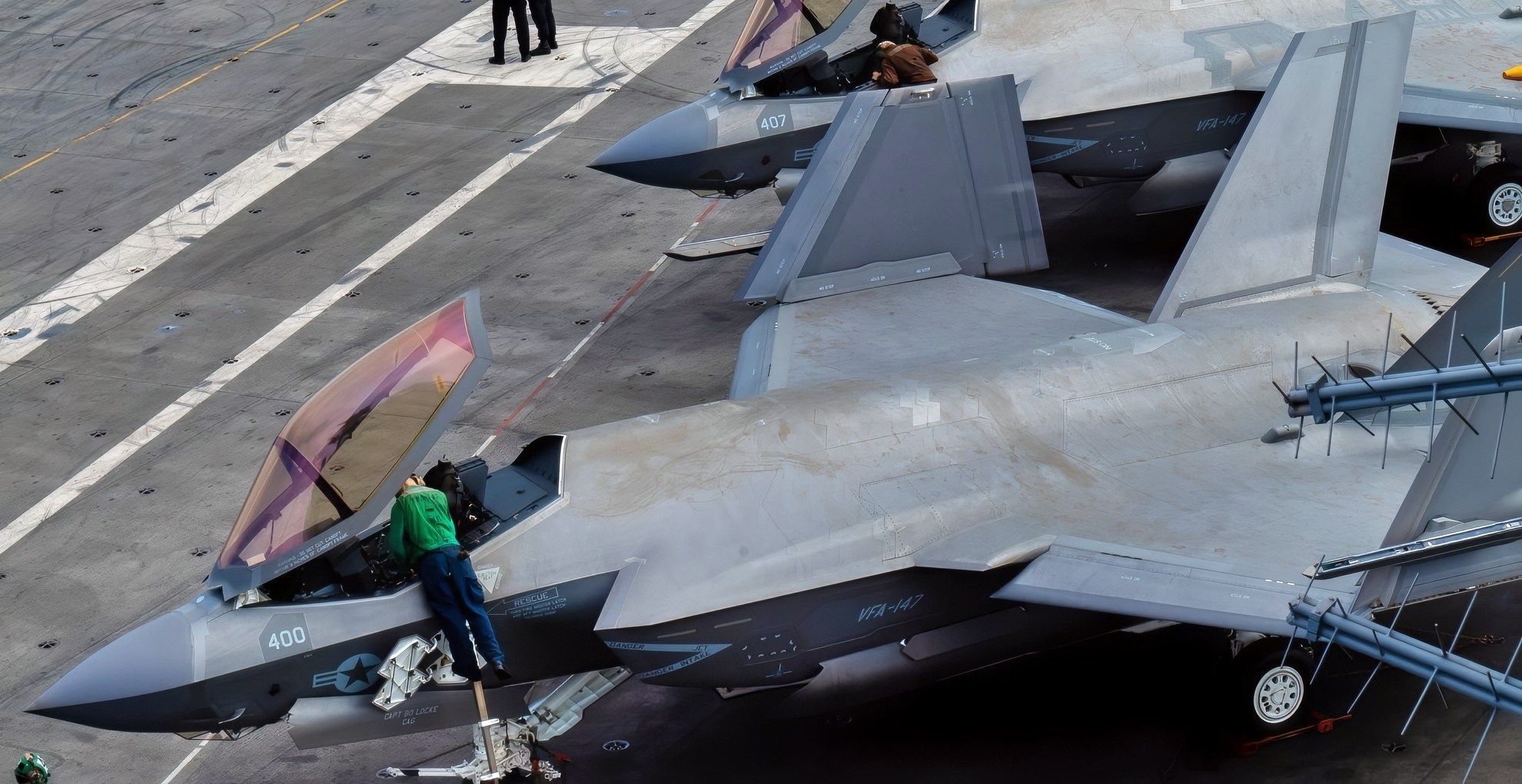
Key Points and Summary – Viral images of “rusting” F-35s aboard the USS Carl Vinson sparked a media firestorm, but the reality is a misunderstood feature of stealth technology.
-The Myth: Critics claimed the F-35 was unfit for sea duty due to visible corrosion and rust after deployments.

F-35 Demonstration Team members sprint to their positions during the ground show at the Defenders of Liberty Air & Space Show at Barksdale Air Force Base, La., May 17, 2019. The team’s ground show consists of pre-flight inspections with sharp, quick-paced movements that showcase the pride and professionalism of the U.S. Air Force. (U.S. Air Force Photo by Senior Airman Alexander Cook)
The Science: The discoloration wasn’t structural rust but the oxidation of iron-based particles in the Radar-Absorbent Material (RAM) coating, a cosmetic issue that does not degrade stealth.
-The Fix: Lockheed Martin has since reformulated the RAM topcoat to prevent discoloration on new jets, ensuring future F-35s remain “rust-free” while maintaining their low-observable edge.
The “Rusting” F-35: Why People Love To Hate The Joint Stealth Fighter
A few years ago, in February 2022, stories quickly made the rounds about the F-35s on their first operational deployment aboard the aircraft carrier USS Carl Vinson in the Western Pacific, which had shown signs of “significant corrosion and rust.”
And this particular story was far from the only one.
Then came the questions about whether the F-35 was not a fit for sea duty due to its complex, maintenance-intensive nature. Of course, it was soon learned that there wasn’t any rust at all, but while that may have quashed the story, it did little to stop the constant bashing of the F-35.
People Love To Hate The F-35:
People “love to hate” the F-35 because it has become a popular target for criticism regarding its high cost, long development timeline, and initial performance issues, which are often amplified by public debate and media attention.
While it is the world’s most advanced aircraft with incredible capabilities, criticisms persist regarding its high price tag (it is far from the most expensive, BTW), reliability, software glitches, and, for some, its complexity, which has led to ongoing maintenance and operational readiness challenges.
Nothing will generate more social media clicks than a piece that bashes something about the F-35. In our social media age, negativity sells, whether that is in defense-related reporting or in the sports world, something I’ve been involved in for the better part of two decades.

Two U.S. Air Force F-16 Fighting Falcons fly alongside a KC-135 Stratotanker, assigned to the 340th Expeditionary Aircraft Refueling Squadron, after receiving fuel while flying routine operations over Southwest Asia Feb. 16, 2021. The F-16 Fighting Falcon is a compact, multi-role fighter aircraft that delivers airpower to the U.S. Central Command area of responsibility. (U.S. Air Force photo by Staff Sgt. Taylor Harrison)
And for those too young to remember, both the F-16 and F-15, when they were first introduced, were the targets of much criticism, stating that they were overpriced, unsafe, too maintenance-intensive, etc.
But first, “Rust Never Sleeps.”
The “Rust” Wasn’t Rust at All:
We learned that the discoloration wasn’t rust at all, no, the F-35s were not rusting in the traditional sense because they are not made of iron, but the visible “rust” was caused by the oxidation of the iron-based particles in their radar-absorbent material (RAM) coating.
This coating is designed to absorb radar waves and dissipate them as heat. The issue was cosmetic and affected the stealth coating, not the aircraft’s structural integrity. And as Alex Hollings of Airpower wrote on November 29, it didn’t really affect the stealth capability of the F-35 at all.
“The RAM coating on America’s stealth fighters has been said to be capable of absorbing upwards of 80% of inbound radar waves, and former Skunk Works director Ben Rich famously attributed about 35% of a stealth fighter’s stealth to this advanced coating,” Hollings wrote.
“This coating is particularly important anywhere there are seams between body panels, for example, on the leading edges of the wings, around jet inlets, and anywhere else that’s likely to produce a sizable radar return.”
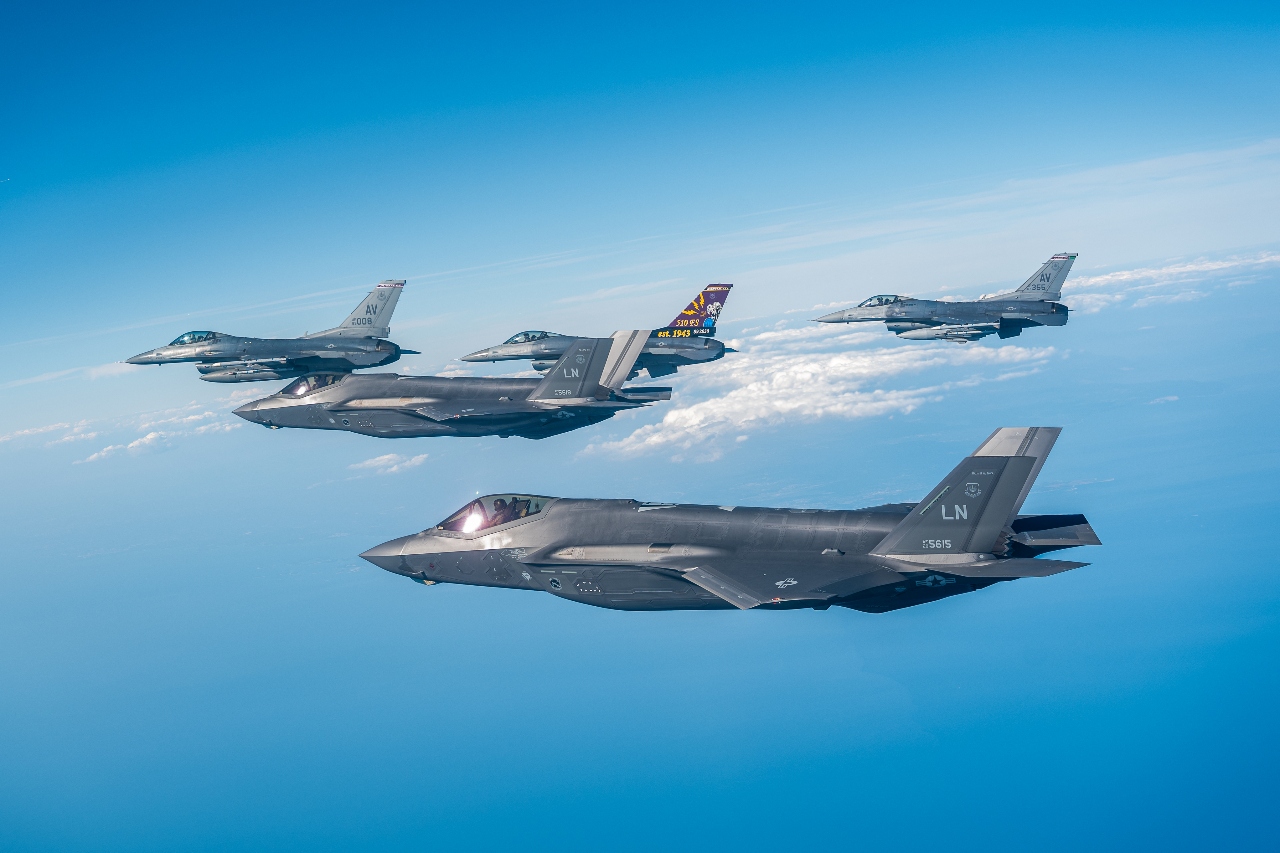
A formation of U.S. Air Force F-35 Lighting IIs and F-16 Fighting Falcons assigned to the 48th and 31st Fighter Wings respectively fly in formation as a part of Exercise Combined Strike along the coast of Italy, August 18, 2025. Exercises like Combined Strike ensure USAFE remains ready and postured to rely on one another to defend the area of responsibility. (U.S. Air Force photo by Senior Airman Zachary Jakel)
But it gets better, because the F-35’s top layer of RAM coating doesn’t actually do much in the way of stealth anyway. So, the pearl-clutching of the stealth capabilities of “being seriously undermined” was utterly unfounded.
However, the perception of a “rusty F-35” is not something that Lockheed Martin needs, especially since their aircraft is the aviation world’s favorite whipping boy. So, the Skunk Works worked out a way to change the formula of that top layer of RAM coating to prevent rust discoloration from happening again.
Now every new F-35 that rolls off the line will be rust-free for the foreseeable future. As for the older jets, they’ll just receive the latest top coating during their next scheduled maintenance.
F-35 Joint Program Office Statement:
In early May, the F-35 Joint Program Office (JPO) addressed discoloration on F-35C airframes as a result of long-range deployments aboard aircraft carriers, and stated:
“Much of what the public sees as damage, such as the discoloration on jets returning from deployment, does not represent a degraded aircraft. During shipboard deployments, jets often experience coating discoloration due to the harsh maritime environment.
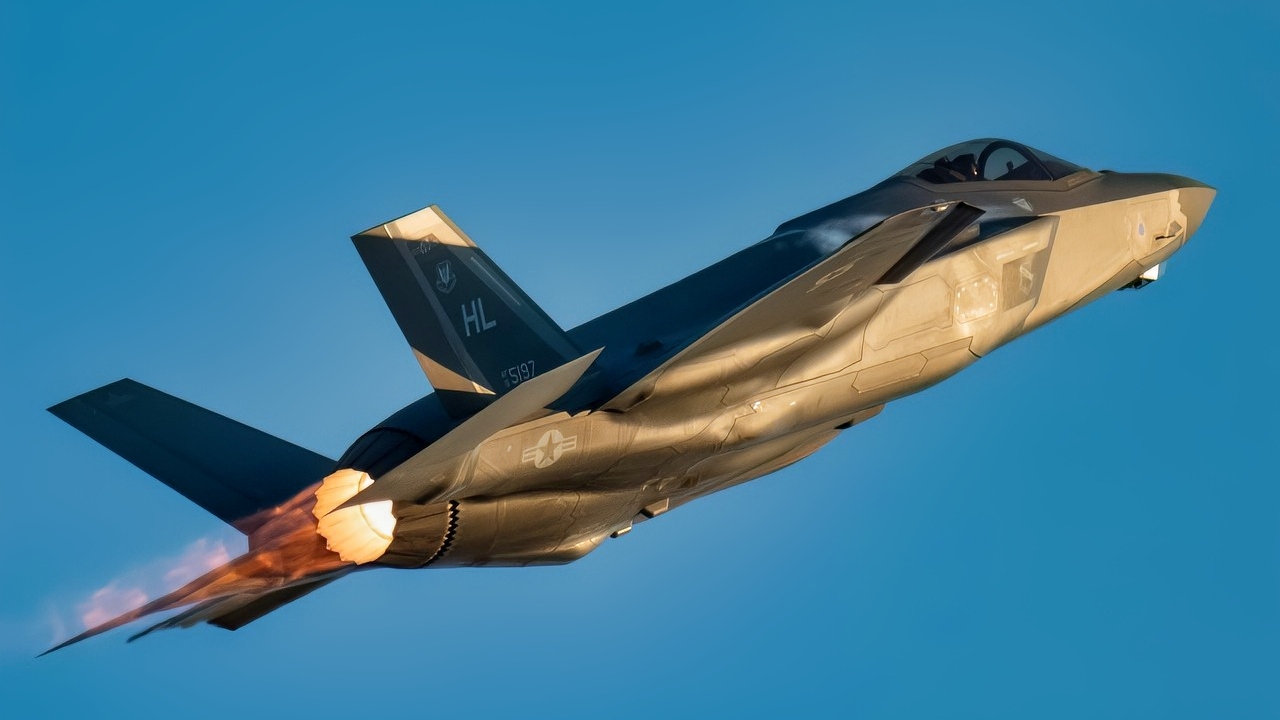
U.S. Air Force Major Kristin “BEO” Wolfe, F-35A Lightning ll Demonstration Team pilot and commander, flies during sunset over Mathers Airport, Calif., Sept. 24th, 2021, at the California Capital Airshow. The team consists of approximately 15 total Airmen to include the pilot and commander, pilot safety officers, superintendent, team chief, maintenance Airmen, aircrew flight equipment specialists, and public affairs personnel. (U.S. Air Force photo by Staff Sgt. Thomas Barley)
Contributing factors include frequent exposure to seawater, contamination from grease, oil, and other fluids, and proximity to jet blast and rotor wash.
While it may look severe, these marks do not indicate a loss of coating integrity nor stealth performance. The discoloration is limited to the coating and does not affect the structure of the aircraft.”
The JPO added that the manufacturer “has developed and introduced a new aircraft coating designed to significantly reduce or eliminate discoloration, enhance durability, and extend the coating’s service life. Over the coming years, this new coating will be applied to fielded aircraft as part of routine maintenance—similar to how coatings are restored on commercial and military jets.
“It will provide improved protection against operational wear and is part of a broader series of upgrades that support the program’s long-term, adaptive sustainability strategy.”
But the F-35 will remain the “bad penny” story regardless, but the funny thing is, our adversaries China and Russia, always compare their aircraft against the F-35. Why do you think that is?
About the Author: Steve Balestrieri
Steve Balestrieri is a National Security Columnist. He served as a US Army Special Forces NCO and Warrant Officer. In addition to writing on defense, he covers the NFL for PatsFans.com and is a member of the Pro Football Writers of America (PFWA). His work was regularly featured in many military publications.


