

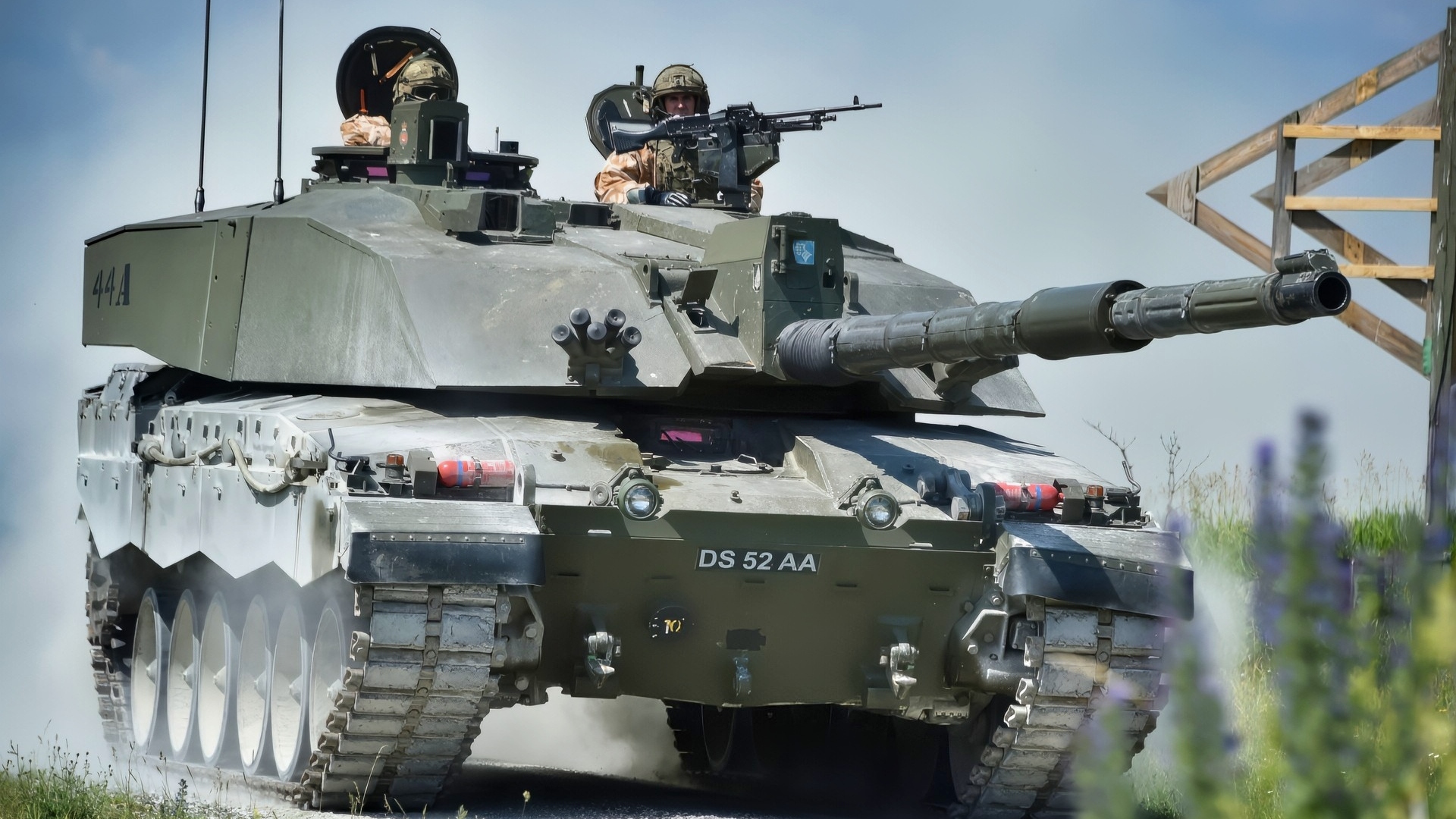
Summary and Key Points: The British Challenger 2 has proven to be a vital, though heavy, asset for Ukraine’s 82nd Airborne Assault Brigade.
-Renowned for its Dorchester composite armor, the tank provides exceptional crew survivability, famously allowing a crew to survive a 720mm-deep hit from a helicopter rocket.

Challenger 2 Tank. Image Credit: Creative Commons.
-Its 120mm rifled gun acts like a “sniper rifle,” enabling precision strikes up to 5.3 km away.
-However, its 71-ton weight makes it prone to getting bogged down in Ukraine’s soft soil, and its 1,200 hp engine is often described as underpowered.
-Despite these mobility and logistics hurdles, its long-range lethality makes it a formidable defensive tool.
“Sniper” Tank: Ukraine’s Challenger 2 Summed Up in 2 Words
The ongoing war in Ukraine has seen the impact of drones and anti-armor missiles take a toll on tanks and armored vehicles. Russia has lost a reported 4,000 tanks and armored vehicles. Ukrainian losses have been high, but their numbers indicate that for every three tanks they destroy, they lose about one.
The West has supplied Ukraine with main battle tanks, including German Leopards, American M1 Abrams, and British Challenger 2s.
There are mixed reviews, but Ukrainian troops are generally pleased with the Challengers’ performance. Ukraine deployed 14 Challenger 2 tanks to the 82nd Airborne Assault Brigade in Bukovyna.
British Challenger 2 tanks are performing well in Ukraine, largely regarded by crews for their superior protection, exceptional long-range accuracy (often called a “sniper” rifle),, and better crew survivability compared to Soviet-era tanks.
While effective in combat and during operations like the Kursk incursion, their 71-ton weight makes them prone to getting stuck in deep mud.
The Challenger’s Dorchester Armor Is Outstanding:
The Challenger 2 is among the best-protected main battle tanks operated by the 32 NATO member allies, thanks to its Dorchester armor.
The armor, itself an evolution of the United Kingdom’s Chobham armor used on the M1 Abrams, is a multi-layered composite material, thought to be made of several kinds of metals, ceramics, and possibly other materials that are a tightly guarded British secret.
One example of how tough the armor is was when a Ukrainian tank crew survived a direct hit from a high-explosive round during a rocket attack by Russian helicopters.
“The damage was 720 mm deep, but the crew inside survived. The tank could still move and complete its mission,” according to the tank commander.
The Challenger 2 Works “Like A Sniper” Against Russian Targets:

Challenger 2 Tank. Image Credit: Creative Commons.
The tank crew relayed that one of Challenger 2’s key strengths is its accuracy. The tank features a rifled 120mm gun and a sophisticated firing system that compensates for factors such as wind speed and humidity.
The onboard computer serves as the tank’s “brain,” enabling the crew to make highly accurate shots at distances up to 10 kilometers. “It works like a sniper,” the tank commander named Oleksandr said.
The brigade has changed its usage, now using the Challenger 2s to support the infantry rather than the other way around. Other tankers said they fight their tank from Ukrainian-controlled treelines, firing at Russian-controlled treelines up to 1.8 miles away while drones correct their shots.
The targets were the Russians’ “full-concrete, dug-in positions.” But “no vehicles yet,” one tanker added.
One tank commander, identified by the call sign “Hera,” described the tank’s main gun as highly accurate, noting that his crew successfully hit a Russian infantry fighting vehicle at a distance of 5,300 meters while operating in the Kursk area. “You don’t need to get too close—you can work from cover and then withdraw,” he said.
“We moved in quickly; the maneuverability was good. The only major issue is drones — they don’t let us work freely. Otherwise, the tanks performed well.” He also added that the Challenger 2 withstood multiple FPV drone strikes.
Unlike Russian or Soviet-designed tanks, the Challenger 2 offers far better situational awareness. “Operating the tank in combat without having to stick your head out of the hatch is much easier,” the tank crew said, while adding that the turret’s fast traverse greatly improves situational awareness.
The 120mm Main Gun Requires Special Ammunition:

Challenger 2 Tank. Image Credit: Creative Commons.
One of the drawbacks of the Challenger 2 is that, despite the tank functioning like a “sniper,” the main gun requires specialized rifled-cannon ammunition, which complicates logistics in NATO-standardized operations.
The Challenger 2 uses separate ammunition loading. According to gunners, this has minimal effect on firing speed and improves safety because shells and propellant charges are stored separately. Crews report achieving a maximum firing rate of eight rounds per minute.
The future Challenger 3 model will incorporate 120mm smoothbore cannons, similar to those found in the Leopard and Abrams tanks, but this doesn’t address the resupply issues that Ukraine faces today.
The tank’s loader, named Stanislav, said he appreciated the way the tank’s gunnery computer could track and switch between targets with ease.
“There is nothing complicated. Yes, for the first shot, everything is done manually. I lower the shutter wedge, load everything, close it, and move it to the desired position.
“And after the first shot, everything happens automatically. You just need to throw another projectile,” he said.
The Challenger II Is “Heavy” For The Soft Ground In Ukraine:
The Ukrainians didn’t use them in attacks for which it was designed. The Challenger 2 was intended as a break-out, defensive line-penetrating platform during the counteroffensive. They were used more as mobile assault guns than in a traditional tank role.
The crew in the Forbes article explained why. “Cross-country mobility is difficult,” one tanker said. “For our ground, the 71-ton British tank is heavy.”
Like its American counterpart, the M1 Abrams main battle tank, the British Challenger 2’s mobility and range are compromised by an effective but heavy armor protection package.
However, a tank driver who was interviewed by United24 stated that the Challenger 2 engine has performed reliably in combat conditions. “No complaints about either the auxiliary or main engine. The tank behaves well, though it is somewhat heavy on loose ground,” he said.
The Tank is Underpowered And Needs An Upgraded Engine:
The Ukrainians learned what NATO has long known. Ukrainian Challenger 2 tank crews have said that the tank’s 1,200-horsepower engine is underpowered for a 71-ton vehicle. Challenger 2s often get bogged down in Ukraine’s soft soil and need towing by other Challengers or engineering vehicles.
A Challenger 2 driver, named Maksym, noted how Western-supplied tanks and equipment are a priority target for the Russians.
“As soon as we are spotted… all the fire is coming at us, therefore you need to constantly manoeuvre,” he said.
“Overall, it’s a very powerful machine. And its defense is great. But there are nuances about the engine. It needs constant maintenance. If this is done on time, then everything is ok. But this is not always possible due to the intensity of the action.
“And it would be possible to put an even more powerful engine here. Now there is 1,200 horsepower, and it would be great if they put 1,500.”
In the heat of combat, when towing isn’t always possible, a bogged-down Challenger 2 is a fat target on Ukraine’s battlefields, where drones and anti-tank missiles are plentiful.
The underpowered engines require constant maintenance to keep them performing as they should. Without timely maintenance, the engine may struggle to perform at optimal levels. That has been a constant complaint since the Challenger 2 first appeared.
The performance of the Challenger 2s has been mixed, but the Ukrainian unit to which they were assigned has learned to leverage their strengths.
“It’s an excellent machine. As for the engine, no complaints — neither about the auxiliary nor the main one. The tank performs reliably. The only drawback is on soft soil, where it tends to struggle a bit,” the driver said.
While the Ukrainian 82nd Air Assault Brigade has suffered a couple of losses due to mines or drone strikes, the Challenger 2 has proven to be a valuable, albeit heavy, asset, often described as a “sniper” on the battlefield.
It has proven to be a tough tank to destroy while providing Ukrainian crews with a powerful vehicle to combat its Russian foes.
About the Author: Steve Balestrieri
Steve Balestrieri is a National Security Columnist. He served as a US Army Special Forces NCO and Warrant Officer. In addition to writing on defense, he covers the NFL for PatsFans.com and is a member of the Pro Football Writers of America (PFWA). His work was regularly featured in many military publications


