

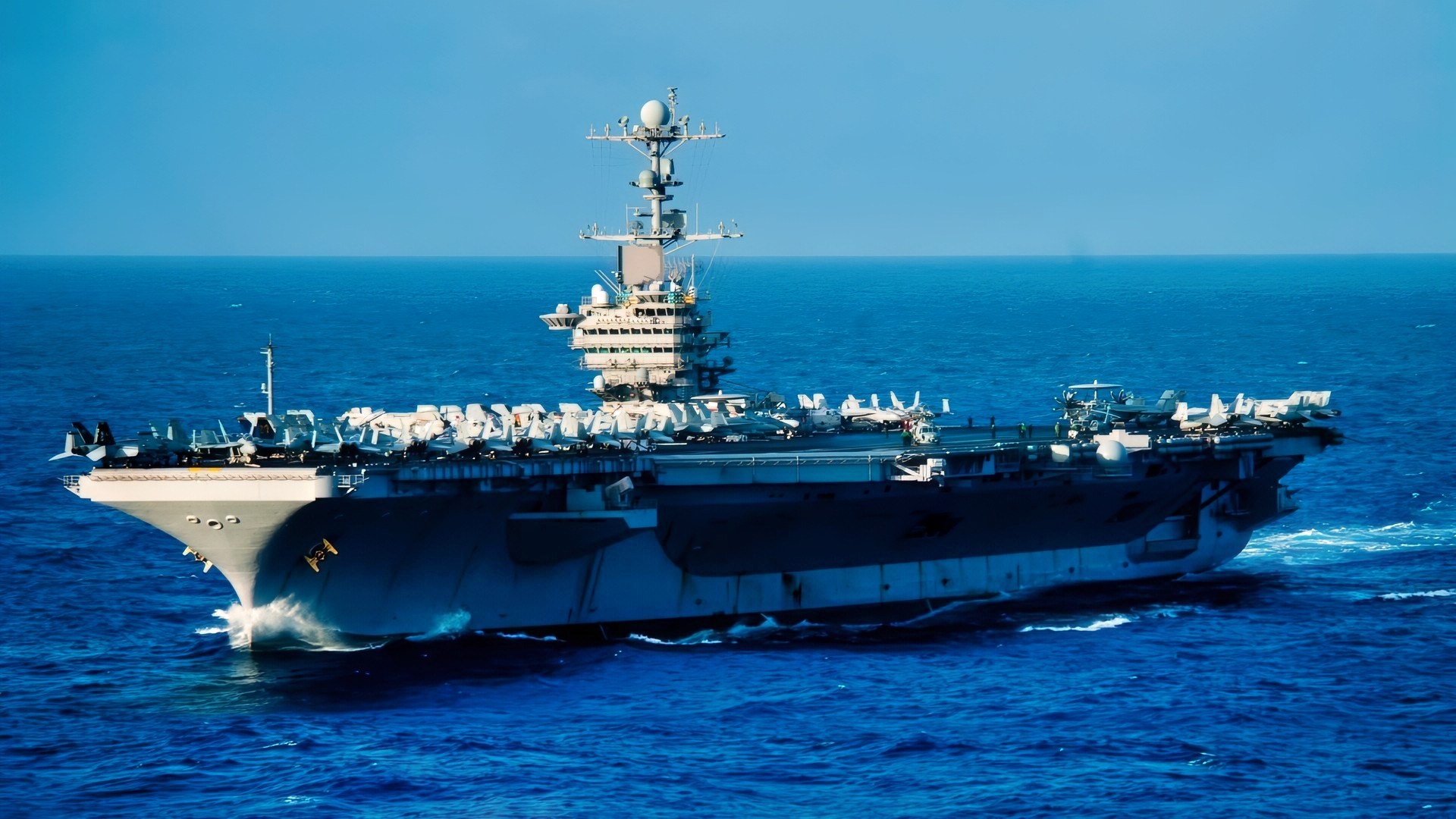
Article Summary – Forget carrier-on-carrier duels. China’s real edge in a Taiwan fight is the PLA Rocket Force and the kill chain that feeds it.
-Land-based ballistic, cruise, and hypersonic missiles, cued by satellites, radar, and drones, can saturate a U.S. carrier strike group long before it’s in comfortable striking range.
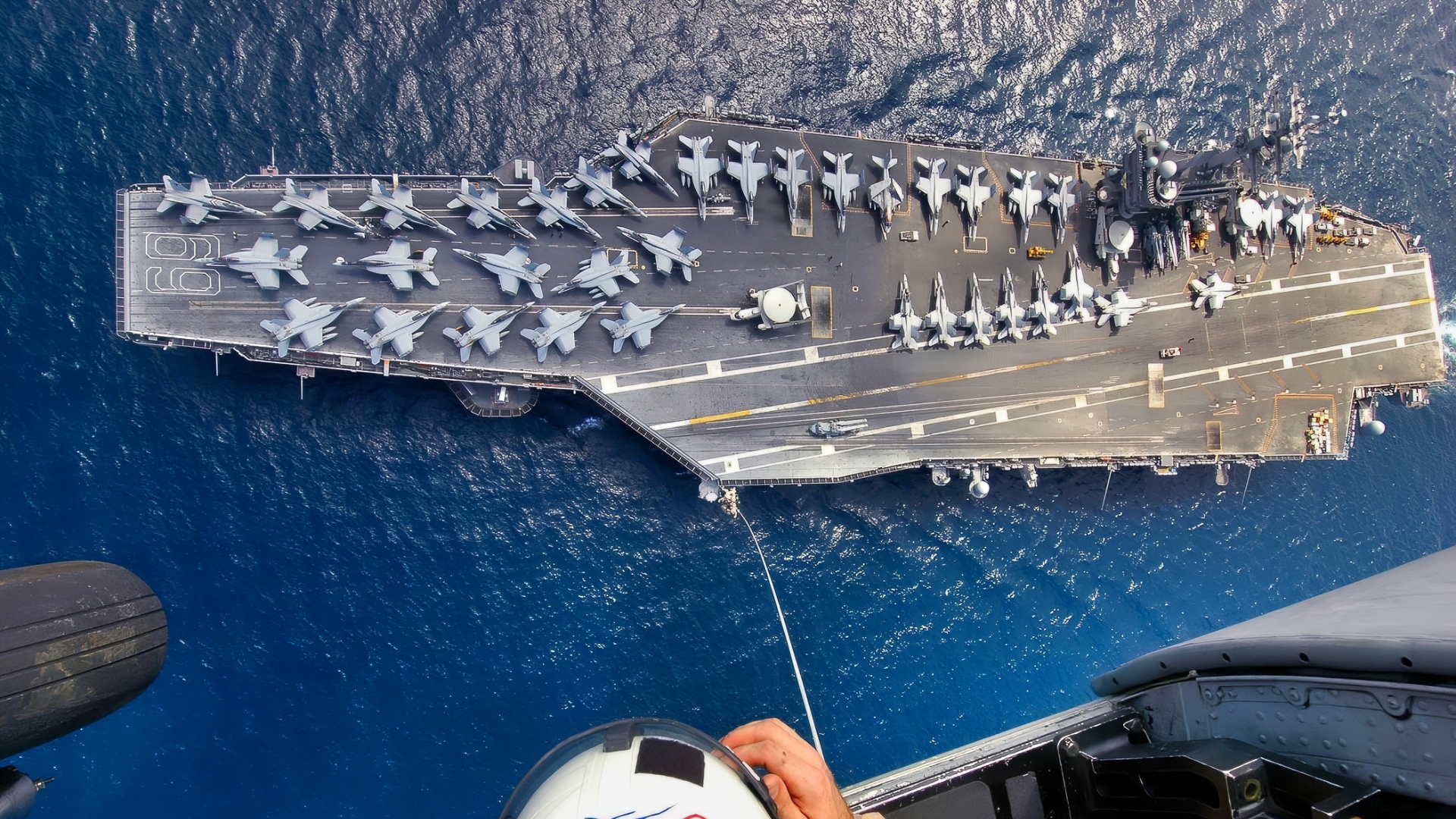
Explosive Ordnance Disposal 1st Class Christopher Courtney assigned to Explosive Ordnance Disposal Mobile Unit Six (EODMU-6), Det. 16 assist his team members during Special Purpose Insertion Extraction (SPIE) training from an SH-60 Seahawk helicopter. The Nimitz-class aircraft carrier USS Dwight D. Eisenhower (CVN-69) is deployed in support of Maritime Security Operations (MSO) and the global war on terrorism.
-Salvo math, geography, and magazine depth all favor Beijing in the opening days, forcing U.S. flattops to fight their way into the theater.
-Carriers still matter, but only as nodes in a wider web of subs, distributed shooters, deception, and long-range weapons built to ride out that first storm.
China’s Missiles vs. U.S. Carriers: One Fight America Can’t Ignore
If you’re comparing flight decks, catapults, and the choreography of launch-and-recovery cycles, the United States still wears the crown. But suppose you compare what happens before a carrier ever gets within its preferred striking range. In that case, China enjoys a blunt, asymmetric edge the U.S. Navy cannot wish away: massive salvos of land-based ballistic, cruise, and now hypersonic missiles that can flood the air around a carrier strike group, force it to maneuver at the enemy’s tempo, and—above all—push it back. In the Indo-Pacific, where geography favors the defender and airfields ring the battlespace, that sheer volume of fire can matter more than the marquee ship you send to sea.
This isn’t a funeral dirge for American carriers. It’s an honest accounting of salvo math, geography, and time—and how those three variables combine to give the People’s Liberation Army (PLA) the initiative in a war that starts near its shores. The punch line is simple: the advantage isn’t China’s carriers. It’s the missile ecosystem that would shape the sea and sky before their carriers join the fight.
The Advantage Isn’t The Carrier—It’s The Missiles
Beijing has spent two decades building the world’s densest arsenal of theater-range missiles. That magazine includes the DF-21D and DF-26 anti-ship ballistic missiles designed to threaten moving naval targets over hundreds to thousands of kilometers; the DF-17 with a maneuvering hypersonic glide vehicle; a broad stable of air-launched weapons like the YJ-12 and YJ-91; ship- and sub-launched cruise missiles like the YJ-18; and the radars, satellites, UAVs, and over-the-horizon sensors to help stitch together an ocean-sized targeting picture. The product of that investment is not a single “carrier killer,” but a stack of overlapping fires that can be called in sequence or all at once.
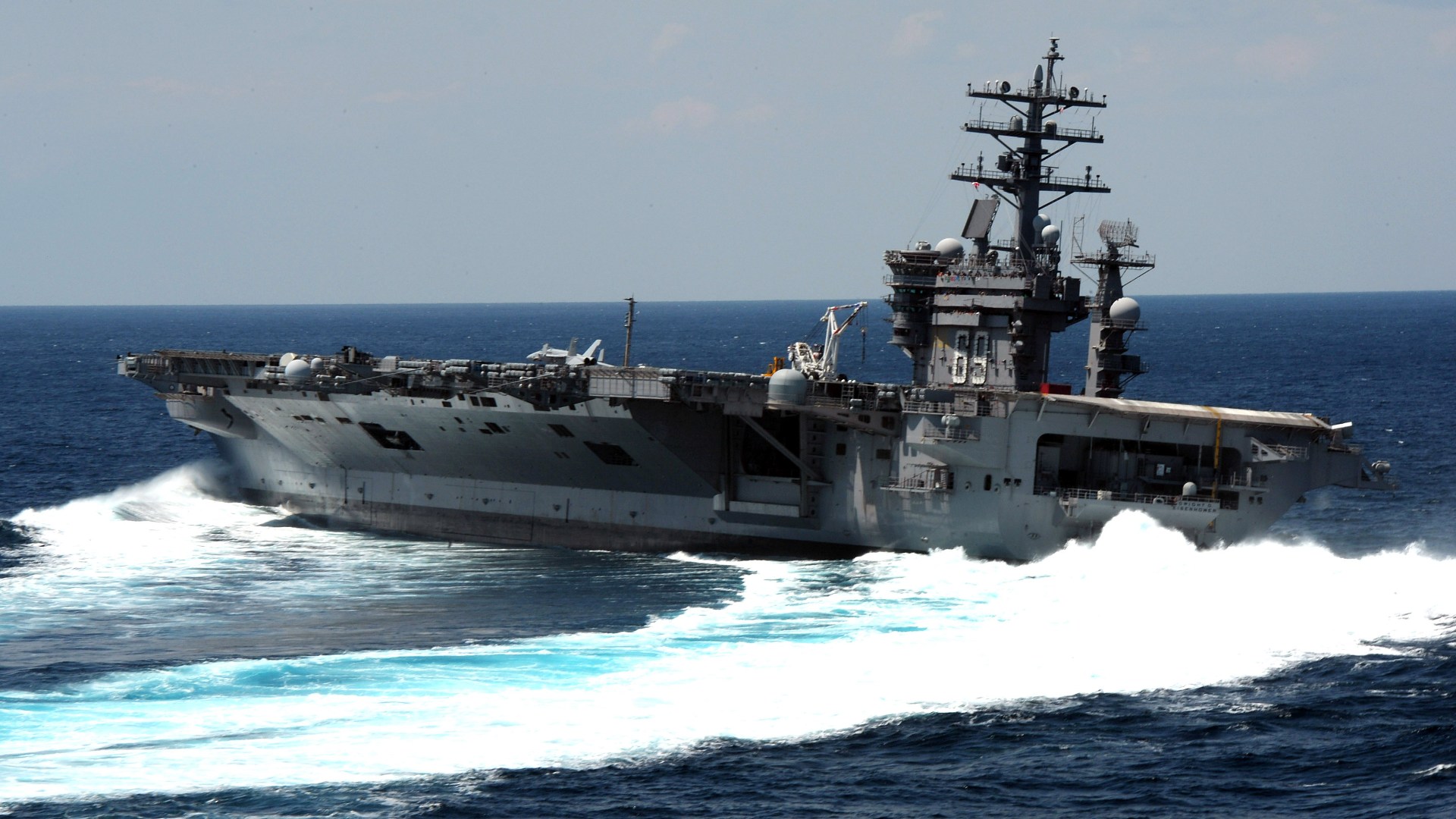
The Nimitz-class aircraft carrier USS Dwight D. Eisenhower conducts rudder turns during sea trials. Dwight D. Eisenhower completed a nine-month planned incremental availability at Norfolk Naval Ship Yard on June 10, 2011.
The uncomfortable truth for any surface force is that defense is a magazine game. A carrier strike group (CSG) can layer Aegis interceptors—SM-6, SM-2, ESSM—plus electronic warfare, decoys, and close-in guns. It can maneuver, use deception, and leverage long-range air patrols to thin inbound raids. But every hard-kill shot consumes a missile; every soft-kill trick loses some edge as the attacker adapts. Attackers reload ashore. Defenders must husband finite cells at sea. In a protracted exchange, numbers and proximity bias the side that can fire the most, from the most directions, at the least cost.
That doesn’t make carriers helpless. It does mean that getting them into the fight—within useful range and with magazines intact—has become the central operational problem of a Western Pacific war.
Geography Is A Weapon, And China Owns The First Move
The maps tell the story. The first island chain bends like a scythe from Japan to the Philippines, bristling with airfields and ports the PLA can saturate in the opening hours. From the Chinese mainland, road-mobile launchers can fire deep into the Philippine Sea. Bombers can push missile range rings still further. Surface combatants and diesel-electric submarines operating under land-based air cover can spread cruise missiles across multiple axes. Every mile a carrier must close to put its air wing in range is a mile deeper into overlapping threat envelopes.
And because time and distance favor the home team, the PLA can sequence its fires: reconnaissance drones probe; cruise missiles herd; ballistic or hypersonic shots exploit distraction; and follow-on waves aim at the leakers. The United States, by contrast, must flow forces across oceans, stage from bases under missile threat, and fight through the opening moves with what’s already afloat. None of that is impossible. All of it is harder than it was a generation ago.
The Kill Chain That Makes Mass Matter
Missiles don’t matter if you can’t find, fix, track, and update a moving carrier’s location. That is the PLA’s true “weapon system”: a kill chain that ties together space-based ISR (electro-optical, radar, signals), over-the-horizon radars, maritime patrol aircraft, UAVs, surface pickets, and submarines—plus data fusion on shore that can cue shooters fast enough to matter. Perfection isn’t required; volume and persistence can overcome gaps. As long as enough track quality makes it through to enough shooters, some salvos will arrive from enough angles to challenge even a well-handled CSG.
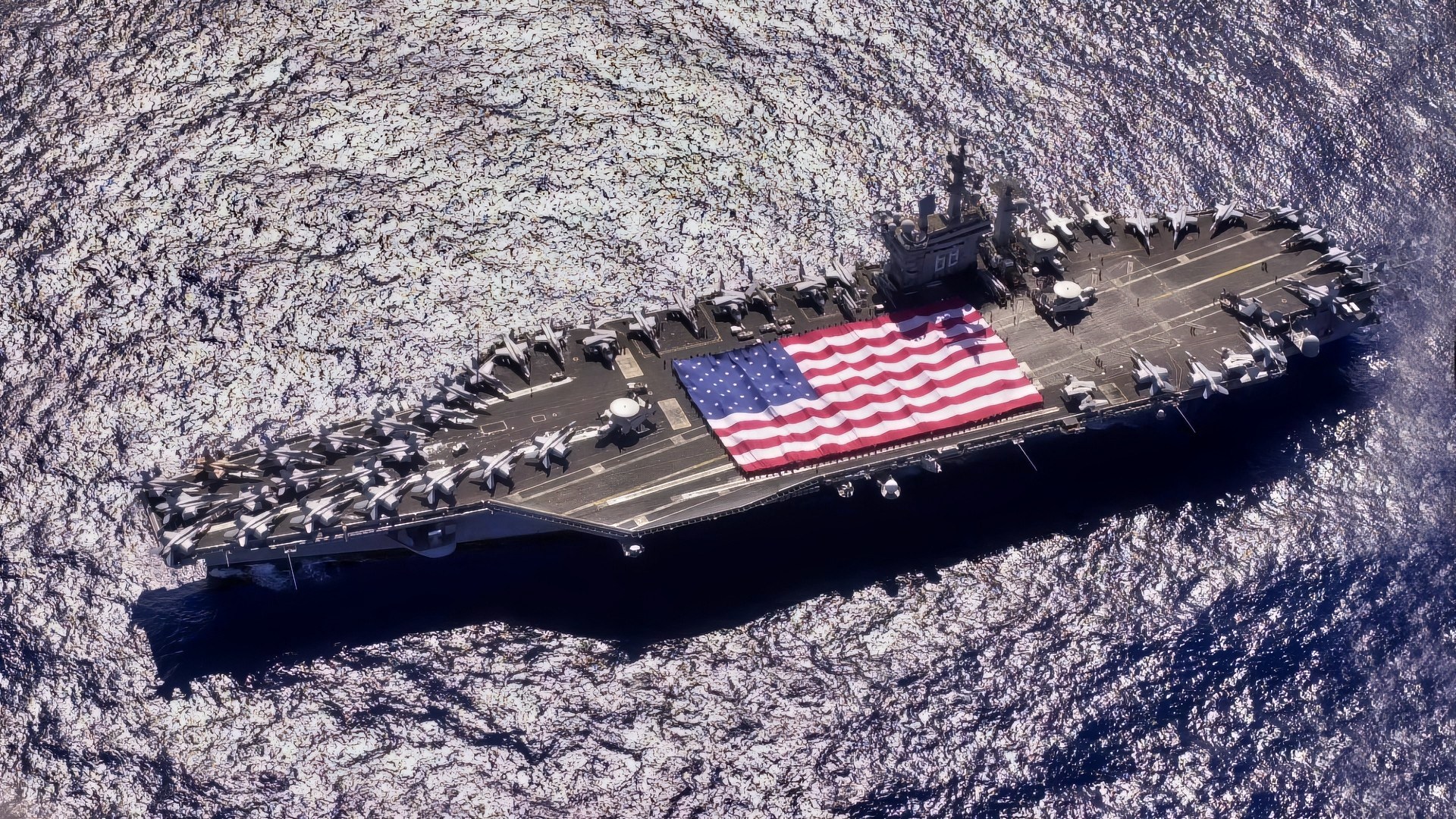
Pacific Ocean (November 3, 2003) — During Tiger Cruise aboard USS Nimitz (CVN 68), Nimitz and Carrier Air Wing Eleven personnel participate in a flag unfurling rehearsal with the help of fellow tigers on the flight deck. The Nimitz Carrier Strike Force and Carrier Air Wing Eleven (CVW-11) are in route to Nimitz homeport of San Diego, California after an eight-month deployment to the Arabian Gulf in support of Operation Iraqi Freedom. U.S. Navy photo.
The U.S. and allies can—and do—attack that chain: jamming, deception, cyber, and kinetic strikes against sensors, relays, and decision nodes. But on Day 0 to Day 3, before attrition takes its toll, the PLA gets first say. That early initiative is what creates the impression of inevitability around those missile salvos.
Magazine Math: Why Saturation Works (And Why It’s Not Automatic)
Think of a carrier group’s defense as a nested set of sieves. The outer layers—fighters, E-2D Hawkeyes, and long-range missiles—try to thin the raid. Middle layers—Aegis warships, multistatic sensors, and electronic warfare—strip more arrows from the quiver. Inner layers—point defense and close-in weapons—deal with what leaks through.
If a raid arrives coherent and concentrated, and if enough of it maneuvers unpredictably or arrives from multiple vectors, some leakers will survive. If the attacker can repeat that cycle, a defender will start to worry about missile depletion before the attacker does—especially if the defender is hundreds of miles from a reload port or underway rearm is still experimental. That’s the essence of saturation.
But saturation is not automatic. It depends on the attacker generating the right geometry and synchronizing different missile types under electronic attack, while the defender denies cueing, spoofs tracks, and hunts archers (bombers, ships, and launchers) as aggressively as it intercepts arrows. The side that better manages complexity wins the exchange. China’s advantage is that it can mass more arrows at the start—close to home, under its own air defense umbrella.
Hypersonics: Hype, Headaches, And Hard Problems
Hypersonic glide vehicles (like those mounted on the DF-17) complicate defenses because they maneuver and fly lower than ballistic arcs, compressing timelines and stressing radar coverage. They are not unstoppable bolts of Zeus—sensor fusion, updated interceptors, and layered soft-kill/hard-kill tactics are catching up—but they thicken an already thick raid. In the early stages of a fight, even a modest number of hypersonic shots, mixed with cruise and ballistic volleys, forces defensive tradeoffs and consumes high-end interceptors that are slow to replace.

Souda Bay, Crete, Greece (Feb. 22, 2006)
Nimitz-class aircraft carrier USS Theodore Roosevelt (CVN 71) heads to sea following a brief logistics stop on the Greek island of Crete. Roosevelt and Carrier Air Wing Eight (CVW-8) are currently underway on a regularly scheduled deployment supporting maritime security operations.
Roosevelt is the fourth ship in the NIMITZ – class of nuclear powered aircraft carriers and is homported in Norfolk, VA.
U.S. Navy photo by Mr. Paul Farley
For the attacker, that’s value: expensive defensive shots burned against relatively cheaper offensive ones. For the defender, it’s a reminder that range and deception are as important as raw intercept power. The war isn’t only about better arrows; it’s about making the other archer shoot first and often.
How China’s Carriers Profit From The Missile Bubble
Here’s the irony: the headline says “China’s carriers have an advantage,” but the reason they do is that they can fight under a missile umbrella their opponent lacks. Inside the A2/AD bubble created by land-based fires, a Chinese carrier—particularly Fujian with catapults that can launch heavier fighters, electronic jammers, and fixed-wing airborne early warning—can project airpower with shorter logistics tails, under the cover of home-based SAMs and coastal aviation. That creates interior lines: the ability to refuel and rearm aircraft quickly ashore, cycle air wings faster, and keep pressure on a distant carrier that must guard every missile it shoots.
In other words, the big advantage isn’t that China’s carriers are “better” than America’s. It’s that their carriers don’t have to carry the opening rounds alone. Their job is to exploit what the Rocket Force buys them: space, time, and a battered enemy air defense picture. In a fight over Taiwan or the South China Sea, that division of labor matters.
Why U.S. Defenses Don’t Erase The Problem
Could a well-handled U.S. carrier group survive and fight under that kind of pressure? Yes—especially with E-2D networks, F-35C sensors feeding the air defense web, and Aegis BMD ships layering SM-6 and other interceptors. But “can” is not the same as “can without cost.” Two specific frictions are stubborn:
Depth Of Magazine. A cruiser or destroyer only carries so many interceptors. The Navy is proving out at-sea VLS reloads, but in combat conditions, with sea state and threat overhead, it’s not a magic wand. Every cell you fill with air defense is one you don’t fill with long-range strike, and vice versa. Salvo warfare is as much about logistics as it is about guidance chips.
The Cost Curve. The United States can build more interceptors—but the unit cost and production tempo of high-end SAMs and hypersonic interceptors make it hard to match an attacker’s ability to produce and fire large numbers of offense-dominant missiles. That doesn’t mean “we can’t win.” It means we must change the engagement—disperse, deceive, and make the attacker waste shots on ghosts.
What Changes If The Fight Moves Past The First Island Chain
The further you push away from mainland China, the more the advantage tilts back. Space-based cueing must cover more ocean. Over-the-horizon radars lose resolution. Land-based launchers face replenishment and survivability problems, while U.S. submarines—which remain America’s best asymmetric tool—gain freedom to hunt PLA surface groups, submarines, and the logistics ships that feed them. The U.S. Navy’s push toward Distributed Maritime Operations (DMO) and long-range carrier air wings is about moving this boundary—denying the PLA the comfortable geometry that lets missile mass dominate.
That shift isn’t a “someday” wish list. It’s happening now: MQ-25 tankers to extend carrier reach; Maritime Strike Tomahawk and LRASM to hold ships at risk from far away; SM-6 evolving into a long-reach multi-mission weapon; and a carrier airwing pivoting to lower-observable platforms and longer-range weapons. None of this flips the table on Day 1. All of it narrows the window in which missile salvos rule the fight.
The Aircraft Carrier Still Matters—But As Part Of A Web, Not A Soloist
One way to read the missile revolution is to declare the carrier obsolete. A better reading is that the carrier is now a node—a powerful, flexible one, but a node nonetheless—in a kill web that must be resilient under fire. The web includes submarines (to kill shooters and scouts), land-based air and missiles (to complicate Chinese planning), uncrewed surface and subsurface systems (to extend sensing and carry decoys or weapons), and space/cyber tools (to blind the kill chain that makes missiles lethal). The carrier brings volume airpower, command-and-control, and the ability to surge effects where and when needed. It just can’t be the only thing you count on.
Viewed that way, China’s “advantage” looks less like an automatic checkmate and more like a powerful opening—one the United States must plan to survive, confuse, and then counterattack through.
China and the Missiles vs. the Aircraft Carriers: A Simple, Honest Bottom Line
In a fight that starts near China, missiles move the need. The PLA has a home-court salvo advantage, built on proximity, magazine depth ashore, and a maturing kill chain. That reality grants China’s carriers a sheltered lane to matter sooner than they otherwise would. The U.S. Navy’s carriers, by contrast, must earn their way into the fight—preserving magazines under pressure, extending the air wing’s reach, and relying on undersea forces and distributed shooters to pry open a door.
Call it unfair if you want. Better to call it a design brief. Build the fleet—and the munitions stockpiles, the rearm concepts, the deception playbooks—that assume you start under a rain of arrows. If you can ride out the first storm and keep fighting, the carrier is still the most versatile, sustainable airfield in the Pacific. If you can’t, it doesn’t matter how good your catapults are.
About the Author: Harry J. Kazianis
Harry J. Kazianis (@Grecianformula) is Editor-In-Chief and President of National Security Journal. He was the former Senior Director of National Security Affairs at the Center for the National Interest (CFTNI), a foreign policy think tank founded by Richard Nixon based in Washington, DC. Harry has over a decade of experience in think tanks and national security publishing. His ideas have been published in the NY Times, The Washington Post, The Wall Street Journal, CNN, and many other outlets worldwide. He has held positions at CSIS, the Heritage Foundation, the University of Nottingham, and several other institutions related to national security research and studies. He is the former Executive Editor of the National Interest and the Diplomat. He holds a Master’s degree focusing on international affairs from Harvard University.
More Military
The YF-23 Black Widow II Stealth Fighter Almost Made the Ultimate Comeback
The New Leopard 2A8 Tank Has a Message for the Russian Army
The F-22J Raptor Stealth Fighter Will Never Fly For Japan (China Is Smiling)


Ooi Chee Teong
October 7, 2025 at 9:06 pm
There is another disadvantage not mentioned. How long can anyone handle such stress. This is definitely a home advantage
JOEL JUSTIN CARLSON
October 7, 2025 at 9:11 pm
You have no idea how their carriers will perform. Ucommunist Sympathizer
Joseph K
October 8, 2025 at 1:50 am
Silly yanks, Chinese aircraft carriers can use EMALS to launch fifth Gen fighter jets. Which is something Americans are still struggling with.
The missiles are obvious which why they would never dare try and pull off a stump like they do in the Middle East. An attack on China will be the end for the yanks.
Dan Dunn
October 8, 2025 at 6:26 am
The reason a Chinese aircraft carrier has a plethora of missiles is because they don’t have the supporting ships and don’t have anything like the ajax system! It’s not a positive. Even China’s newest air carrier carries far less planes can’t launch as fast can’t launch fully loaded or fueled planes. Can’t do night operations or even continuous daytime operations.
Don’t be a Chinese shill and try to spin a negative into something that looks like they have an advantage
R9n
October 8, 2025 at 10:13 am
Close to china.
There I have written your article in 3 words
Chtan
October 8, 2025 at 10:49 am
Do you even know the US carrier catapult’s failure rate are? Lol. Worst, US carrier’s so called electric catapult was builded on old aging AC current which is not reliable while China system is builded around a new AC current.
Daryl C Vernay
October 8, 2025 at 10:53 am
The advantage of not sinking doesn’t qualify it as a proper man of war. There are more reasons than capitol that the us is the only country with a significant cv force. As to their aircraft and training, come to red flag or to gun and get your candy asses whooped up on proper, then you can go home and take another 30 years to re-evaluate your condition. Aim small, miss small, or for off 250 rounds hoping to hit them enough that they can’t retaliate before you reload. I’m so tired of this liberal rag propaganda.
John Thick Sr
October 8, 2025 at 11:38 am
US Navy Sailor with actual combat CVN experience here. First off everyone chill, this appears to be an AI Chinese Propaganda article. Second if the author actually had first hand knowledge of how either side operates,then the would be written differently. Dropping dummy munitions on sand drawn targets is no match for against decades of actual combat experience. This isn’t right wing vs left wing, they’re wings of the same bird; they want us divided. BTW there are Chinese Propaganda Bots in the comments so don’t sweat them.
Mitchell McClarnon
October 8, 2025 at 1:59 pm
It should make a beautiful, and beneficial, reef .zying on the bottom of ocean. Hell their satellites are so good they almost sank 2 of their own while harassing other ships.
Kedst1
October 8, 2025 at 2:29 pm
Just another clickbait article. The title of the article explicitly suggests a comparison between the carriers and not the overall strategic situation under which the carriers would operate.
[email protected]
October 8, 2025 at 3:12 pm
Stupid article….American subs more than offset this “missle umbrella”. Propaganda, nothing more.
Gerald L Green
October 8, 2025 at 3:52 pm
We Don’t need Middle laden Aircraft Carriers.
Don’t believe Everything You Read. Mish formation Abounds From China. Can you say… Submarines Laden with U.S. Missiles.
Bsalarm
October 8, 2025 at 3:52 pm
The Chinese are whipping America in pretty much everything that matters. Stop annoying them and let them get on with their aims – to improve the lot of their people, something which appears not to concern America.
Mark
October 8, 2025 at 4:32 pm
Killing us with words!
🤣🤣😂🤣
Article is to long and full of $#!t
Mark
October 8, 2025 at 5:11 pm
@ Chtan lol is that what you think about our ingenuity?
You are sadly mistaken, in fact you are nowhere in the ballpark, 🤣😂🤣😂🤣😂🤣
Jay
October 8, 2025 at 6:04 pm
lol Chinese military hardware is no match for US military. The US has China surrounded in the south China sea, and would sink these ships quickly in a war. Besides our basis surrounding China, we also have many submarines that the Chinese cannot detect that can rain downs, those of cruise missiles on any Chinese targets.
Captain Obvious
October 8, 2025 at 6:43 pm
This article is ridiculous. It’s pretty basic military strategic logic that you could glean from say, playing the Command and Conquer series of videogames, or just having a basic knowledge of modern ground, air, and naval combat systems, that it’s easier to defend from land than it is to attack from the sea. A text wall to say something completely elementary that everyone knows..
Jay
October 9, 2025 at 8:55 am
You people are forgetting something Chinese stuff doesn’t work hehe good luck with your imagination lol