
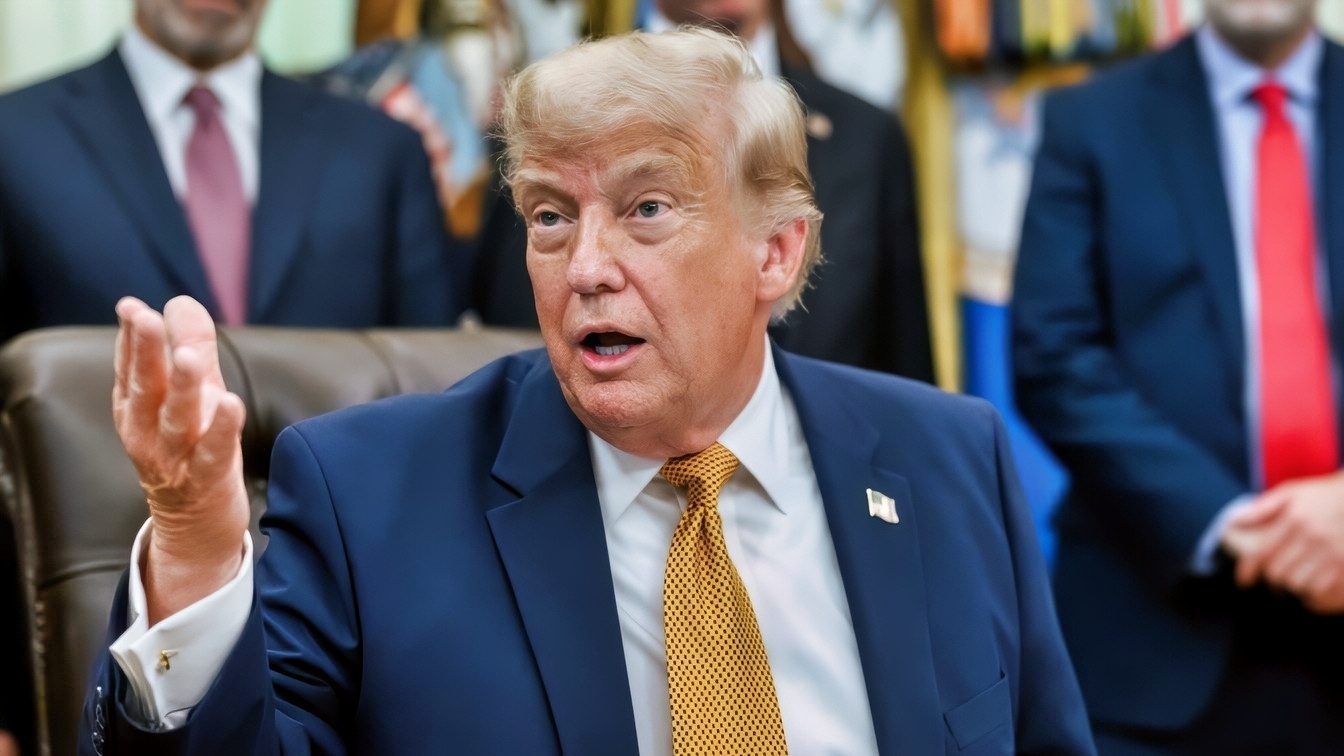
President Donald Trump appeared to make a new threat of military strikes against Iran on Tuesday, June 23, when he told reporters, “I’ll do what I have to do” if Iran doesn’t hold up their end of the agreement.
The comment follows a number of other threats made by the president since signing the memorandum of understanding (MOU) with Tehran that established a 60-day negotiating window for a future peace deal.

President Donald Trump gives remarks after presenting the newly-created “Medal of Sacrifice” to three fallen officers’ families from the Palm Beach County Sheriff’s Office, Monday, May 19, 2025, in the Oval Office. (Official White House Photo by Joyce N. Boghosian)
What Trump Said
President Trump was asked by a reporter in the Oval Office about the prospect of continued economic disruption caused by the war, and whether he was willing to risk “economic catastrophe” and strike Iran again.
“Well, not the way I’m doing it, it’s not going to cause depression,” the president said, adding that “nuclear weapons supersedes depression.”
“Nuclear weapons will cause depression much more quickly,” Trump also said, adding that the U.S. economy is moving in the opposite direction from a depression.
When pressed about the prospect of Iran failing to abide by the memorandum of understanding, the president doubled down on his belief that the United States would avoid a depression under his leadership.
“I said I don’t want to be Herbert Hoover. That’s a president I don’t want to be because he, you know, he was in charge during the Great Depression,” Trump said. “And certainly a lot of bad things could happen. That would be one of the things.”
He then added that while a depression is possible, he doesn’t believe it will happen, and that “if Iran doesn’t live up to their agreement or if they’re not behaving, I will do what I have to do.”

President Donald Trump delivers the Commencement address at the graduation ceremony for the University of Alabama, Thursday, May 1, 2025, at Coleman Coliseum in Tuscaloosa, Alabama. (Official White House Photo by Daniel Torok)
The comment was not an explicit threat of military action, but the meaning is heavily implied – and that’s really all that matters.
MOU Technically Prohibits Threats
The MOU signed on June 17 did more than establish a 60-day negotiating window to create the framework for a permanent peace agreement between Tehran and Washington.
The deal temporarily halted military operations – though there were some clashes when Israel and Hezbollah exchanged fire – and reopened the Strait of Hormuz.
The deal also established a number of rules that both parties were expected to follow.
Not only did the MOU require both sides to stop fighting, but it explicitly prohibited threats of future military action – a measure intended to minimize the chances of coercion throughout the negotiation process.
“The United States of America and the Islamic Republic of Iran and their allies in the current war, by signing this MOU, declare the immediate and permanent termination of military operations on all fronts, including in Lebanon, and undertake from now on not to initiate any war or any military operation against each other, and to refrain from the threat or use of force against each other, and ensuring the territorial integrity and sovereignty of Lebanon. The final deal will confirm the permanent termination of the war on all fronts, including in Lebanon, and other provisions of this paragraph.”
The language in the text leaves little room for interpretation, prohibiting both the use of force and the threat of doing so – and while Trump did not explicitly threaten military action on Tuesday, his warning could easily be viewed through that lens.
For Tehran, which has endured major strikes on its energy and military infrastructure since the beginning of the year, it’s hard to see the threat as being anything other than military in nature.
Iranian officials could reasonably argue that the president was threatening actions beyond those outlined in the MOU signed by both parties and walk away from negotiations as a result. It wouldn’t be the first time, actually.
Iran Almost Waked Out Last Time
The threat of Iran walking away from the talks is very real. While Washington has the military advantage over Tehran, the regime can still hold the global oil market hostage via the Strait of Hormuz.
Not only has Iran proven it is willing to disrupt the global economy to preserve itself, but its negotiators also demonstrated last week that they are willing to walk out on negotiations when they feel as though they are being threatened.
On June 21, negotiators walked out of talks with Vice President JD Vance in Geneva, Switzerland, after President Donald Trump issued new threats on social media.
As the negotiations moved forward, President Trump said that he would hit Iran again if efforts were not taken to rein in Hezbollah in southern Lebanon.
“Iran must immediately stop their highly paid PROXIES in Lebanon from causing trouble. If they don’t, we’ll hit Iran very hard again, just like we did last week, only harder!!!” the president said.
The latest round of threats may not only encourage Iranian negotiators to threaten to walk away, but could embolden Tehran to push for yet more concessions from Washington.
About the Author: Jack Buckby
Jack Buckby is a British researcher and analyst specializing in defense and national security, based in New York. His work focuses on military capability, procurement, and strategic competition, producing and editing analysis for policy and defense audiences. He brings extensive editorial experience, with a career output spanning over 1,000 articles at 19FortyFive and National Security Journal, and has previously authored books and papers on extremism and deradicalization.


