


Just when you thought the chances for peace were over, it looks like President Donald Trump is reversing course again and reopening indirect talks with the Islamic Republic of Iran.
The forty-seventh president is absolutely living up to his image as a leading reality television star with all this will-we-won’t-we tension over the war.
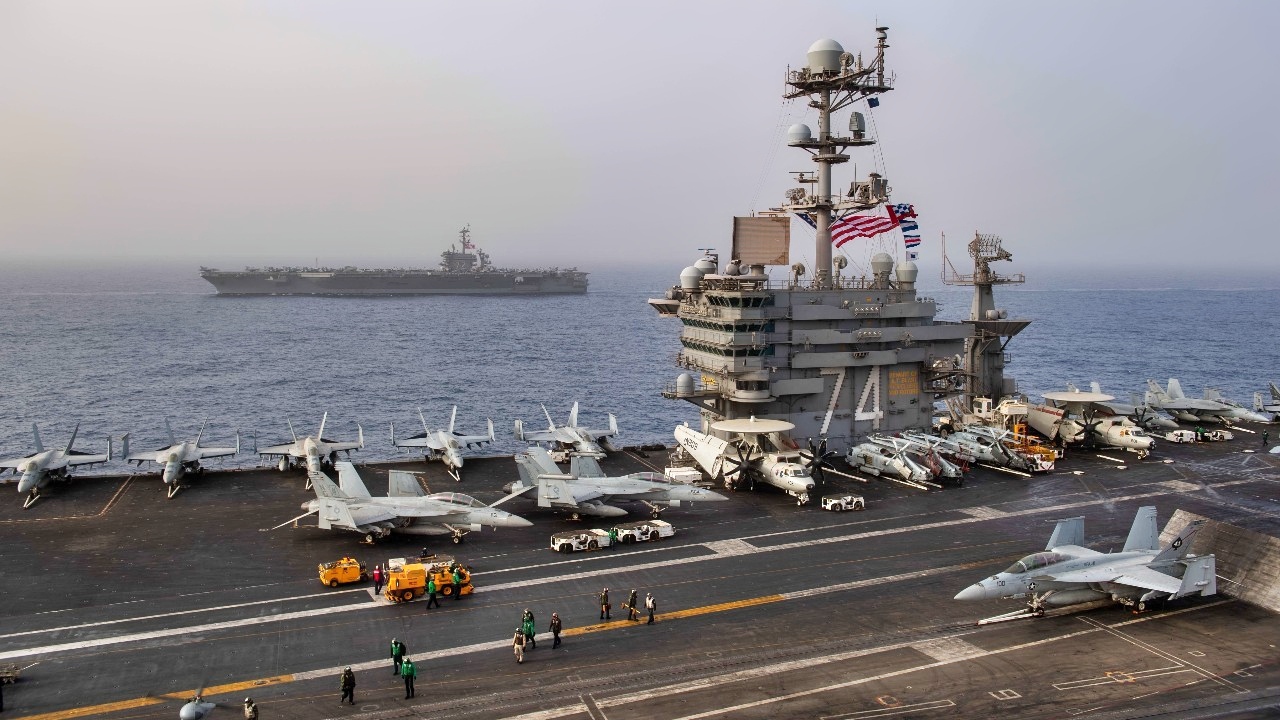
The aircraft carrier USS Abraham Lincoln (CVN 72), back, steams alongside the aircraft carrier USS John C. Stennis (CVN 74) in the Mediterranean Sea, April 24, 2019. The John C. Stennis Carrier Strike Group (CSG) 3 and Abraham Lincoln Carrier Strike Group (CSG) 12 are conducting dual carrier operations, providing opportunity for two strike groups to work together alongside key allies and partners in the U.S. 6th Fleet area of operations. John C. Stennis is underway in the Mediterranean Sea as part of the John C. Stennis Carrier Strike Group (JCSCSG) deployment in support of maritime security cooperation efforts in the U.S. 6th Fleet area of responsibility. (U.S. Navy photo by Mass Communication Specialist 3rd Class Grant G. Grady)

Zumwalt-class Guided Missile Destroyer USS Michael Monsoor (DDG 1001) transits the Pacific Ocean, June 25, 2022. Twenty-six nations, 38 ships, four submarines, more than 170 aircraft and 25,000 personnel are participating in RIMPAC from June 29 to Aug 4 in and around Hawaiian Islands and Southern California. The world’s largest international maritime exercise, RIMPAC provides a unique training opportunity while fostering and sustaining cooperative relationships among participants critical to ensuring the safety of sea lanes and security on the world’s oceans. RIMPAC 2022 is the 28th exercise in the series that began in 1971.
It looks increasingly like the world might get lucky, as the president met with his military advisers in the last few days and clearly did not like what he heard about the prospects of resuming the war (which he had threatened to do until those meetings).
Buying Time, But Not Peace
The June memorandum created a temporary framework that paused the fighting and allowed shipping to resume through the contested Strait of Hormuz until a broader agreement could be reached.
Until the last few days, it was not at all clear that the world would ever reach a final agreement.
Indeed, it remains to be seen if the ceasefire, which has been poorly enforced by all sides, can even hold until the end of the Memorandum of Understanding (MoU) on August 18.
Yet the president seems to be making a pivot away from violence. And it could not come at a more opportune moment.
After all, the United States was depleting its Strategic Petroleum Reserve (SPR) at a dangerous rate.
While the SPR is technically at 330 million barrels, most experts believe that once it hits 300 million (which it is quickly approaching), the SPR becomes harder to rely on.
That’s because the SPR is maintained in salt caverns, which create a bevy of complications for the oil stored there.
Some analysts in recent weeks have posited that there are really only around 100 million usable barrels of oil remaining in the SPR at this rate, due to the degradation oil undergoes while sitting in salt caverns.
If that is true, so long as 20 percent of the world’s oil and 18 percent of the world’s natural gas remain blockaded (at least partially) in the Strait of Hormuz, the US economy is about to go off a cliff, as the entire system runs on affordable, available energy.
But the Iranians are the ones who can determine whether the energy flows will come back at all. They will only be incentivized to do that if there is a lasting deal that the Americans both agree to and adhere to.

The world’s largest aircraft carrier, USS Gerald R. Ford (CVN 78), conducts flight operations in the North Sea, Aug. 23, 2025. Gerald R. Ford, a first-in-class aircraft carrier and deployed flagship of Carrier Strike Group Twelve, is on a scheduled deployment in the U.S. 6th Fleet area of operations to support the warfighting effectiveness, lethality, and readiness of U.S. Naval Forces Europe-Africa, and defend U.S., Allied and partner interests in the region. (U.S. Navy photo by Mass Communication Specialist 2nd Class Maxwell Orlosky)
Hormuz is the Biggest Obstacle
Tehran insists that any final agreement must acknowledge its authority over the Strait of Hormuz.
Iran seeks recognition of its control over maritime traffic in the Strait, which is why it has created its own Traffic Separation Scheme (TSS). Tehran wants the ability to regulate passage through the Strait. Finally, Iran’s leadership seeks the authority to impose transit fees once the temporary toll-free period under the MoU expires on August 18.
Washington rejects these demands outright, arguing that Hormuz is an international waterway and cannot legally become an Iranian-controlled chokepoint.
The likelihood that the Iranians will give up their control over the Strait is near-zero, which is why many are skeptical about any chances for a longer-term peace deal with Iran.
Nukes? What Nukes?
Interestingly, the current talks between Washington and Tehran are focused on restoring maritime trade flows and maintaining security in the Strait of Hormuz during the ceasefire period.
The previous fixation by the Americans on Iran’s purported nuclear weapons arsenal has gone by the wayside.
Iran refuses to allow any greater discussion on their nuclear weapons arsenal during the ceasefire period, while the US president continues bringing it up.
Although in his recent comments to the press following meetings with his top military advisers, Trump indicated the nuclear issue was no longer his paramount concern–at least not for now.
This indicates that the forty-seventh president has again reversed course away from his truculent commitment ot war with Iran toward some semblance of a protracted ceasefire and negotiation phase.
Military Options Remain On the Table
Although the president has not totally ruled out military action, President Trump has reportedly discussed contingency plans with senior military officials, should negotiations fail (or should Iran refuse further concessions once the MoU expires).
So, it seems as though diplomacy has now become Trump’s preferred path. Until the entire diplomatic side of things can be fully ruled out as viable.
The Broader Strategic Significance
The negotiations are really about whether the US is willing to recognize any special Iranian role in governing one of the world’s most important maritime chokepoints, the Strait of Hormuz.
Thus far, contrary to some of the evidence put forward in multiple articles in the last 24 hours, there does not seem to be any movement by Trump toward that outcome.
After all, if Trump accepted even limited Iranian authority over shipping through the Strait of Hormuz, it would represent a major shift in the Gulf security architecture.
If it refuses–and Iran insists–the ceasefire could prove temporary.
The current ceasefire has reduced the fighting, but it has not yet resolved the underlying disagreement over sovereignty, freedom of navigation, or regional power–all of which are quickly turning against Washington.
And that’s why the hope that this tenuous ceasefire will convert into a long-term peace deal is so low. There are simply two irreconcilable strategic visions at play here.
For Iran, the Strait of Hormuz is effectively under Iranian stewardship, and they want that reality acknowledged politically and economically.
The United States, meanwhile, insists the Strait of Hormuz remain open to the world and free from unilateral Iranian control (or tolls).
So long as those two positions remain unchanged, regardless of whatever Israel does against Iran’s proxy, Hezbollah, in Lebanon, the ceasefire will struggle to hold, even as indirect talks continue.
Unless one of the two major sides is willing to compromise on the Strait of Hormuz–which they don’t appear able to do–the ceasefire will expire with no hope for a lasting, durable peace.
About the Author: Brandon J. Weichert
Brandon J. Weichert is Senior National Security Editor. He also manages The Weichert Brief on Substack. Weichert also hosts “National Security Talk” on Rumble. He is the author of four bestselling national security books, the most recent of which is A Disaster of Our Own Making: How the West Lost Ukraine (Encounter Books). Follow him via Twitter/X @WeTheBrandon.


