

As Ukraine’s massive force of one-way attack drones strikes further into the interior of Russia, Moscow finds its already inadequate number of air defense assets even more lacking than before.
In the most recent attack by Ukraine on Russia’s largest refinery in the Siberian city of Omsk, the facility was embarrassingly almost completely undefended.

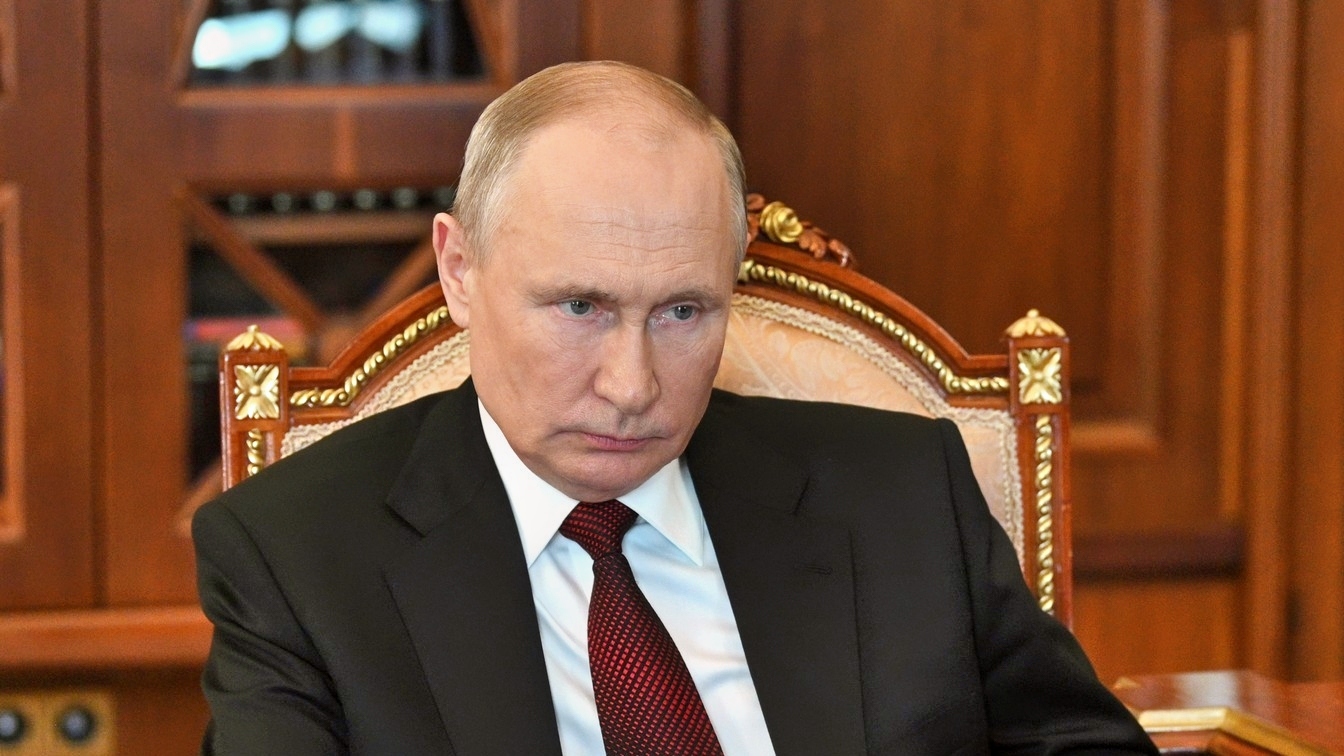
Putin in 2023. Image Credit: Creative Commons.

Putin in 2022. Image Credit: Creative Commons.
As these unmanned attack aircraft were exploding on impact with the refinery facility, there was one huge fireball after another.
Tanks of crude oil and refined petrol went up in massive conflagrations, and the skies filled with plumes of black smoke.
Nothing could stop the drones, because there were almost no air defense units available, as the Russian military deemed defending the site to be unnecessary. This turned out to be a fatal assumption.
Omsk is more than 1500 miles from the Ukraine-Russia border. It had been thought to be much too far to the East for even the most capable strike systems being used by Kyiv in its escalating war on Moscow’s oil industry to be able to reach it.
This attack has now prompted Russia to ban diesel fuel exports until at least the end of July 2026 and has exacerbated a mounting fuel crisis in Russia.
As of today, 78 of Russia’s 83 regions are paralyzed by the inability of ordinary citizens to purchase petrol. Stories of drivers queuing for 36 hours or more have become increasingly common.
The illegally annexed and occupied region of Crimea has become one of the most seriously affected by fuel shortages.
On Wednesday, 8 July, Sergey Aksyonov, the Russian-installed head of Crimea, stated: “The fuel supply situation remains tense and will persist for some time. On certain days, fuel will not be available for sale [at all],” he added.
Not The Full Striking Range
As numerous defense commentators have detailed, up until the strike on Omsk and other facilities deep inside Russia, Ukraine’s drone attacks had been limited to targets in the regions of European Russia, an engagement envelope roughly within 1,000 miles of Ukrainian territory still controlled by Kyiv.
Omsk is 1,500 miles “as the crow flies,” but Ukraine drones are by no means flying in a straight line.
To reach the Omsk refinery, Ukrainian drones had to take many twists and turns to avoid Russian air defense batteries that might intercept them along the way.
This gives the Ukrainian drones used in this attack an endurance range of up to 2,100 miles, said representatives of the systems’ manufacturer, Fire Point.
This is several hundred miles beyond even the far-flung Omsk facility, with implications that Russia’s military planners have almost no capacity to adapt to.
The additional range of the Fire Point puts huge tracts of Russian territory in this remote region of the country.
Unfortunately for Moscow, this area of western Siberia is one of the major centers of Russia’s oil and gas industry. In addition, there are a huge number of major Russian military installations in the same Siberian locations.
Protecting all of these sites from Ukrainian drone attacks with the scant air defense forces that remain in this part of Russia may prove to be beyond impossible.
Leveling the Playing Field
“We’re leveling the playing field. In 2026, we can finally do, intensively, what Russia has been doing to us since 2022,” Mykola Bielieskov, a research fellow at the National Institute for Strategic Studies, a state think tank in Ukraine, told the US Wall Street Journal.
“Russia is much bigger than us, and this means that the attacker has an advantage because they never know what will be struck next, and will find it very difficult to defend. Undoubtedly, geography here works in our favor.”
These attacks on Russian oil are having an increasing impact not just on Moscow’s war machine but also on the life of the average citizen.
Petrol production has been cut back by at least 25 percent. And the effects seen to date of long queues due to petrol shortages and rationing are now spilling over into neighboring nations.
On Thursday, 9 July, the one-time Soviet Republic of Kazakhstan set up 59 checkpoints along its border to prevent Russian motorists from crossing over, purchasing petrol in large quantities, and then smuggling it back into Russia proper.
“In a sense, hitting Omsk may well be the straw that broke the camel’s back,” said James Henderson, a distinguished research fellow at the Oxford Institute for Energy Studies.
“It’s certainly significant, and the further the Ukrainians hit, the more serious it gets for the Russian energy system,” he also told the WSJ.
About the Author: Reuben F. Johnson
Reuben F. Johnson has thirty-six years of experience analyzing and reporting on foreign weapons systems, defense technologies, and international arms export policy. Johnson is the Director of Research at the Casimir Pulaski Foundation. He is also a survivor of the Russian invasion of Ukraine in February 2022. He worked for years in the American defense industry as a foreign technology analyst and later as a consultant for the U.S. Department of Defense, the Departments of the Navy and Air Force, and the governments of the United Kingdom and Australia. In 2022-2023, he won two awards in a row for his defense reporting. He holds a bachelor’s degree from DePauw University and a master’s degree from Miami University in Ohio, with a specialization in Soviet and Russian studies. He lives in Warsaw.


