


Russia and Ukraine Racing Neck and Neck in the Battlefield Innovation Race – Which side in the Russo-Ukrainian war has the technological advantage? One could argue that Ukraine has a clear high-tech edge. The defenders are adept at fighting a battle, holding a real-time “hot wash” after-action review, and making technological innovations on the fly. This is particularly true with drones.
But Russia has a vote in this contest too. They have developed their own attack drones and have adjusted defensive tactics to bog down Ukraine on the battlefield. Russia is getting tutelage about unmanned vehicle use from China, particularly with its use of one-way kamikaze drones that are incessantly hitting civilian targets in Ukrainian cities.
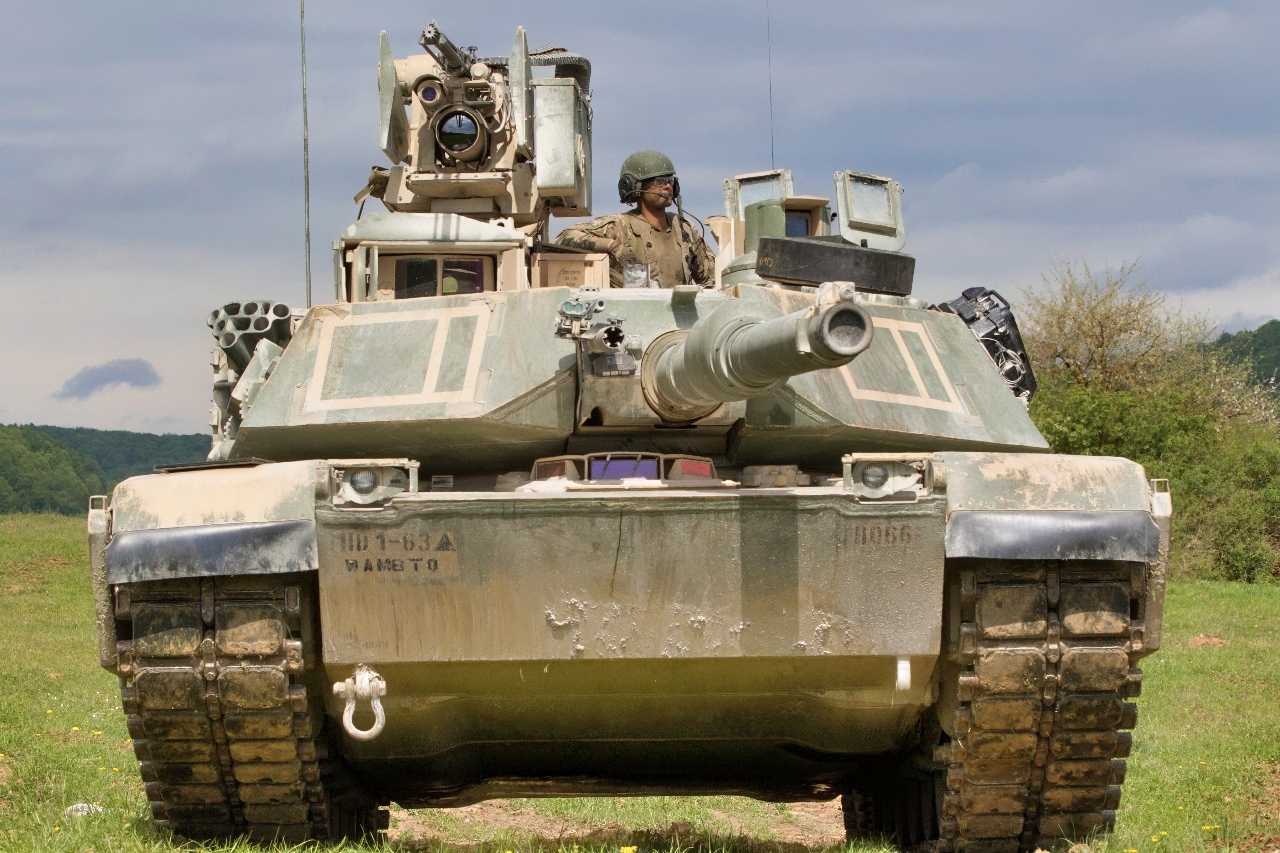
An M1A2 Abrams tank from 1st Battalion, 63rd Armor Regiment, “Dragons,” 1st Infantry Division, Fort Riley, Kansas, pulls during Combined Resolve X at the Hohenfels Training Area, Germany, May 1, 2018. Exercise Combined Resolve X is a U.S. Army Europe exercise series held twice a year in southeastern Germany. The goal of Combined Resolve is to prepare forces in Europe to work together to promote stability and security in the region. (U.S. Army photo by Spc. Andrew McNeil / 22nd Mobile Public Affairs)

A U.S. Army tank crew assigned to 2nd Battalion, 5th Cavalry Regiment, 1st Armored Brigade Combat Team, 1st Cavalry Division, maneuvers an M1A2 Abrams tank at a railhead in preparation to transport it to Hohenfels, Germany during a railhead operation, Corbu, Romania, October 24, 2018. The Battalion has deployed to Europe in support of Atlantic Resolve, an enduring training exercise between NATO and U.S. Forces. (U.S. Army National Guard photo by Sgt. Jamar Marcel Pugh, 382nd Public Affairs Detachment/ 1st ABCT, 1st CD/Released)
Questionable Ukrainian Personnel Move Favors Russia
Vladimir Putin was happy to know that one of the biggest thorns in his side has been sacked by Ukraine. Ukrainian Defense Minister Mykhailo Fedorov was removed from office recently after getting crossways with Commander-in-Chief Oleksandr Syrskyi. The top military leader prefers the old ways with massed artillery and infantry to forge victory. The Ukrainian media and ordinary citizens were not happy. Fedorov was the innovation guru who built a force of loitering munitions that have terrorized Russian soldiers and destroyed Putin’s energy infrastructure throughout the country.
Discarding Ukraine’s Failed Soviet-era Battlefield Tactics
Fedorov’s dismissal could undercut the tech-savvy Ukrainians at the worst time. The 35-year-old had tech chops in spades, and without his leadership, Russia could catch up in tactical and strategic innovation. He led the transformation away from Ukrainian forces that were once schooled in Soviet-style frontal attacks. Ukrainian armored columns were easily warded off by Russian fighters who had their own drones and anti-tank missiles. Federov discouraged this mass assault practice.
Federov glimpsed the future when he ordered Ukrainians to make use of loitering first-person view drones that routinely eliminated enemy soldiers and forced the invaders to bog down in trench warfare. No Russian wanted to hear the infernal buzzing of a kamikaze craft headed down to murderous paydirt.
Deep Drone Strikes
The erstwhile Ukrainian defense minister also saw that saturation strikes deep into Russia could hurt civilians. The attacks on oil refineries throughout Russia have made Putin and his citizens quake with anger. Fuel shortages and gas lines are a daily occurrence. Drones have even hit an e-commerce company that is considered Russia’s Amazon.
But Russia Has Kept Up
But Russia is making its own advances in drone warfare. The Western media outlets, think tanks, and open-source intelligence firms have made Ukrainian drone tactics public information. Russia simply has to translate the screeds to their mother tongue and come up with countermeasures. NATO is also guilty of publishing reports on Ukrainian drone actions in the public domain, according to the Atlantic Council.
Chinese Are Turning the Screws
The American think tank has also claimed that Russian drone operators are visiting Beijing to get training on new unmanned tactics, techniques, and procedures with Chinese-made drones. This has improved Russian aerial operations and helped the invaders catch up to Ukraine.
Russia Has Stolen Ukraine’s Thunder
The Atlantic Council estimates that the Russians have “built a one hundred thousand-strong drone force that is modeled on Ukraine’s own Unmanned Systems Forces. When both sides are able to adapt and innovate rapidly in response to each other, the cycle eventually stabilizes. Surprise gives way to absorption, and industrial depth begins to matter more.”
Russia Can Absorb Hardship and Casualties
One fear is that the Ukrainian military may be overconfident. The press clippings seem to favor the defenders, but the invaders refuse to capitulate and lay down their arms. The Russian people are known for enduring shared hardship in times of war, so even though a long gas line is frustrating, it is not enough for the populace to convince Putin to stop the conflict.
We also know that Russia can absorb casualties like no other modern army. It is estimated that new recruits are only surviving 20 to 30 minutes when they are sent to the battlefield, yet the Kremlin still commands its generals to attack. Ukraine may have seized the initiative with its strikes against civilian targets, but there is no end in sight to the war.
Ukrainian Technology Must Come Out on Top
Military analyst Miro Sedlák believes that Ukraine must continue to innovate or die trying. “In order to stay ahead of Russia in the race to innovate, Ukraine should focus on maintaining adaptation discipline and operational unpredictability. Adaptation discipline means sustaining a cycle of testing, fielding, and replacing defense tech innovations faster than Russia can replicate. Operational unpredictability means refusing to let successful methods harden into visible routines that make it easier for Russia to anticipate Ukraine’s most likely next steps,” he wrote.
Can Ukraine accomplish this without former Defense Minister Federov? This is a question that Volodymyr Zelensky and his generals must address. Russia has a high number of people working in the fields of science, technology, engineering, and mathematics (STEM). The country’s brainpower is immense, and these STEM workers can bring their own new battlefield innovations to the forefront too.
Ukraine must continue to turn battlefield lessons into homegrown military innovations on the fly or risk losing the edge to Russia. Zelensky should also remind the traditional media, bloggers, and social media users who trumpet Ukrainian victories that they are giving operational intelligence back to Russia and allowing it to adapt and overcome. Plus, Ukraine and its allies must also account for Chinese assistance offered to Russia as a new fact of life. Conducting these countermeasures can make Ukraine into a military technology powerhouse, but Russia is still right behind the defenders in innovative technologies and advanced tactics and techniques.
About the Author: Dr. Brent M. Eastwood
Author of now over 3,500 articles on defense issues, Brent M. Eastwood, PhD, is the author of Don’t Turn Your Back On the World: A Conservative Foreign Policy and Humans, Machines, and Data: Future Trends in Warfare, plus two other books. Brent was the founder and CEO of a tech firm that predicted world events using artificial intelligence. He served as a legislative fellow for US Senator Tim Scott and advised the senator on defense and foreign policy issues. He has taught at American University, George Washington University, and George Mason University. Brent is a former US Army Infantry officer. He can be followed on X @BMEastwood.


