


Over the past four months, tensions between the United States and the Islamic Republic of Iran have thrust the Strait of Hormuz back into the global spotlight. The conflict has not only intensified instability in the Middle East but has also revived one of the oldest strategic assumptions in international politics: the importance of the Strait of Hormuz to the U.S. Thus, central is this assumption that many Iranian officials and analysts now describe the Strait as Tehran’s most valuable strategic asset and its primary instrument of deterrence against the U.S. This raises an important question: does the Strait’s geopolitical importance to the U.S. necessarily make it an effective deterrent for Iran? More fundamentally, does the ability to impose costs automatically translate into the ability to deter a great power from pursuing its strategic objectives?
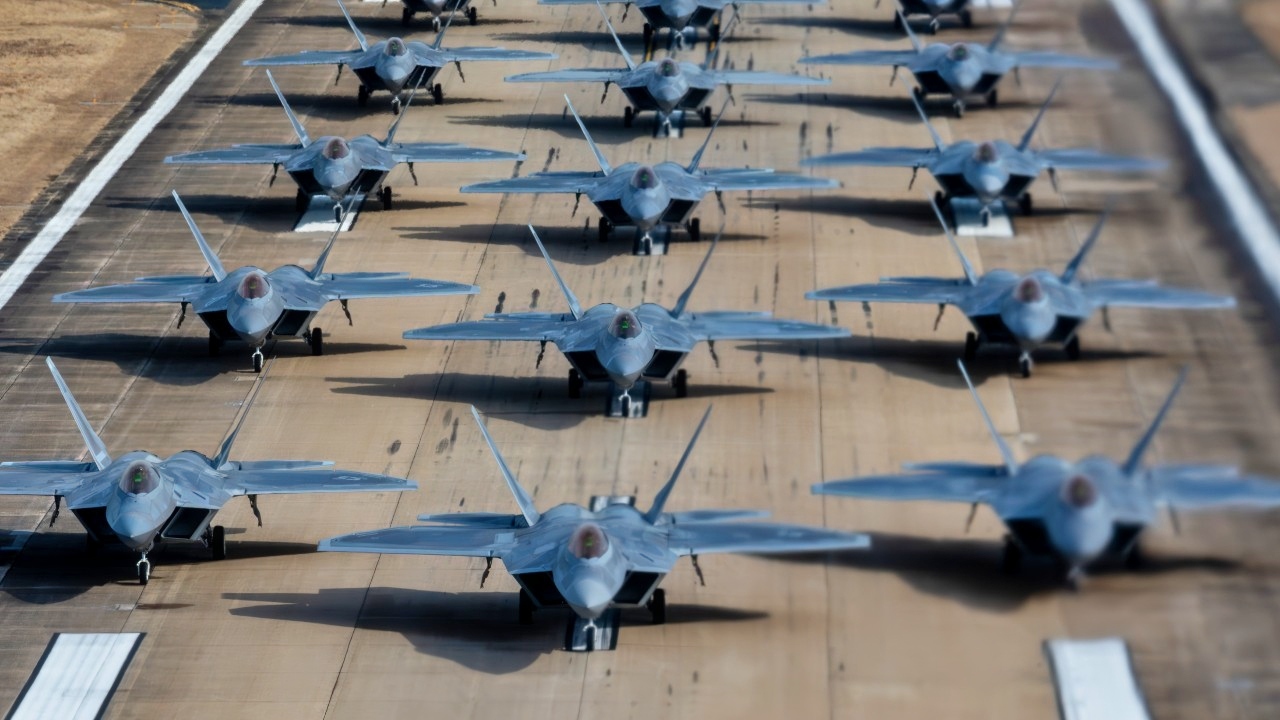
Aircraft from the 1st Fighter Wing conducted an Elephant Walk at Langley Air Force Base, Jan. 31, 2025, showcasing the wing’s readiness and operational agility. This demonstration highlighted the wing’s capability to mobilize forces rapidly in high-stress scenarios. The wing’s fleet includes F-22 Raptors and T-38 Talons. As Air Combat Command’s lead wing, the 1 FW maintains unparalleled combat readiness to ensure national defense at a moment’s notice. (U.S. Air Force photo by SrA Ian Sullens)

A B-2 Spirit bomber, deployed from Whiteman Air Force Base, Missouri, is staged on the flightline at Joint Base Pearl Harbor-Hickam, Hawaii, Jan. 25, 2019. Three B-2 Spirit stealth bombers and more than 200 Airmen deployed here in support of U.S. Strategic Command’s Bomber Task Force (BTF) mission. During the BTF mission 37 sorties were flown for a total of 171 hours, with eight of the missions including F-22 Raptor integration. (U.S. Air Force photo by Senior Airman Thomas Barley)
Much of today’s commentary examines the Strait of Hormuz through Tehran’s lens, accepting the prevailing narrative that it represents Iran’s principal deterrent against the U.S. To assess this claim, however, it is necessary to ask whether America’s dependence on the Strait remains what it was in the 1970s and early 2000s. During those decades, the U.S relied far more heavily on the Persian Gulf energy supplies. According to the Energy Information Administration (EIA), the U.S imported roughly 6.6 million barrels of oil per day in 1977, more than two million barrels of which came through the Strait of Hormuz. By 2000, total U.S. oil imports had risen to more than nine million barrels per day, with over 2.6 million barrels transiting the Strait. By 2025, however, U.S. imports through Hormuz had fallen to less than 500,000 barrels per day.
This sharp decline in direct dependence does not mean the Strait has lost its importance for the U.S. The stability of the global oil market still depends heavily on the uninterrupted flow of energy through Hormuz, one of the world’s most critical maritime chokepoints. According to the EIA, roughly 20 million barrels of oil, about one-fifth of global oil consumption, pass through the Strait each day.
Moreover, the Persian Gulf crude is generally heavier and more sour than U.S. shale oil, while also being cheaper to produce. Many refineries around the world are configured to process medium and heavy crude, making substitution with lighter grades economically costly and, in some cases, operationally less efficient.
Any prolonged disruption in the Strait would therefore unsettle global energy markets and indirectly affect the U.S. economy. In other words, the Strait’s importance to Washington today is less about securing America’s own energy supplies than about preserving global economic stability and maintaining a strategic maritime order. In this respect, Hormuz serves much the same geopolitical function for the U.S today as it once did for the British Empire in the nineteenth and twentieth centuries, and for Portugal in the sixteenth century.
If Tehran’s deterrence logic is taken seriously, an important contradiction emerges. Closing the Strait would harm not only the United States but also China, India, and much of East Asia. In fact, some of the countries with the closest economic ties to Iran are also among the most dependent on Persian Gulf energy. Approximately 84 percent of the oil passing through the Strait of Hormuz is destined for Asian markets, particularly China and India. Nearly 45 percent of India’s oil imports and between 45 and 50 percent of China’s imported oil transit the Strait. Given that China is Iran’s largest oil customer, one must ask: if Hormuz is truly a deterrent, whom is it meant to deter, friends or adversaries?
Moreover, closing the Strait would impose substantial costs on Iran itself. It would effectively cut off the country’s own oil exports, while a U.S. naval blockade in response would only deepen the economic damage for Iran. In that sense, closing Hormuz risks becoming an act of “self-deterrence” rather than “strategic deterrence.” At the same time, the continued perception of the Strait as a major security threat reinforces the rationale for the U.S. military presence in the Persian Gulf. It helps justify American military bases, the deployment of the Fifth Fleet, arms sales to Arab states, stronger regional security dependence on Washington, multinational maritime coalitions, and the U.S’ role as the guarantor of freedom of navigation.
For this reason, if Tehran overestimates the Strait’s deterrent value, Washington has little incentive to correct that perception. On the contrary, the narrative can work to America’s advantage. It places additional energy pressure on China, allows the U.S to portray itself as the defender of global maritime commerce, and helps rally international support against Iran, while sharing the political and strategic costs of confrontation with its allies.
There is, however, another way to look at the issue. The primary audience of the Strait of Hormuz crisis may not be the United States at all, but rather China, India, the European Union, global energy markets, and even Washington’s allies in East Asia. From this perspective, the Strait may matter to Tehran less as a tool of deterrence than as a strategy of survival. The underlying logic is straightforward: if Iran comes under attack and its survival is at stake, it can threaten to destabilize the global economy. In doing so, Tehran may hope that America’s Asian allies, Arab partners, Western governments, and global markets would pressure Washington to avoid further military escalation.
This logic has been reflected in statements by senior Iranian officials. Ebrahim Zolfaghari, spokesperson for the Khatam al-Anbiya Central Headquarters, warned that if attacks on Iran continued and its power infrastructure were targeted, the Strait of Hormuz would be completely closed. Likewise, Alaeddin Boroujerdi, a member of Iran’s parliamentary National Security Committee, described the Strait as an important instrument for deterring Israeli attacks on Lebanon, stating that “closing Hormuz would be the first serious step in response to Israel’s actions and warning that further measures would follow if those actions did not cease”.
From the perspective of U.S. strategic thinking, the Strait of Hormuz remains one of the world’s most critical energy chokepoints. At the same time, however, numerous American policy reports argue that while Iran is capable of disrupting traffic and imposing high costs in the waterway, it lacks the ability to close the Strait completely or sustain such a closure for an extended period. Any attempt to do so would also impose severe costs on Iran itself. This suggests that Washington has long anticipated such a scenario and has devoted significant military resources to preparing for it. In U.S. strategic assessments, Hormuz is viewed as a tool capable of imposing costs and creating disruption, not as a deterrent capable of forcing the United States to abandon its core strategic objectives
Iran therefore appears to conflate the “ability to impose costs” with the “ability to achieve strategic deterrence.” Deterrence is about changing an adversary’s strategic calculations, not merely raising the price of its actions. There is little doubt that closing the Strait of Hormuz could inflict substantial economic and political costs on the global economy. Yet this does not necessarily mean it would alter Washington’s strategic decision-making, particularly in the Persian Gulf. The Strait’s strategic value therefore lies less in Iran’s actual ability to close it than in the gap between perception and reality. As long as Tehran equates cost imposition with strategic deterrence, it may end up shaping its own calculations more than Washington’s. This reflects a form of psychological deterrence built around perceptions of the Strait’s potential consequences, a narrative that neither Tehran has much incentive to abandon nor Washington has much incentive to challenge.
About the Author:
Behrouz Ayaz is an Iranian political and geopolitical analyst specializing in the foreign policy of Iran, Afghanistan, South Asia, and Terrorism. This first appeared in RealClearDefense.


Hujjathullah M.H.B. Sahib
July 25, 2026 at 10:40 am
A rather good analysis of the probable rationale of both I.R.Iran and the U.S. for the “real nature” of their management of the current Hormuz crisis. While there are elements of strategic deterrence, cost imposition and even self-deterrence present, taking the quantum of hydrocarbons impacted in those, suggest that holding an exploitable lever on hydrocarbon prices and tactical pressure on not so much the U.S as on Israel are actually more salient. The effective if not also actual mutual rope-a-doping on disjointed deal-making and breaking appear to suggest these !