
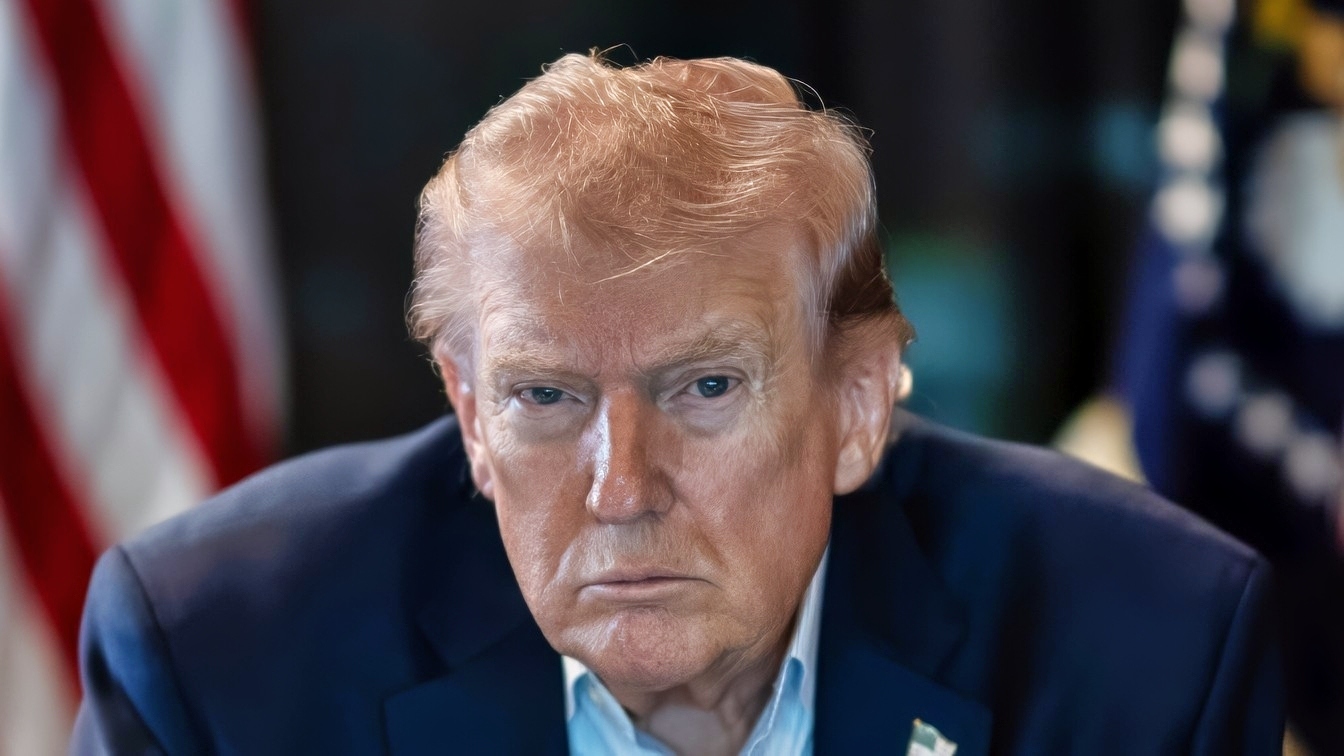
President Donald Trump has once again suggested that he is inclined to launch a new round of major military strikes against Iran if negotiations ultimately fail, even amid warnings that the ongoing American naval blockade against Iranian ports could make it impossible to end the war.
Iran appears to be preparing to test that blockade, and has warned that U.S. attacks on its tankers could risk Iranian strikes on nearby U.S.-linked sites and energy infrastructure.

A U.S. Air Force B-1B Lancer assigned to the 34th Expeditionary Bomb Squadron, Ellsworth Air Force Base, South Dakota, flies over the United States, July 2, 2025. The B-1B is a heavy bomber with up to a 75,000 pound payload. (U.S. Air National Guard photo by Airman Spencer Strubbe)
Speaking to Fox News on Sunday, November 22, the president suggested that he was prepared to resume strikes after the New Year if Tehran refuses to reach an agreement, marking what appears to be a U-turn after weeks of suggesting that he would allow economic pressure to further weaken Iran rather than returning to military operations.
The comments come as Tehran considers sending a convoy of its tankers from Kharg Island out of the Strait of Hormuz and into international waters.
Some analysts believe President Trump could be forced to lift the blockade, with analyst Trita Parsi suggesting he may ultimately need to allow the tankers to leave the strait if he wants to end the conflict without escalation.
Trump Signals New Strikes Against Iran
Speaking to Fox News correspondent Trey Yingst on Sunday, November 22, the president said that he would be inclined to resume military strikes against Iran in the new year if Tehran still refuses to make an agreement with the United States and scale back its nuclear program.
The comments are not new, but they do mark a shift in tone from the president, who in recent weeks said he was willing to maintain the naval blockade and delay further decisions about military strikes until 2027.
President Trump said that indirect negotiations are continuing for now, but also expressed frustration about the lack of progress, accusing Tehran of becoming more confrontational since the midterm elections.
Tehran, it seems, is aware that the incoming Democratic-controlled Congress could make it harder for him to resume a military campaign against Iran fully.
“They’re more aggressive now than before the election,” he said, adding that he sees the country’s leaders as “professional tap dancers.”
“They talk all the time, all they do is talk, but it’s all…,” he continued.

U.S. Air Force F-16 Fighting Falcons intercept two U.S. Air Force B-1B Lancers during exercise Amalgam Dart 21-2, March 23, 2021. The exercise will run from March 20-26 and range from the Beaufort Sea to Thule, Greenland and extend south down the Eastern Atlantic to the U.S. coast of Maine. Amalgam Dart 21-2 provides NORAD the opportunity to hone homeland defense skills as Canadian, U.S., and NATO forces operate together in the Arctic. A bi-national Canadian and American command, NORAD employs network space-based, aerial and ground based sensors, air-to-air refueling tankers, and fighter aircraft controlled by a sophisticated command and control network to deter, detect and defend against aerial threats that originate outside or within North American airspace. NATO E-3 Early Warning Aircraft, Royal Canadian Air Force CF-18 fighter aircraft, CP-140 long-range patrol aircraft, CC-130 search and rescue and tactical aircraft, and a CC-150T air refueler; as well as U.S. Air Force F-16 fighter aircraft, KC-10 Extender refueler, KC-46 Pegasus, KC-135 Stratotanker, as well as C-130 and C-17 transport aircraft will participate in the exercise. (U.S. Air National Guard courtesy photo)
But only recently, Trump was expressing skepticism about any need to return to military strikes, telling Axios on November 19 that he was “not rushing to make any decision on Iran” amid reports that Israel continues to push Washington to authorize a new round of attacks.
He also said in recent days that he would explore the possibility of renewed strikes against Iran sometime in the new year.
Analysts Say Blockade Could Prevent Peace
Meanwhile, some analysts are speculating that the U.S. naval blockade of Iranian ports, which prevents Iran from selling its oil on the international market, could prevent a peace deal in the near term.
Speaking to Al Jazeera on November 22, Trita Parsi, executive vice president of the Quincy Institute for Responsible Statecraft, said Trump might ultimately prefer to declare victory and withdraw rather than negotiate another agreement with Iran that could be seen as a loss for the United States.
Parsi also warned that Iran will continue to respond militarily, striking regional targets, if the blockade remains in place.
“If he continues the blockade, there will be escalation,” Parsi said.
Speaking to The Atlantic, Parsi also said there could be a “Swiss cheese” scenario in which the United States gradually and secretly lifts the blockade and sanctions while formally keeping them in place.
That could theoretically free up American ships and naval assets for deployment elsewhere and gradually allow more tankers to leave the Strait of Hormuz, easing the global energy supply crisis.
Meanwhile, the Gulf nations could start negotiating their own agreements with Tehran to prevent attacks on their own infrastructure.
Iranian Attacks Keep Escalating
Iran continues its strike campaign against commercial shipping in the Strait of Hormuz and is threatening to escalate attacks on regional targets, too.
On Saturday, reports confirmed that two tankers had been struck by unidentified projectiles near Khasab, Oman, at the entrance to the Strait of Hormuz.
Bahrain also reported an attack on a civilian industrial site that left two people injured.
The IRGC also claimed to have targeted U.S. military installations and Patriot radar systems located in Bahrain, but the claims are unverified.
Neighboring Gulf states, including Saudi Arabia, Kuwait, and Qatar, condemned the attacks on Bahrain and continue to state their concern about potential Iranian attacks on infrastructure inside their own borders.
Trump now faces a major challenge: does he maintain the blockade that will economically cripple Iran but also incentivize the regime to authorize new strikes, and thereby risk “peace,” or does he strike now in the hope that it could finally force the regime to concede?
About the Author: Jack Buckby
Jack Buckby is a British researcher and analyst specializing in defense and national security, based in New York. His work focuses on military capability, procurement, and strategic competition, and he produces and edits analysis for policy and defense audiences. He brings extensive editorial experience, with a career output spanning over 1,000 articles at National Security Journal, and has previously authored books and papers on extremism and deradicalization.


