

A Sunday, 9 August report on the American Fox News network details what it calls the opening of “a dangerous new front emerging in the Russia-Ukraine war.” Different defense industry analysts are reporting that attacks by assassins and alleged intelligence operatives are increasingly targeting the executives and engineers who are “developing the cutting-edge drone technology that is reshaping the battlefield.”
These attacks include a 4 August car bombing near Yekaterinburg in the Urals region of Russia that critically injured Vladimir Tkachuk, the head of the Russian drone manufacturer Uraldronzavod.
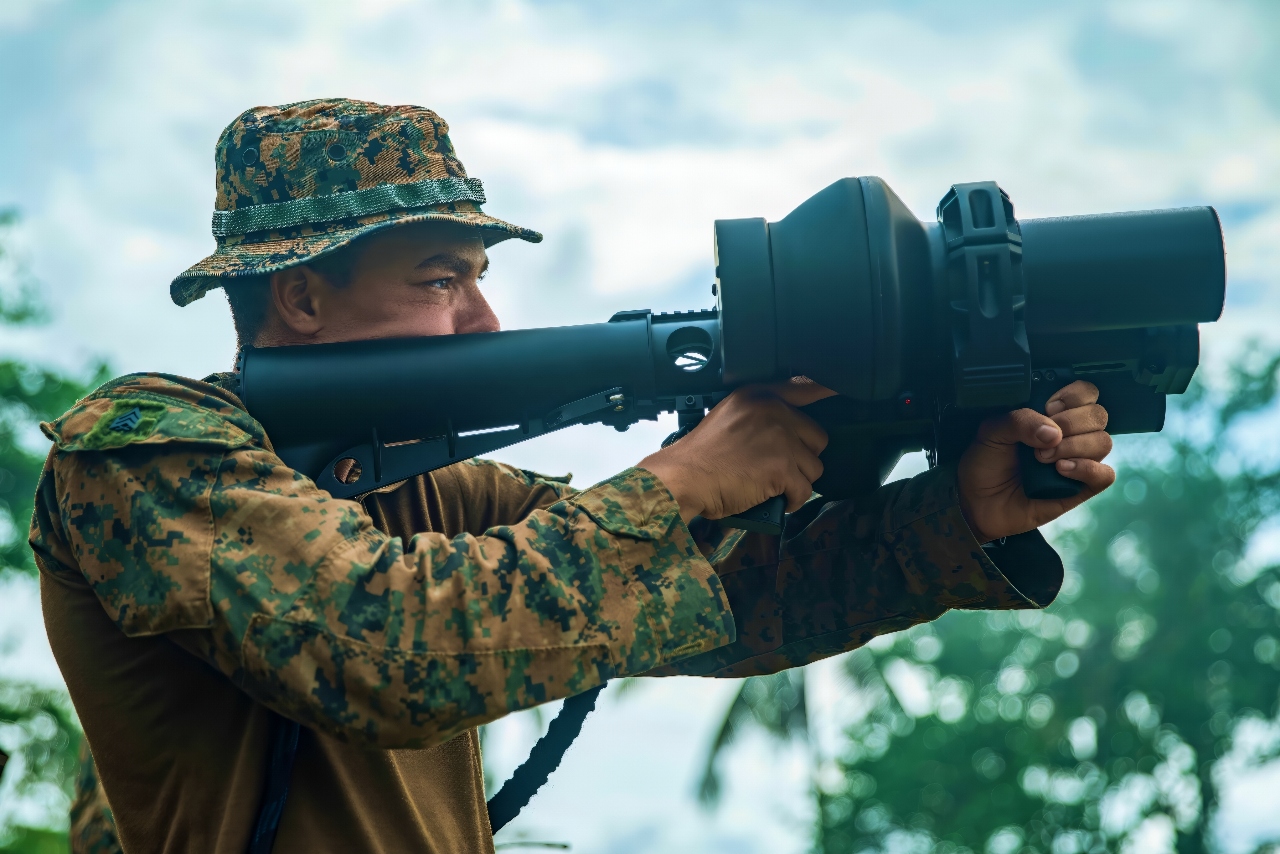
U.S. Marine Corps Sgt. Colin Clark, a mortarman assigned to Bravo Company, Battalion Landing Team 1/5, 15th Marine Expeditionary Unit, and a native of Texas, engages a target with a NightFighter S counter-unmanned aerial vehicle system during a demonstration for Philippine Marines assigned to Intelligence Company, 3rd Marine Brigade, as part of exercise KAMANDAG 8 at Tarumpitao Point, Palawan Province, Philippines, Oct. 17, 2024. KAMANDAG is an annual Philippine Marine Corps and U.S. Marine Corps-led exercise aimed at enhancing the Armed Forces of the Philippines’ defense and humanitarian capabilities by providing valuable training in combined operations with foreign militaries in the advancement of a Free and Open Indo-Pacific. This year marks the eighth iteration of this exercise and includes participants from the French Armed Forces, Royal Thai Marine Corps, and Indonesian Marine Corps; including continued participation from the Australian Defense Force, British Armed Forces, Japan Ground Self-Defense Force, and Republic of Korea Marine Corps. (U.S. Marine Corps photo by Sgt. Amelia Kang)

U.S. Army Pvt. 1st Class Ian Wojick, assigned to 552nd Military Police Company, 25th Infantry, aims a DroneBuster, an anti-drone weapon, toward the sky during the Joint Pacific Multinational Readiness Center Exportable (JPMRC-X) exercise at Fort Magsaysay, Philippines, June 1, 2025.
This iteration of the JPMRC-X marks the second Combat Training Center (CTC) rotation conducted in the Philippines. As part of the Army’s premier regional CTC, JPMRC-X enables the U.S. Army, joint force, allies, and partners to develop skills in realistic environments and conditions. Through exportable capabilities, JPMRC-X strengthens war-fighting readiness, enhances multilateral relationships, and contributes to regional security and stability in the Indo-Pacific. (U.S. Army photo by Staff Sgt. Keith Thornburgh)
While the bomb failed to kill the defense industry executive, his driver did not survive, according to Russian state news agency TASS, which was then reported by The Associated Press. This Russian firm produces the “Upyr,” Russian for “Ghoul,” which is a first-person-view (FPV) attack drone used by Russian forces in Ukraine.
A few days prior, on the night of 28-29 July, Andrei Cherezov, the director of another Russian drone company, was shot three times in the defense industrial city of Tula.
Law enforcement authorities have classified the incident as an assassination attempt, as reported by the Ukrainian news outlet Ukrainskaya Pravda.
Russian Authorities have not publicly leveled any accusations or made any suggestion of Ukraine’s involvement in either incident.
This is despite a series of high-profile assassinations that have taken place in Russia since the war began that Moscow has stated can be linked to Kyiv’s extensive special operations and security services.
A CEO Can Be The Single Point of Failure
In an interview with Fox News Digital, the head of the US drone maker Draganfly, Cameron Chell, told the broadcaster that this increase in assassination attempts is taking place in parallel as Russia and Ukraine are competing for superiority over one another in their drone warfare campaigns.
Given that there are a limited number of persons responsible for developing any new innovations in this industry, this makes the chief executive or the lead engineering technologist the proverbial “single point of failure.”
“When you can’t take out all the distributed infrastructure, drone manufacturing leadership becomes the primary target,” Chell said. “These strikes in Russia and Ukraine and Germany on founders, leaders, engineers of defense and, in particular, drone-type companies are down to drones and these companies having such an impact themselves.”
“Because drone technology evolves rapidly — often with significant iterations occurring every 10 to 30 days — targeting a key engineer, founder, or product lead creates immediate operational disruptions on the battlefield,” he continued
“Taking out a particular engineer or taking out a particular leader can set a very important weapons program back quite some time and disrupt shipments to the front line,” Chell added.
“Targeting small drone companies is a relatively easy operation compared to targeting individuals in state-run weapons programs,” said Chell. “It is a fairly inexpensive, low-risk tactic for intelligence agencies that yields an immediate impact on the battlefield, and that’s why we’ve seen this tactic. It is a very interesting turn of tactic that’s being played by both sides here.”
Espionage and Assassination Go Hand-in-Hand
Earlier this month, German authorities arrested two operatives accused of working on behalf of the Russian intelligence services.
The two were caught spying on the Bavarian drone manufacturer Donaustahl in support of one of Moscow’s intelligence-gathering operations.
Other reports this month claim that the alleged operation included preparations to target the company’s executive Stefan Thumann, according to an article from the German daily Die Zeit.
This incident has parallels to another assassination plot in 2024 that was foiled by US and German intelligence.
In that case, the target was Armin Papperger, the CEO of the German defense giant Rheinmetall.
The plan was presumably hatched to discourage further production of weapons and military vehicles that were to be delivered to Ukraine.
According to an official government statement, Berlin has supplied €5.2 billion ($5.7 billion) worth of military equipment to Ukraine since the beginning of Russia’s full-scale invasion in 2022.
Chell also explained that as Ukraine and Russia develop their own advancements in artificial intelligence and autonomous weapons systems, the engineers developing those technological innovations become strategic assets – as well as another set of targets for assassination.
“What we see in the Ukraine-Russia conflict is nobody in the loop — total autonomy is the direction things are going because it moves with more speed and precision,” Chell told Fox.
“AI and total autonomy are the big innovations for the next 18 months, so a potential reason we could see more targeted activity against [industry] leaders is that Ukrainians have that technology advantage” in these disciplines.
About the Author: Reuben F. Johnson
Reuben F. Johnson has thirty-six years of experience analyzing and reporting on foreign weapons systems, defense technologies, and international arms export policy. Johnson is the Director of Research at the Casimir Pulaski Foundation. He is also a survivor of the Russian invasion of Ukraine in February 2022. He worked for years in the American defense industry as a foreign technology analyst and later as a consultant for the U.S. Department of Defense, the Departments of the Navy and Air Force, and the governments of the United Kingdom and Australia. In 2022-2023, he won two awards in a row for his defense reporting. He holds a bachelor’s degree from DePauw University and a master’s degree from Miami University in Ohio, specializing in Soviet and Russian studies. He lives in Warsaw.


