
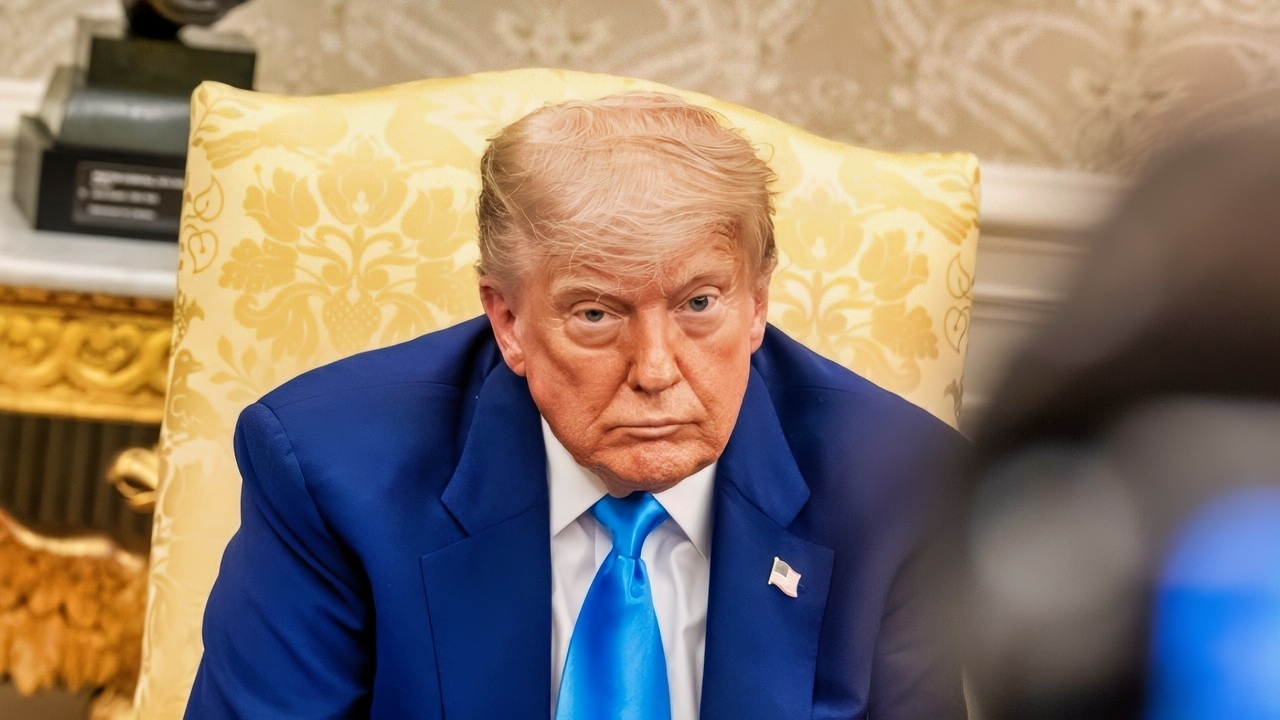
Trump Faces a Political Reckoning – U.S. President Donald Trump faces the prospect of losing control of Congress in November as his approval ratings continue to collapse and Republican candidates in usually safe seats face competitive races against Democrats. And there’s a growing number of American voters expressing their frustration over the direction of the country, putting the Republicans at risk now and for as long as the economic impacts of the war in Iran are felt.
New polling published Sunday, October 11, suggests the president’s problems are worsening, after months of surveys showing his party at risk.

President Donald Trump greets members of the Navy Midshipmen football team from the U.S. Naval Academy, Tuesday, April 15, 2025, in the State Dining Room of the White House. (Official White House Photo by Daniel Torok)

President Donald Trump takes questions after signing Executive Orders, Tuesday, February 18, 2025, at his Mar-a-Lago resort in Palm Beach, Florida. (Official White House Photo by Daniel Torok)
President Donald Trump signs Executive Orders, Tuesday, February 18, 2025, at his Mar-a-Lago resort in Palm Beach, Florida. (Official White House Photo by Daniel Torok)
A new Financial Times/Focaldata poll shows Trump’s overall approval rating has fallen to just 34%, with voters increasingly blaming the White House for the country’s worsening economic situation. The findings come as Democrats expand their campaign operations into traditionally Republican states, raising the possibility of a major political defeat for the president on November 3.
But even if Democrats win control of Congress in November, and they likely will, the question is whether that victory will meaningfully constrain the president during the final two years of his presidency.
Trump Approval Rating Falls to 34%
The new Focaldata poll showed that just 28% of respondents approve of President Trump’s handling of jobs and the economy. Only around one in five approve of his handling of inflation.
The findings also show that 45% of voters believe President Trump is hurting Republican candidates’ chances in the November elections.
The results are particularly damaging when one considers that President Trump returned to office in January 2025 promising to bring down inflation and restore American prosperity. Incredibly, his promise also included no new long-lasting wars in the Middle East. Since then, his time in office has been plagued by rising energy costs and a series of controversial foreign and domestic policy decisions that even his own supporters say violate the president’s commitments.
A different poll, this time from Reuters/Ipsos and published on October 9, found that 78% of respondents believe that the White House bears at least some responsibility for rising living costs. That included some 64% of Republicans.
The findings show that economic dissatisfaction isn’t confined to Democratic voters, and that President Donald Trump is struggling to convince even some of his own supporters that his policies are improving their lives as he said they would.
Democrats Gain In Republican States
The situation is becoming increasingly concerning for Republican campaign strategists — and not only in the toss-up states. Many Republican campaigns now have to spend money defending seats once considered safe. On Friday, October 9, the nonpartisan Cook Political Report changed its ratings for 18 House races in the Democrats’ favor.
Five contests in Iowa, Pennsylvania, and Washington shifted from toss-ups to favor the Democrats. It’s not just independents switching to Democrats; Republicans are also feeling less enthusiastic about turning out to vote.
The latest polling and projections now suggest that Democrats could win between nine and 19 additional House seats, giving them a majority in the chamber.
An ABC News report published on Sunday also revealed that the Republican Party’s problems are expanding well beyond the traditional battleground states. In Ohio, for example, former Democratic Senator Sherrod Brown is polling ahead of the Republican incumbent Jon Husted, despite the state turning out strongly for Trump in the last presidential election. The same report cited interviews with Republican voters, noting that Trump’s backers expressed frustration with his economic policies, including tariffs and rising fuel prices.
“Everyone in the community, whether it’s in church or the auction house, we’re feeling the strain of things being more expensive,” Daniel DeGarmo, a pastor from Chillicothe, rural Ohio, told the outlet.
“Some people are going to blame politics; they’re going to blame the government; they are going to blame Trump. Other people are going to blame the previous government and the previous president,” the father of eight, who voted for Donald Trump in 2016 and 2024, said.
The Real Test Comes After November
Republicans are about to be tested massively, but the real test, arguably, comes after the votes are counted.
If the Democrats win decisively, the Republican Party will need to decide whether to keep defending an increasingly unpopular president and risk problems in the 2028 presidential election, or start preparing for a post-Trump political environment.
If—or when — Republicans lose control of Congress in November, the relationship between the White House and Republican lawmakers could change dramatically, particularly for those facing difficult reelection campaigns in 2028. For President Trump, the consequences could extend well beyond an inability to pass major pledges through legislation. It could also mean broader legislative gridlock and extensive congressional investigations that make it hard for him to advance the rest of his agenda.
A major defeat for the Republicans would weaken his influence over the party and could encourage ambitious Republicans to position themselves as his successor; with just two years of his presidency left, the president could see his influence over the Republican Party wane quickly.
About the Author: Jack Buckby
Jack Buckby is a British researcher and analyst specializing in defense and national security, based in New York. His work focuses on military capability, procurement, and strategic competition, and he produces and edits analysis for policy and defense audiences. He brings extensive editorial experience, with a career output spanning over 1,000 articles at National Security Journal, and has previously authored books and papers on extremism and deradicalization.


