
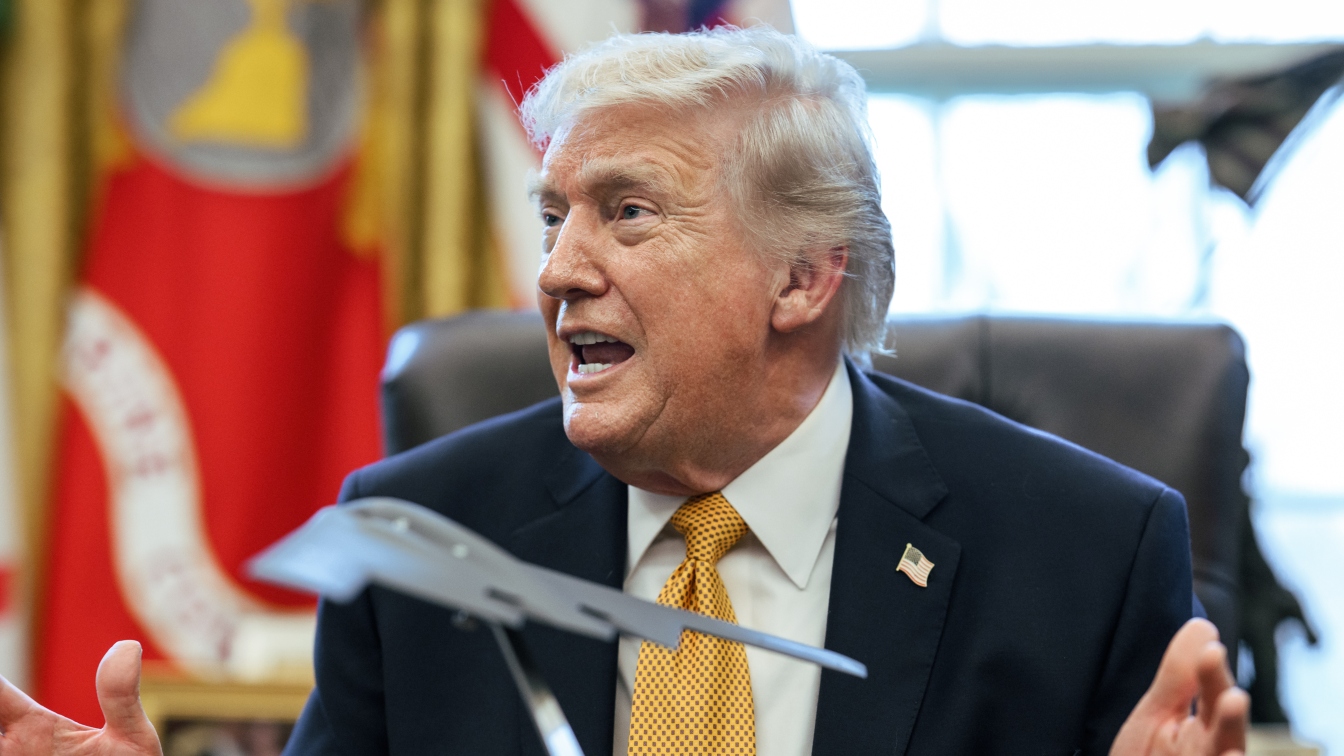
President Donald Trump appears to be stepping up his campaign appearances ahead of the November 3 midterm elections.
While it’s clearly an effort to rally his base, new reports suggest his rallies are drawing smaller crowds than in previous years, and low approval ratings and growing dissatisfaction with the state of the U.S. economy are complicating his efforts to mobilize Republican voters.

President Donald Trump attends an event celebrating Women’s History Month, Wednesday, March 26, 2025, in the East Room of the White House. (Official White House Photo by Daniel Torok)

President Donald Trump holds a Cabinet meeting, Thursday, April 10, 2025, in the Cabinet Room. (Official White House Photo by Molly Roberts)
On Monday, October 12, Reuters reported that the president is preparing additional campaign appearances in Ohio, Alaska, Arizona, and Montana in the coming weeks, as Republican candidates face competitive races even in states the president won in 2024.
The new campaign stops are being organized amid growing dissatisfaction with the president’s performance so far, and as new polling suggests Democrats are considerably more enthusiastic about voting in November than the Republicans who helped return Trump to the White House.
A new Financial Times/Focaldata poll, published on Sunday, October 11, also found President Trump’s approval rating had fallen to just 34%.
It showed voters expressing growing dissatisfaction with his handling of the economy and inflation, as well as the Iran war.
Trump Takes Campaign to Republican Strongholds
President Donald Trump’s new campaign schedule reportedly includes stops in several states where Republicans historically have the advantage.
It suggests Trump is not there to drum up support among independents and former Democrats, but among the base, who may not feel particularly enthusiastic about turning out to vote for Republican candidates.
In Ohio, the president is helping campaign for Republican Senator Jon Husted, who is facing former Democratic Senator Sherrod Brown.
The president has also thrown his support behind Senator Dan Sullivan in Alaska, where Republicans are fighting to hold on to a seat in a state Trump won two years ago.
The new schedule follows President Trump’s appearance at a rally in Syracuse, New York, where he campaigned alongside Republican gubernatorial nominee Bruce Blakeman, who is challenging Democratic Governor Kathy Hochul.
The president continues to express public confidence that Republican candidates can outperform expectations and has, on some occasions, even suggested a major electoral surprise for the country.
“I think we’re going to have a big surprise, because they don’t know what’s happening,” Trump said at a rally near Dayton, Ohio.
Trump also told voters at the Ohio rally to imagine he is running.
“When I run, we win,” he said. “Just pretend I’m running.”
He also suggested Republicans could win.
“We’re going to win big,” he said. “And we’re going to shove it up their…”
The administration seems to be focused on heavily encouraging people who voted for Trump in 2024 to participate in the election as though the president’s name is on the ballot.
Smaller Crowds?
Some reports have questioned whether President Trump can still draw crowds like he used to.
An October 6 investigation by The Daily Beast and Punchup found that attendance at some recent Trump events was below levels recorded during his first presidential campaign.
The investigation cited events where crowds were reportedly as much as 75% smaller than similar events he has held in the past.
And other outlets are noticing the trend too.
On Monday, October 12, local public radio station WAER reported that as many as 3,000 protesters gathered in Clinton Square during President Trump’s appearance in Syracuse, and that the Republican rally drew around three-quarters as many people.
Those estimates were based on photographs of the event and the crowds outside.
Polls Show Troubling Trend for Trump
The polls also show a significant enthusiasm gap between Republican and Democrat voters.
A Reuters/Ipsos poll published on October 8 found that only 30% of people who voted for Trump in 2024 were very enthusiastic about turning out to vote in the midterms, compared with about 48% of former Vice President Kamala Harris’s voters.
A Pew Research Center survey published on October 8 also found that 44% of registered voters saw their midterm vote as against President Trump, compared with 19% who saw it as a vote for him.
That same survey also put Trump’s approval rating at 30%, while 84% of registered voters said that the economy was a very important issue in the election.
The latest Financial Times/Focaldata poll also showed Democrats with an eight-point advantage over Republicans among likely voters on the generic congressional ballot.
Republican Donors Ramp Up Spending
Republican donors are helping ramp up spending to avert a crisis.
On Monday, October 12, the Associated Press reported that billionaire Elon Musk has contributed more than $276 million to Republican election efforts since July.
That funding includes $158 million for the Senate Leadership Fund and another $76 million for America PAC, which has built a voter-turnout operation.
The spending will give Republicans extra resources to reach voters who might otherwise have stayed home this year.
About the Author: Jack Buckby
Jack Buckby is a British researcher and analyst specializing in defense and national security, based in New York. His work focuses on military capability, procurement, and strategic competition, producing and editing analysis for policy and defense audiences. He brings extensive editorial experience, with a career output spanning over 1,000 articles at National Security Journal, and has previously authored books and papers on extremism and deradicalization.


