
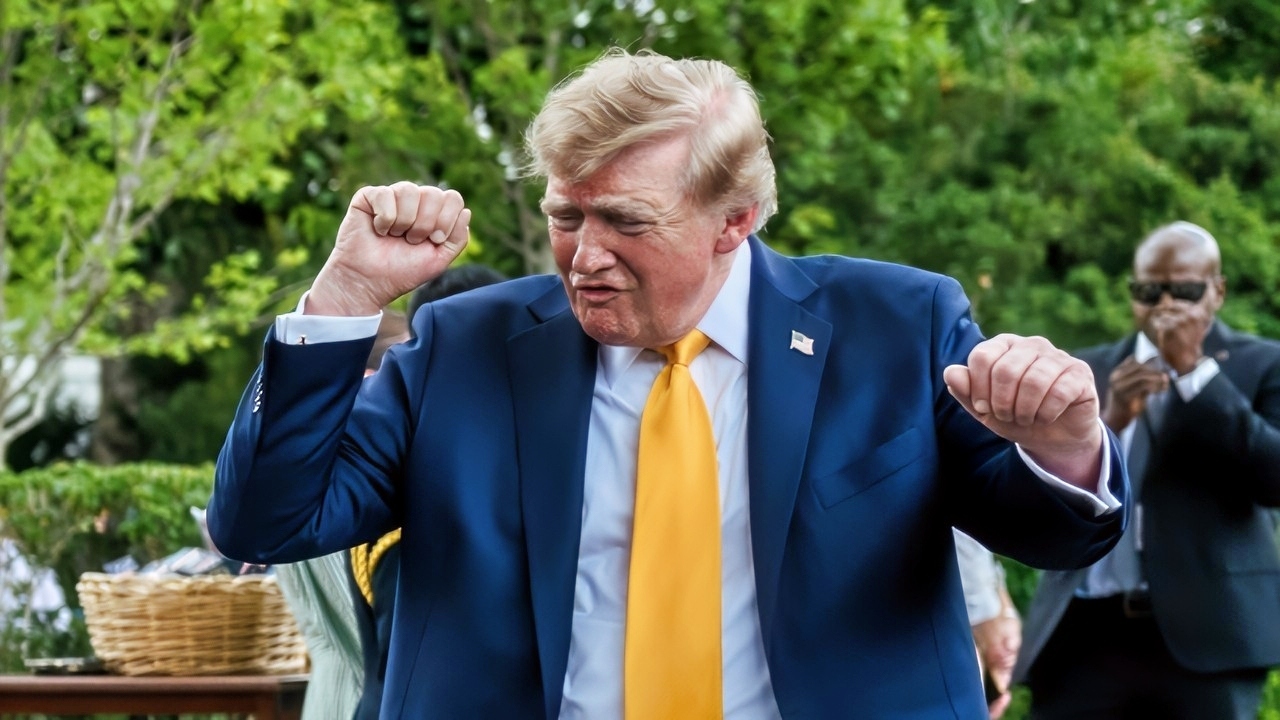
As the U.S. faces rising prices and growing frustration over the war with Iran, Republican candidates are doubling down on a campaign strategy that appears to focus on anything but the issues that polls show Americans care most about.
As the November 3 midterms approach, Republican candidates across the country are betting that cultural issues and personal criticisms will help mobilize conservative voters, as the rest of the country tells them it’s time to get prices under control and end the war with Iran.

Maj. Joshua “Cabo” Gunderson, F-22 Raptor Demo Team commander and pilot, maneuvers into a climb after a tactical-pitch at the Cold Lake Air Show July 17, 2022, at Cold Lake, Alberta, Canada. The F-22 Raptor’s two Pratt and Whitney F119 Turbofan engines bring a combined 70,000 pounds of thrust in combination with two-dimensional thrust vectoring to enable maximum maneuverability for the multi-role air-to-air stealth fighter. (U.S. Air Force photo by Tech. Sgt. Don Hudson)

Eight U.S. Air Force F-22 Raptors from Joint Base Elmendorf-Richardson, Alaska, sit on the flightline, July 9, 2018, at Yokota Air Base, Japan. Eight F-22s evacuated from Kadena Air Base, Japan due to Typhoon Maria. The F-22 are deployed under U.S. PACOM’s theater security package (TSP) program, which has been in operation since 2004. (U.S. Air Force photo by Yasuo Osakabe)
A New York Times report published on Saturday, October 31, described how President Donald Trump and other prominent Republicans are doubling down on their attacks against Democratic Senate candidates in Texas, Kansas, and Michigan, while polling suggests that Republicans are struggling to maintain their advantage in historically Republican and conservative states.
The strategy is a gamble.
It recognizes that President Trump can neither simply end the war with Iran without serious negative consequences nor bring down oil prices in the short term.
But it’s also costing a great deal of money and could alienate independent voters who may still be willing to give the Republicans a chance.
An Associated Press report described how Republican campaigns and the groups that support them have spent somewhere in the region of $183 million on television advertisements targeting Democratic candidates over transgender issues.
But will the strategy work?
Republicans Escalate Personal Attacks
The October 31 report from The New York Times identified several examples of Republicans making extremely personal accusations against Democratic candidates.
In Texas, for example, Vice President JD Vance suggested that Democratic Senate nominee James Talarico’s interest in transgender issues raised questions about his personal behavior. President Trump also called the candidate “Talafreako.”
In Kansas, Republican Senator Roger Marshall suggested that his Democratic opponent, Adam Hamilton, was involved in grooming children.
Meanwhile, in Michigan, Trump also characterized Democratic Senate candidate Abdul El-Sayed as a violent extremist.
This is not to say that those criticisms are not necessarily valid.
Still, it is interesting to see the Republican Party leaning so heavily on culture war issues when the country is largely focused on the economy and the Iran war.
President Trump arguably won the culture war issue two years ago, and every major national poll shows the vast majority of the country is more concerned about the rising cost of living than anything else.
Republicans Spend Millions On Cultural Issues
The attacks form what appears to be a fairly unified Republican strategy to rally the conservative base over cultural issues. And it is costing an enormous amount of money.
The Associated Press reported on October 28 that Republicans have spent somewhere in the realm of $183 million on 217,000 television advertisements that have focused on transgender issues through October 25.
Data from AdImpact found that spending already exceeded comparable advertising expenditure at the same stage of the 2024 presidential election.
Texas has been a hotbed for Republican culture war-related campaigning.
On October 30, the Houston Chronicle reported that advertisements supporting Republican Ken Paxton would frequently focus on his opponent’s extreme views on LGBTQ issues, appearing in 42% of pro-Paxton advertisements.
The Republicans, it seems, hope to capitalize on the radicalism of the Democratic Party rather than focus on its own achievements in government — almost certainly a sign that the party recognizes the first two years of the Trump administration have failed to deliver the promises Trump made during the campaign.
New Polls Suggest Republicans Are In Trouble
Republicans are undoubtedly aware of the fact that the polls suggest they are about to lose control of the House of Representatives, and potentially also the Senate.
An October 26 Reuters/Ipsos poll found Democrats leading Republicans by nine percentage points nationally. 53% support Democrats compared with 44% for Republicans.
An October 30 Emerson College poll also found Democrat Adam Hamilton leading Republican Senator Roger Marshall by 49% to 45% in Kansas — a state that Trump won comfortably in 2024, and that his party should, under normal circumstances, have no trouble winning again.
The RealClearPolitics average also shows Democrats maintaining a substantial advantage nationally.
Voters Care About the Economy
Republicans are beating the wrong drum — though probably because they have no basis to beat the right one. Recent polls show the GOP is no longer the party most trusted with the economy, and voters are overwhelmingly focused on their financial circumstances.
The Trump administration cannot realistically claim that it has lowered prices, as most metrics show otherwise, and Republican candidates are even distancing themselves from the president in particularly tight races.
The October 26 Reuters/Ipsos survey found that just 25% of Americans approved of President Trump’s handling of the economy, while just 20% approved of his handling of the cost of living.
With just days to go until the midterms, Republicans will soon know whether their culture-war campaigning strategy has saved them from total defeat.
About the Author: Jack Buckby
Jack Buckby is a British researcher and analyst specializing in defense and national security, based in New York. His work focuses on military capability, procurement, and strategic competition, and he produces and edits analysis for policy and defense audiences. He brings extensive editorial experience, with a career output spanning over 1,000 articles at National Security Journal, and has previously authored books and papers on extremism and deradicalization.


