


The lull in the Gulf is over. It lasted a little more than two months. Overnight Tuesday into Wednesday, Iranian drones went after Ali Al Salem Air Base in Kuwait, just hours after American fighter jets hit an IRGC missile launch site on Qeshm Island in the Strait of Hormuz.
Kuwaiti air defenses opened up in the dark, and the Kuwaiti Army’s General Staff told residents that any explosions they heard were interceptions.
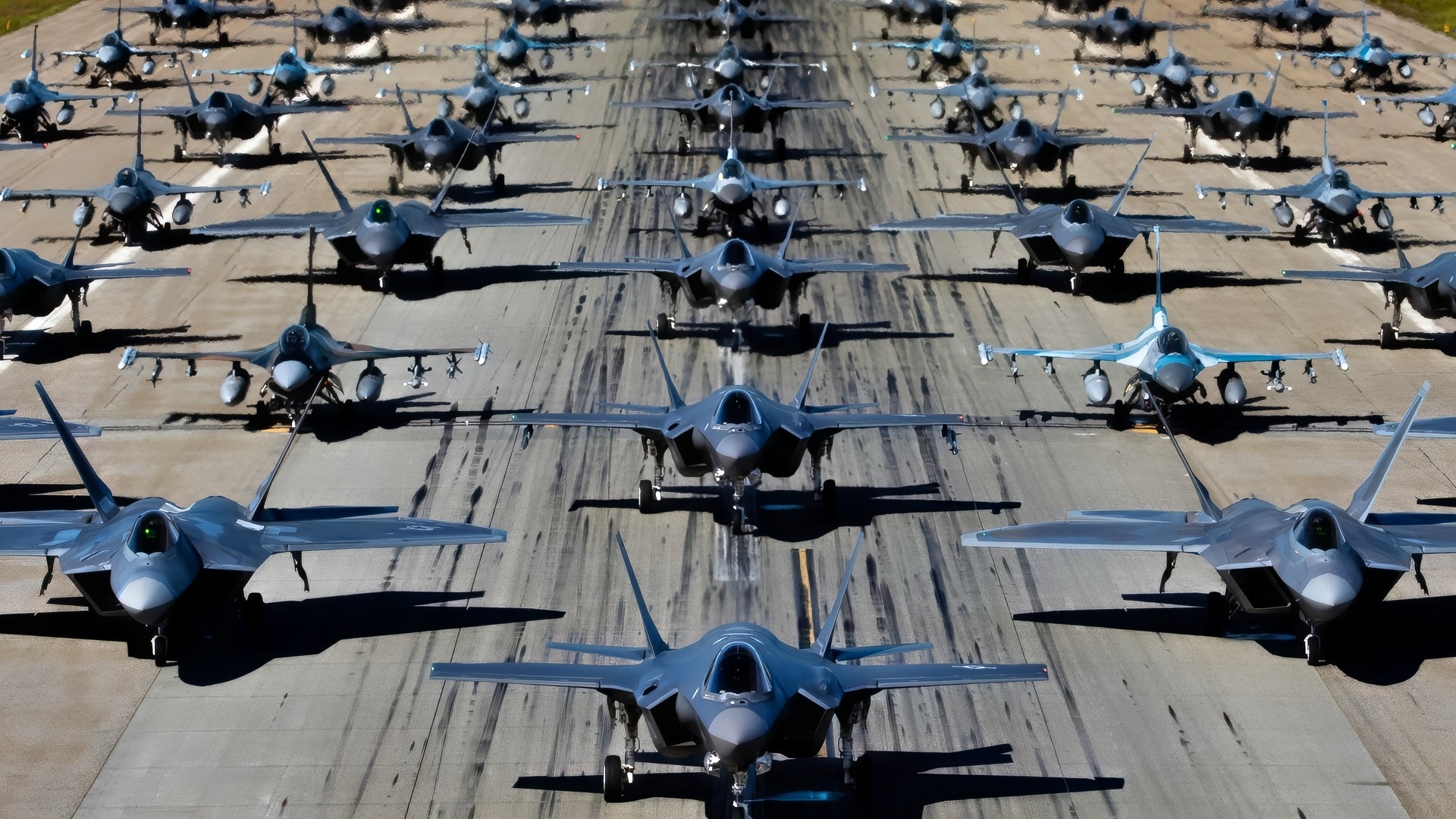
The 354th Fighter Wing conducts a 75-fighter jet formation at Eielson Air Force Base, Alaska, Aug. 12, 2022, in honor of the U.S. Air Force’s 75th Anniversary. This capabilities demonstration included F-35A Lightning II, F-16 Fighting Falcon and F-22 Raptor aircraft from across Pacific Air Forces. (U.S. Air Force photo by Senior Airman Gary Hilton)

A Polish F-16 pilot awaits instructions from his crew chief after completion of a Baltic Air Policing sortie at Šiauliai Air Base, Lithuania, Aug. 30, 2017. The Polish air force recently relinquished control of the NATO Baltic Air Policing mission to the U.S. Air Force for the forty-fifth rotation of allied protection of the sovereign skies of the Baltic region since Baltic Air Policing operations began in 2004. (U.S. Air Force photo/ Tech. Sgt. Matthew Plew)
Kuwaiti authorities said every incoming drone and missile was knocked down, with no damage or casualties reported. According to Reuters, it was Tehran’s first attack on Kuwait since September.
How We Got Here In 24 Hours
The sequence follows a familiar pattern.
On Tuesday, the IRGC launched drones at a US radar at Sheik Isa Air Base in Bahrain, claiming it was answering American drone incursions into Iranian airspace.
Bahrain reported no casualties or damage. It was the second time in three days Iran had gone after radar positions in Bahrain, after an attack on Riffa Air Base on Sunday.
American fighter-bombers attacked IRGC missile launchers on Qeshm Island using precision munitions.
“Earlier today, U.S. fighter aircraft used precision munitions to strike an Islamic Revolutionary Guard Corps (IRGC) missile launch site on Qeshm Island in self-defense.
“The strike was in response to IRGC aggression targeting U.S. personnel and assets,” a US official said in a statement.
An Iranian provincial official, Ahmad Nafisi, insisted nothing residential, commercial, or critical was damaged on the island.
In contrast, Iranian media said an air defense launcher in the Nariman area was hit.
Then came the drones. Iran’s army said in a statement carried by state television that “combat and kamikaze drones” targeted Patriot air defense systems and drone and missile launch platforms belonging to US forces at Ali Al Salem.
Bahrain’s air defenses were busy at the same time, intercepting several more Iranian attacks early Wednesday.
Strike. Counterstrike. Counter-counterstrike.
All before breakfast in Kuwait City.
The Iranian Army Took The Shot This Time
Here’s the detail most of the coverage glossed over.
The Kuwait strike was claimed by Iran’s regular army, the Artesh.
The IRGC attacked Bahrain on Tuesday.
The Artesh attacked Kuwait on Wednesday.
That split is probably deliberate.
For most of this war, the Revolutionary Guard has been the face of Iranian retaliation across the Gulf.
Putting the regular army’s name on the Kuwait strike tells Washington and the Gulf capitals that the whole Iranian military owns this fight.
That’s a messaging choice as much as a military one.
The rhetoric backs that up.
Iranian state outlet Press TV reported the army vowing a response without geographic limits after Qeshm.
Iran’s judiciary chief added that the armed forces won’t back down and claimed Iran has more military equipment now than when the war started. You can take that last part with a large grain of salt.
Why The Patriots Were The Target
Patriot batteries. Drone launch platforms. Missile launch platforms.
The Iranians weren’t trying to crater a runway. They were going after the umbrella.
The army’s statement, as relayed by Tasnim, described Ali Al Salem as one of the major US bases in the region and a key hub for moving military equipment and personnel by air into the theater.
That’s an accurate description, and it’s exactly why it keeps getting hit. Kuwait hosts US forces at several installations, including Camp Arifjan and Ali Al Salem, and Ali Al Salem has been in Tehran’s crosshairs repeatedly since the spring.
A one-way attack drone is cheap. A Patriot interceptor is anything but, and the inventory isn’t bottomless. Every interceptor fired at a drone is one that isn’t sitting on the rail when a ballistic missile comes over the horizon.
Iran doesn’t need a single drone to get through to win that exchange. It just needs us to keep shooting.
However, the Kuwaitis say nothing got through, and so far no one has produced evidence to the contrary.
If that holds, Tehran’s claim of hits on Patriot systems is aimed at the home audience.
Iran’s army also claimed it shot down a US LUCAS drone over the Strait. The US hadn’t commented as of Wednesday.
Kuwait Is Tired Of Being The Bullseye
Kuwait has been here before. Back in June, after an earlier round of US strikes on Qeshm, Iranian drones hit Kuwait International Airport, and Fox News reported the Kuwaiti Foreign Ministry condemning attacks that killed one person and damaged diplomatic missions.
This time, the Foreign Ministry called the drone attacks violations of Kuwaiti sovereignty, international law, the UN Charter, and UN Security Council Resolution 2817.
It invoked Article 51 to affirm its right to self-defense.
The GCC secretary-general condemned the strike and pledged member states’ support. The UAE called it a flagrant breach of Kuwait’s sovereignty.
The markets noticed, too. Most Gulf stocks closed lower Wednesday on fears the exchange would keep climbing.
Meanwhile, In The Strait
Kuwait wasn’t the only flashpoint overnight. ADNOC Logistics & Services said one of its vessels was attacked Tuesday evening while transiting the Strait of Hormuz, with one crew member missing and 11 injured. Search and rescue was still underway Wednesday.
Further south, Saudi air defenses intercepted Houthi missiles fired toward Riyadh. That is attacks on Kuwait, Bahrain, a tanker in the Strait, and the Saudi capital, all inside roughly 24 hours.
The Back-and-Forth Trade-Off
The US has been running smaller strikes around Qeshm for weeks.
Earlier this month, the Wall Street Journal reported a strike on the island, and the IRGC claimed it had downed three US drones, including an MQ-9 Reaper.
Each round is limited. Each round is labeled defensive. And each round hands the other side a reason for the next one.
That’s the trade-off of this approach. Keeping the strikes small keeps the war from boiling over, and that’s worth something.
However, the bill for every US strike on Iranian soil gets paid by the Gulf states that host our troops. Kuwait and Bahrain catch the return fire. They didn’t pick the targets on Qeshm, but they’re the ones with drones over their cities at 2 a.m.
Two things should probably happen now.
First, a serious push of cheaper counter-drone systems forward to bases like Ali Al Salem, so Patriots are saved for the threats they were built to kill.
Second, a clear answer on what the end state of these “self-defense” strikes is supposed to be. Tactical responses without a strategic objective just become a rhythm, and the Iranians have learned to dance to it.
CENTCOM’s commander is due in Israel for talks with the IDF. Watch what comes out of those meetings. They’ll tell us whether the next round is another tit-for-tat or something bigger. The lull lasted a little more than two months. Nobody in Kuwait City is betting the next one will last that long.
About the Author: Steve Balestrieri
Steve Balestrieri is a National Security Columnist. He served as a US Army Special Forces NCO and Warrant Officer. In addition to writing on defense, he covers the NFL for PatsFans.com and is a member of the Pro Football Writers of America (PFWA). His work was regularly featured in many military publications


