
Few would expect the Iran War to end quickly now, as it has continued far longer than the handful of weeks or months President Trump originally anticipated.
Speaking to reporters on Thursday, November 19, the president said that he is in no hurry to decide whether to launch a fresh round of major airstrikes against Tehran, and that he would discuss the possibility of further strikes after the new year.

A U.S. Air Force F-15EX Eagle II, assigned to 85th Test and Evaluation Squadron, Eglin Air Force Base, Florida, lands at Kadena Air Base, Japan, July 16, 2025. The F-15EX plays a critical role in modern warfare, providing substantial additional capacity for long-range fires, sensors, and electronic warfare in contested areas, complementing 5th generation fighters. (U.S. Air Force photo by Airman Nathaniel Jackson)
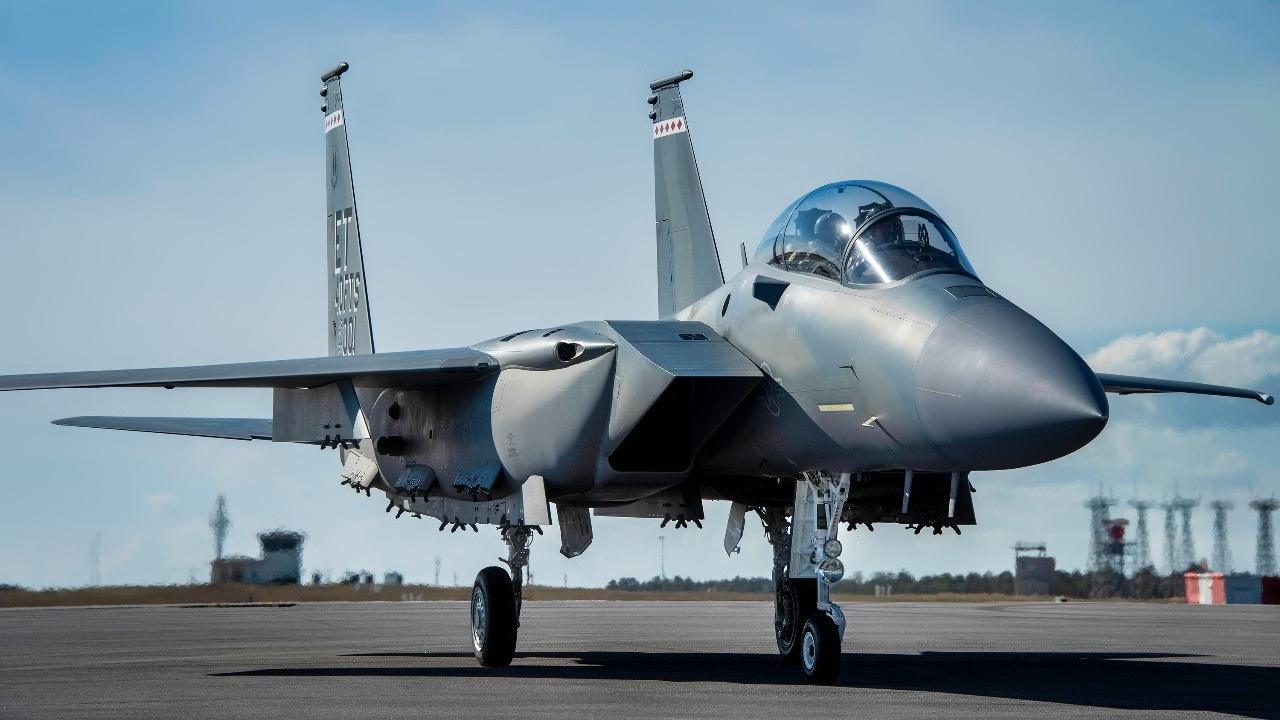
The F-15EX, the Air Force’s newest fighter aircraft, arrives to Eglin Air Force Base, Florida March 11. The aircraft will be the first Air Force aircraft to be tested and fielded from beginning to end through combined developmental and operational tests. The 40th Flight Test Squadron and the 85th Test and Evaluation Squadron personnel are responsible for testing the aircraft. (U.S. Air Force photo/Ilka Cole)
The comments, made to reporters aboard Air Force One, come as Israeli Prime Minister Benjamin Netanyahu continues to push Washington to return to the large-scale strike campaign and join Israeli forces in targeting military targets and energy infrastructure.
The comments suggest the war, which began on February 28 and was expected to end in the spring, could continue into its eleventh month, even after the new Democratic-controlled Congress convenes in January.
Trump Pushes Iran Decision to 2027
After analysts predicted President Trump would launch new strikes against Iran immediately after the November 3 midterm elections, Trump is now indicating that he will not rush to make a decision and will continue with his strategy of economic pressure.
The president also repeated the same claims during multiple interviews this week.
Speaking to Axios, Trump said that he was not rushing to make a decision.
“I’m not rushing into any decision,” Trump said. “We will see what happens after the beginning of the year.”
Trump made the comments aboard Air Force One on his return trip to the United States from China.
In a Fox News interview that aired Thursday, the president said the United States would see what happens after January 1.
“We’re going to have a new year coming up, and we’ll see what happens after January 1. But they’ve been nasty,” the president said.
Meanwhile, the administration continues to enforce the naval blockade against Iran.
It is still expanding its economic sanctions campaign, preventing Iran from trading with global partners, limiting land-based imports and exports from Iran, and sanctioning companies and entities that continue to facilitate financial transactions that benefit Tehran.
Israel Pushes for Major Strikes
Meanwhile, Israel continues to push the president to return to major strikes. Reports suggested this week that the White House has requested assessments from the Pentagon and intelligence specialists on how Iran might respond to another round of U.S. attacks.
Tehran has previously indicated that it will attempt to strike American military infrastructure in the region, and that its missile strikes could extend as far as Europe.
Israeli officials have also reportedly presented Washington with evidence that Tehran is working to expand its chemical weapons research.
Last week, Mossad Director Roman Gofman visited the United States to meet with CIA Director John Ratcliffe and White House envoy Steve Witkoff to discuss Israel’s concerns.
Netanyahu is reportedly looking to receive President Trump’s backing for a bombing campaign that would last several days, with the intent of preventing Iran from rebuilding its military capabilities.
According to an Axios report from November 18, the proposed American targets include Iran’s underground Pickaxe Mountain nuclear facility.
This time, though, the strikes are also expected to impact civilian infrastructure, with plans reportedly including strikes on bridges, power plants, and both civilian and military senior leaders.
However, the White House is concerned that the attacks could trigger significant Iranian retaliation against energy infrastructure across the Gulf.
And there are disagreements over Israeli intelligence, with one senior U.S. official reportedly describing Gofman’s warnings about Iranian chemical weapons as being “driven by an agenda.”
Democrats Could Complicate Trump’s Plans
Trump’s plans could soon be complicated, with Democrats preparing to take control of Congress in January. The balance of power in Washington will, therefore, change – and on Thursday, November 19, the Republican-controlled Senate rejected a resolution that would have directed the president to end all military operations against Iran unless Congress approves further action.
The measure failed by a narrow margin of 51 to 48 votes, with three Republicans — Susan Collins, Lisa Murkowski, and Rand Paul — joining Democrats in support of the resolution.
Democratic Senator John Fetterman was the only member of his party to oppose it.
Democratic legislators are now preparing to use government funding legislation to restrict financing for further operations against Iran, with several Democratic senators having already proposed legislation to prohibit spending on further strikes.
The measures could complicate planning for President Trump if he does decide to go ahead with additional strikes against Iran after January.
However, restrictions would still face a presidential veto, which will undoubtedly be used if the president determines that further action is necessary.
Nonetheless, the next round of strikes against Iran could face more hurdles for the president and his administration.
About the Author: Jack Buckby
Jack Buckby is a British researcher and analyst specializing in defense and national security, based in New York. His work focuses on military capability, procurement, and strategic competition, and he produces and edits analysis for policy and defense audiences. He brings extensive editorial experience, with a career output spanning over 1,000 articles at National Security Journal, and has previously authored books and papers on extremism and deradicalization.


