

Iran is rationing electricity and rolling back subsidies on bread and gasoline as U.S. economic pressure squeezes the country’s economy, The Washington Post reported.
President Masoud Pezeshkian warned of “difficulties this winter” in a message to the nation Sunday announcing the electricity cuts. He said blackouts would last up to two hours a day and could be extended once winter weather sets in.

The world’s largest aircraft carrier USS Gerald R. Ford (CVN 78) steams in the Adriatic Sea, June 23, 2023. Gerald R. Ford is the U.S. Navy’s newest and most advanced aircraft carrier, representing a generational leap in the U.S. Navy’s capacity to project power on a global scale. The Gerald R. Ford Carrier Strike Group is on a scheduled deployment in the U.S. Naval Forces Europe area of operations, employed by U.S. Sixth Fleet to defend U.S., allied, and partner interests. (U.S. Navy photo by Mass Communication Specialist 2nd Class Jackson Adkins)
The measures come nearly nine months into the war with the United States and less than a year after Iranian authorities carried out a deadly crackdown on protesters.
Subsidy Cuts Hit Bread and Fuel
The blackouts follow months of quieter cuts. The government has restricted access to aid programs and dropped plans to raise wages, according to the Post.
This month, authorities limited how much subsidized bread residents could buy in at least three provinces. Pezeshkian defended the tighter controls on Nov. 18, pointing to widespread abuse of cheap energy and staples.
Last month, millions of people were dropped from a state food voucher program, known as kalabarg, that the government launched in January for nearly 80 million Iranians.
Fuel prices have also climbed. In September, Iran raised gasoline prices for its heaviest users, the second increase since December, the Associated Press reported. The new pricing doubled the cost to 100,000 rials per liter for drivers using more than 110 liters a month.
Iranians interviewed by the Post said the fuel subsidy rollback has hurt their daily lives more than any other measure. A 25-year-old Tehran woman who delivers eggs from her car said it cut her profits by about a third.
A 40-year-old language teacher in Tehran called the blackouts “infuriating.” “People are too tired, but they are also kind of numb,” she said.
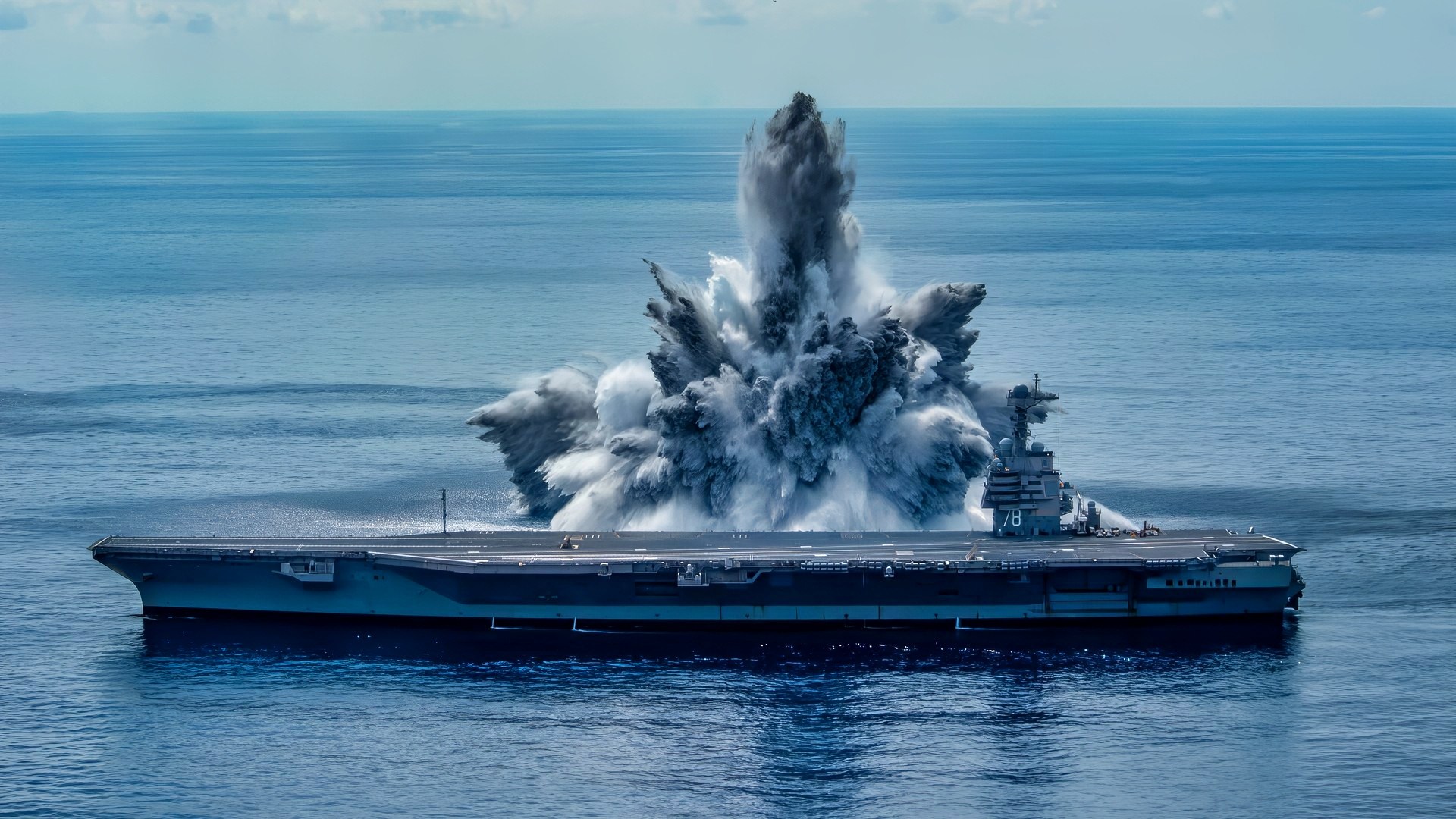
The aircraft carrier USS Gerald R. Ford (CVN 78) successfully completes the third and final scheduled explosive event of Full Ship Shock Trials while underway in the Atlantic Ocean, Aug. 8, 2021. The U.S. Navy conducts shock trials of new ship designs using live explosives to confirm that our warships can continue to meet demanding mission requirements under harsh conditions they might encounter in battle. (U.S. Navy photo by Mass Communication Specialist 3rd Class Novalee Manzella)
Blockade Drains Billions
After a provisional truce collapsed in July, the U.S. reimposed its blockade on Iranian oil exports. The measures have cost Iran between $3 billion and $4 billion a month in revenue, according to the Post.
Brandeis University research fellow Hadi Kahalzadeh, an Iranian economist, said the blockade and wartime damage to infrastructure could shrink Iran’s economy by 4% to 6% this year. He said Iran is under more economic strain than at any time in recent decades.
He said the blockade alone will not force a collapse, since Iran still collects taxes and trades overland with many of its neighbors. “Iran still has some leverage, some capacity to survive,” Kahalzadeh said, but he warned that “this survival will be very costly.”
Prices in July were 88% higher than a year earlier, with food inflation above 128%, according to Iran’s Statistical Center. The International Monetary Fund projects Iran’s inflation will reach nearly 69% in 2026, the highest since the 1979 Islamic Revolution.
The dollar broke through 2.85 million rials on Iran’s open market this week, after the Treasury Department sanctioned dozens of people and entities tied to Iran’s shadow banking networks.
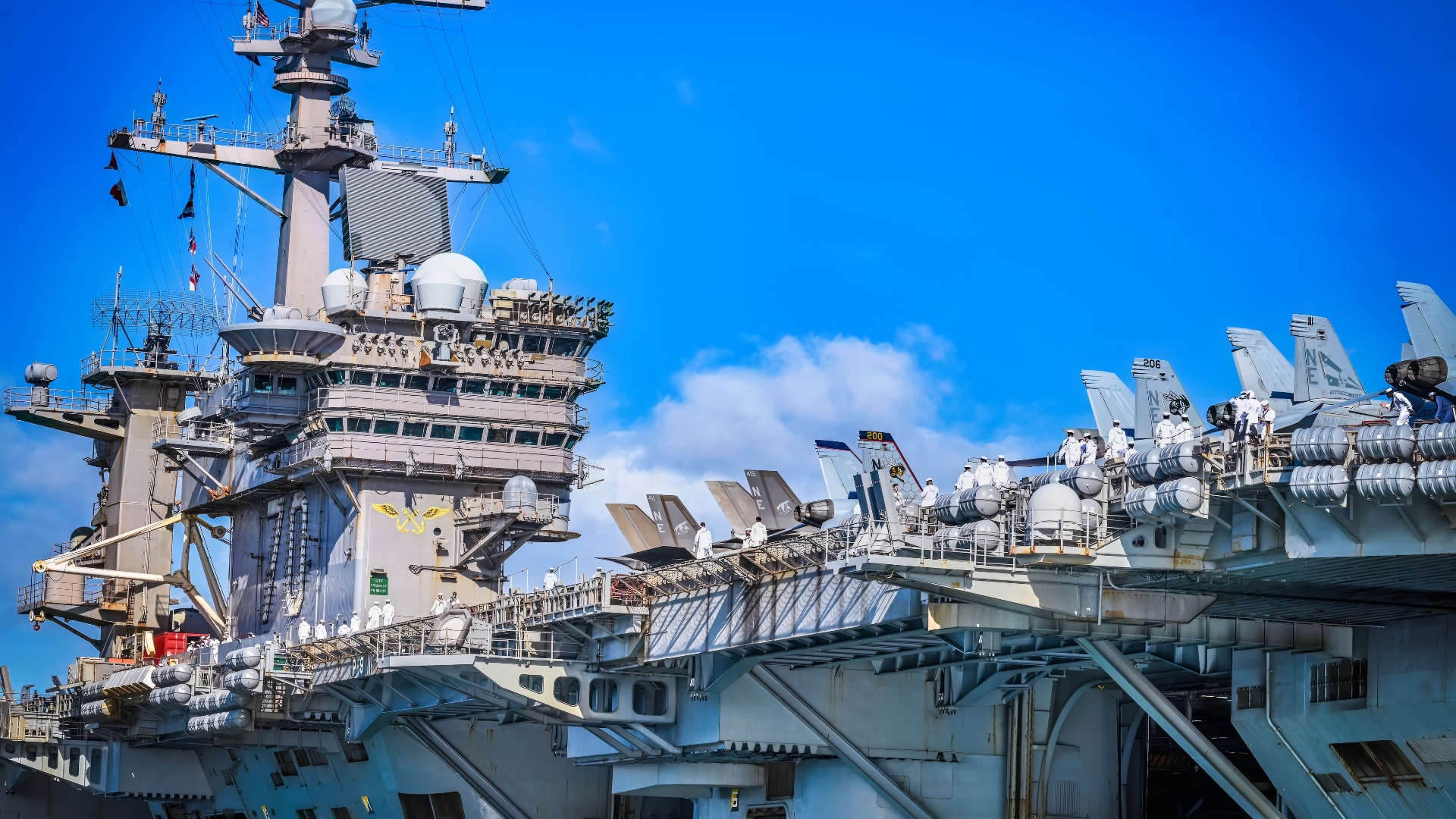
The Nimitz-class aircraft carrier USS Carl Vinson (CVN 70) arrives in Joint Base Pearl Harbor-Hickam, Hawaii, for a scheduled port visit, July 30, 2025. Vinson, the flagship of Carrier Strike Group ONE, is underway conducting routine operations in the U.S. 3rd Fleet area of operations. (U.S. Navy photo by Roann Gatdula)
Lawmakers and Activists Push Back
Criticism is also coming from inside the government. Reformist lawmaker Ahmad Bigdeli condemned the state’s failure to address wages for teachers, farmers, the military and police in a webinar this month.
“Workers cannot breathe today,” he said, according to state-affiliated Nour News.
Labor activist Somayeh Golpour accused the state of “structural injustice” in an essay on state-affiliated Mehr News after the government said it could not raise some salaries.
Shamseddin Hosseini, head of the Iranian Parliament’s economic commission, warned on state media of fuel and heating shortages this winter caused by wartime damage to energy infrastructure. Describing the expected shortages as an ‘energy imbalance,’ Hosseini warned that they should not ‘come at the cost of closing industrial units and making workers unemployed.
Fear of Unrest
Fuel subsidy cuts helped spark protests in 2019 and fueled unrest again last December. A government crackdown in January killed thousands of people, the Post reported, leaving many Iranians afraid to organize.
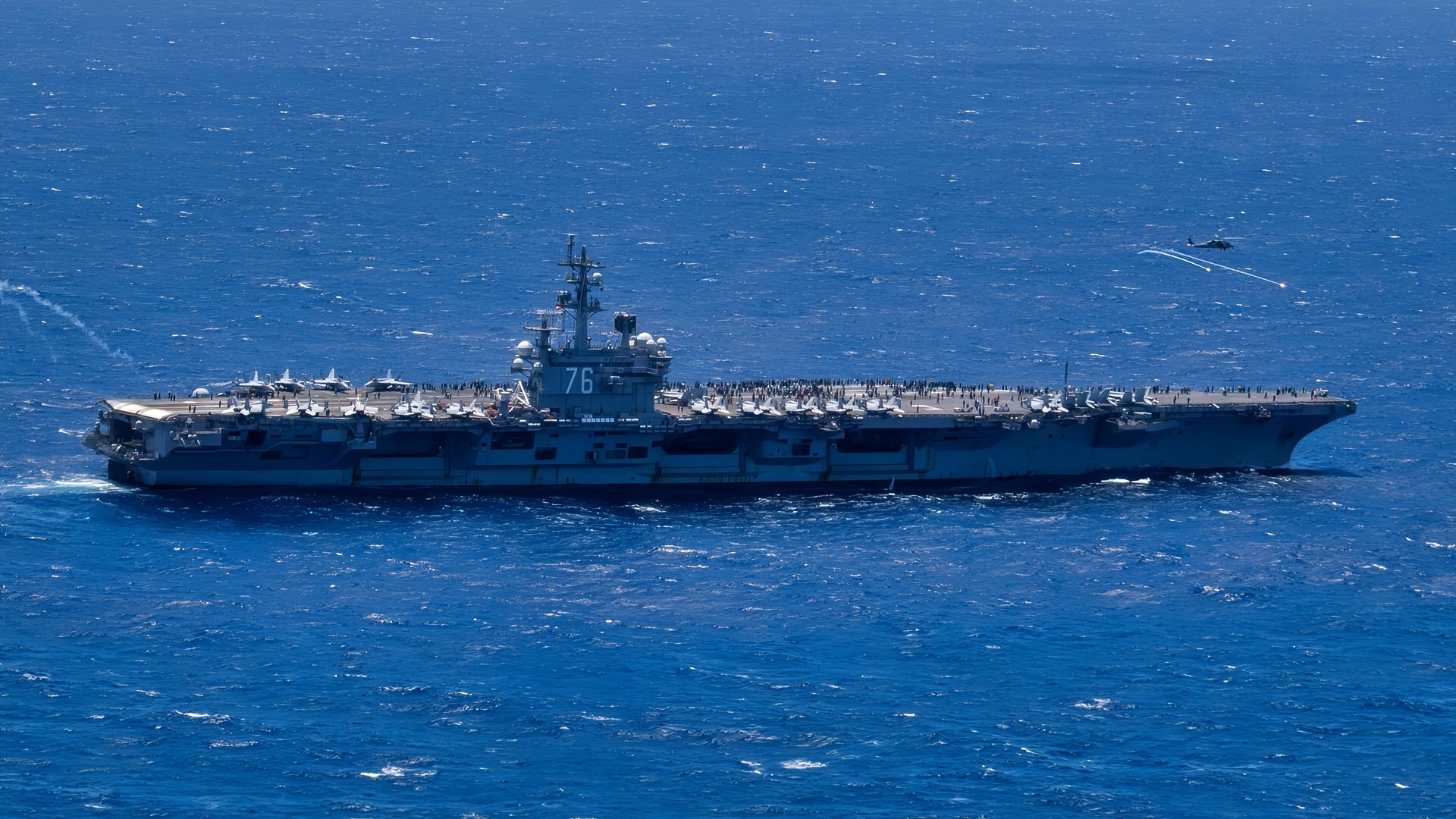
(July 3, 2024) An MH-60R Sea Hawk helicopter, attached to the Saberhawks of Helicopter Maritime Strike Squadron (HSM) 77, launches flares near the U.S. Navy’s only forward-deployed aircraft carrier, USS Ronald Reagan (CVN 76) during air combat-skills practice in the Pacific Ocean, July 3. HSM 77’s missions include surface warfare, anti-submarine warfare and a variety of support roles for Ronald Reagan and Carrier Strike Group 5. Ronald Reagan, the flagship of Carrier Strike Group 5, provides a combat-ready force that protects and defends the United States, and supports alliances, partnerships and collective maritime interests in the Indo-Pacific region. (U.S. Navy photo by Mass Communication Specialist 2nd Class Charlotte Dudenhoeffer)
A 26-year-old musician from Tehran who joined the protests said public anger is now greater than it was then. “People are scared, but the conditions are unbearable,” he told the Post.
Iran’s chief negotiator, parliament speaker Mohammad Bagher Qalibaf, said Tuesday that Tehran will not negotiate with Washington until its seven conditions are met. Iranian state media have said the conditions include lifting sanctions and ending the naval blockade.
About the Author: Lulia Lupse
Lulia Lupse is a journalist and Young Voices senior contributor whose work has appeared in The Washington Post, the New York Post, Reason, The National Interest, and Fox News Digital. She writes across politics, focusing on foreign policy, energy, and national security, and her reporting draws on original interviews with policymakers and national security experts, including former Deputy National Security Advisor Victoria Coates. She spent five years in the Fox News newsroom and served as editor-in-chief of Clear News Daily. She holds a B.S. in Diplomacy and International Relations from Seton Hall University.