

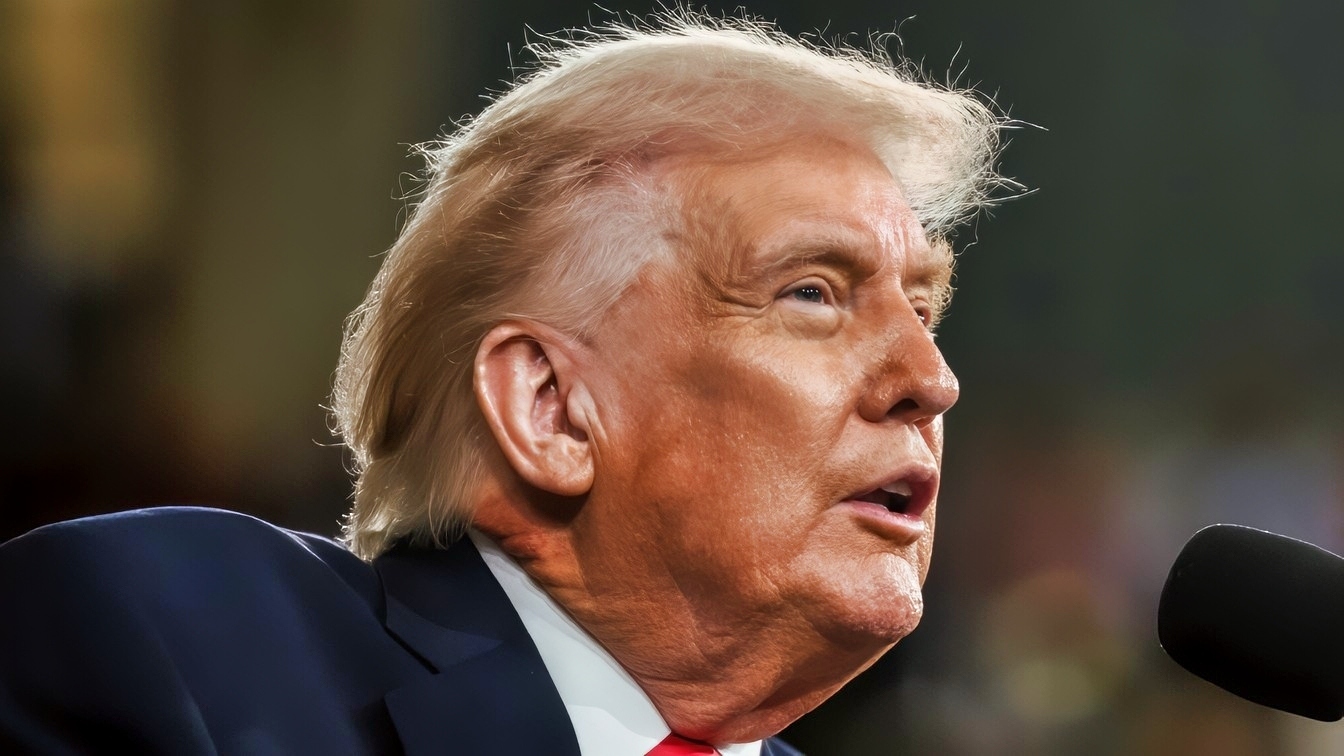
U.S. President Donald J. Trump has made recent public pronouncements that the Iran War—aka Operation Epic Fury in the United States and Operation Roaring Lion in Israel—has already been “won,” and that “Iran militarily is effectively over.” However, the war hasn’t really ended; rather, it has metamorphosed. The kinetic phase, i.e., the “shooting” war, now mostly consists of tit-for-tat, back-and-forth pinprick strikes, but now Mr. Trump has chosen to focus on non-kinetic warfare, as in economic sanctions and blockades against the theocratic totalitarian Islamic Republic of Iran regime.

A U.S. F-35A Lightning II departs after conducting aerial refueling with a KC-10 Extender from the 908th Expeditionary Air Refueling Squadron, June 11, 2019 at an undisclosed location. The fifth generation fighter provides the pilot with comprehensive situational awareness in a sphere around the aircraft for missile and aircraft warnings, day and night vision, extended range detection and precision targeting against air and ground threats, granting the U.S. Air Force and its allies’ air superiority. (U.S. Air Force photo by Staff Sgt. Keifer Bowes)
The Basics
A detailed analysis of the Trump Administration’s economic war plan comes to us courtesy of reporter Danny Zaken—a seasoned reporter whose journalistic career spans nearly four decades— in a 21 November 2026 article for Israel Hayom, the Jewish State’s most widely distributed newspaper.
Mr. Zaken follows up on previous Israel Hayom reports about President Trump’s instructions to his intelligence community (IC) and policy teams, along with several Cabinet members, to prepare options for dealing with Iran, with the objectives of eliminating Iran’s military threats, nuclear and otherwise, to neighboring countries and beyond, while laying the groundwork for a possible regime change.
The brain trust came up with four options:
-“[R]eaching an agreement, which was ruled out in light of Iran’s positions;” presumably Zaken is referring to the failed Memorandum of Understanding (MOU);
-Resumption of full-scale war, which was rejected because of the significant risks to the Gulf Cooperation Council (GCC) states and uncertainty over the outcome;
-Conducting targeted strikes against nuclear, missile, and chemical and biological weapons facilities—presumably the nuclear variable of that equation would be along the lines of 2025’s Operation Midnight Hammer; and
-Maintaining and further tightening the economic campaign until its objectives are achieved.
Zaken writes that “According to the diplomatic sources, Trump favors the fourth option, supported by Secretary of State Marco Rubio, Treasury Secretary Scott Bessent and Commerce Secretary Howard Lutnick. This approach carries almost no risk, the sources say, given the near-complete resumption of tanker traffic and the decline in oil prices to reasonable levels.”

A U.S. Air Force F-35A Lightning ll assigned to the 388th Fighter Wing, Hill Air Force Base, Utah, sits in a hangar at Lakeland Linder International Airport, Lakeland, Fla., following a aerobatic routine by the F-35A Lightning ll demonstration team at the Sun ‘n Fun Holiday Flying Festival, Dec. 4, 2020. The Lightning II is a stealth-capable, multi-role attack fighter designed to penetrate the most hostile areas of the world without the threat of detection. (U.S. Air Force photo by Staff Sgt. Codie Trimble)
Meanwhile, regarding the Iranian weapons of mass destruction (WMDs), the President ordered closer surveillance of the facilities, as well as sites suspected of involvement in chem/bio weapons development.
Trying to Avoid Another Iraq
Zaken also notes that some members of Trump’s inner circle warn against repeating the mistakes of the Iraq War, aka Operation Iraqi Freedom, which lasted from 2003 to 2011: “The argument, advanced in books and interviews, is that Israel pushed the [George W.] Bush administration toward the 2003 Iraq War by providing information about Saddam Hussein’s pursuit of unconventional weapons.”
It is interesting that those inner circle members should invoke the memories of the Iraq War, because that conflict provides a night-and-day contrast in the effectiveness of sanctions vis-à-vis the Iran War.
Back then, ordinary Iraqi people suffered whilst then-strongman Saddam Hussein, his sons Uday and Qusay, and his Ba’ath Party cronies continued to live high off the hog and in the lap of luxury.
12 years of sanctions, dating back to the 1991 Persian Gulf War, aka Operation Desert Storm, were not enough to deter Saddam’s bad behavior, let alone bring about regime change.
By contrast, even the highest levels of the Iranian government are now feeling the squeeze of the sanctions and the American naval blockade. As noted by Yashraj Sharma—winner of the Thomson Foundation’s Young Journalist Award 2022—in a 25 November 2026 Al Jazeera report:

U.S. Air Force Maj. Melanie “Mach” Kluesner, pilot of the F-35A Demonstration Team, performs aerial maneuvers at the Sun ‘n Fun Airshow in Lakeland, Florida, April 4, 2025. The demonstration team showcases the skill and precision U.S. Air Force pilots and aircraft are capable of. (U.S. Air Force photo by Senior Airman Nicholas Rupiper)
“Wearing a blue jacket to protect against the cold, Iranian President Masoud Pezeshkian pores over paperwork under a table lamp in his dimly lit office as he asks millions of Iranians to conserve electricity as an energy crisis compounds the country’s economic battering…During a televised interview with state broadcaster IRIB [Islamic Republic of Iran Broadcasting; Seda o Sima] at the presidential office on Tehran’s Pasteur Street, the chandeliers are switched off and curtains drawn aside to let in daylight instead.”
Why the stark difference? A major differentiating factor was the UN’s Iraq Oil-for-Food Programme, which was initiated and, at least in theory, allowed Iraq to sell limited oil to purchase food, medicine, and humanitarian goods under strict UN supervision, in order to ease Iraqi civilian suffering.
Instead, it turned out to be a big racket that enabled Saddam and his acolytes to continue to enrich themselves whilst everyday Iraqis continued to endure misery. By contrast, Iran has no equivalent of Oil-for-Food to leech off of.
Bigger Picture
Mr. Sharma also cites government spokeswoman Fatemeh Mohajerani— the first woman in the Islamic Republic to hold such a position—who publicly said Iran’s gas shortfall could reach 430 million cubic meters a day this winter, compared with about 300 million in previous years.
Meanwhile, a separate Al Jazeera report dated 23 November 2026 stated that visible Iranian crude exports decreased to near zero in recent months on account of the blockade.
It remains to be seen whether that high-level suffering will be enough to cause regime collapse along the lines of the economic collapse of the Soviet Union in 1991.
About the Author: Christian D. Orr
Christian D. Orr is a Senior Defense Editor. He is a former Air Force Security Forces officer, Federal law enforcement officer, and private military contractor (with assignments worked in Iraq, the United Arab Emirates, Kosovo, Japan, Germany, and the Pentagon). Chris holds a B.A. in International Relations from the University of Southern California (USC) and an M.A. in Intelligence Studies (with a concentration in Terrorism Studies) from American Military University (AMU). He is also the author of the book “Five Decades of a Fabulous Firearm: Celebrating the 50th Anniversary of the Beretta 92 Pistol Series,” the second edition of which was recently published.


