

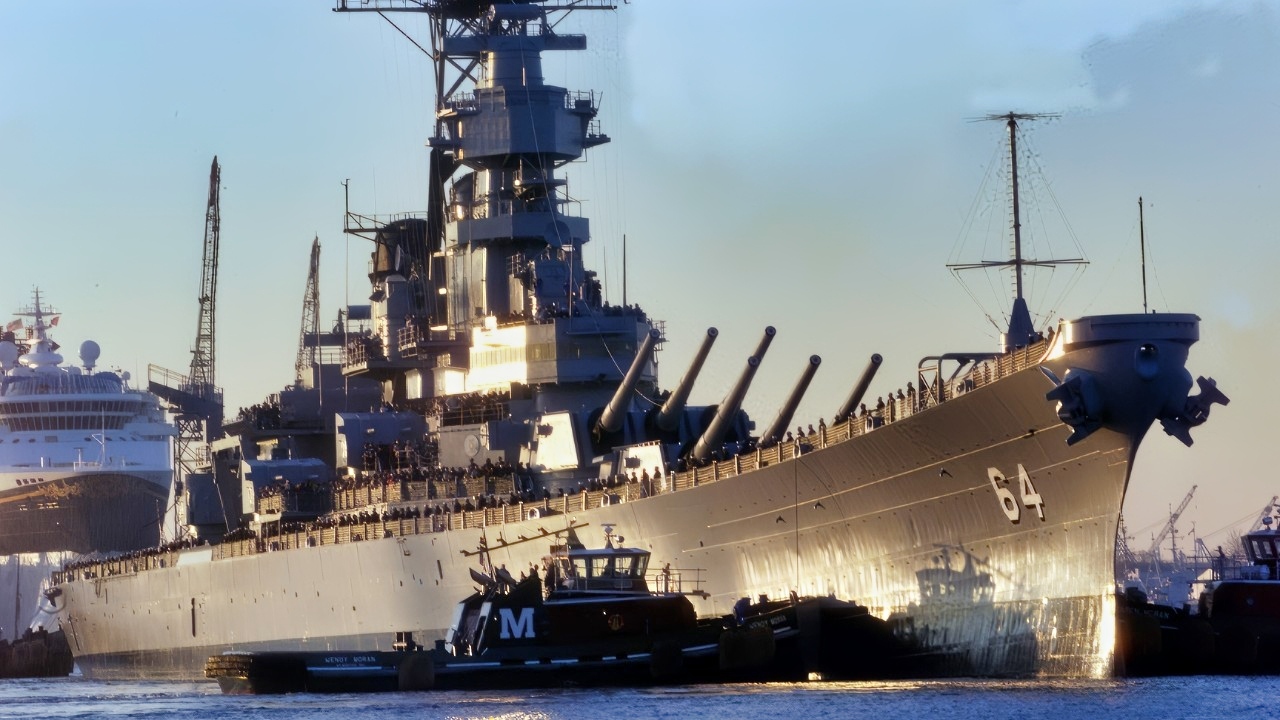
Key Points and Summary – In May 1956, a Navy PR cruise off the East Coast turned disastrous when heavy fog and a radar outage left destroyer USS Eaton effectively blind. During a man-overboard drill near carrier USS Coral Sea, Eaton crossed directly in front of the Iowa-class battleship USS Wisconsin, which was making 15 knots.

Iowa-Class Battleship USS Missouri U.S. Navy Photo
-Wisconsin’s bow sliced into Eaton’s starboard side, nearly tearing the destroyer’s bow off and badly damaging the battleship.
-Casualties were miraculously light.
-The Navy then executed a remarkable fix: grafting a 68-foot bow section from unfinished battleship USS Kentucky onto Wisconsin, returning her to service in just two months.
The Day Iowa-Class Battleship USS Wisconsin Smashed a Destroyer – and Came Back Bigger
Throughout the U.S. Navy’s history, there have been numerous collisions and close calls with allied ships, civilian ships, and even Soviet ships.
In one such instance, an Iowa-class Battleship, the USS Wisconsin (BB-64), collided with a Fletcher-class destroyer, the USS Eaton (DDE-510). Despite the crash’s dramatic nature, casualties were thankfully light.
Even more surprisingly, repairs in Wisconsin only lasted around two months. Both ships returned to active duty, and the Navy met its fleet requirements without issue.
It Starts as a Simple Parade
On May 6, 1956, the Navy organized a weekend cruise for politicians and dignitaries aboard a small task group, showcasing the strength and sophistication of the fleet.
At the center of this formation were three major warships: the aircraft carrier USS Coral Sea (CVA-43), the battleship USS Wisconsin, and the heavy cruiser USS Des Moines (CA-134). Surrounding them were four Fletcher-class destroyers from Escort Destroyer Division 22: USS Eaton, USS Bache, USS Beale, and USS Murray. Eaton served as the flagship for the division commander, Captain Terrell H. W. Conner, who was referred to as “commodore” by courtesy.

Iowa-Class 16-Inch Shell Menu. Image Credit: National Security Journal.
The plan was simple: parade the ships for the guests and later conduct gunnery exercises. However, nature had other plans.
Heavy fog blanketed the operating area, reducing visibility to near zero.
This was particularly problematic for Eaton, whose surface-search radar had been out of commission for four days.
Despite frantic efforts by the ship’s electronics technician, repairs had failed, leaving the destroyer effectively blind in the fog. The lack of radar would prove catastrophic.
Things Start to go Wrong
At approximately 1510 hours, a man-overboard alarm was sounded aboard the Coral Sea. Such emergencies required immediate maneuvering by the escorting destroyers to recover the sailor.
In the confusion, Eaton turned across the path of Wisconsin, which was steaming at about fifteen knots.

USS New Jersey Iowa-Class Battleship. Image Taken on 8/2/2025 by National Security Journal/Stephen Silver.
The Wisconsin, an Iowa-class battleship displacing over forty-five thousand tons, was a behemoth compared to Eaton’s twenty-nine hundred tons. The destroyer’s speed and maneuverability were no match for the battleship’s momentum in the dense fog. At 1514 hours, the inevitable happened.
Wisconsin’s massive bow sliced into Eaton’s starboard side forward of the bridge.
Eaton’s bow was nearly torn off, her keel broken, and her forward engine room flooded.
One of her five-inch guns was ripped from its mount and hurled into the sea.
The collision tore through the mess decks and chief’s quarters which were fortunately empty because the crew had been called topside for the man-overboard drill.
Wisconsin did not escape unscathed.
Her bow suffered a thirty-foot gash, rendering her unfit for sea until repairs could be made.
Aftermath: Two Ships out of Action
The Eaton’s crew sprang into action to prevent the destroyer from sinking. According to eyewitness accounts, the entire forward section of the ship was swinging precariously because the keel had fractured.
Sailors used cables and even wrapped anchor chains around the damaged structure, welding them in place to hold the bow together. These improvised measures kept Eaton afloat long enough for her to be towed stern-first back to Norfolk.

Iowa-Class Battleship Looking Really Old. Image Credit: Harry J. Kazianis/National Security Journal.
Casualties were miraculously light given the scale of destruction. On Wisconsin, a civilian observer suffered a minor leg abrasion after being thrown from the bridge.
On Eaton, two sailors were injured, including George Wickham, who sustained head and facial injuries while retrieving vegetables from the reefer for the evening meal.
Wickham was transferred to Wisconsin’s sick bay and later hospitalized for thirty days, eventually requiring skin grafts.
How to Repair a Iowa-Class Battleship in Record Time
Both ships limped back to port with Wisconsin under her own power and Eaton in tow. The Navy faced a daunting challenge: how to repair Wisconsin quickly without compromising her operational schedule.
Fortunately, there was an unfinished carrier nearby. At the Norfolk Naval Shipyard, workers initiated Operation Bow Transfer, a remarkable feat of shipbuilding.
The unfinished hull of another Iowa-class battleship, USS Kentucky (BB-66), whose construction had been canceled after World War II, provided the answer. A sixty-eight-foot, 120-ton section of Kentucky’s bow was cut away, transported by barge, and welded onto Wisconsin’s hull.
To preserve Wisconsin’s distinctive profile, its original “bull nose” was salvaged from the wrecked bow and grafted onto the Kentucky section. This complex operation was completed in just sixteen days, an astonishing turnaround for a battleship repair.

Iowa-Class Missile Launchers
Wisconsin emerged slightly longer than her sister ships (measuring in at 889 feet compared to their 887 feet), earning her the unofficial title of America’s largest battleship. On July 9, 1956, barely two months after the collision, Wisconsin departed for Spain, fully restored and ready for service.
The Eaton, though badly damaged, was repaired and returned to duty. She continued serving until her decommissioning in 1969 and was ultimately sunk as a target in 1970.
Her survival after such catastrophic damage was a testament to the resilience and skill of her crew.
The collision highlighted several critical issues for the Navy in the mid-1950s. Eaton’s radar failure left her vulnerable in poor visibility, underscoring the importance of redundancy in critical systems.
The man-overboard drill, combined with fog and communication challenges, created a perfect storm of confusion.
About the Author: Isaac Seitz
Isaac Seitz, a Defense Columnist, graduated from Patrick Henry College’s Strategic Intelligence and National Security program. He has also studied Russian at Middlebury Language Schools and has worked as an intelligence Analyst in the private sector.


