

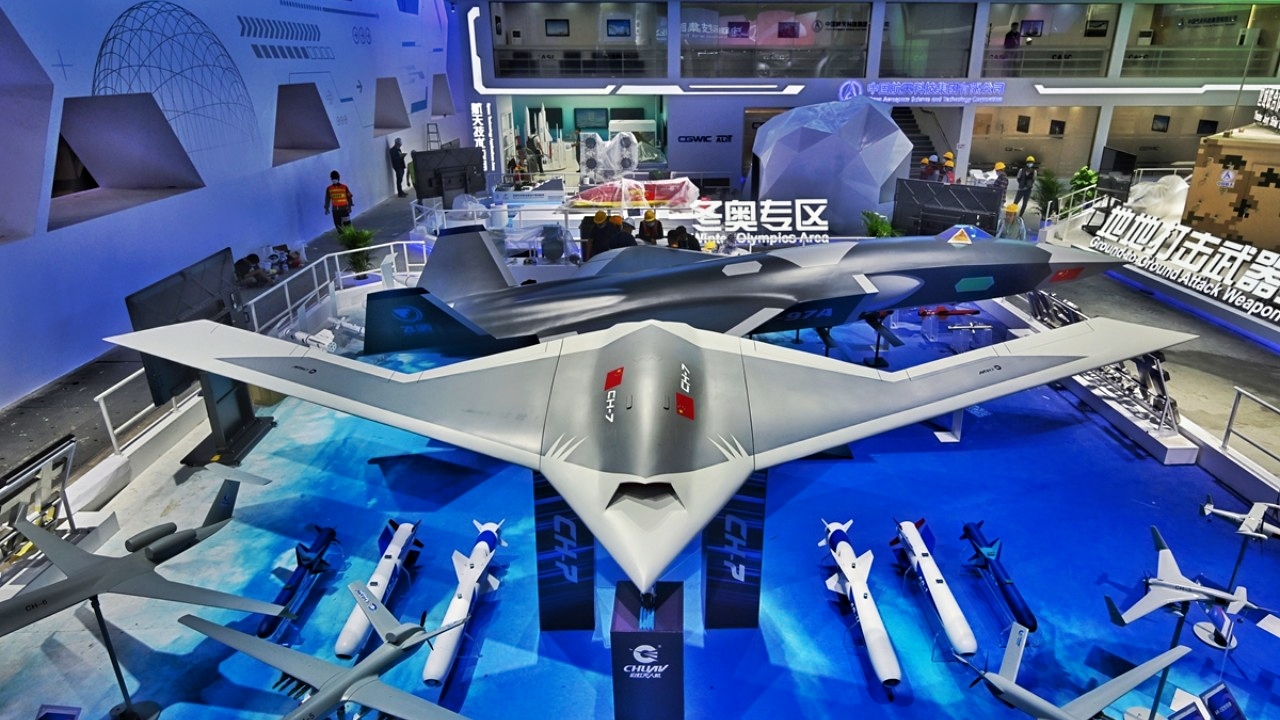
Key Points and Summary – China’s CH-7 flying-wing stealth UAV has completed its maiden flight, a major milestone for Beijing’s high-altitude, long-endurance, stealthy unmanned fleet.
-Built to penetrate contested airspace, it is intended for reconnaissance, signal collection, targeting support, and data relay while reducing radar and infrared exposure.

CH-7 Drone from China. Image Credit: Creative Commons.
-State media cites up to 15 hours of endurance, speeds near 920 km/h, ceilings around 13,000 meters, and a 2,000-kilometer operational radius, with capacity for anti-radiation missiles and standoff weapons.
-Developed by CASC’s China Academy of Aerospace Aerodynamics, the CH-7 has evolved through iterative design since its 2018 Zhuhai debut, with an operational aircraft shown in 2024.
China’s CH-7 Stealthy Drone Makes Maiden Flight
The latest stealth-design, long-endurance People’s Republic of China (PRC) aerial vehicle, the CH-7, has just completed its maiden flight. This Unmanned Aerial Vehicle (UAV) is the latest design from the PRC industry to join Beijing’s growing arsenal of autonomous and unmanned weapons.
The vehicle’s engineering teams state that the UAV’s low-observable design enables it to penetrate its assigned target areas for reconnaissance missions. Then it uses its ability to evade radar networks to transmit information from the battlefront to a command node or another airborne platform.
The PRC’s state-controlled broadcast network, China Central Television (CCTV), also announced on Monday that the new high-altitude, high-speed, long-endurance CH-7 had completed its first successful flight.
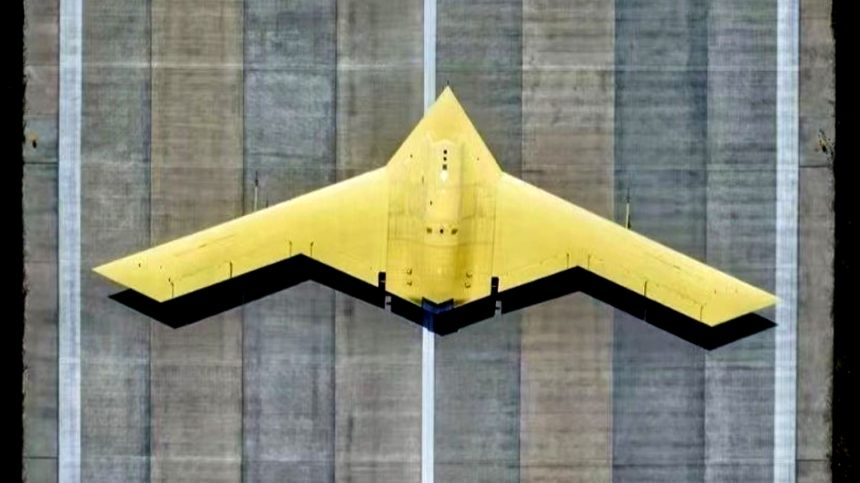
CH-7 Drone from China. Image Credit: Creative Commons.
This official CCTV announcement means that the program’s status as tested and validated has been officially declared by the People’s Liberation Army (PLA). This is in contrast to numerous occasions in which new PRC fighter aircraft and other air vehicles are initially revealed on unsanctioned sites or social media platforms before they are officially recognized or acknowledged.
Performance and Origins
The CCTV report stated that the CH-7 offers PLA users an extended endurance mission capability of up to 15 hours, according to the same broadcast. This duration of “loiter time” meets the needs of ground observation, data support, and communication missions under complex conditions, the report said.
This is all accomplished while still operating as a stealth platform with a high cruising speed. The vehicle’s platform is a flying-wing configuration similar to the X-47B. Its wingspan is 22 meters, and its fuselage is 10 meters in length.
The vehicle can fly at 920 km/h and at altitudes up to 13,000m. The vehicle’s operational radius is 2000 kilometers, and it can also carry anti-radiation missiles and standoff weapons, in addition to performing reconnaissance and intelligence missions.
According to the UAV’s chief designer, “the CH-7 can intercept radar electronic signals, and simultaneously detect, verify and monitor high-value targets, such as hostile command stations, missile launch sites and naval vessels.”
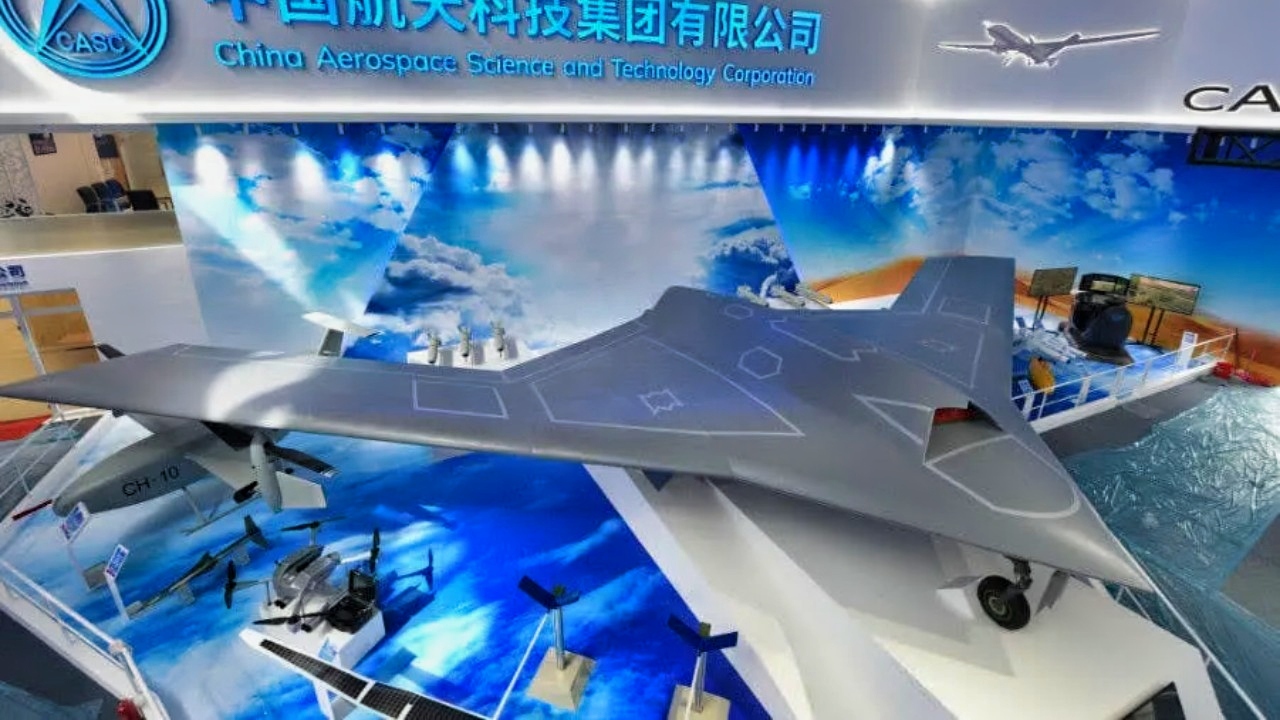
CH-7 Drone from China. Image Credit: Creative Commons.
The CCTV report on the CH-7 stated that the vehicle would continue testing, including validating the UAV’s flight performance envelope and its multiple-payload configuration.
Future Program Plans
The CH-series of UAVs was developed entirely by the China Academy of Aerospace Aerodynamics, a subsidiary of the China Aerospace Science and Technology Corporation (CASC). The CH-designator vehicles are also the PRC’s bestselling UAV models on the international market.
CH-7 was first introduced to the public in 2018, when a full-scale model was displayed for the first time at the biennial Zhuhai air show. First-time appearances of new designs at the Zhuhai expo are frequently displayed without any detailed explanations or any personnel from the company responsible for the design present and authorized to respond to inquiries.
The information vacuum prompted speculation that the vehicle was a long-range reconnaissance and strike UAV, which was more than partly accurate. An actual working CH-7 vehicle was eventually displayed at the 2024 Zhuhai air show six years later.
Since its introduction, the CH-7’s design has undergone continuous modifications. Earlier official reports stated that, rather than being a multirole unmanned platform, the aircraft would be used only for reconnaissance missions.
“The current version of the CH-7 is a high-speed reconnaissance aircraft,” Fang Shuai, one of the drone’s designers, told CCTV this past May.
Fang said the CH-7’s unique feature was its flying-wing configuration. That platform makes the vehicle one characterized by a high degree of wing-body integration. According to its designers, this gives the car a maximum stealth profile but without compromising its aerodynamic performance.
Specifically, this is achieved by positioning the CH-7’s engine air intakes above the fuselage, while the engine exhaust nozzles are semi-concealed to reduce the IR signature.
A CCTV report in 2018 said the model was scheduled to conduct its maiden flight in 2019, but later reports suggested it had undergone several design modifications. A later article on the CH-7 listed 2022 as a first flight, which then only happened this year.
“Designing a UAV of this type—it is an iterative process,” said a senior, retired US Air Force officer with significant experience in stealth programs. “If you are looking to produce a long-range, long-endurance vehicle that is also stealthy, it can end up taking much longer than the design team thinks it will at the beginning of the program. This is particularly true if the designers—in this case the Chinese—lack the many years of experience in stealth that exists in US industry.”
About the Author: Reuben F. Johnson
Reuben F. Johnson has thirty-six years of experience analyzing and reporting on foreign weapons systems, defense technologies, and international arms export policy. Johnson is the Director of Research at the Casimir Pulaski Foundation. He is also a survivor of the Russian invasion of Ukraine in February 2022. He worked for years in the American defense industry as a foreign technology analyst and later as a consultant for the U.S. Department of Defense, the Departments of the Navy and Air Force, and the governments of the United Kingdom and Australia. In 2022-2023, he won two awards in a row for his defense reporting. He holds a bachelor’s degree from DePauw University and a master’s degree from Miami University in Ohio, specializing in Soviet and Russian studies. He lives in Warsaw.


