
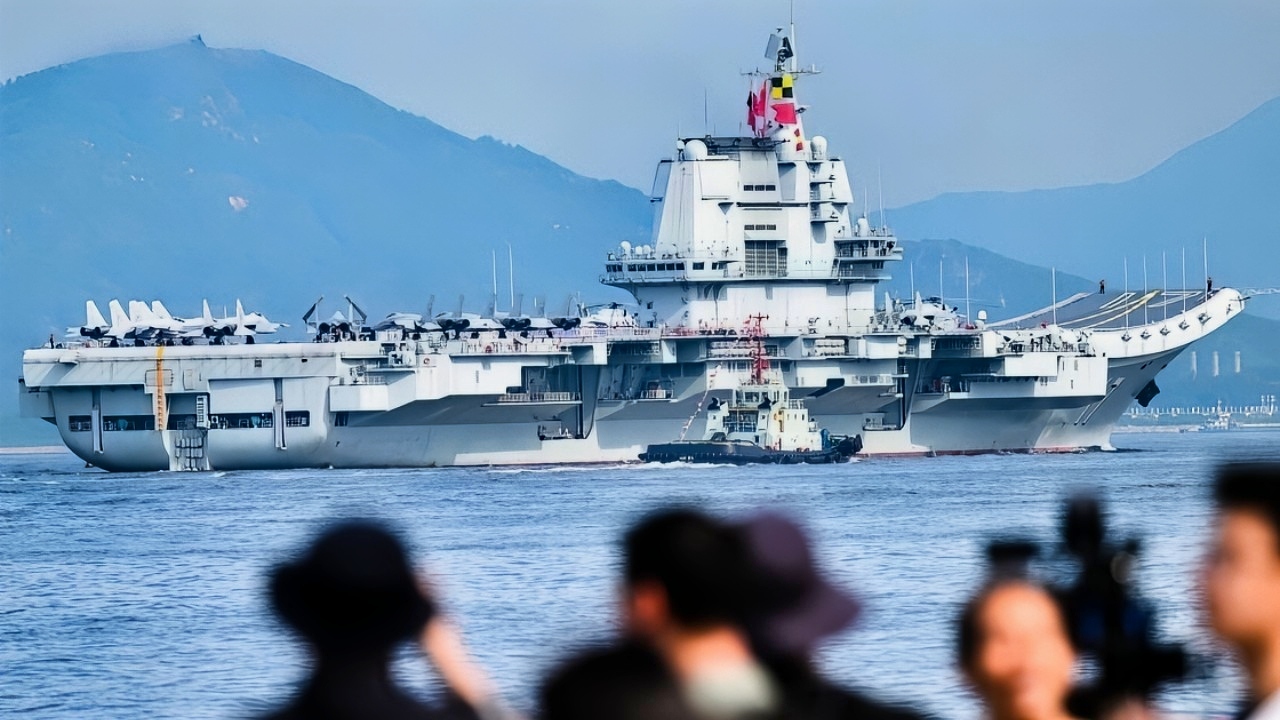
Key Points and Summary – China’s Type 003 Fujian carrier has completed electromagnetic catapult and arrested-landing trials with J-35 stealth fighters, J-15T strike jets, and the KJ-600 AEW aircraft—its first full CATOBAR demonstrations.
-The EMALS-like system enables heavier takeoff loads, longer ranges, and U.S.-style sortie generation, a leap beyond Liaoning and Shandong’s ski-jump decks.

J-35 Fighter. Image Credit: X/Screenshot.
-After multiple sea trials since May 2024, Fujian is tracking toward operational service as early as late 2025 or 2026.
-With a 40+ aircraft air wing and a mix of fighters, EW variants, and AEW, Fujian positions the PLAN for true blue-water operations—and signals what a future Type 004 could bring.
China’s Fujian Aircraft Carrier Edges Closer to U.S.-Style Operations with Catapult Trials
China’s third aircraft carrier, the Type 003 Fujian, has reached another significant milestone before it enters operational service. State media reports revealed this week how the aircraft carrier has used its electromagnetic catapult systems for the first time, launching all three kinds of fixed-wing aircraft the carrier was designed to accommodate.
State broadcaster CCTV revealed on Monday, September 22, that the Fujian’s electromagnetic catapult successfully launched J-15T fighter jets, fifth-generation J-35 stealth jets, and the carrier-based KJ-600 early warning aircraft.
The aircraft were not only launched using the catapult systems, but successfully landed on the carrier using arresting gear.
The test not only brings the aircraft carrier closer to being commissioned, but marks the first time that the J-35 carrier-based stealth fighter was launched from an aircraft carrier. The J-35 is the second carrier-based stealth fighter to be developed, following Lockheed Martina’s F-35.
“This means that the Fujian has attained electromagnetic catapult and recovery capabilities, representing another breakthrough in China’s aircraft carrier development and a milestone in the transformation of the navy,” CCTV reports.
Electromagnetic catapult launch systems operate like giant slingshots built into a carrier’s deck, accelerating aircraft to takeoff speed in just a few hundred feet.
Unlike ski-jump ramps, which limit planes to lighter loads, electromagnetic catapults use powerful electric currents to generate magnetic fields that push a launch shuttle down the track.
The result is a smoother, more controlled acceleration that reduces stress on airframes and allows heavier aircraft, like stealth fighters and early warning planes loaded with fuel, weapons or radar systems, to operate from the carrier.
While the report did not specify when the test launch occurred, it did confirm that it took place ahead of the September 3 Victory Day parade that took place in Beijing. The parade – which was the biggest in its history – saw a series of new aircraft, missiles, and military hardware unveiled to the world for the first time.
The three aircraft successfully launched from Fujian were present at the parade, alongside advanced unmanned aircraft like the Type B unmanned stealth fighter.
What is the Fujian?
The Fujin is the People’s Liberation Army Navy’s (PLAN) third aircraft carrier and the lead – and currently sole – vessel of China’s Type 003 class.
Unlike the earlier Liaoning and Shandong carriers, which used a ski-jump (STOBAR) launch system, Fujian is the first Chinese carrier built with catapult-assisted launch and recovery capability (CATOBAR), employing electromagnetic catapults.
Construction on Fujian began in the mid-2010s, with block assembly gaining momentum by 2020 and superstructure installation commencing by mid-2021.
The ship was officially launched on 17 June 2022, and outfitting, trials, and catapult system integration took place thereafter.
Fujian then entered its first sea trials in May 2024, and by the end of the year and into 2025, it has undergone multiple additional trials designed to test its power, systems, and technology.
Following this month’s catapult launch and arrested-landing trials for all three types of carrier aircraft, the ship continues to inch closer to officially entering operational service. Open-source assessments suggest that the carrier could enter regular service by the end of 2025 or in early 2026.
Fujian’s strategic role is to serve as the centerpiece of a modern, “blue-water” Chinese naval force – that is, a fleet designed to operate on the open oceans rather than staying close to home waters. The carrier gives Beijing a platform to project air power well beyond its shores and to support large, far-reaching carrier strike groups.
Among the most notable innovations on the carrier is its catapult launch systems, which are similar in design to the U.S. Navy’s Electromagnetic Aircraft Launch System (EMALS). The system allows aircraft to take off with heavier payloads and on shorter runways, meaning aircraft can carry more fuel for longer missions and larger weapon loads, dramatically expanding both their range and effectiveness.
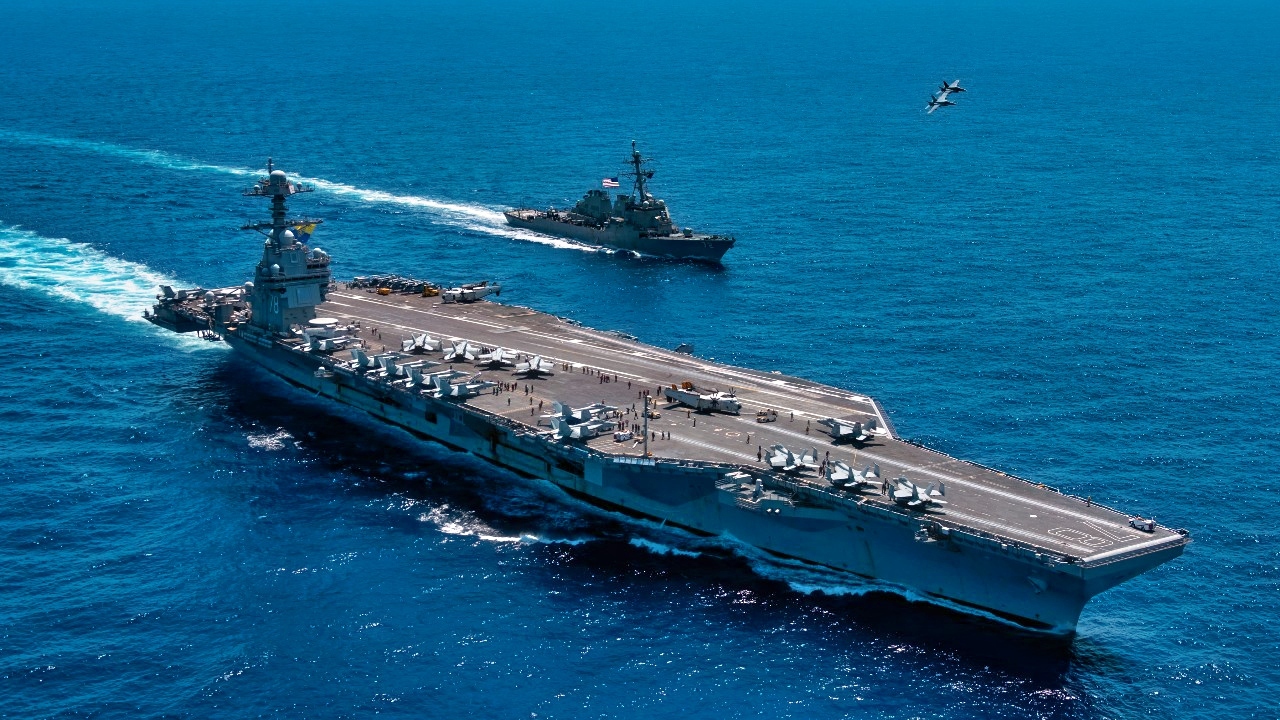
An F/A-18F Super Hornet, attached to the “Blacklions” of Strike Fighter Squadron (VFA) 213 and a F/A-18E Super Hornet, attached to the “Golden Warriors” of Strike Fighter Squadron (VFA) 87 fly over the world’s largest aircraft carrier, USS Gerald R. Ford (CVN 78), the Arleigh Burke-class guided-missile destroyer USS Mahan (DDG 72), April 11, 2025. The Gerald R. Ford Carrier Strike Group is underway in the Atlantic Ocean completing integrated naval warfighting training. Composite Training Unit Exercise (COMPTUEX) is the Joint Force’s most complex integrated training event and prepares naval task forces for sustained high-end Joint and combined combat. Integrated naval training provides America’s civilian leaders and commanders highly-capable forces that deter adversaries, underpin American security and economic prosperity, and reassure Allies and partners. (U.S. Navy photo by Mass Communication Specialist 2nd Class Maxwell Orlosky
In terms of its air wing, Fujian is designed to carry a mix of fixed-wing combat aircraft and support planes, likely numbering 40 or more fighters alongside helicopters. Fujian will nbe China’s largest and most versatile carrier to date.
The J-15T is expected to operate from the carrier – a carrier-capable fighter adapted to work with catapult systems. A specialized electronic warfare version of the J-15 that can jam or disrupt enemy radars and communications will also be deployed on the aircraft, as well as the J-35 stealth fighter, which is designed to evade detection by radar.
The Xi’an KJ-600 airborne early warning and control plane will also operate from the carrier, serving a similar function to the U.S. Navy’s E-2 Hawkeye in that it operates as a flying radar station, extending the carrier’s ability to detect and track threats from a distance.
Together, these capabilities make the Fujian the closest China has come to U.S.-style carrier operations – and once its deployed, the even larger Type 004 supercarrier could soon follow.
About the Author:
Jack Buckby is a British author, counter-extremism researcher, and journalist based in New York who writes frequently for National Security Journal. Reporting on the U.K., Europe, and the U.S., he works to analyze and understand left-wing and right-wing radicalization, and reports on Western governments’ approaches to the pressing issues of today. His books and research papers explore these themes and propose pragmatic solutions to our increasingly polarized society. His latest book is The Truth Teller: RFK Jr. and the Case for a Post-Partisan Presidency.
More Military
Mach 2.65 F-111 ‘Aardvark’ Strike Fighter Has a Message for the U.S. Military
Russia’s MiG-29 Fulcrum Fighter Has a Message for NATO
The X-40A Space Plane Has a Message for the U.S. Military
The Mach 6.7 X-15 Space Plane Has a Message for the U.S. Air Force


