


Key Points and Summary – The F-21 is Lockheed Martin’s India-only evolution of the F-16, pitched as a “Make in India” fighter that blends proven design with serious upgrades.
-Triple missile adapters boost air-to-air firepower, while an India-specific electronic-warfare suite, AESA radar, IRST, conformal fuel tanks, and a fifth-gen style cockpit push it into 4.5-generation territory.

F-16 Fighting Falcon Onboard USS Intrepid. Image Taken on September 18, 2025.
-A GE engine and 12,000-hour airframe aim to cut life-cycle costs and support future Indian systems.
-Strategically, the F-21 would deepen U.S.–India defense ties, complement Tejas, and nudge New Delhi further from Russian hardware—even as Pakistan still flies earlier-generation F-16s under tight U.S. restrictions.
F-21 vs. F-16 Fighting Falcon Fighter: How India’s Custom Fighter Changes the Game
The time-honored F-16 Fighting Falcon is a fourth-generation fighter—or in the case of the F-16V “Viper” variant, a 4.5-generation fighter—and therefore no longer the world’s predominant air superiority fighter.
However, despite the dominance of fifth-generation aircraft, and the sixth-generation jets soon to arrive, the F-16 is far from obsolete.
In fact, it is the most common fixed-wing aircraft in military service around the world. It faithfully flies not just in the U.S. Air Force, but with roughly 25 of America’s foreign military sales customers.
The warbird continues to demonstrate its combat effectiveness in the hands of the Iraqi and Ukrainian air forces. Now, the Indian Air Force is joining the F-16 club, thanks to the F-21 project.
F-21 Program Raison D’Être
As noted by Lockheed Martin’s official info page, “The F-21 is an unprecedented ‘Make in India’ opportunity─combining the strength of Lockheed Martin, the world’s largest defence contractor, and Tata, India’s premier industrial house, to deliver a historic win-win for the US and India.
“We hope to strengthen and grow our relationship with India as part of an unprecedented F-21 fighter aircraft partnership for India, from India.”
Lockheed emphasizes the economic boost and the jobs created by the F-21 program, including owners and employees of “Micro, Small & Medium Enterprises (MSMEs) and suppliers throughout India.”
So, What Makes the F-21 So Special?
India’s iteration of the iconic F-16 includes special features in several categories:
-Weapons Capacity: The F-21 is configurable with the the Triple Missile Launch Adapter and 40 percent greater air-to-air firepower compared to legacy fighters.
-Advanced Electronic Warfare (EW): Enhanced survivability against air and ground threats is offered by an EW system “uniquely developed for India.”
– Active Electronically Scanned Array Radar: The radar offers nearly double the range of mechanically scanned array radars, which translates to more targets engaged with higher precision.
-Infrared Search and Track: This capability enables first look, first kill operability, which means the pilot can detect and destroy the enemy before being detected by that enemy.

A F-16 Fighting Falcon assigned to the 35th Fighter Wing takes off at Yokota Air Base, Japan, May 21, 2022 during the Japanese-American Friendship Festival. Due to COVID-19 pandemic, this year festival marks the first time Yokota has held the annual event since 2019. (U.S. Air Force photo by Yasuo Osakabe)
-Fuel Efficiency: This will be the only fighter in the world to combine probe-and-drogue and boom aerial refueling. Conformal fuel tanks enable greater range penetration and loiter persistence. (Loitering capability is a relative weakness of gas-guzzling supersonic fighters compared with subsonic warbirds such as the A-10 Warthog.)
-Advanced Cockpit: A Large Area Display will include fifth-generation technologies to enable greater battlespace awareness and network operations (thereby presumably making the F-21 a generation-4.5 warbird).
-General Electric (GE) Aerospace Engine: This will increase reliability and ease of maintenance and lower life cycle costs.
-Unique Aero Design: Will ensure a 12,000-hour service life, as well as increased growth capacity for integration of future indigenous systems.
The Big Picture: Integrating the F-21 with the Tejas (and American Technology in General)
The F-21 program ties in with the greater effort underway to expand military ties between India and the U.S., especially in the context of The Quad—the four-way partnership including Australia and Japan to push back against China.
Washington also hopes to wean India away from its longstanding dependence on Russian-made military technology such as the MiG-21 and the MiG-29. (The Trump administration’s secondary tariffs against India for buying Russian oil remain a bone of contention, but that’s a topic of discussion for another time and place.)
The GE engine is especially noteworthy, because the F-21 isn’t the only IAF fighter using the company’s products. India is developing a homegrown fighter, the Hindustan Aeronautics Limited Tejas Light Combat Aircraft. But the Tejas is not 100 percent domestic—the Mark 2 variant contains the GE 414 engine, while the Mark 1 and Mark 1A use the slightly less powerful F404-GE-F2J3 afterburning turbofan engine
The Big Picture Part Deux: But What About Pakistan’s F-16 Fighters?
India’s effort to sustain an F-16 fighter jet program is somewhat eye-catching given that its greatest adversary, Pakistan, is another F-16 Fighting Falcon customer.
According to the World Directory of Modern Military Aircraft, the Pakistani Air Force flies 85 of the American-made planes, which thus comprise 17 percent of their 498-strong fighter fleet (which also includes the French-made Mirage III and the Sino-Pakistani joint venture JF-17 Thunder).
So in case of yet another Indo-Pakistani War, what are the chances we will see an IAF F-21 vs. PAF F-16 clash?
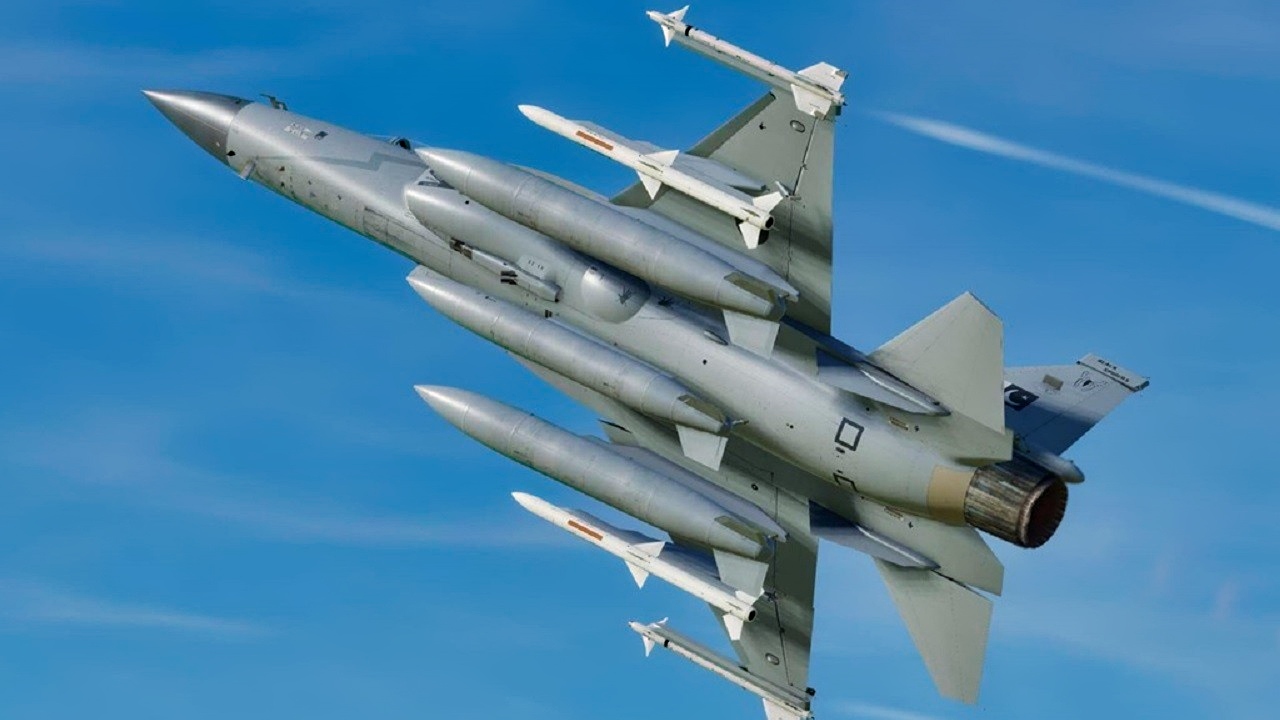
JF-17 Thunder Fighter. Image Credit: Creative Commons.
Such a meeting is not likely, at least on paper. The U.S. government placed very restrictive provisions on Pakistan’s use of the F-16, expressly forbidding it for use against conventional states such as India, and instead limiting it to counterterrorism missions.
Any violation of this stipulation could lead to suspension of spares and maintenance contracts, or even to sanctions.
About the Author: Christian D. Orr, Defense Expert
Christian D. Orr is a Senior Defense Editor. He is a former Air Force Security Forces officer, Federal law enforcement officer, and private military contractor (with assignments worked in Iraq, the United Arab Emirates, Kosovo, Japan, Germany, and the Pentagon). Chris holds a B.A. in International Relations from the University of Southern California (USC) and an M.A. in Intelligence Studies (concentration in Terrorism Studies) from American Military University (AMU). He is also the author of the newly published book “Five Decades of a Fabulous Firearm: Celebrating the 50th Anniversary of the Beretta 92 Pistol Series.”


