
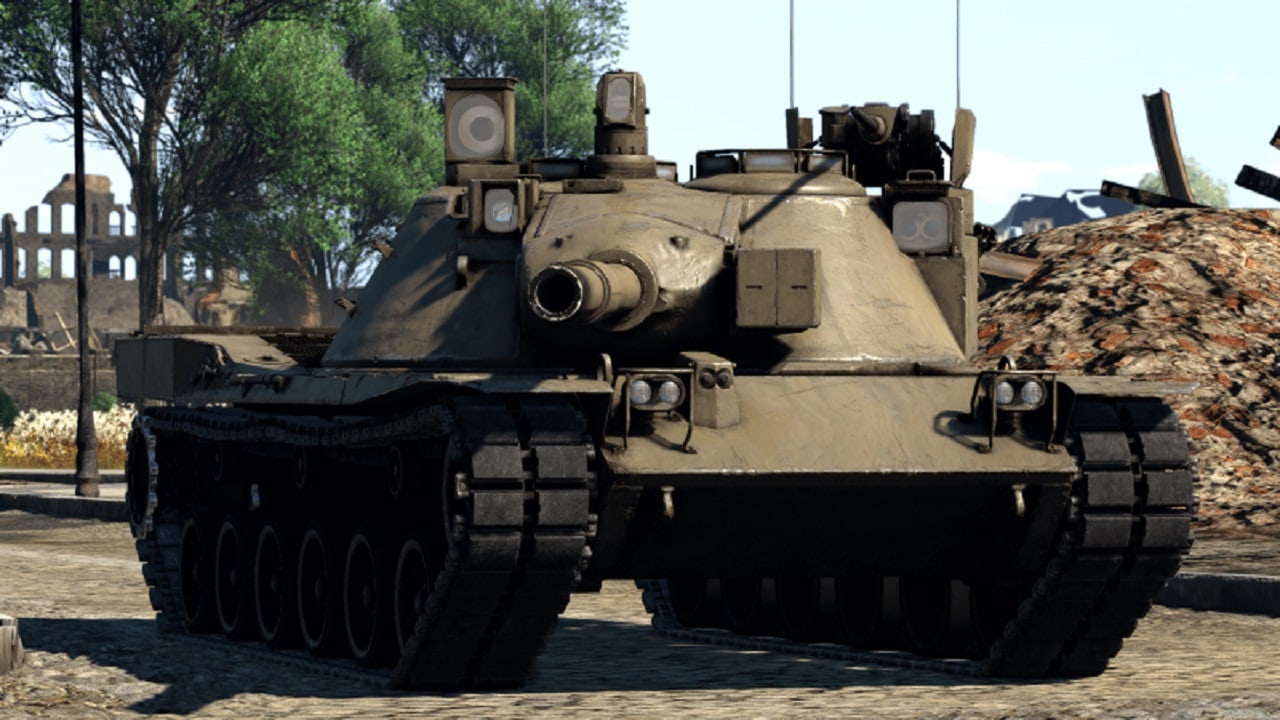
Key Points and Summary – Launched in 1963, the U.S.–West German MBT-70 set out to leapfrog Soviet armor with radical tech: hydropneumatic “kneeling” suspension, spaced armor, advanced fire control, and a 152mm gun that could fire Shillelagh missiles (Germany pursued a 120mm gun).
-Add NBC protection, a 1,470-hp diesel, and crew-survivability design—and costs soared.

MBT-70. Image Credit: Creative Commons.
-Differing doctrines, metric vs. imperial standards, and feature creep pushed the program off the rails; Germany exited in 1969, and the U.S. canceled in 1971.
-Despite failure, MBT-70 concepts influenced later Leopards and Abrams, proving that ambitious prototypes can reshape future tanks even when they never enter service.
What We Learned From the MBT-70
In the midst of the Cold War, the United States and West Germany embarked on a truly ambitious project: the MBT-70 (Main Battle Tank for the 1970s) program.
Kicked off formally in 1963, the goal was simple, but significant: to design a next-generation tank that would replace both the U.S. Army’s M60 Patton and the German Bundeswehr’s Leopard I, and outmatch the latest generation of Soviet armored vehicles.
What followed was six years of collaboration, innovation, and engineering—but cost overruns, feature creep (new features added throughout development), and changing requirements also plagued the project.
The project was ultimately canceled in 1971, and the MBT-70 never actually entered service—and yes, it left behind a solid legacy, with design elements that resonate today and have even influenced later main battle tanks.
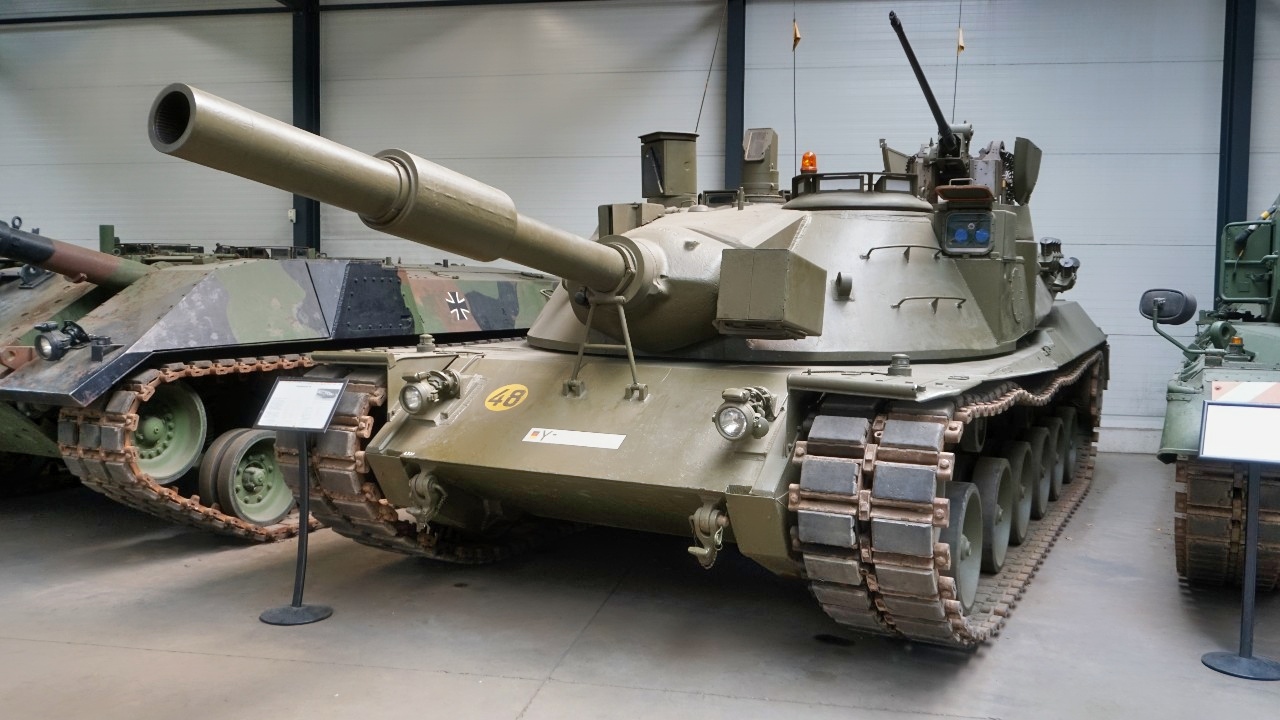
MBT-70 Tank. Image Credit: Creative Commons.
Origins and Purpose
The MBT-70 was born out of NATO’s anxiety about Soviet armored vehicle advances.
By the early 1960s, the Warsaw Pact, a collection of Soviet and Eastern European satellite states, was fielding new designs like the T-62 that threatened to overwhelm NATO’s existing tank fleets.
In response, U.S. Secretary of Defense Robert McNamara pushed for a new, bold, joint U.S.-West German effort to leapfrog Soviet designs rather than simply catch up.

Tim Murry, a foreign threats compound contractor, drives a T-72 battle tank into position to serve as adversary targets for a joint service exercise, Emerald Flag, at Eglin Air Force Base, Fla., Nov. 30. Emerald Flag is a multi-service exercise aimed to unify information sharing across joint domain platforms. (U.S. Air Force photo/1st Lt Karissa Rodriguez)
The concept was to build one advanced main battle tank to serve both nations, equipped for mobility, firepower and survivability in Central Europe’s likely high-intensity armored fights. But what started with good intentions and a solid plan quickly became complicated.
The U.S. and West Germany had different tactical philosophies, their industrial bases were by no means comparable, and they had different logistical and engineering standards, which made sticking to the plan difficult.
The differences ranged from the use of imperial and metric units to different preferred armament types.
By 1969, West Germany withdrew from the program and decided to go its own way.
The U.S. continued briefly via the XM803 tank program before canceling the MBT-70 entirely by 1971.
But the underlying purpose of the tank was essential; with the prospects of an armored war in Europe, the MBT-70 was meant to be NATO’s best tool to stay ahead of the game in terms of technological capability and set a new standard for advancement.
The West wasn’t intending to catch up with the Soviets, but to leapfrog them completely and remain ahead of the game in perpetuity. It was, however, perhaps too ambitious an effort – and one that was always doomed to fail.
Technical Specifications and Key Innovations
On paper, the MBT-70 was strikingly advanced for its era, and the prototype weighed around 50 tons, with some sources putting it as high as 54 tons.
It measured roughly 9.1 m in length, 3.51 m in width, and, in its low-profile configuration, had a height ranging from approximately 1.99 m to 2.59 m, depending on suspension settings.
In terms of mobility, the tank was driven by a 1,470-horsepower air-cooled Continental V12 diesel engine (for the U.S. variant), giving it a top road speed of around 68 km/h and a range of roughly 400 miles.
The key innovation here, though, was the use of a hydropneumatic suspension system that combined hydraulic fluid and pressurized gas to allow variable ride height.
The tank could literally raise or lower itself, or “raise” and “kneel,” to help manage terrain.
As for firepower, the main armament on the U.S. version was the XM150E5 152 mm gun, capable of firing both conventional rounds and the MGM-51 Shillelagh.
The German version, meanwhile, used a 120 mm gun. Secondary armament included a 20 mm autocannon and a coaxial 7.62 mm machine gun.
The MBT-70 also featured space armor—a configuration in which layers of armor are separated by gaps to disrupt penetrating projectiles. Its armor was designed to withstand 105 mm rounds from a distance of 800 m. It also included NBC (nuclear, biological, chemical) protection and was built with crew survivability in mind, meaning the internal layout was designed to keep the crew as protected as possible during combat.
But all these innovations came with trade-offs: as the program went on, the weight began to increase, the logistics became more complex, and the unit cost skyrocketed. The project ballooned from an estimated $80 million to over $300 million by 1969.
The MBT-70 was a visionary failure. It was too advanced, too complex, and too expensive for its time. And yet, its innovations in suspension, fire control, and protection completely reshaped tank design for decades, proving that even canceled programs can drive military and technological advancements—and even how future wars are fought.
About the Author:
Jack Buckby is a British author, counter-extremism researcher, and journalist based in New York. Reporting on the U.K., Europe, and the U.S., he works to analyze and understand left-wing and right-wing radicalization, and reports on Western governments’ approaches to the pressing issues of today. His books and research papers explore these themes and propose pragmatic solutions to our increasingly polarized society. His latest book is The Truth Teller: RFK Jr. and the Case for a Post-Partisan Presidency.
More Military
China’s H-20 Stealth Bomber Has a Message for the U.S. Air Force
China’s New J-35 Stealth Fighter Has a Message for the U.S. Air Force
China Is Studying the Ukraine War to Become a Drone Superpower
The Road to a China-America Nuclear War
China Could Fire Mach 6 Hypersonic Missiles from Bombers to Sink Navy Aircraft Carriers


