

Russia has been firing ballistic missiles at Ukraine, including a deadly strike on the Kyiv region on Wednesday. According to President Volodymyr Zelensky, Ukraine was unable to intercept any of those missiles. This led Zelensky to call on his allies to deliver more of them.
According to an ominous new report, one expert says a lot more missiles are coming, and Russia has plenty more to fire.
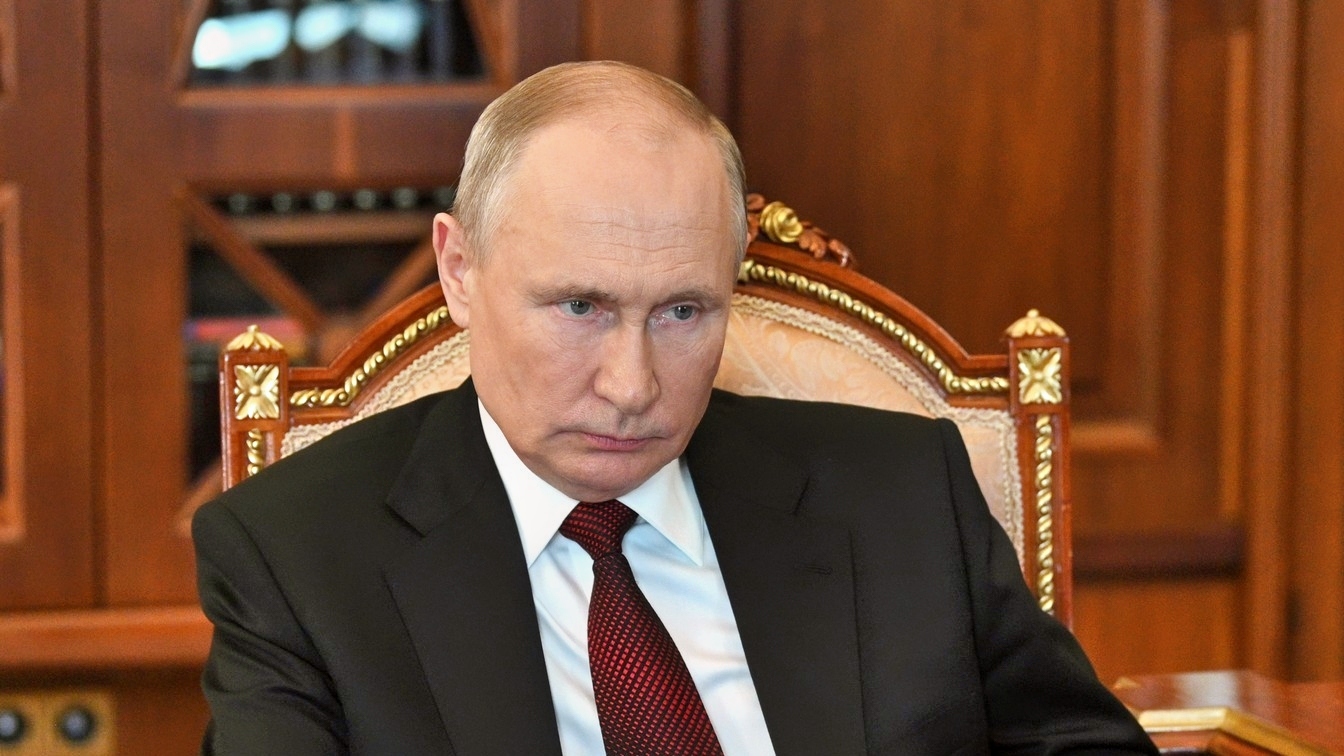
Putin In Meeting Creative Commons Image
A report by United 24 Media on Wednesday said that Serhii “Flash” Beskrestnov, an adviser to the Ukrainian government on defense issues, said this week that Russia “could keep launching roughly 100 ballistic missiles a month once its current surge of strikes eases.”
The comments were made in a Facebook video this week. In his comments following the strike on Wednesday, Beskrestnov made it clear that this was his personal estimate, not an official one from the government, although past government estimates track closely with his numbers.
Attacks like the one on Wednesday, he said, “will continue as long as the enemy has ballistic missiles.” And he added that the Russian side has recently been expanding the types of targets it attacks and is also using local informants to select them.
According to Euromaidan Press, the man known as “Flash” shared additional details about how the Russians locate warehouses to attack.
“A person is hired, a traitor for a few thousand hryvnia, who watches what happens at the warehouse, the movement of trucks, the volume. Then this information reaches Russia, and a decision is made about a strike,” Beskrestnov said in the Facebook video.
He added that warehouse data is entirely open and does not require satellites or intelligence channels, and that businesses should diversify how they handle their storage needs.
An Attack on His Own Home
Back in April, the same outlet reported that Beskrestnov was the victim of a drone attack that struck his own home. He was injured, and the home was destroyed.
“Tonight, Russians tried to kill me,” the man known as “Flash” said at the time. “A guided jet-powered Shahed struck the wall of my house. I no longer have a home.” He also posted photographs from the hospital and vowed that the incident would not deter him from his work.
Beskrestnov has said that he believes such a low-cost informant was involved in the attack on his home earlier this year.
Help From North Korea
Meanwhile, on the Russian missile front, Reuters reported Wednesday that a North Korean missile unit had deployed to the Western part of Russia and is equipped with as many as 120 ballistic missiles and six launchers for attacks on Ukraine. The unit is expected to consist of about 90 people.
Russia, since the start of the war, has fired “scores” of North Korean ballistic missiles at Ukraine, but it appears more are to come. On July 30, when Russia struck the village of Radushne with KN-23 ballistic missiles, it marked Russia’s first use of North Korean missiles fired at Ukraine since August of 2025.
Andrii Cherniak, from Ukraine’s Main Directorate of Intelligence, told Reuters that the unit will be based in Voronezh, as part of its 112th Missile Brigade.
“Ballistic missile defence is one of Ukraine’s greatest vulnerabilities, so any increase in the quantities of ballistic missiles they face will pose a greater challenge,” Rob Lee, a senior fellow at the Foreign Policy Research Institute, told Reuters.
North Korea’s KN-23 and KN-24 missiles, Reuters said, have “a greater range and larger payload than Russia’s equivalent, Iskander, but are much less accurate.”
North Korea has been playing a role in Russia’s war effort throughout the war, and even contributed 14,000 troops to a 2024 effort to turn back a Ukrainian ground invasion in the Kursk region. Russia and North Korea reached a “Comprehensive Strategic Partnership Treaty” in 2024.
The Kyiv Independent reported that North Korea’s ballistic missiles, much like Russia’s, can only be intercepted by the Patriot missile system. But that system is in growing demand worldwide, and the U.S. has gone back and forth on whether to grant Ukraine a license to manufacture it.
About the Author: Stephen Silver
Stephen Silver is an award-winning journalist, essayist, and film critic, and contributor to the Philadelphia Inquirer, the Jewish Telegraphic Agency, Broad Street Review, and Splice Today. The co-founder of the Philadelphia Film Critics Circle, Stephen lives in suburban Philadelphia with his wife and two sons. For over a decade, Stephen has authored thousands of articles that focus on politics, national security, technology, and the economy. Follow him on X (formerly Twitter) at @StephenSilver, and subscribe to his Substack newsletter.


