

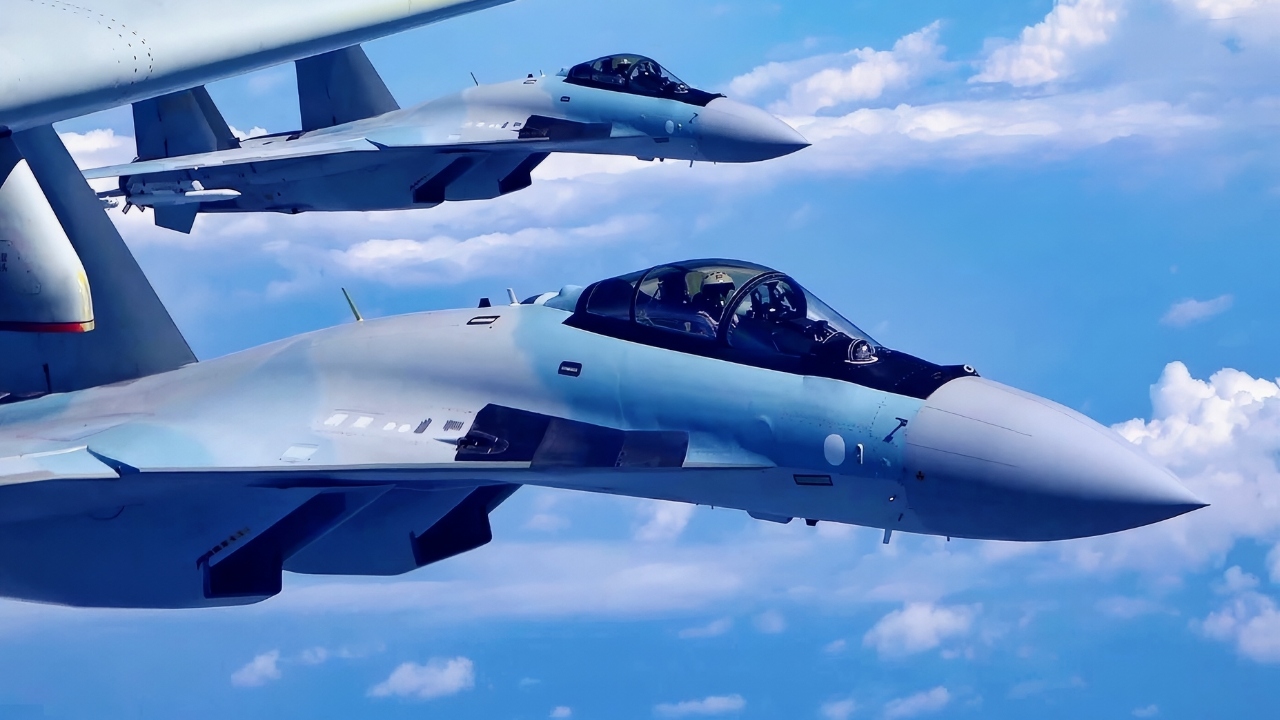
Key Points and Summary – When China purchased 24 advanced Su-35 fighter jets from Russia in 2015, the real prize wasn’t the aircraft itself but its powerful AL-117S engines.
-At the time, China’s indigenous jet engine development was a major “Achilles’ heel,” and it lacked a suitable powerplant for its new J-20 stealth fighter.
-Since Russia refused to sell the engines as a standalone product, Beijing bought the entire weapons system with the goal of reverse-engineering them.
-The copied engine then powered the J-20 until China’s own advanced WS-15 was finally ready for production.
How And Why Did The Chinese Get the Su-35 Aircraft From Russia?
China was interested in Russia’s Su-35 multirole fighter for years before it finally purchased the aircraft. Beijing, however, did not prize the advanced fourth-generation because it wanted to fly it.
In November 2015, Beijing acquired the Su-35 fighter jet from Russia through a $2 billion contract that sent 24 of the Russian multirole fighter aircraft to China, TASS reported, according to Kommersant.
The Su-35 is a highly advanced fourth-generation-plus fighter. It can supercruise and has a top speed of Mach 2.35 (1,803 miles per hour). The fighter offers significant technological advantages, such as thrust-vectoring engines, enhanced avionics, and a reduced radar cross-section.
The Su-35 became China’s first purchase of such advanced military equipment from Russia in a decade. China had first expressed interest in the Sukhoi Su-35 during the China International & Aerospace Exhibition in 2008. After several years of negotiations, a preliminary agreement over the purchase was reached in 2012.
“The protracted talks on Su-35 deliveries to China have ended. We have signed the contract,” Sergey Chemezov, director-general of the Russian state corporation Rostec, told Komersant.
“China has officially become the first foreign contractor of the Su-35 aircraft. The contract has no precedents in the history of military aircraft deliveries,” he added.
Why Did China Want The Su-35?
The Su-35 (NATO reporting name: Flanker-E) is a twin-engine, highly maneuverable multirole fighter jet powered by two AL-117S turbofan engines – and those powerful engines were in fact the real reason China was interested in acquiring the jet.
The Diplomat reported in an intriguing article that, “With its domestic programs seemingly in limbo, some analysts have argued that an AL-117S purchase would be the fastest way for the Chinese to get their hands on a suitable turbofan for the J-20.
“Since Russia is reportedly unwilling to sell the new engine as a standalone product, the PLAAF will have to buy the Su-35 and acquire the AL-117S as a part of a complete weapons system.
“Additionally, the aircraft features “an export-standard radar system — the Irbis-E passive-electronically scanned-array radar, capable of tracking up to 30 targets simultaneously and purportedly able to engage up to eight — an electronic warfare and communications suite, as well as a newly integrated receiver for the domestically-built BeiDou satellite navigation system.”
China was trying to build a pair of fifth-generation stealth fighters at the time; one of them was the J-20. And Chinese manufacturing didn’t have the engine needed to power the Mighty Dragon, which is why they were so interested in the AL-117S.
Chinese engineers copied the AL-117S, which was used for the J-20 until the Chinese finished their own version, the WS-15.
China’s Penchant For Stealing Military Technology:
The Chinese think nothing of stealing from friends and foes alike. Look at any “Chinese” military aircraft from the past 20 years or so, and you will think you are seeing an American or Russian aircraft. And in many cases, you are.
China’s well-known, heavily documented effort to copy or steal foreign technologies began with the J-11 fourth-generation fighter, which emerged shortly after China acquired the Russian Su-27.
A Chinese national arrested in Canada in 2014, Su Bin ( aka Stephen Su), was charged along with two unidentified Chinese accomplices with stealing more than 630,000 files related to American aviation, including the C-17 Globemaster, the F-22, and the F-35.
China’s reverse-engineered versions of advanced foreign technologies, as mentioned, include the indigenous WS-15 engine that powers its J-20.
China ‘s WS-10A turbofan engines were unreliable – engine development was in general a major Achilles’ heel in Chinese efforts to develop aircraft. The AL-117S offered a solution.
About the Author: Steve Balestrieri
Steve Balestrieri is a National Security Columnist. He served as a US Army Special Forces NCO and Warrant Officer. In addition to writing on defense, he covers the NFL for PatsFans.com and is a member of the Pro Football Writers of America (PFWA). His work was regularly featured in many military publications.
Military Affairs
China’s Stealth Air Force Has 1 Mission


