


Key Points and Summary – The M551 Sheridan was America’s last true light tank: airdroppable, amphibious, and armed with a 152mm gun that could launch MGM-51 Shillelagh missiles.
-Fast and agile, it delivered bunker-busting HEAT, beehive, and canister rounds in Vietnam, then smashed roadblocks in Panama and led 82nd Airborne thrusts in Desert Storm.
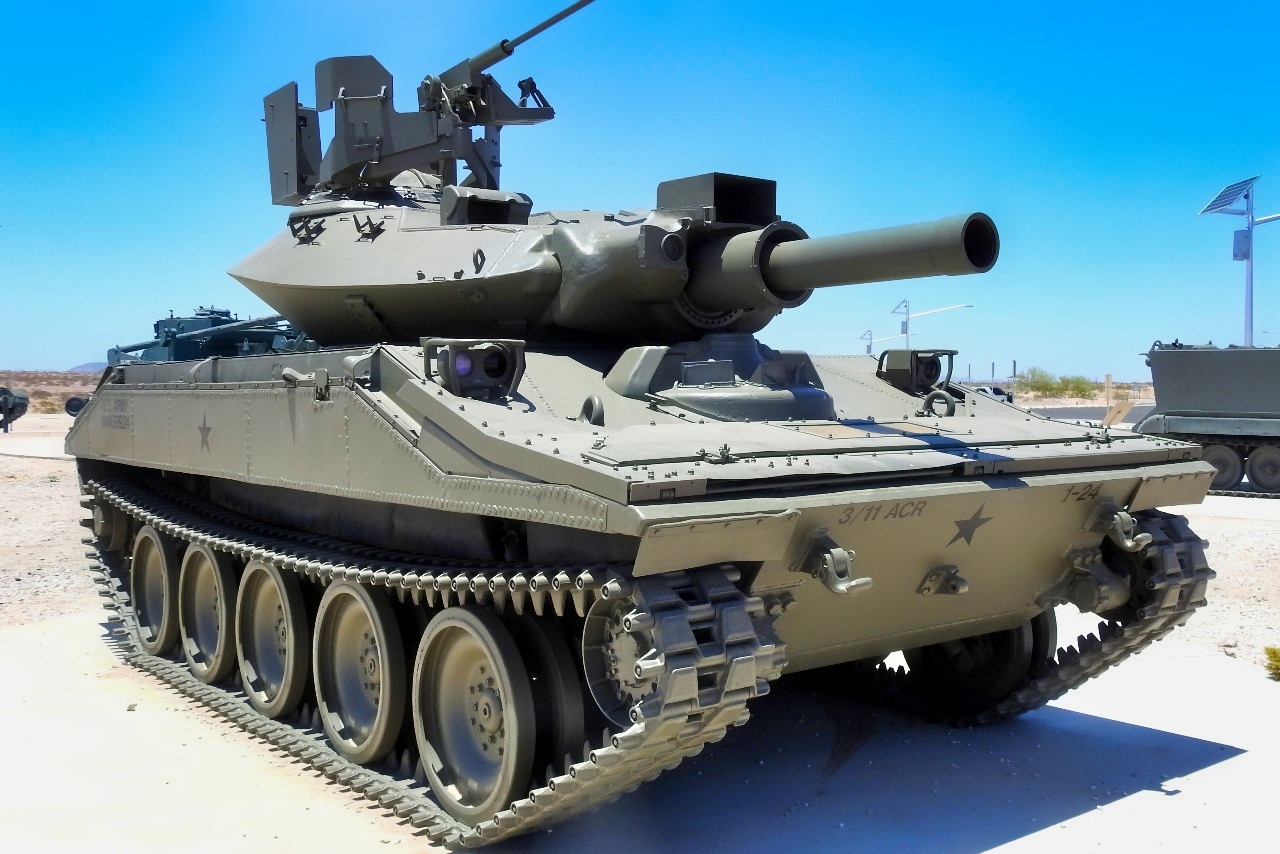
M551 Sheridan Light Tank. Image Credit: Creative Commons.
-But its thin aluminum armor, vulnerability to mines and RPGs, and volatile caseless ammunition were costly drawbacks.
-Built by Cadillac (1,662 produced), the four-man, 16.8-ton Sheridan proved both innovative and imperfect—an audacious attempt to marry mobility with outsized firepower that still turns heads in museums across North America.
M551 Sheridan Tank Explainer
The U.S. Army has a longstanding tradition of naming its tanks after its general officers. For example, the current M1 Abrams main battle tank (MBT) was named for Gen. Creighton Abrams of Vietnam War fame. There was the M26 Pershing, named for World War I’s John “Black Jack” Pershing. And there have been more tanks named for World War II icon George S. Patton than you can shake a stick at.
But at least a plurality, if not an outright majority, of American tanks have been named for generals who served in a war that took place five decades before the tank was even invented: the American Civil War.
National Security Journal now focuses on one such tank, the M551 Sheridan.
The Sheridan’s Historical Namesake
Along with M4 Sherman, the M551 Sheridan’s namesake doesn’t sit terribly well with American soldiers of Southern heritage. Both tanks were named for Union Army generals who were much hated by the Confederacy for the destruction they wrought.

M551 Sheridan U.S. Army. Image Credit: Creative Commons.
William Tecumseh Sherman had his March to the Sea, while Philip Henry Sheridan oversaw “The Burning,” which was a scorched-earth campaign that cast a swath of destruction of through the Shenandoah Valley, which was both the breadbasket of the Confederacy and a key transportation route for “Johnny Reb’s” war effort.
“Little Phil” is also none-too popular with Native Americans, as he pacified the Great Plains employing the same brutal tactics he’d used in the Shenandoah.
Love him or hate him, Gen. Sheridan was definitely effective at his job. And for all his battlefield brutality, he did also have a beneficent side; he oversaw military relief efforts during the Great Chicago Fire, and was largely responsible for the establishment of Yellowstone National Park.
M551 Sheridan Initial History
The M551 Sheridan Armored Reconnaissance/Airborne Assault Vehicle was considered a light tank. Indeed, it was the Army’s last attempt to build an effective light tank. Envisioned to be parachute-dropped and to swim across rivers, it was designed between 1959 and 1965, and it stayed in operational service from 1969 to 1997. Built by the Cadillac Motor Company, a total of 1,662 were produced.
Technical Specifications and Vital Stats
-Crew: 4 (commander, gunner, loader, and driver)
-Length: 20 feet 8 inches
-Width: 9 feet 2 inches
-Height: 9 feet 8 inches
-Mass: 16.8 tons
-Powerplant: 6-cylinder Detroit Diesel engine generating 300 horsepower
-Maximum Speed: 43 mph (paved roads); 3.6 mph (“swimming” mode)
-Operational Range: 350 miles
-Armament: 1 x M81E1 152mm main gun and 9 x MGM-51 Shillelagh antitank guided missiles (primary); 1 x .30 caliber M73/219 machine gun and one Browning M2 “Ma Deuce” .50 caliber machine gun (secondary)
The Shillelagh has the historic distinction of being the first gun-launched guided missile deployed by U.S. Army ground forces.
Operational Performance/Combat History
The Sheridan saw its first combat during the Vietnam War. The Army Historical Foundation assesses the tank’s performance in that conflict:
“The Sheridan demonstrated that it possessed a number of advantages and over the vehicles it replaced. It packed far heavier firepower than the ACAVs. The Sheridans HEAT [High Explosive Anti-Tank] round was extremely effective against pillboxes and bunkers, while the beehive and canister rounds could mow down waves of enemy infantry. It was faster and more maneuverable than the M48A3 [Patton tank]. It also had a reliable track system—few Sheridans ever threw a track.
“The Sheridan, however, also exhibited a number of problems. It was far more vulnerable to mines and rocket propelled grenades (RPGs) than the M48A3 (additional armor was added to the tank’s floor for protection against mines). In some cases, enemy heavy machine gun rounds penetrated the Sheridan’s light aluminum armor. Compounding this problem was the highly combustible caseless main gun ammunition, which if hit, could lead to a catastrophic explosion.”
Despite those shortcomings, the M551 went on to serve in combat during Operation Just Cause in Panama in 1989 and the Persian Gulf War in 1991. During the former conflict, the Sheridans demonstrated an ability to crash through and over most roadblocks and strong points and participated in assault on the Commandancia belonging to Panama Defense Forces under the command of strongman Manuel Noriega.
In the latter war, Sheridans serving with 3-73 Armor led the 82d Airborne Division’s advance into Iraq; to quote the Army Historical Foundation again, “Company A engaged Iraqi forces at Talil Air Base while the rest of the battalion was used in direct support to eliminate enemy bunkers. With the inactivation of 3-73 Armor in July 1997, the Sheridan ended its service as a front line tank.”
Where Are They Now?
At least 30 different venues, including museums and military installations, have preserved Sheridans for posterity.
All are located in the United States except for the Ontario Regiment RCAC Museum in Oshawa, Ontario.
Three stateside examples are the Airborne & Special Operations Museum in Fayetteville, North Carolina; the Museum of American Armor in Old Bethpage, New York; and the American Heritage Museum in Stow, Massachusetts. The M10 Booker, as shown below, tried to replace it. That failed.

A live fire demonstration of the Army’s newest and most modernized combat vehicle, the M10 Booker, marks the conclusion of the M10 Booker Dedication Ceremony at Aberdeen Proving Ground, in Aberdeen, Md., April 18, 2024. (U.S. Army photo by Cpl. Jonathon Downs)
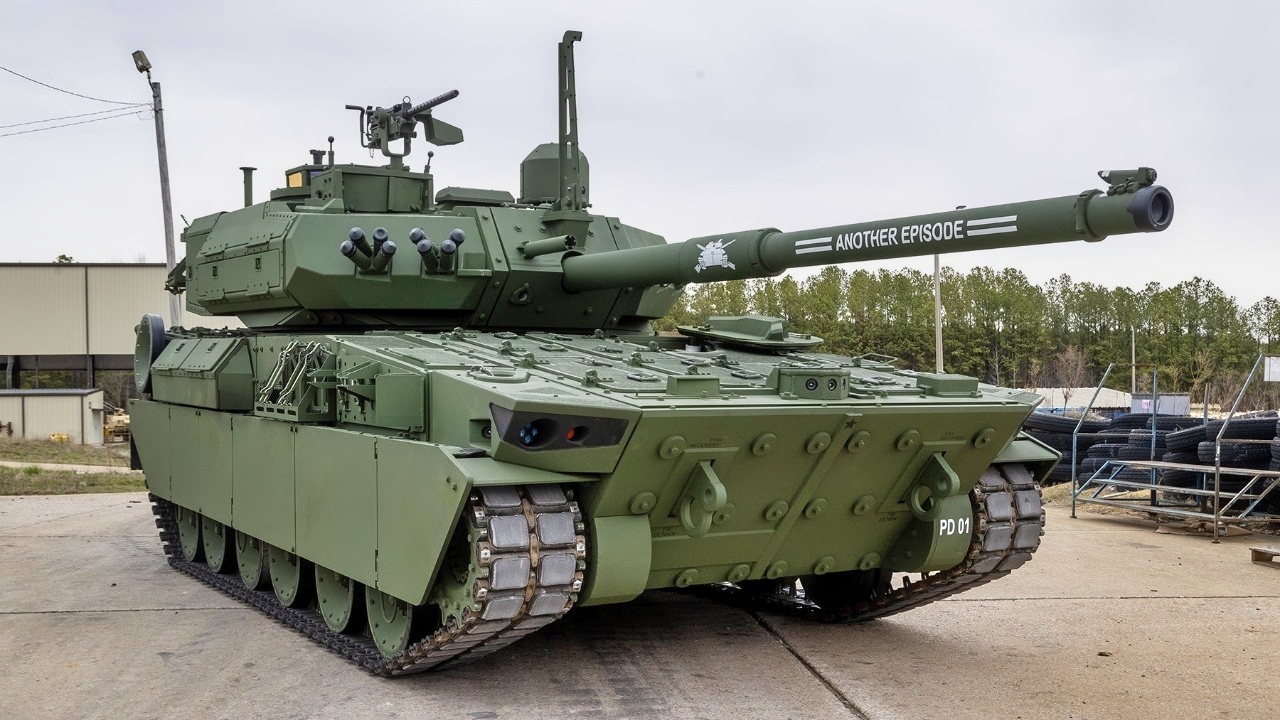
PD1 – Delivery of First Production Vehicle M10 Booker Combat Vehicle. Image Credit: U.S. Army.

The M10 Booker Combat Vehicle proudly displays its namesake on the gun tube during the Army Birthday Festival at the National Museum of the U.S. Army, June 10, 2023. The M10 Booker Combat Vehicle is named after two American service members: Pvt. Robert D. Booker, who posthumously received the Medal of Honor for actions in World War II, and Staff Sgt. Stevon A. Booker, who posthumously received the Distinguished Service Cross for actions during Operation Iraqi Freedom. Their stories and actions articulate the Army’s need for the M10 Booker Combat Vehicle, an infantry assault vehicle that will provide protection and lethality to destroy threats like the ones that took the lives of these two Soldiers. (U.S. Army photo by Bernardo Fuller)

M10 Booker. Image Credit: Creative Commons.
About the Author: Christian D. Orr, Defense Expert
Christian D. Orr is a Senior Defense Editor. He is a former Air Force Security Forces officer, Federal law enforcement officer, and private military contractor (with assignments worked in Iraq, the United Arab Emirates, Kosovo, Japan, Germany, and the Pentagon). Chris holds a B.A. in International Relations from the University of Southern California (USC) and an M.A. in Intelligence Studies (concentration in Terrorism Studies) from American Military University (AMU). He is also the author of the newly published book “Five Decades of a Fabulous Firearm: Celebrating the 50th Anniversary of the Beretta 92 Pistol Series.”


Stephen
November 6, 2025 at 10:36 pm
No ! Not true.i was gunner on M60 tank waiting on Sheridans coming straight at my position . They were so fast I couldn’t get ballistic solution on them . They were moving ! Weaving back and fro down in Ditch and back dow closing on me . I cant get laz on them commander.
Michael Mineni
November 12, 2025 at 5:43 pm
SGT Keith Hudson is the Soldier in the phot next to A30 (Sheridan)