


Key Points and Summary – The M551 Sheridan was the Army’s answer to a real problem: light and airborne units needed organic, protected, direct fire at the speed they deploy.
-Built around a 152 mm gun/launcher in an aluminum hull, it offered big HE, canister, and a missile option in a package that could air-drop or air-land with paratroopers.
-In Vietnam it was fragile but timely; in Panama it cracked bunkers and roadblocks at the speed of the jump; in Desert Storm it screened and deterred.
-Retired in the 1990s, it has resisted replacement: weight, survivability, drones, and budgets have tripped successors. The requirement endures—the implementation must evolve.
M551 Sheridan: The Little Tank That Carried A Big Burden
By the late 1950s the U.S. Army faced a nagging problem: airborne and light infantry could deploy fast, but once they hit the ground they lacked organic, protected, direct fire to crack bunkers, roadblocks, or enemy armored cars. Borrowing heavy battalions solved the problem weeks later—not when platoons were pinned down in a city block or jungle treeline.
The Army wanted a lightweight, air-deliverable vehicle that brought a real cannon, some protection, and enough mobility to run with paratroopers.
That requirement—rapid lift over perfect survivability—produced the M551 Sheridan: a compact, aluminum-hulled “light tank” built around an unconventional 152 mm gun/launcher and a promise that it could go where heavy armor couldn’t and still hit hard.
From Drawing Board To Fielding
The Sheridan’s central gamble was its weapon: a 152 mm gun/launcher that could fire both short, heavy conventional rounds for close support and the Shillelagh guided missile for long-range anti-armor shots.
Pair that with a hull light enough for airdrop or air-land delivery, flotation gear for river crossings, and a crew of four in a turret that—on paper—gave infantry brigades their missing punch. The trade space was brutal. Aluminum armor held weight down but could not shrug off big guns. A large, low-pressure cannon promised thumping HE at short range, but its recoil, blast, and propellant gasses pushed crews and components hard.
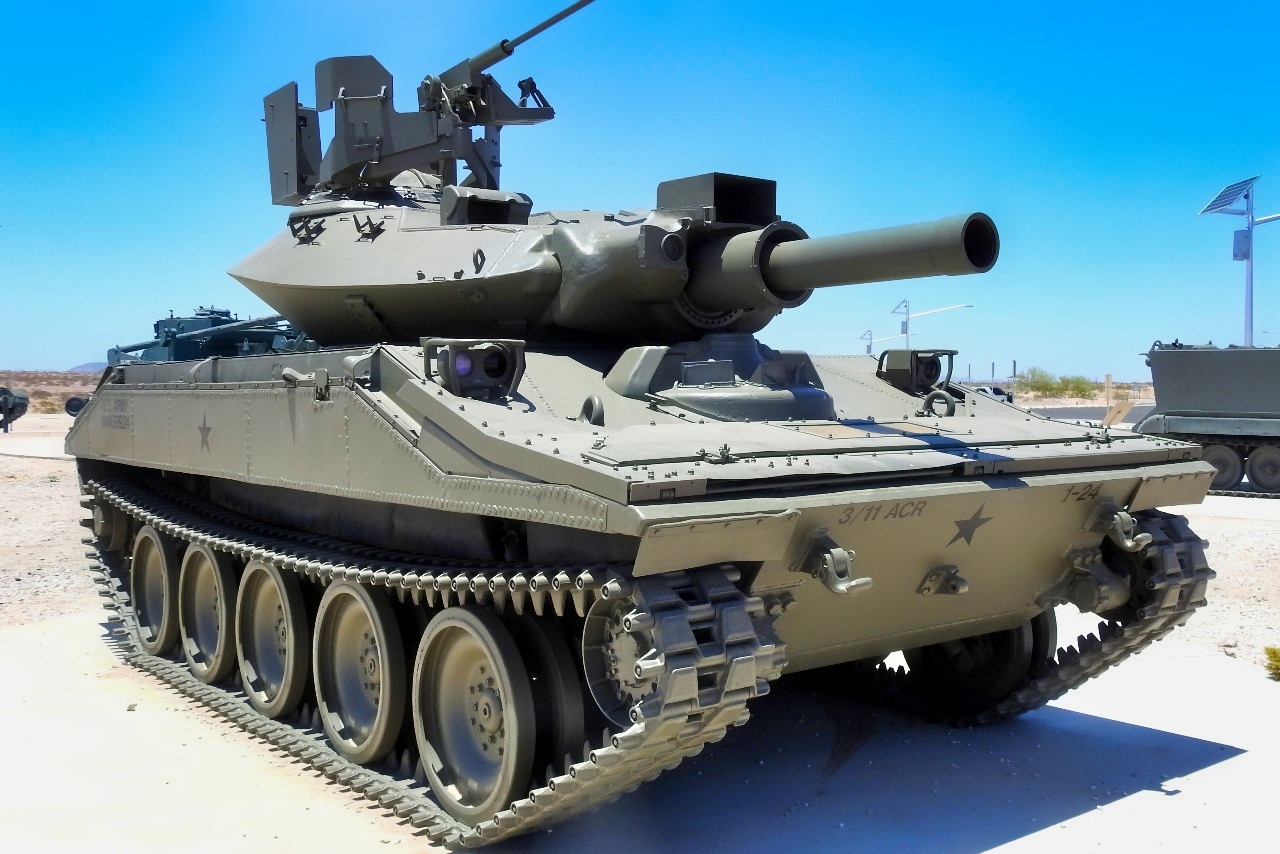
M551 Sheridan Light Tank. Image Credit: Creative Commons.
The missile extended reach, but it added electronics and maintenance complexity to a chassis that was supposed to be simple. Even with those compromises, the Army judged that the mission—fast, organic firepower for light forces—was worth the risk and pushed the M551 into service in the late 1960s.
What The M551 Sheridan Brought To The Fight
When everything worked, the Sheridan offered an unusual mix. It could sprint and turn with light formations, ford rivers with a flotation screen, and deliver big-bore HE against bunkers, treelines, and roadblocks. Its canister (“beehive”) and HEAT rounds were terrifying at close range, and the missile, when aligned and functioning, gave a theoretical standoff kill against enemy tanks.
The aluminum hull kept weight down for bridges and air transport; a compact profile helped in concealment; and the crew enjoyed modern (for the time) night-fighting aids. Most importantly, it lived inside the light force’s logistics and training system. Commanders didn’t have to request tanks—they had them, trained with them, and built tactics around them.
Vietnam: Brutal Lessons
Combat in Vietnam revealed both the Sheridan’s strengths and its unforgiving edges. In cavalry units and airborne brigades, Sheridans proved agile fire-support platforms. Their canister and HE rounds shredded ambushes, cut landing-zone perimeters out of thick vegetation, and punched through bunkers that 106 mm recoilless rifles struggled with. They were small enough to move on narrow dikes and jungle tracks, and their punch often arrived minutes after contact, not hours.
Costs were real. Mines and RPGs punished the aluminum hull, and internal fires could become catastrophic—especially with combustible-case ammunition stacked in a tight compartment. The 152 mm gun’s blast and gas were hard on crews and optics; sustained firing could fatigue components; and the missile system was seldom used in the jungle’s short-range chaos, where line-of-sight and stable guidance were rare.
Field units frequently de-emphasized the missile gear, leaning on conventional rounds and treating the Sheridan as a direct-fire assault gun. The verdict from Vietnam was nuanced: the Sheridan was fragile but fast, temperamental but timely—a tank that often arrived in time to matter, yet asked crews to accept risks a heavy battalion would not.

M551 Sheridan U.S. Army. Image Credit: Creative Commons.
Between Wars: Airdrop, Amphib, And The 82nd’s Tank
After Vietnam the Army kept the M551 Sheridan where it had always made the most sense: with airborne forces.
The 82nd Airborne Division trained to air-drop or quickly air-land M551s so paratroopers had immediate shock and breach capability. The vehicle’s flotation gear and light axle loads were useful in austere theaters with weak bridges and fords that would stop an Abrams cold. Meanwhile, the tank force modernized around M60s and then M1s; the Sheridan existed in a parallel universe—expeditionary, niche, and indispensable to the units that used it.
Panama: Fire Support At The Speed Of Airborne
Operation Just Cause (1989) validated the M551 Sheridan in the role it was born for. When the 82nd jumped into Panama, M551s followed fast, rolling straight from pallets to contact. The tanks blasted barracks, roadblocks, and hardened positions with HE and canister, pried open intersections, and provided a psychological edge in crowded urban fights where infantry alone can stall.
The vehicle’s small size and mobility were assets in tight streets. Crews and rifle platoons who had trained together at Fort Bragg now moved as a team in a real city under fire—proof that organic armor inside a light division changes the tempo and risk calculus from the first hour.
Desert Storm: Screening And Presence
In 1991, Sheridan battalions deployed with the 82nd to the Gulf. They did not duel Republican Guard tank brigades; that was never the point. Instead, the vehicles served in screening and security roles, guarded assembly areas, and offered a rapidly positioned direct-fire deterrent as the coalition built combat power. Against modern tanks in the open, the M551 would have been outmatched; as a light cavalry tool under a joint umbrella, it was useful and reassuring to commanders who needed a gun now, not after a heavy brigade finished a road march.
Why The Sheridan Was Retired
By the 1990s the math turned against the M551. The gun/launcher remained maintenance-intensive; the missile system felt like a relic next to modern ATGMs carried by infantry; survivability against proliferating top-attack and tandem-warhead threats looked grim; and the vehicle’s age translated into rising sustainment bills.
Simultaneously, the Army’s heavy force had matured into a combined-arms machine with Abrams, Bradleys, and attack aviation—and budget priorities favored upgrading that core rather than pouring more money into a niche platform. The Sheridan left frontline service in the mid-1990s, though many hulls gained an afterlife at the training centers as “vis-mod” enemy armor—a final service teaching new generations how to fight tanks.
Why It Has Been So Hard To Replace
If the Sheridan’s shortcomings were obvious, so was its value proposition: a gun inside light formations that arrives with them. Replacing that has proven hard for three reasons.
First, weight versus survivability is unforgiving. To survive modern battlefields, a vehicle wants more armor, active protection, and better sensors; all add pounds. Pounds break the airdrop dream and strain the roads, bridges, and aircraft that make a light force useful.
The Army’s 1990s-era Armored Gun System (XM8) came closest—a 105 mm, airdroppable tank—before budget cuts killed it at the goal line. Later, the Stryker Mobile Gun System put a 105 mm on a wheeled chassis, but it brought autoloader and reliability headaches, limited ammo carriage, and no airdrop; it has since been retired.
Most recently, the Mobile Protected Firepower effort produced a capable M10 Booker light tank for infantry brigades—more protection, better fire control, and modern optics—but at a weight that pushes the boundaries of the original “light” idea and, as the Army re-prioritized for the drone-rich fight, the program was discontinued. Each attempt solved one side of the triangle (firepower and some protection) while breaking the other (deployability).
Second, the battlefield changed. Precision drones, top-attack munitions, and cheap sensors punish any vehicle that lingers. A light tank must now assume it will be seen from above and attacked from odd angles, demanding active protection systems, signature discipline, and decoys—the kinds of features that eat weight and power budgets the way armor once did.
Third, the Army’s doctrine evolved. Light brigades now generate precision fires with loitering munitions and team with robotic breachers and engineers; attack aviation and joint fires arrive faster than in 1969.
Those tools don’t erase the need for immediate, breach-at-the-corner firepower, but they reduce the number of fights where a manned light tank is the only answer.
What The Army Learned
The Sheridan left five durable lessons:
Own the first five minutes. Infantry who can call a gun in the first minutes of contact take fewer casualties. Whether the answer is a light tank, a robotic assault gun, or a precision loiterer, the effect must be organic to the brigade.
Design to the infrastructure. Bridges, ramps, aircraft, and roads veto wishful thinking. If a vehicle can’t move on the routes your brigade will actually use, it’s a liability.
Simplicity matters in light forces. Maintenance and resupply loads kill tempo. A light formation needs sturdy, fixable systems more than it needs exquisite features.
Train together. The Sheridan worked best where tank crews and paratroopers drilled the same lanes, radio calls, and breach drills for months. The tool is only as good as the team.
Assume the drone. Any future light direct-fire vehicle must treat counter-UAS and signature control as core design goals, not bolt-ons.
In 4 Words: Imperfect Was Good Enough
The M551 Sheridan was an imperfect answer that filled a real need: put a smashing, protected gun in the hands of airborne and light infantry at the speed they deploy. It was too fragile to be anyone’s idea of a main battle tank and too temperamental to be loved by every crew that worked on it.
But it made a difference where it counted—on jungle trails, Panamanian streets, and desert assembly areas—because it was there when rifle companies needed cannons, not promises. Replacing that effect has proven harder than replacing the vehicle.
The Army’s next solution—manned, unmanned, or mixed—will succeed only if it stays ruthlessly true to the Sheridan’s original purpose: give light brigades immediate, reliable, and repeatable direct fire without dragging them into heavy logistics. Get that right, and the lessons bought in aluminum and sweat won’t have been wasted.
About the Author: Harry J. Kazianis
Harry J. Kazianis (@Grecianformula) is Editor-In-Chief and President of National Security Journal. He was the former Senior Director of National Security Affairs at the Center for the National Interest (CFTNI), a foreign policy think tank founded by Richard Nixon based in Washington, DC. Harry has over a decade of experience in think tanks and national security publishing. His ideas have been published in the NY Times, The Washington Post, The Wall Street Journal, CNN, and many other outlets worldwide. He has held positions at CSIS, the Heritage Foundation, the University of Nottingham, and several other institutions related to national security research and studies. He is the former Executive Editor of the National Interest and the Diplomat. He holds a Master’s degree focusing on international affairs from Harvard University.
More Military
M10 Booker: The Army’s Light Tank Disaster
The U.S. Navy’s Constellation-Class Frigate: Is It Beyond Saving?
Boeing’s F-47 NGAD: Soon To Get Injection of Ferrari F-35 DNA?


