

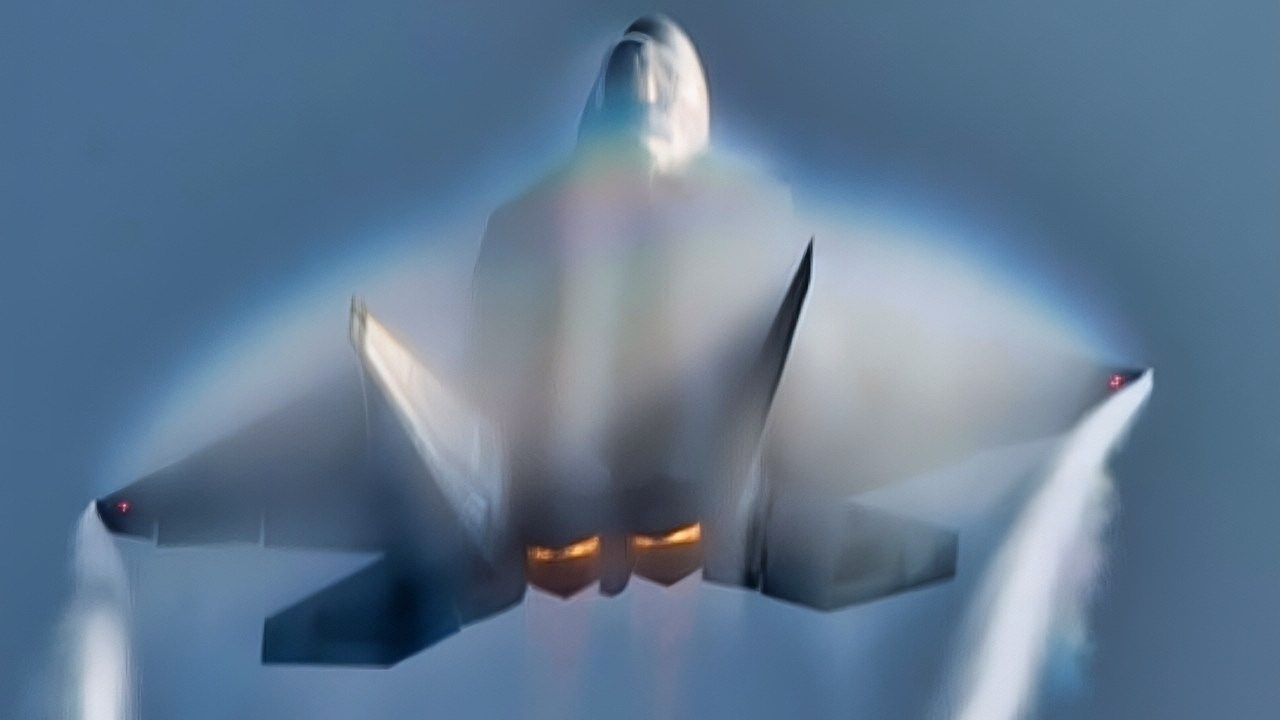
The F-22’s New Fuel Tanks Don’t Have to Be Dropped Before Combat — That Single Change Adds 850 Nautical Miles of Range and Solves the Raptor’s Biggest Weakness
The US Air Force’s fifth-generation fighter, the F-22 Raptor, remains the world’s stealthiest aircraft. Introduced in 2005, it is the world’s first mass-produced fifth-generation fighter jet and has been a cornerstone of the US Air Force’s air superiority strategy.
Currently, there are 178 F-22 fighters in service. And it is still the benchmark against which all fighters are measured.

A U.S. Air Force F-22A Raptor aircraft flies over Colorado after in-flight refueling by a KC-135R Stratotanker aircraft from the 336th Air Refueling Squadron on May 30, 2006. The Raptor is attached to the 53rd Test and Evaluation Group.
(DoD photo by Tech. Sgt. Rick Sforza, U.S. Air Force. (Released))
The issue with the F-22 is the cost to keep it flying. It has always been a very expensive aircraft to maintain, and those expenses will only continue to grow as the aircraft and airframe age.
How Expensive Is It To Keep The Raptor Flying?
The maintenance and repair of the F-22 Raptors are exceptionally expensive, with operating costs exceeding $85,000 per flight hour and requiring roughly 10–30 hours of maintenance for every hour flown.
The high cost is driven by fragile, high-maintenance radar-absorbent coatings, specialized maintenance infrastructure, limited spare parts from a small fleet of 178 aircraft in service, and high-intensity maintenance needs.
At roughly $85,325 per flight hour, the F-22 is roughly four times more expensive to fly than the F-16 and double the cost of the F-35A.
Keeping the remaining Raptors operational until 2030 is projected to cost the Air Force more than $9 billion in sustainment.
The high cost of maintaining F-22 capabilities is a factor in the move towards the future Next Generation Air Dominance (NGAD) (F-47) program.
FlyAFighterJet wrote that, “One of the most cost-intensive technical elements of the F-22 is its stealth architecture: optimized structure, composite materials, anti-radar coverage, serpentine air intakes, and RAM (Radar Absorbent Material) coatings.

F-22 and F-35 and the Flag. Image Credit: Creative Commons.
“Stealth coating is not limited to ‘painting’ the aircraft: it is an active/passive system, subject to mechanical wear, hostile environments (sand, humidity, sea salt), thermal stresses associated with supercruise (high speed without afterburner), and reduced infrared signature requirements. A 2009 source indicates that one-third of F-22 maintenance activity was related to stealth systems, including the aircraft’s skin.
“These coatings require regular inspection, frequent repairs, controlled environments for application, and parts that are often produced in small batches. As a result, every time the aircraft is flown, comes into contact with the ground or air, or suffers minor damage, the repair cycle is long and costly. In the early days, maintenance times of more than 20-30 hours per flight hour were reported.”
With the air campaign in Iran as intense as it has been, the costs of keeping the Raptors flying will increase.
However, Upgrades By The USAF Keep The Raptors’ Talons Sharp:
While the Raptor was already supposed to be retired by now, the Air Force is constantly upgrading the aircraft with enhancements that will keep it on top of its game until the Generation Air Dominance (NGAD) program, slated for the 2030s, is ready.
And with an $11 billion upgrade that includes conformal, stealthy new fuel tanks and infrared search-and-track pods being installed further outboard on the wings, the Raptor has increased its combat range without sacrificing its incredible stealth profile.
Lockheed Martin unveiled a model of the improved F-22 “Raptor 2.0” at the Air and Space Forces Association Annual Warfare Symposium this week.
Fuel Tanks Can Now Fly Into Combat and Have Increased The Range:
One criticism against the Raptor has always been its short range. Raptors have carried 600-gallon fuel tanks under each wing to increase their ferry range, but these had to be dropped if the Raptors went into combat. The drop tanks also severely affected the Raptor’s stealth capability.

F-22 Raptor National Security Journal Image

F-22 Raptor at US Air Force Museum. Image taken by National Security Journal.
The F-22’s unrefueled combat range was 590 nautical miles. However, these new drop tanks, which Lockheed says have been developed after years of flight testing, can be flown directly into combat without being jettisoned.
The Low Drag Tank and Pylon (LDTP) program is a Lockheed Martin effort to develop stealth-compatible external fuel tanks for the F-22 Raptor, significantly extending its combat range for Pacific operations without sacrificing low-observability. These tanks feature a low-drag, sleek design and can be jettisoned to leave a clean, stealthy aircraft profile or remain.
“These can go into combat,” says Katie Ciccarino, vice-president of Lockheed’s F-22 program.
“They are droppable if they need to be,” she added. “But the idea would be not to drop them, and to retain them throughout whatever the pilot is doing and then coming home and being able to use them again.”
Both the current and new external tanks provide F-22s with an extra 850 nautical miles (1,570km) of range, according to Lockheed.
New IRST Sensors, More Survivability, More Lethality:
Lockheed Martin has upgraded its F-22 Raptor with upgraded infrared threat-detection sensors. This newest enhancement will improve the aircraft’s survivability and lethality by adding an infrared search and track (IRST) capability.
The inclusion of infrared search-and-track pods enables passive detection and tracking of airborne targets by sensing thermal signatures, eliminating the need to use radar signals that could reveal the aircraft’s position.
Although mounted externally, the pods appear optimized for stealth management. Although any externally mounted equipment will affect stealth, the trade-off in capability is considered worth it. In environments characterized by advanced electronic warfare and anti-access strategies, passive sensing enhances survivability and situational awareness.
TWZ pointed out that “an IRST sensor is useful for detecting stealthy targets, something that is also becoming increasingly relevant in the Pacific region. There is also the option of IRST-equipped Raptors sharing their sensor data with ‘clean’ F-22s, enhancing their situational awareness.”
The F-22 Remains The Standard That Aircraft Are Measured Against:
Whenever a US or NATO ally needs support to protect its borders or airspace, the Air Force sends the F-22 to put out fires, project power, and deter aggression.
In April 2023, F-22 fighters were dispatched from Poland to Amari Air Base in Estonia to bolster NATO’s Air Shielding mission and deter Russian aggression in the Baltic Sea region.
“It cannot be matched by any known or projected fighter aircraft, making it a highly strategic platform to support NATO Air Shielding,” the USAF said.

F-22 Raptor Sitting in AF Museum National Security Journal Photo. Image Credit: Harry J. Kazianis
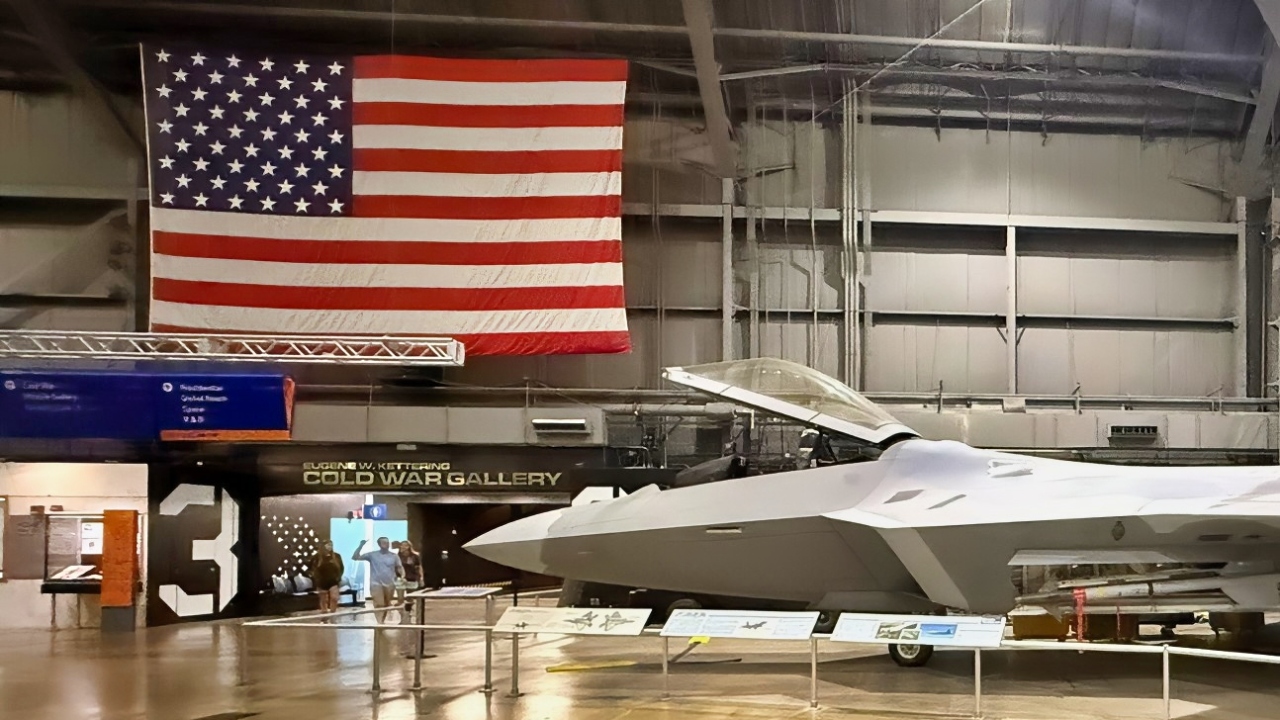
F-22A Raptor in the Air Force Museum NSJ Photo.
In November, the US deployed F-22 Raptors, and later F-35s, to Kadena Air Base in Japan as a show of force against China.
Kadena is located in Okinawa, one of Japan’s southwest Ryukyu islands that form the first island chain. This U.S. defense concept links Japan, Taiwan, and the Philippines, pooling the resources of allied nations to contain the Chinese military in the region. And it is only 370 miles from Taiwan.
F-22s were used in the US airstrikes against Iran’s nuclear facilities in June, as well as the operation in Venezuela to remove strongman Nicolas Maduro. And it has been used again over Iran since late February.
The Raptor Is Operating With Collarborative Combat Aircraft:
The F-22 Raptor has it all: stealth, supercruise capabilities, and integrated avionics. And it just got better. It is equipped with an advanced sensor suite to detect, identify, and engage threats before they can be detected.

A U.S. Air Force F-22 Raptor assigned to the 422nd Test and Evaluation Squadron at Nellis Air Force Base, Nevada, is seen on the flightline during Weapons System Evaluation Program 25.09 at Tyndall Air Force Base, Florida, Sep. 8, 2025. WSEPs are formal, two-week evaluation exercises designed to test a squadron’s capabilities to conduct live-fire weapons systems during air-to-air combat training missions. (U.S. Air Force photo by Airman 1st Class Zeeshan Naeem)
The cockpit design and advancements in sensor fusion have notably improved pilots’ situational awareness. Another contract involves upgrading the Raptor’s countermeasures.
And the Raptor is the first aircraft to control the Collaborative Combat Aircraft in flight testing.
An F-22 pilot controlled an MQ-20 drone from the fighter’s cockpit. General Atomics Aeronautical Systems (GA-ASI) MQ-20 Avenger uncrewed aircraft performed a test mission with an Air Force F-22 stealth fighter as the company separately plans long-range standoff weapons for the MQ-9B.
Flight Global wrote that the “F-22 acted as a command aircraft and the MQ-20 demonstrated the ability to receive and execute commands through a tactical data link.
“The MQ-20 was able to send messages to the F-22, which in turn sent commands via the Autonodyne Bashi Pilot Vehicle Interface (PVI), software that lets a human pilot in a manned aircraft command and task autonomous uncrewed aircraft during missions.”
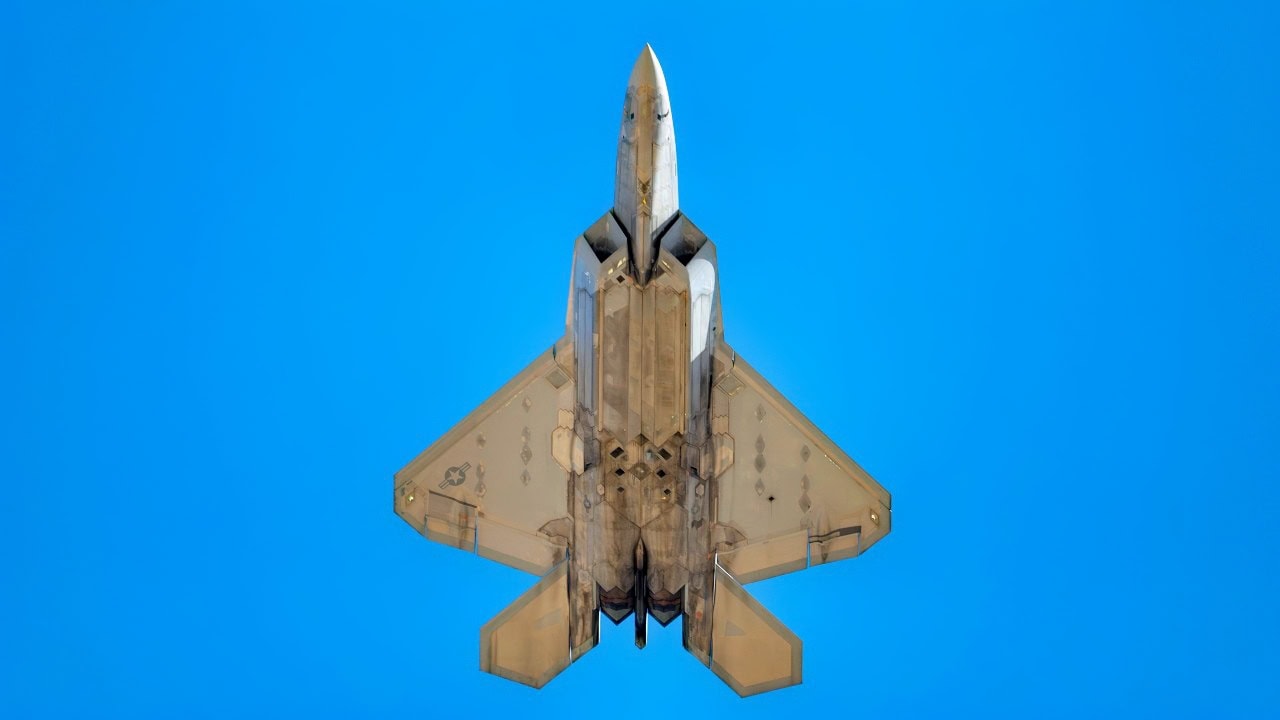
F-22 Raptor High in the Sky. Image Credit: Creative Commons.
The upgrades to the F-22 will help preserve the aircraft’s air-superiority fighter role and competitive edge as the US military confronts more advanced threats from its enemies, especially in the Indo-Pacific, where China poses a particular challenge.
The upgrades are impressive for an aircraft already impressive. But budgetary woes stemming from the F-47 program will keep the F-22 a very expensive option until the new fighters are ready to take over.
About the Author: Steve Balestrieri
Steve Balestrieri is a National Security Columnist. He served as a US Army Special Forces NCO and Warrant Officer. In addition to writing on defense, he covers the NFL for PatsFans.com and is a member of the Pro Football Writers of America (PFWA). His work was regularly featured in many military publications.


Andy
April 7, 2026 at 2:48 pm
One of the photos captioned:” The F-22 Raptor performs a demonstration at the Mather Airshow in Sacramento, California, Sept. 23, 2018 ” shows a photo of a single engine F-35. That kind of error makes it hard to read the article and further. I worked on the initial materials development for the F-22 at Lockheed in Burbank ~1986-88