


Key Points and Summary – The U.S. Navy’s Ford-class supercarriers are plagued by significant problems that have caused major delays and cost overruns.
-Two revolutionary systems, the Electromagnetic Aircraft Launch System (EMALS) and the Advanced Arresting Gear (AAG), have suffered persistent reliability failures.
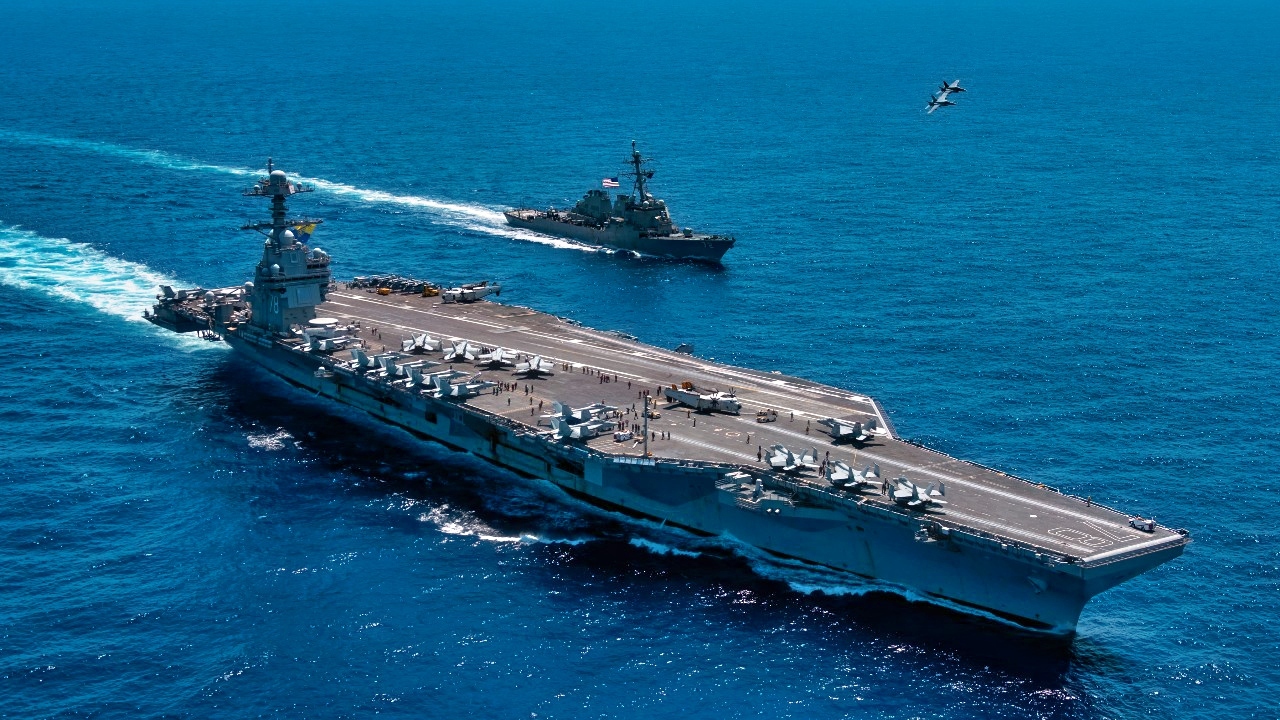
An F/A-18F Super Hornet, attached to the “Blacklions” of Strike Fighter Squadron (VFA) 213 and a F/A-18E Super Hornet, attached to the “Golden Warriors” of Strike Fighter Squadron (VFA) 87 fly over the world’s largest aircraft carrier, USS Gerald R. Ford (CVN 78), the Arleigh Burke-class guided-missile destroyer USS Mahan (DDG 72), April 11, 2025. The Gerald R. Ford Carrier Strike Group is underway in the Atlantic Ocean completing integrated naval warfighting training. Composite Training Unit Exercise (COMPTUEX) is the Joint Force’s most complex integrated training event and prepares naval task forces for sustained high-end Joint and combined combat. Integrated naval training provides America’s civilian leaders and commanders highly-capable forces that deter adversaries, underpin American security and economic prosperity, and reassure Allies and partners. (U.S. Navy photo by Mass Communication Specialist 2nd Class Maxwell Orlosky

The world’s largest aircraft carrier USS Gerald R. Ford (CVN) 78 and the USNS Laramie (T-AO-203) conduct a refueling-at-sea in the Eastern Mediterranean Sea, Oct. 11, 2023. USS Gerald R. Ford is the Navy’s newest and most advanced aircraft carrier, representing a generational leap in the U.S. Navy’s capacity to project power on a global scale. The Gerald R. Ford Carrier Strike Group is currently operating in the Eastern Mediterranean Sea, at direction of the Secretary of Defense. The U.S. maintains forward deployed ready and postured forces to deter aggression and support security and stability around the world.(U.S. Navy photo by Mass Communication Specialist 2nd Class Jackson Adkins)
-The integration of 23 new technologies simultaneously, including advanced weapons elevators, has proven extremely challenging.
-Compounding these technical issues are the staggering costs, with the lead ship exceeding $13 billion.
-Furthermore, the carriers face increasing vulnerability to modern anti-ship missiles and cyber threats, raising fundamental questions about their survivability and strategic value.
The Ford-Class Aircaft Carrier Problem?
The Gerald R. Ford-Class supercarriers are the newest class of aircraft carriers intended for the United States Navy. The new vessels are intended to replace the older Nimitz-class and serve as the Navy’s main carriers until their eventual replacement.
Despite high hopes, construction on these ships has not gone as smoothly as hoped. From technical difficulties and cost overruns, to shifting defense priorities, a number of factors have contributed to the slow and troubled construction of these carriers.
EMALS Reliability Issues
One of the most prominent issues has been the reliability of the Electromagnetic Aircraft Launch System, or EMALS. This system was introduced to replace the traditional steam catapults used on previous carriers.
EMALS is intended to launch aircraft more smoothly and with less stress on airframes, while also supporting a broader range of aircraft weights, including lighter unmanned aerial vehicles. However, during testing and early deployment, EMALS has been plagued by frequent technical failures.
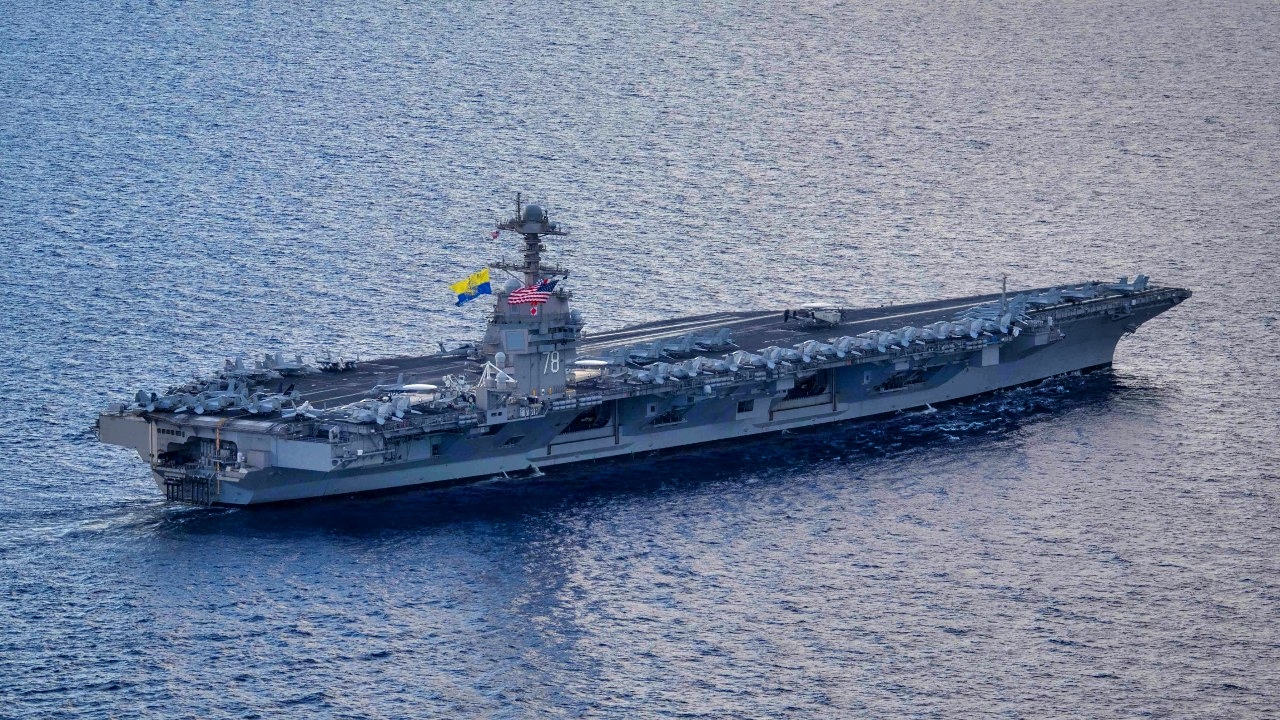
The world’s largest aircraft carrier USS Gerald R. Ford (CVN 78) sails in the Mediterranean Sea, Dec. 31, 2023. The U.S. maintains forward deployed, ready, and postured forces to deter aggression and support security and stability around the world. (U.S. Navy photo by Mass Communication Specialist 2nd Class Jacob Mattingly)
Reports from the Pentagon and the Government Accountability Office have documented numerous breakdowns and a lack of operational reliability. These failures have not only delayed the system’s full implementation but have also impacted the carrier’s ability to meet its promised sortie generation rate.
Maintenance of EMALS has also proven to be more complex than anticipated, requiring specialized knowledge and tools that are not yet widely available among carrier crews. Although improvements have been made over time, EMALS remains a source of concern for the Navy and defense analysts alike.
Technical Difficulties with the Arresting Gear
Closely related to EMALS is the Advanced Arresting Gear, or AAG, which is designed to recover aircraft more efficiently and safely than the legacy hydraulic arresting systems. Like EMALS, AAG relies heavily on electromagnetic and software-driven components.
Unfortunately, AAG has also suffered from reliability issues, including frequent breakdowns and software integration problems.
During early testing, the system struggled to safely recover lighter aircraft, such as drones and trainer jets, which limited its operational flexibility. The complexity of the system has made troubleshooting and repairs difficult, and its performance has not consistently met expectations.
These problems have compounded the challenges posed by EMALS, further hindering the Ford-class’s ability to conduct sustained flight operations and meet its operational goals.
High Costs and Budget Constraints
Another major problem with the Ford-class carriers is their cost. The lead ship in the class, the USS Gerald R. Ford (CVN-78), has cost over $13 billion, making it one of the most expensive military platforms ever built.
This figure does not include the cost of the air wing or the support infrastructure required to operate the carrier. Initial cost estimates have ballooned due to technical challenges, redesigns, and delays.
Although the Navy has attempted to reduce costs for subsequent ships in the class, the overall expense remains high. This has placed a significant strain on the Navy’s shipbuilding budget and has raised concerns about opportunity costs.
Critics argue that the resources devoted to the Ford-class could have been used to develop more distributed and survivable platforms, such as smaller carriers, unmanned systems, or missile ships.
In an era of budget constraints and shifting defense priorities, the financial burden of the Ford-class raises strategic questions about the sustainability of carrier-based power projection.
Too Many Technologies in One Package?
The integration of new technologies and systems has also proven to be a major challenge for the Ford-class. These carriers incorporate more than 23 new technologies, including dual-band radar, improved nuclear reactors, and advanced weapons elevators.
While these innovations promise long-term benefits, their integration has been fraught with difficulties. One of the most notable examples is the Advanced Weapons Elevators (AWEs), which are designed to move munitions more efficiently from storage to the flight deck.
These elevators were not fully operational at the time of the USS Gerald R. Ford’s commissioning, and their complex electromagnetic design caused significant delays.
The introduction of so many new systems at once has created a steep learning curve for sailors, requiring extensive retraining and adaptation. Ensuring that all systems work together seamlessly has been a major challenge, with software bugs and hardware mismatches causing operational disruptions.
These integration issues have delayed the carrier’s full deployment and reduced its readiness, highlighting the risks of introducing too many new technologies simultaneously.
Easy Targets?
This applies to all carriers in operation today, but it is especially prudent to think about for America’s future carrier fleet. Aircraft carriers have long been symbols of American naval strength, but the strategic environment is starting to change in unforeseen ways.
The Ford-class, despite its advanced capabilities, faces growing threats from anti-access/area denial (A2/AD) systems.
Nations such as China and Russia have developed long-range anti-ship missiles, like the DF-21D and DF-26, which can target carriers from hundreds of miles away. These weapons pose a significant threat to large, conspicuous platforms like the Ford-class.
Additionally, the carrier’s reliance on digital systems makes it a potential target for cyberattacks, which could disable critical functions or compromise operational security.
The concentration of so much capability in a single platform also creates a high-value target; the loss of a Ford-class carrier in combat would be a strategic catastrophe.
These vulnerabilities challenge the traditional role of carriers in power projection and have prompted the Navy to explore alternative concepts such as distributed lethality and unmanned systems.
About the Author: Isaac Seitz
Isaac Seitz, a Defense Columnist, graduated from Patrick Henry College’s Strategic Intelligence and National Security program. He has also studied Russian at Middlebury Language Schools and has worked as an intelligence Analyst in the private sector.
More Military
Russia’s ‘Black Hole’ Kilo-Class Submarine Has a Message for the U.S. Navy
How a Russian Pilot Defected With A Mach 2 MiG-29 Fulcrum Fighter
The F-4 Phantom II Has a Message for Any Air Force on Earth
The F-16 Fighting Falcon Fighter Has a Message For Any Air Force on Earth


William Staton
October 24, 2025 at 3:35 pm
Why can’t the US Navy use the Iron Dome Software hook it to the Laser to stop unlimited incoming threats. Also, use the Iron Dome Software with a laser undersea to stop treats undersea. In that way the Air Craft Carrier is protected against unlimited threats in the air and under the sea. Can this be done?
William Staton
911 President