

Summary and Key Points: As of 2026, the F-16 Fighting Falcon remains a cornerstone of global airpower despite being nearly 48 years old.
-Through aggressive Service Life Extension Programs (SLEP), the U.S. Air Force has extended the service life of airframes from 8,000 to 12,000 flight hours, pushing potential retirement into the 2040s.

F-16 Logo on F-16A in NYC. Image Credit: National Security Journal.
-The modern “Viper” (F-16V) variant features AESA radars and digital electronic warfare suites that bear little internal resemblance to the 1970s originals.
-While the oldest blocks are being retired, the F-16’s role as a cost-effective multirole partner to 5th-gen stealth fighters ensures its relevance for decades to come.
How the 48-Year-Old F-16 is Outlasting the Jets Designed to Replace It
The F-16 Fighting Falcon was first built in the 1970s and introduced into service in 1978, making it almost 48 years old. The aircraft was built during the Cold War, leading to the question: How much longer will it remain in service?
Continuous upgrades to the aircraft have ensured that the F-16 remains a relevant asset for the United States Air Force and air forces around the world for decades to come.
Development of the F-16
The original concept behind the F-16 was rooted in lessons learned from Vietnam and from the energy-maneuverability theories advanced by reform-minded fighter pilots and engineers.
The aircraft was meant to be agile, simple, and survivable, with a strong emphasis on pilot visibility and handling. Its frameless bubble canopy, side-stick controller, relaxed static stability, and fly-by-wire controls were revolutionary at the time. These features allowed the aircraft to excel in close-in maneuvering combat while remaining easier to fly and maintain than many contemporaries.

F-16 Fighting Falcon Onboard USS Intrepid. Image Taken on September 18, 2025.
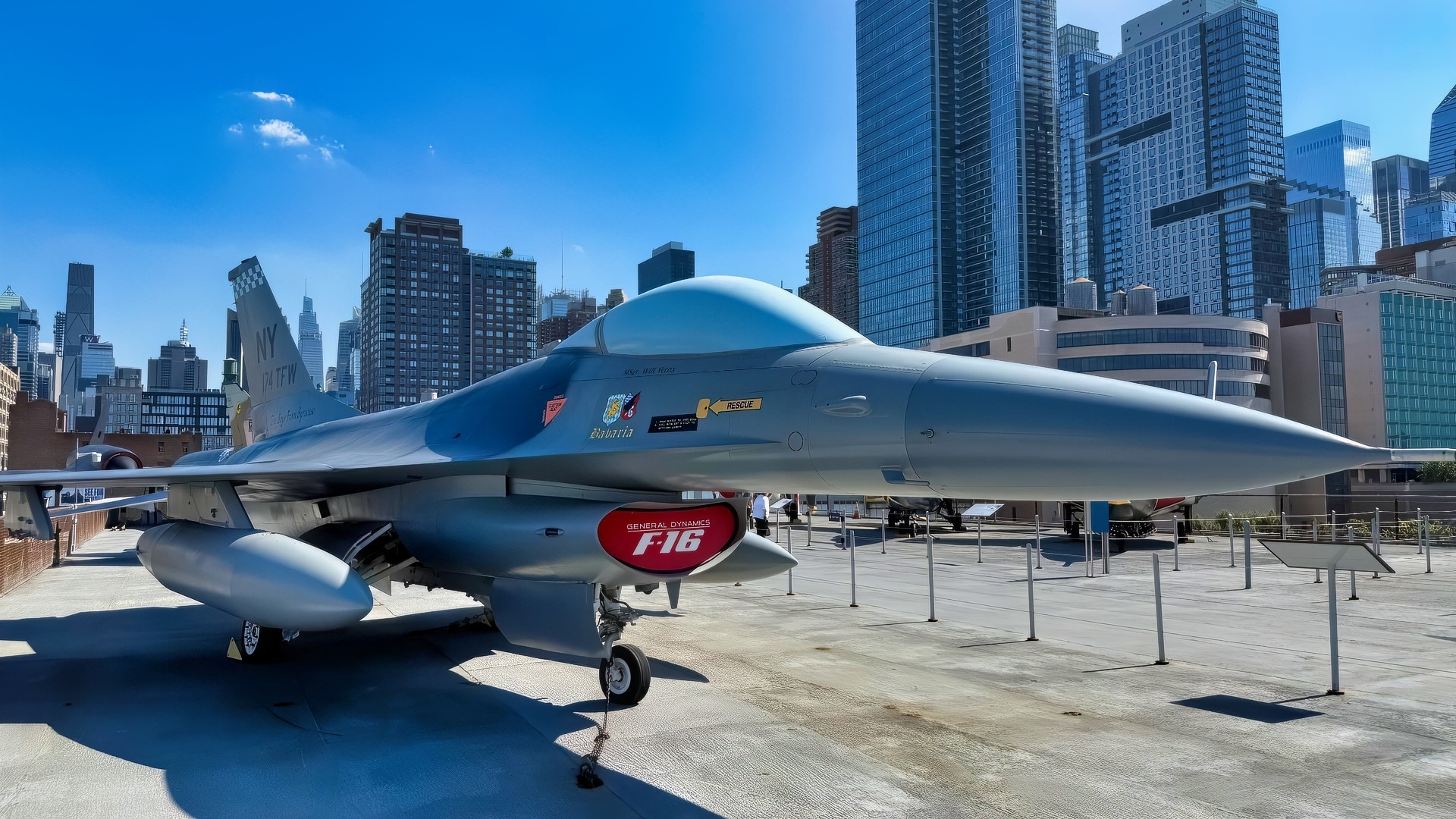
F-16 Fighting Falcon National Security Journal Photo. Taken on 9/18/2025 Onboard USS Intrepid.
Early versions of the F-16 were optimized for air-to-air combat, but from the beginning, there was recognition that actual value lay in adaptability.As the Cold War progressed, the F-16 steadily grew in capability. More powerful engines, enhanced radar systems, and expanded avionics allowed it to take on increasingly complex missions.
Precision strike, suppression and destruction of enemy air defenses, maritime attack, close air support, and deep interdiction all became part of the Viper’s resume.
By the 1990s and early 2000s, the F-16 was no longer a lightweight fighter in any narrow sense; it was a competent multirole platform, capable of carrying many of the same weapons as larger, more costly jets.
It proved this repeatedly in combat across the Middle East, the Balkans, and beyond, earning a reputation for reliability and effectiveness.
Why the F-16 is Still Around
One of the reasons the F-16 has endured so long is the strength of its basic design. The airframe proved robust and adaptable, capable of accepting major upgrades without fundamental redesign.
Over the decades, new blocks were introduced with improved engines, strengthened structures, advanced sensors, and modernized cockpits. Each iteration extended the aircraft’s relevance and ensured compatibility with new weapons and tactics.
This evolutionary approach allowed the Air Force to continuously modernize the fleet rather than replace it outright, saving cost while maintaining combat power.
By the time fifth-generation aircraft such as the F-22 and F-35 entered service, the F-16 had already exceeded what most planners in the 1970s could have imagined for its lifespan.
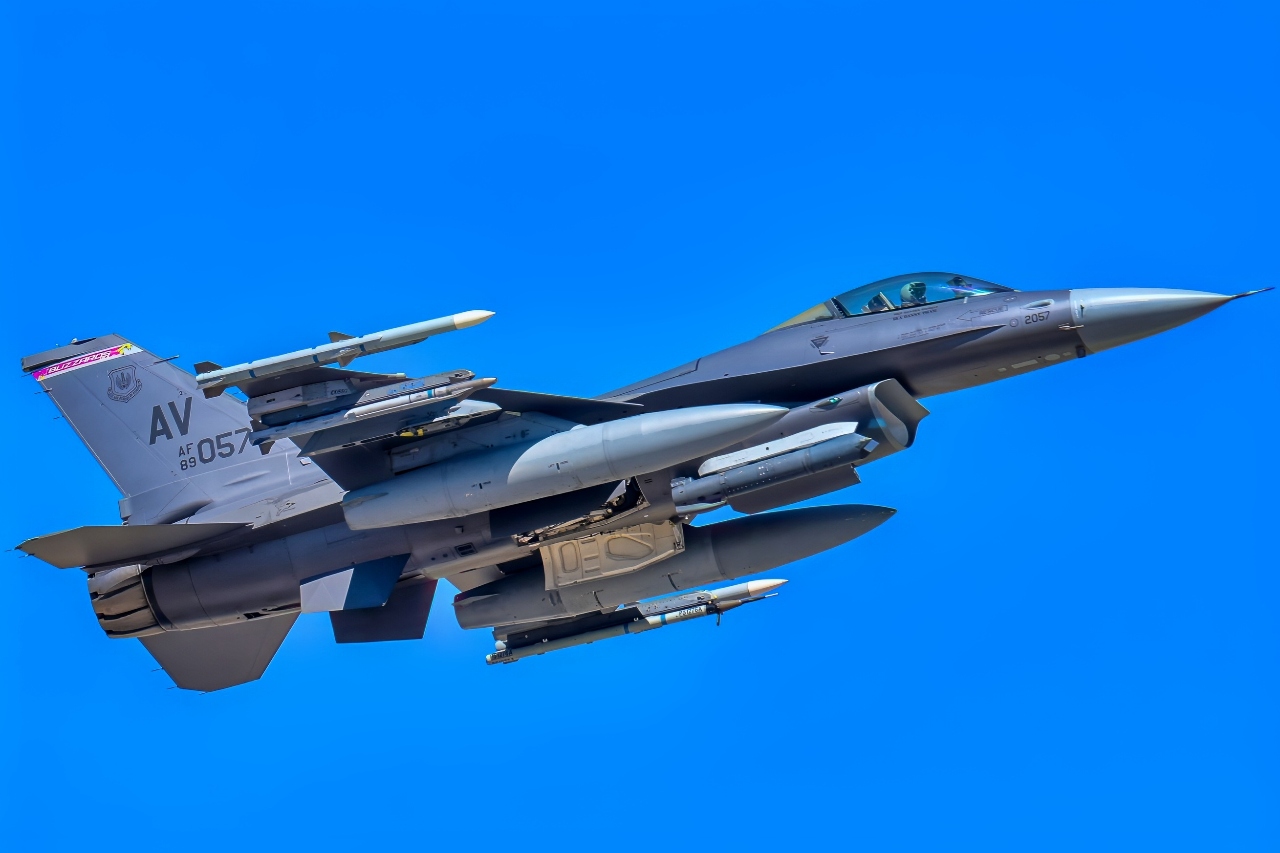
A U.S. Air Force F-16 Fighting Falcon assigned to the 510th Fighter Generation Squadron takes off during Exercise Anatolian Eagle 25 at the 3rd Main Jet Base, Konya, Türkiye, June 30, 2025. Through realistic multinational training, the 31st Fighter Wing enhances survivability, increases combat effectiveness and demonstrates that the U.S. and its Allies and partners are prepared to defend the homeland, deter aggression, and, if necessary, fight and win. (U.S. Air Force photo by Airman 1st Class Zachary Jakel)
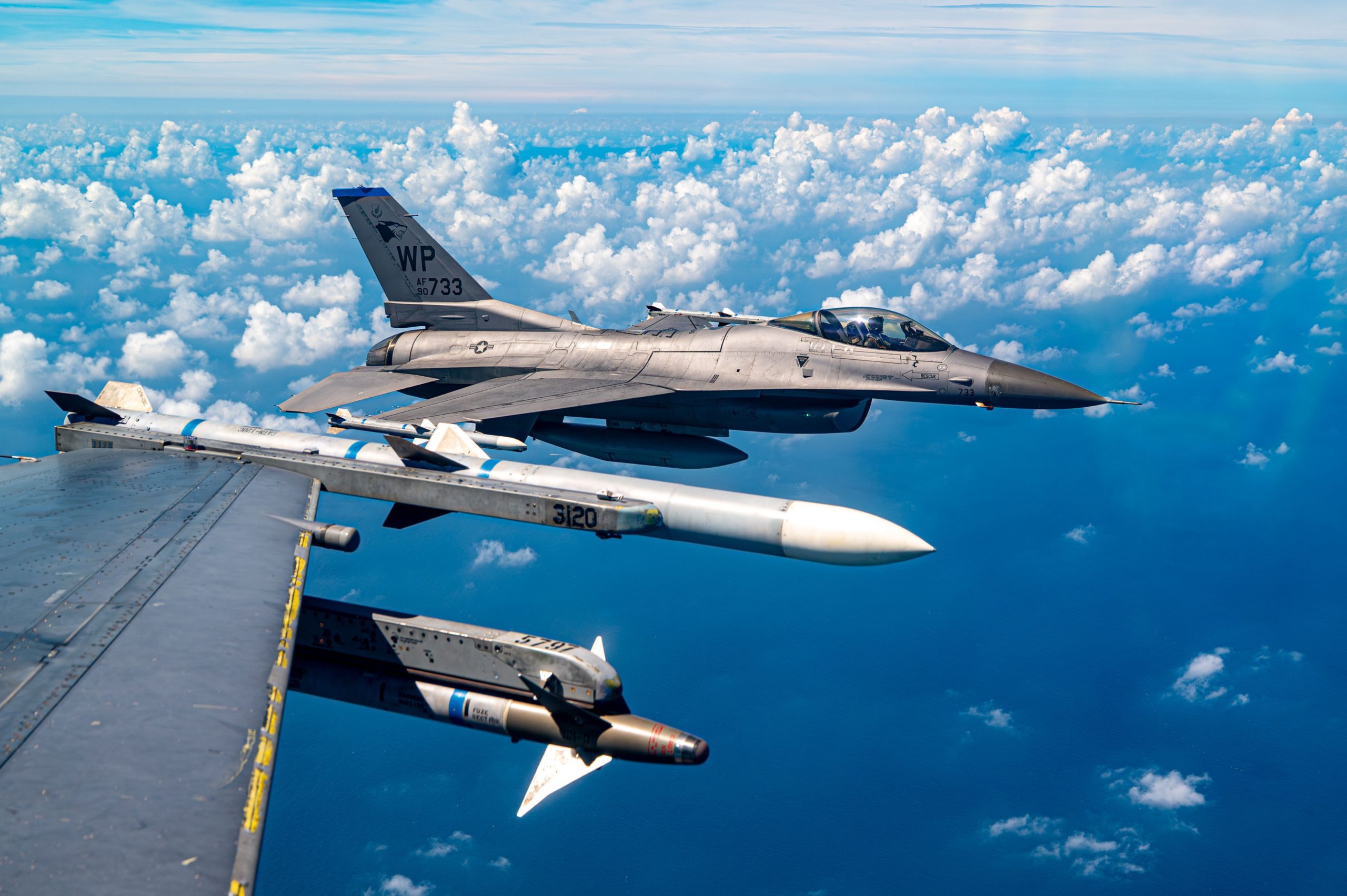
A 35th Fighter Squadron F-16 Fighting Falcon flies near the Korean peninsula during a dogfighting training scenario during exercise Ulchi Freedom Shield 25 at Kunsan Air Base, Republic of Korea, Aug. 20, 2025. UFS25 is a combined, joint, all-domain military training exercise that integrates ground, air, naval, space, cyber and information elements, enhancing readiness through realistic combat simulations. (U.S. Air Force photo by Senior Airman Landon Gunsauls)
Many aircraft built during the Cold War remained operational well into the 21st century. This longevity, however, created new challenges.
The F-16 fleet was aging, both structurally and technologically. Airframes approached their original design limits, and increasingly advanced threats began to stress the survivability of a fourth-generation platform operating without stealth.
Evolution of the Fighting Falcon
Rather than rapidly retiring the F-16, the Air Force chose a different path. Recognizing that it would take decades to fully replace the fleet with newer aircraft, the service invested heavily in life extension and modernization efforts. Structural life-extension programs were developed to reinforce key components of the airframe, including bulkheads, wing roots, and fuselage sections.
These modifications significantly increased the allowable flight hours, turning what had once been an eight-thousand-hour fighter into an aircraft capable of safely flying for twelve thousand hours or more. With these upgrades, many F-16s gained decades of additional service life.
Modernization went beyond structural reinforcement. The F-16’s avionics and sensors have undergone major upgrades, most notably with the introduction of AESA radars.
This new radar provides greater range, improved target detection, enhanced reliability, and resistance to electronic interference compared to older mechanically scanned systems. Coupled with new mission computers, digital electronic warfare suites, and improved cockpit displays, these upgrades dramatically improve situational awareness and lethality.
In many respects, a modernized F-16V Viper bears little resemblance internally to the jet that first entered service in the late 1970s.
How Much Longer Will the F-16 Remain in Service
The question of how much longer the F-16 will remain in the Air Force does not have a single, simple answer. The service has already begun retiring its oldest and least capable variants, particularly those that lack the structural potential or upgrade compatibility of later models.
At the same time, it continues to invest in the most modern blocks, especially those that have received life extension and advanced avionics upgrades. This has created a bifurcated fleet in which some aircraft are clearly nearing the end of their service life, while others are positioned to remain operational for many years.
Current planning indicates that significant numbers of F-16s will remain in service throughout the 2030s. The pace of retirement depends heavily on factors such as funding levels, the rate of F-35 procurement, readiness concerns, and congressional oversight.
MORE: The Trump-Class Battleship Is Useless
MORE: China’s New H-20 Stealth Bomber Looks Like a Failure
MORE: Russia’s New Su-57 Felon Super Fighter Just Broke Cover
Budget pressures and delays in newer programs have consistently slowed plans to divest legacy aircraft, reinforcing the F-16’s continued relevance. Additionally, the Air National Guard relies heavily on the F-16 for homeland defense missions, and replacing these aircraft nationwide is neither quick nor inexpensive.
The combination of structural life extension and modernization makes service beyond the 2040s a realistic expectation for many F-16s, especially the later-block aircraft.
By that point, the Air Force expects a more mature force of fifth- and next-generation systems, potentially including crewed and uncrewed platforms operating together.
As these capabilities become widespread, the need for large numbers of fourth-generation fighters will gradually diminish.
Even then, the F-16 is likely to remain in service with other air forces that cannot afford to field large numbers of fifth-generation aircraft.
About the Author: Isaac Seitz
Isaac Seitz, a Defense Columnist, graduated from Patrick Henry College’s Strategic Intelligence and National Security program. He has also studied Russian at Middlebury Language Schools and has worked as an intelligence Analyst in the private sector.


