

Key Points and Summary – Northrop’s YF-17 “Cobra” lost the U.S. Air Force’s 1970s Lightweight Fighter competition to the YF-16, but it went on to shape American and allied air power for decades.
-Designed as a maneuverable, low-cost air-superiority jet, the twin-engine YF-17 underperformed the simpler, cheaper, faster-accelerating YF-16 in key metrics.

A U.S. Air Force F-16 Fighting Falcon connects with a U.S. Air Force KC-10 Extender over Iraq, Nov. 5, 2021. The F-16 is a compact, multi-role fighter aircraft that delivers war-winning airpower to the U.S. Central Command area of responsibilty. (U.S. Air Force photo by Staff Sgt. Jerreht Harris)
-Yet those very twin engines and its robust structure made it ideal for carrier use.
-Reworked with McDonnell Douglas into the F/A-18 Hornet and later the Super Hornet and Growler, the YF-17’s DNA has flown from Libya to Desert Storm and beyond.
-As Super Hornet production ends, its forgotten roots matter more than ever.
How the YF-17 Shaped America’s Fighters
The Northrop YF-17 “Cobra” is one of the most influential American fighter prototypes ever built – despite never actually entering U.S. Air Force service.
First flown in 1974, the twin-engine lightweight jet eventually evolved into the F/A-18 Hornet, which is now used by the U.S. Navy, U.S. Marine Corps, and more than half a dozen allied nations.
But the YF-17’s original purpose – and the reasons behind its ultimate loss to the General Dynamics YF-16 in the 1970s Lightweight Fighter (LWF) competition- are often misunderstood.
With fresh attention on America’s ongoing tactical aviation modernization and the pressure the F-35 program is putting on the industrial base, the YF-17 design is a good example of how the requirements of the past have shaped the fighter ecosystem we live with today.
What the YF-17 Was Designed To Do
The YF-17 began as Northrop’s entry to the U.S. Air Force’s Lightweight Fighter competition – a 1970s program that sought to develop an affordable air-superiority fighter to complement heavier aircraft like the F-15.
The Air Force issued official LWF requirements in 1971, calling for a lightweight demonstrator focused on maneuverability.
Specifically, they sought low cost, high agility, and high thrust-to-weight performance.

(Jan 31, 2009) An F/A-18 Super Hornet assigned to the “Tomcatters” of Strike Fighter Squadron (VFA) 31 launches from the flight deck of USS Theodore Roosevelt (CVN 71). The Nimitz-class aircraft carrier and embarked Carrier Air Wing (CVW) 8 are operating in the 5th Fleet area of responsibility and are focused on reassuring regional partners of the United States’ commitment to security, which promotes stability and global prosperity (U.S. Navy photo by Mass Communication Specialist 3rd Class Jonathan Snyder/Released)
Northrop delivered, and its prototype made its first flight on June 9, 1974. The aircraft featured a twin-engine design that used two GE YJ101 turbojets.
These were early versions of what later morphed into the F404 engine family.
The YF-17 proved promising and was tested by the U.S. Air Force extensively between 1974 and 1975. Those tests evaluated its maneuvering, weapons carriage, turn radius performance, and energy maneuverability compared to the competing YF-16.
The jet proved to be perfectly capable, too, reaching up to 34 34-degree angle of attack during flight tests.
There were, however, some problems.
The YF-17 couldn’t quite match up to the YF-16 in some aspects, with the latter eventually being selected by the Air Force in January 1975.
The YF-16 “Fighting Falcon,” developed by General Dynamics, ultimately proved to be a simpler, cheaper, and easier-to-maintain design.
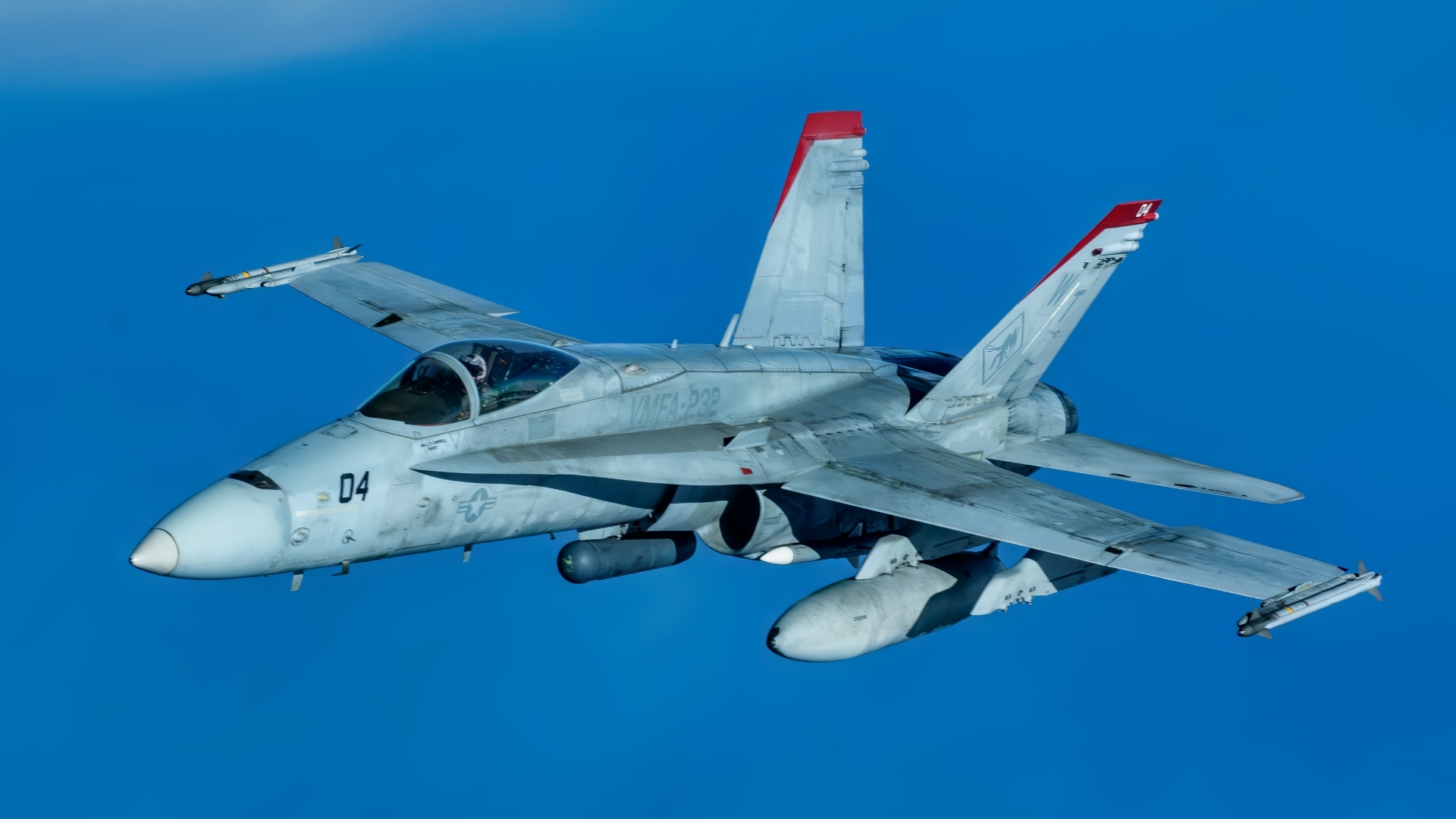
A U.S. Marine Corps F/A-18 Hornet pulls away from a U.S. Air Force KC-135 Stratotanker from Kadena Air Base after refueling over the Pacific Jan. 3, 2024. Conducting joint operations enhances the lethality and readiness of U.S. forces and its ability to project superior airpower to the Indo-Pacific region. (U.S. Air Force photo by Senior Airman Cedriue Oldaker)
It even had superior acceleration according to LWF evaluation metrics, making it a no-brainer for planners.
But that didn’t mean the end for the YF-17.
The aircraft’s twin-engine safety margin – meaning it could continue flying if one engine failed – along with its overall structural robustness, made it particularly appealing for the Navy – factors that were ultimately irrelevant to the Air Force competition.
How the YF-17 Became the F/A-18
After the Air Force picked the YF-16, the U.S. Navy launched its own competition – the Navy Air Combat Fighter (NACF) program, seeking a replacement for the aging A-7 Corsair II and a lower-cost partner aircraft to the F-14.
The Navy explicitly stated that it required twin engines for carrier operations, citing safety concerns about single-engine recovery.
Northrop then teamed up with McDonnell Douglas to adapt the YF-17 design into a new, carrier-capable strike fighter.
The redesign included strengthened landing gear and airframe for arrested carrier landings, larger wings and leading-edge extensions, redesigned surface controls, and more powerful F404 engines.
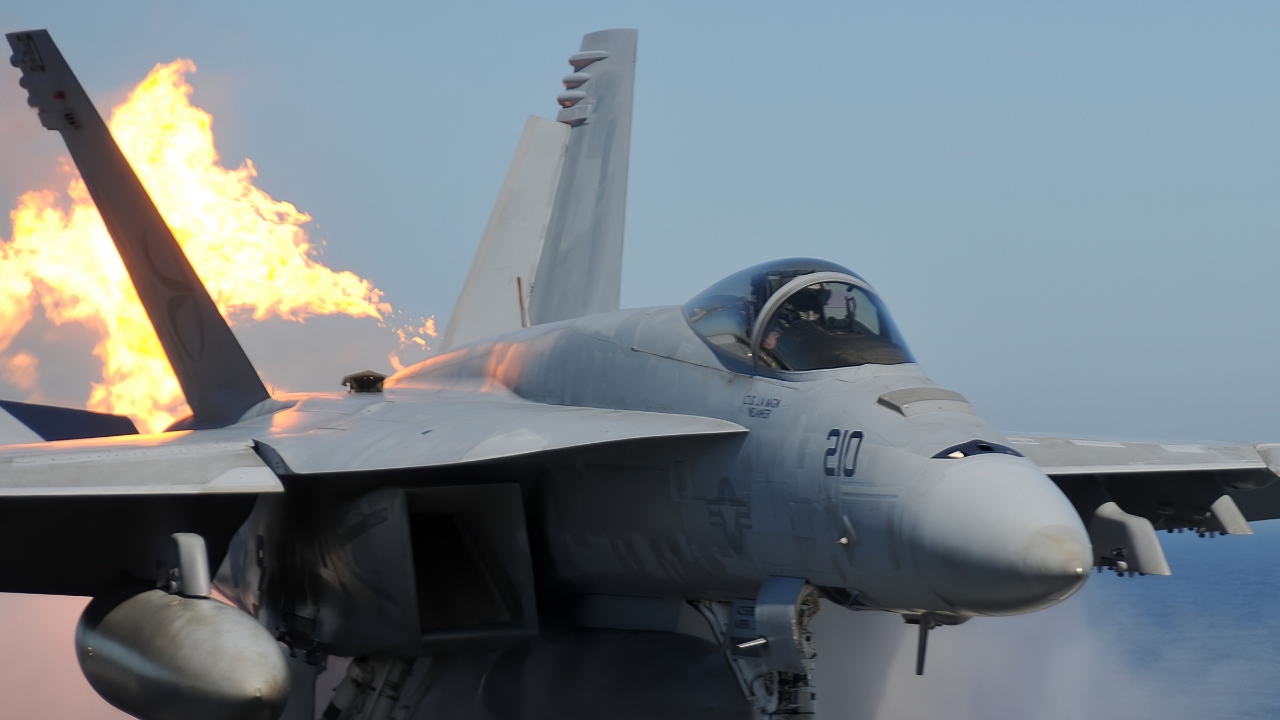
A U.S. Navy F/A-18E Super Hornet aircraft assigned to Strike Fighter Squadron 137 is launched from the flight deck of the aircraft carrier USS Abraham Lincoln (CVN 72) while underway in the Pacific Ocean on Feb.2, 2009.
(DoD photo by Petty Officer 2nd Class James R. Evans, U.S. Navy. (Released))
The result was the F/A-18 Hornet, which first flew in November 1978. The Hornet entered service in 1983 and became a mainstay of U.S. carrier aviation.
That lineage means modern naval aviation was directly influenced by the YF-17, including the current F/A-18E/F Super Hornet and EA-18G Growler.
They were built on the YF-17’s architecture. While they technically share a few direct physical components with the original Hornet, their design is a clear evolutionary step from the F/A-18A/B. It’s not a totally new design at all.
And the influence can be seen abroad as well.
Canada, Australia, Spain, Switzerland, Finland, and Kuwait have operated the Hornet family of aircraft.
What’s more, the YF-17 is the root of a fighter jet family that has flown in every single American conflict that has taken place since the 1980s – from Libya in 1986 to Desert Storm in 1991, to operations against ISIS.
In March 2024, the US Navy placed what is expected to be the final order for 17 Super Hornet carrier-based fighter jets, confirming the end of a fighter lineage that started with the YF-17 five decades ago. It’s just enough to keep production going until 2027.
As the Super Hornet line approaches the end, and the Navy faces a potential gap, the YF-17’s story seems particularly relevant today.
About the Author:
Jack Buckby is a British author, counter-extremism researcher, and journalist based in New York who writes frequently for National Security Journal. Reporting on the U.K., Europe, and the U.S., he works to analyze and understand left-wing and right-wing radicalization, and reports on Western governments’ approaches to the pressing issues of today. His books and research papers explore these themes and propose pragmatic solutions to our increasingly polarized society. His latest book is The Truth Teller: RFK Jr. and the Case for a Post-Partisan Presidency.
More Military
The Army’s AH-64E Apache Helicopter Can Destroy Drones with Missiles
U.S. Navy Iowa-Class Battleship USS New Jersey’s ‘Comeback’ Is Now Complete
Blaze of Glory: The SR-71 Blackbird Retired Hitting Mach 3.21


