

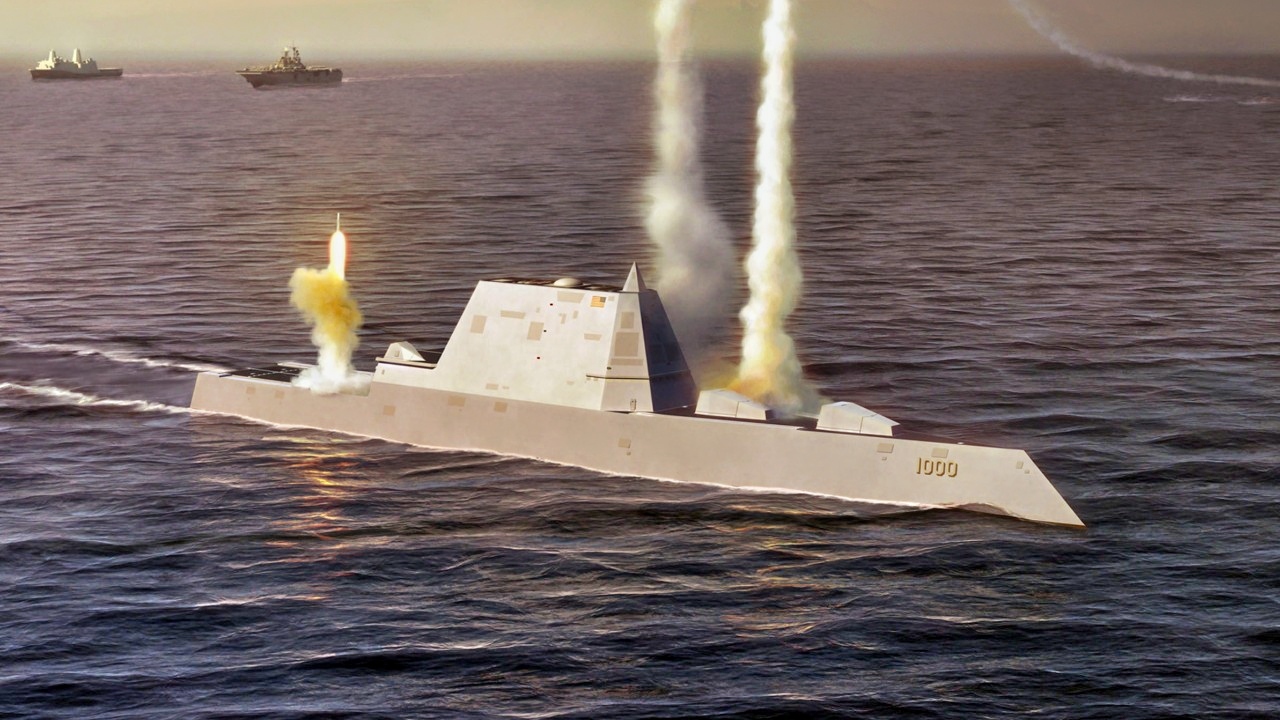
Key Points and Summary on Zumwalt-Class: The U.S. Navy’s Zumwalt-class destroyers, known for their radical, stealthy “tumblehome” hull design, are undergoing a massive transformation to salvage the troubled program.
-Originally designed for naval gunfire support, the ships’ advanced guns were canceled due to the outrageous $800,000 cost per round of ammunition.
-Now, the three-ship class, which cost a staggering $8 billion each, is being retrofitted with hypersonic missiles.
-This Conventional Prompt Strike (CPS) system will give the Zumwalts a new, long-range (1,725 miles) strike mission, turning what could have been a colossal failure into a potentially relevant and powerful naval asset.
Is the Zumwalt-class of Destroyers Worth All of the Money?
Have you ever seen a U.S. Navy ship that looks like a submarine without the curves? The USS Zumwalt has a curious shape.
Gone are the gentle rounding and smooth contours one comes to expect.
The Zumwalt is instead edgy and boxy. It bears no resemblance to the ships you are accustomed to seeing.
The Zumwalt is a guided missile destroyer, and it is completely modernized with a next-generation design that makes it one of the most advanced ships in the fleet.
The Zumwalt received its name from the youngest ever Chief of Naval Operations Elmo Zumwalt, who at 49 took the reins of the Navy in 1970 and didn’t let go until he retired in 1974. Zumwalt was known for promoting minorities and giving younger officers the command of warships. He ran unsuccessfully for the U.S. Senate in 1976.
What Is a Tumblehome Hull?
Let’s take a closer look at the vessel that represents his name. The USS Zumwalt features an angular tumblehome hull, which gives it its distinctive shape. This is designed to pierce the waves better. And most importantly, the shape promotes a decent level of radar evasion, making the Zumwalt a partially stealthy ship.
The tumblehome hull slopes inward with a narrowing above the waterline. The bow doesn’t just ride over the waves; it cuts through them, as SlashGear.com noted in a profile of the Zumwalt. The ship appears smaller on a radar scope, giving the enemy the impression that the destroyer resembles a small fishing boat.
This Is a Large Ship for Its Class
The Zumwalt is large for a destroyer, weighing in at nearly 16,000 tons with a length of 610 feet. This is 40 percent bigger than the Arleigh Burke-class destroyer. “This hull design is complemented by a composite deckhouse structure, and a revolutionary electrical propulsion system,” SlashGear explained.
There are two other stealth destroyers in the Zumwalt-class – the USS Michael Mansoor was commissioned in 2019. The USS Lyndon B. Johnson was launched in 2018 but is still receiving updates to its weapons systems.
The Program Had Its Problems with Delays and Price Creep
The Zumwalt-class has suffered cost overruns and schedule slips. At one point, the Navy wanted 32 Zumwalt-class ships. Each of the three remaining stealth destroyers costs a whopping $8 billion each, approaching the price of an aircraft carrier.
Eight Hundred Thousand Dollar Rounds?
The Zumwalt-class was initially envisioned to sneak close to shore and help with fire support for an amphibious invasion by the U.S. Marine Corps. Since it was partially able to evade radar, the Navy had high hopes for the Zumwalt.
However, the powerful guns, originally standard on the ships, were faulty. The two 155mm Advanced Gun Systems utilized specialized ammunition, known as the Long-Range Land Attack Projectile, with a range of 63 nautical miles. Each of the projectiles was going to cost $800,000.
The Navy considered this price ridiculous. Therefore, the maritime branch canceled the Advanced Gun Systems and installed missile tubes on board.
Hypersonic Missiles Could Save the Day for Zumwalt-Class
This upgrade is called the Conventional Prompt Strike system and would comprise hypersonic missiles that can fly at speeds of Mach 5 to Mach 7, with a range of 1,725 miles. The missile is equipped with the Common Hypersonic Glide Body , which maneuvers well and is difficult to shoot down.
There will be 12 hypersonic missiles on each destroyer fired from four tubes. There are also tubes that can launch Tomahawk cruise missiles.
The USS Zumwalt entered dry dock in 2023 to begin the process of installing the hypersonic missile tubes. The original gun units were removed in 2024. The ship also needed new bulkheads in the lower decks.
Now the Navy had a reason to keep the Zumwalt-class ships in service. The Zumwalts can also produce a significant amount of electrical power. This is enabled by the Integrated Power System. A central processing computer runs the ship. The class of stealthy destroyers can also hit a top speed of 30 knots.
The Navy believes the Zumwalts are survivable due to two effective sonar arrays at two different frequencies. This is able to track and engage enemy submarines and avoid torpedoes.
The Zumwalt-class is a complex vessel with various pros and cons. The ships are expensive and limited to three in number. They may have a forward-deployable mission set with the hypersonic missiles. The gun system proved to be a significant disappointment, ultimately removing the shore support mission. Now the Zumwalts are relevant again, but there are not enough to make a massive difference in warfare. Twelve hypersonic weapons for each ship is an encouraging number, though.
In 4 Words: Not Worth the Money?
The Navy has done a good job of minimizing what could be seen as a significant failure. This has been an expensive program, and, unfortunately, the class is limited to just three ships. The stealth idea was a good one, but it only works if each Zumwalt patrols alone to launch its hypersonic missiles from different areas in coordinated strikes. However, having a Zumwalt sailing with a carrier strike group in various regions of the world increases the lethality of the flotilla.
In that respect, the Zumwalt-class can be considered a success, especially if it launches hypersonics successfully in a shooting war.
About the Author: Dr. Brent M. Eastwood
Brent M. Eastwood, PhD is the author of Don’t Turn Your Back On the World: a Conservative Foreign Policy and Humans, Machines, and Data: Future Trends in Warfare plus two other books. Brent was the founder and CEO of a tech firm that predicted world events using artificial intelligence. He served as a legislative fellow for U.S. Senator Tim Scott and advised the senator on defense and foreign policy issues. He has taught at American University, George Washington University, and George Mason University. Brent is a former U.S. Army Infantry officer. He can be followed on X @BMEastwood.
The Best Tanks on Earth
AbramsX: The Tank the US Army Wants


