

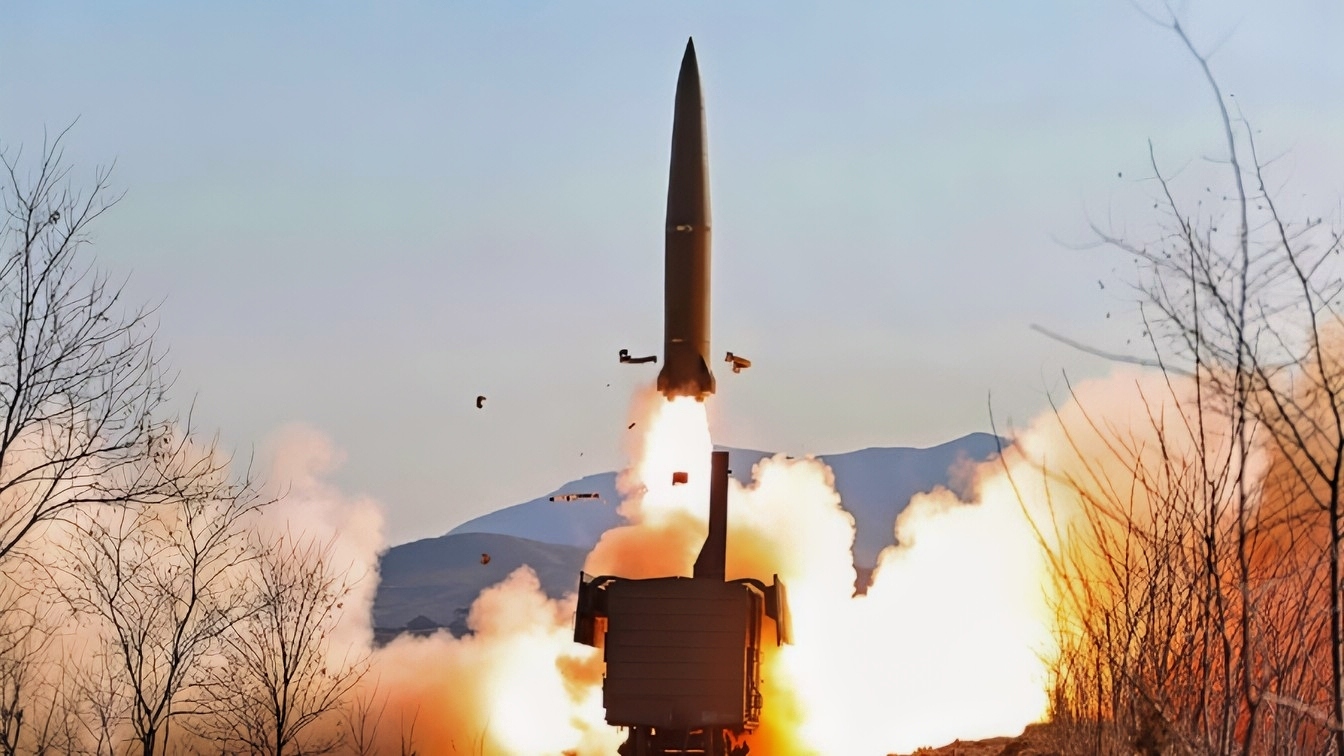
North Korean Missiles Are Reshaping Russia’s Assault on Ukraine – More than four years into Russia’s full-scale invasion of Ukraine, one of the most consequential shifts in the conflict has been the deepening integration of North Korea into Moscow’s war effort.
What began in 2023 as sporadic reports of artillery shell shipments has evolved into something far more substantial: North Korean ballistic missiles are now a fixture of Russian strike packages, North Korean troops have fought and died in large numbers on Russian soil, and North Korean factories are effectively running as a forward supply line for Putin’s military.
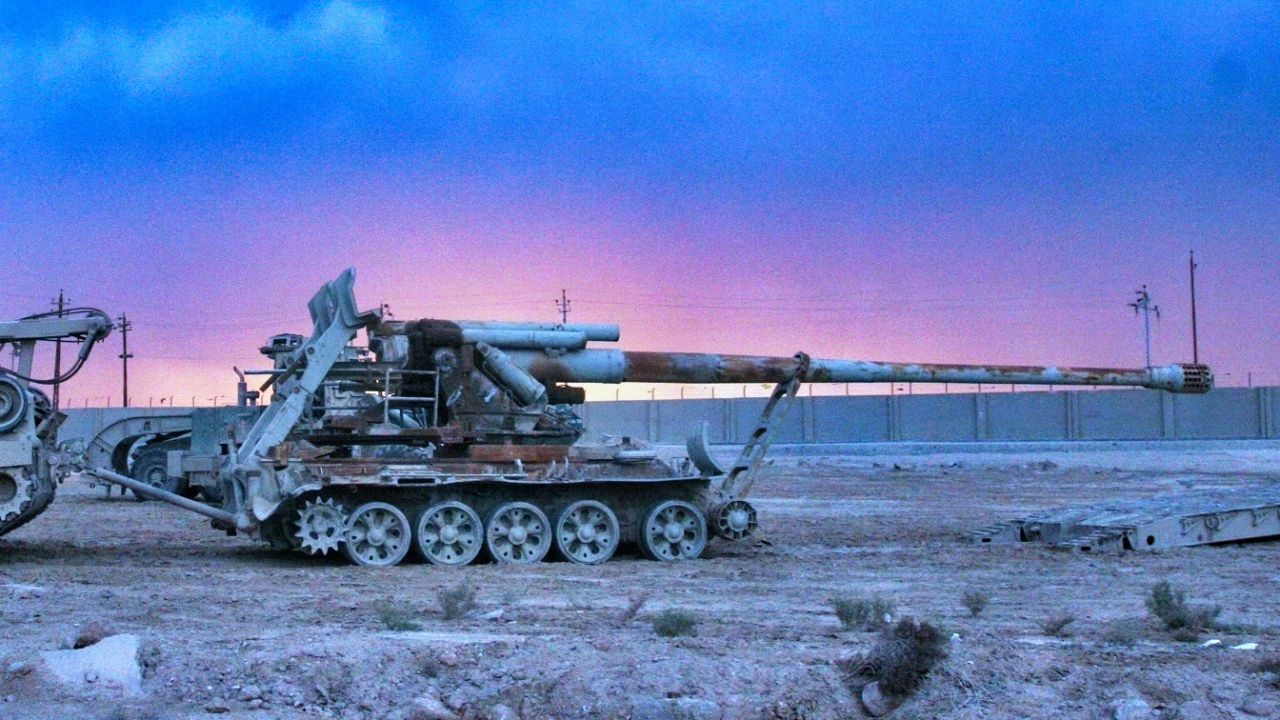
North Korea Artillery. Image Credit: Creative Commons.
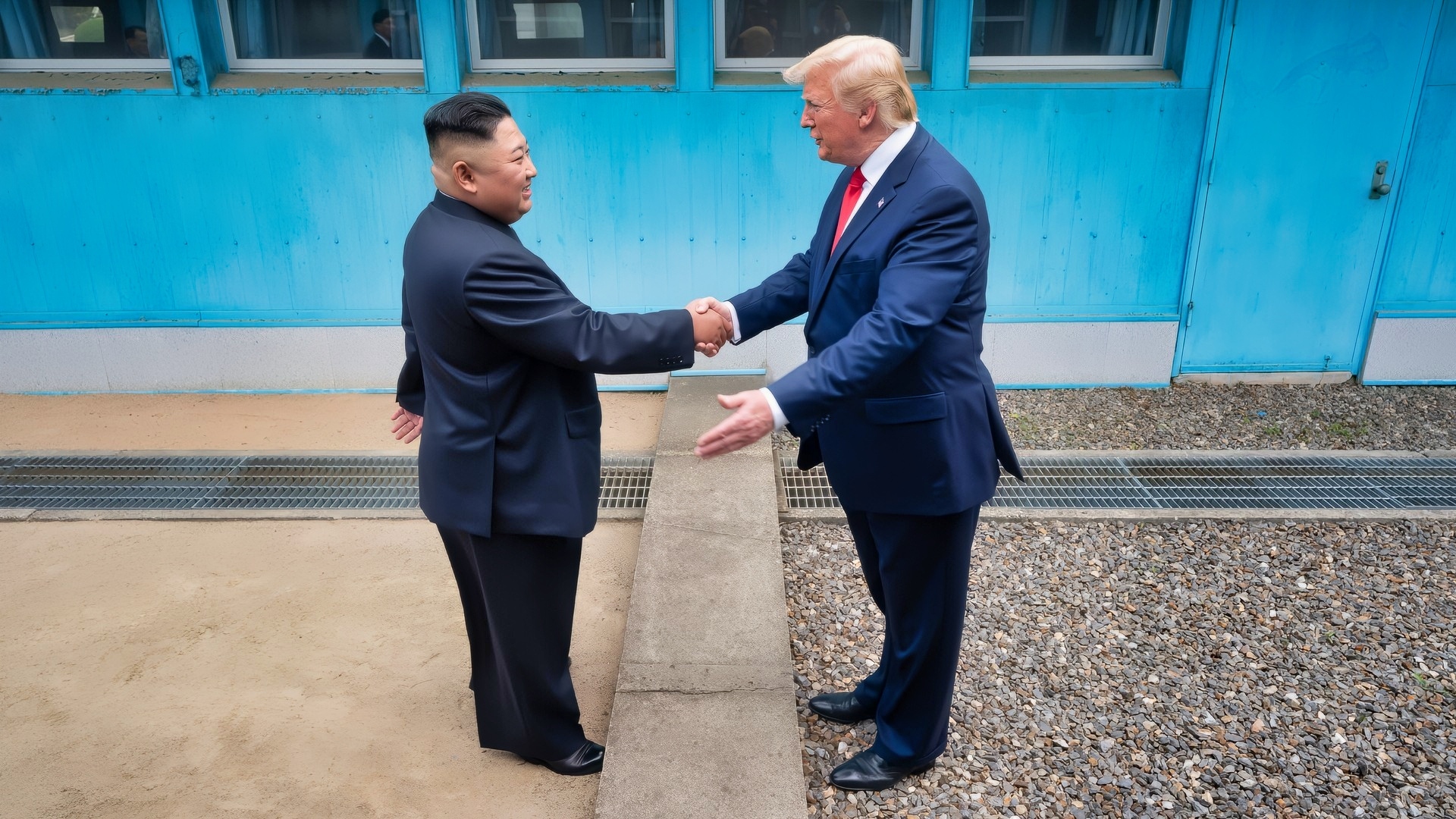
North Korea and Donald Trump DMZ back in 2019. Image Credit: White House.
Early last month, Ukrainian President Volodymyr Zelenskyy warned that the Kremlin has decided to deploy between 30,000 and 50,000 North Korean troops on Russian soil.
From Artillery to Ballistic Missiles
Pyongyang’s support initially centered on conventional munitions. Ukrainian intelligence has said North Korea supplied over a million artillery shells along with self-propelled howitzers and multiple-launch rocket systems to keep Russian batteries firing through a war that has consumed ammunition faster than Russia’s domestic industry can replace it.
But the more dangerous escalation has been on the missile front. Since late 2023, North Korea has transferred KN-23 and KN-24 short-range ballistic missiles, known domestically as the Hwasong-11A and Hwasong-11B, for use against Ukrainian cities.
Ukrainian officials estimate roughly 150 of these missiles arrived between late 2023 and mid-2025, and the pace has since accelerated sharply.
In August 2026, Ukraine’s Main Directorate of Intelligence reported that a North Korean missile brigade was deploying directly into Russia’s Voronezh region, bringing with it up to 120 ballistic missiles and six launchers, along with roughly 90 North Korean personnel to operate them as part of Russia’s 112th Missile Brigade.
That same month, Russia reportedly received its first shipment of a newer, larger North Korean missile, the Hwasong-11C, or KN-30, a 10-meter-long weapon capable of carrying a 2,500-kilogram warhead to a range of 900 kilometers (560 miles).
Analysts note this gives Russia a way to strike deep into Ukrainian territory from well inside its own borders while conserving domestically produced Iskander missiles for other targets.
Why These Missiles Matter on the Battlefield
The tactical answer is straightforward and very simple: ballistic missiles are far harder to intercept than the cruise missiles and drones that dominate nightly Russian barrages. And Ukraine is lacking the defensive missiles that can shoot down ballistic missiles, such as the US-made Patriot.
According to the commander of Ukraine’s Unmanned Systems Forces, Major Robert “Magyar” Brovdi, Russia is seeking to nearly triple the number of ballistic missiles it can launch simultaneously against Ukraine from seventy-seven to two hundred. This figure is likely to outpace Western deliveries of interceptors to Ukraine, which have dropped to one-third of the 2025 level.
Rob Lee of the Foreign Policy Research Institute has noted that additional North Korean ballistic missiles compound one of Ukraine’s most persistent vulnerabilities, a shortage of interceptors capable of reliably downing them.
Unlike Iranian-designed Shahed drones, which Ukraine’s layered air defenses can often shoot down at relatively low cost, ballistic missiles force Kyiv to expend scarce, expensive Patriot interceptors or accept that a strike will get through.
The human cost has been severe. North Korean-supplied missiles have been linked to some of the war’s deadliest recent strikes, including an attack on the village of Radushne in Dnipropetrovsk Oblast that killed an entire family, and strikes on Zaporizhzhia that killed civilians and wounded dozens.
Ukrainian forensic analysis has found these missiles are not exact copies of Russian designs; they are notably longer than the Iskander and carry larger warheads, but are also less accurate, which analysts say helps explain the elevated civilian casualties associated with their use.
Thousands Of Troops, Not Just Weapons
North Korea’s involvement goes well beyond hardware. Since October 2024, Pyongyang has sent more than 14,000 troops to fight alongside Russian forces, concentrated in the Kursk region after Ukraine’s surprise cross-border incursion.
North Korea officially confirmed the deployment, with Kim Jong Un praising the soldiers as “heroes” after Russia said it had recaptured Kursk with their help.
South Korean intelligence estimates North Korean casualties from that fighting at around 6,000 killed or wounded, a staggering toll that Seoul says Pyongyang has treated as an acceptable price for battlefield experience, modernized tactics, and Russian technical assistance in return.
A Deepening Strategic Partnership
This cooperation is formalized at the highest level. Kim Jong Un and Vladimir Putin signed a mutual defense treaty in June 2024, and further senior-level talks between Moscow and Pyongyang on expanding missile deployments were reportedly scheduled for September 2026.
In exchange for troops, artillery ammunition, and missiles, North Korea is widely believed to be receiving Russian assistance with satellite technology, air defense systems, and submarine and missile programs, support that could meaningfully upgrade North Korea’s own military capabilities against South Korea and the United States long after the Ukraine war ends.
Pyongyang has become an integrated node in Russia’s war machine: a munitions depot, a missile arsenal, and a source of expendable manpower, all in exchange for money, technology, and battlefield legitimacy for its own forces.
For Ukraine and its allies, that means the war is no longer a two-country conflict but one increasingly shaped by decisions in Moscow that heavily incorporate Pyongyang.
About the Author: Steve Balestrieri
Steve Balestrieri is a National Security Columnist. He served as a US Army Special Forces NCO and Warrant Officer. In addition to writing on defense, he covers the NFL for PatsFans.com and is a member of the Pro Football Writers of America (PFWA). His work was regularly featured in many military publications.


