

YF-23 Black Widow II: The Fast, Quiet Future That Didn’t Win
Key Points and Summary – Northrop’s YF-23 Black Widow II and Lockheed’s YF-22 dueled to become America’s next air-dominance fighter.
-The YF-23 prioritized stealth, range, and supercruise, with shielded exhausts, a diamond wing, and canted ruddervators to stay hidden and fast; the YF-22 pushed agility with thrust vectoring while still meeting low-observable goals.
-In a short demo window, the YF-22 performed live internal missile shots and showcased high-alpha control, shaping perceptions of risk and schedule.
-The Air Force chose the Raptor. Fans still love the YF-23’s campaign-minded efficiency and IR discipline; critics say the service rightly picked the jet that proved more, sooner.
A YF-23 Fighter Walkaround In Dayton and Outside of Los Angeles
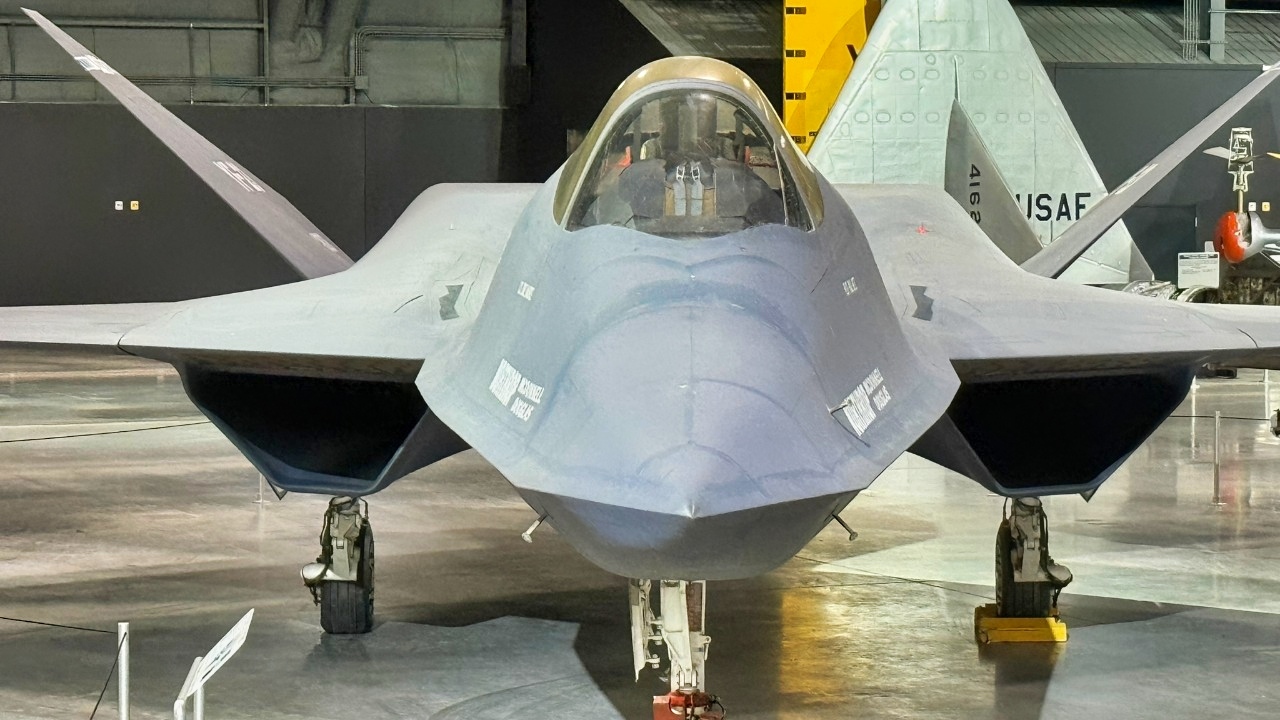
Back in July, I spent two days at the National Museum of the U.S. Air Force in Dayton, Ohio, shooting photos and video of the YF-23 Black Widow II from every angle—canted tails, cavernous inlets, the long diamond wing that seems to stretch past your peripheral vision. I even asked the museum staff in a phone call with their PR folks to get a little closer in a return visit, but, alas, they said “they didn’t have the staff or budget”. Hmm.
But I wasn’t done with the Black Widow II just yet. I then went out to California last month to do it again, this time to the Western Museum of Flight, to see the second and only other YF-23.
Needless to say, I was getting a little obsessed. Although recent headlines regarding this fighter jet seem to have justified my recent interest.
In person, it doesn’t look like a relic that lost; it seems like a thesis on how to disappear at speed.
The surfaces align like a geometry lesson, the exhaust sits tucked beneath an aft “deck” to hide heat, and the whole airframe whispers an idea: go far, go fast, be seen as little as possible. You don’t have to be a romantic to feel a pang that this one never got its squadron patch.
Why The Air Force Wanted It—And A Rival—At All
By the late 1980s, the Advanced Tactical Fighter (ATF) program set out to replace the F-15 with a true next-generation air superiority jet.
The brief was ruthless: very low observability, supercruise (sustained supersonic flight without afterburner), long range, sensor fusion, and survivability against modern SAMs and high-end fighters.
Two industry teams answered: Lockheed/Boeing/General Dynamics with the YF-22, and Northrop/McDonnell Douglas with the YF-23. Both would fly prototypes, prove big ideas, and give the Air Force a choice between two different philosophies of the same problem.
The YF-23’s Design Philosophy
Northrop’s entry emphasized stealth and kinematic efficiency over showy maneuver tricks.
Start with the platform: a diamond-shaped wing blended into a long, slender fuselage. Replace vertical tails with outward-canted all-moving ruddervators to cut radar returns. Bury the engines deep with serpentine inlets to hide fan faces.
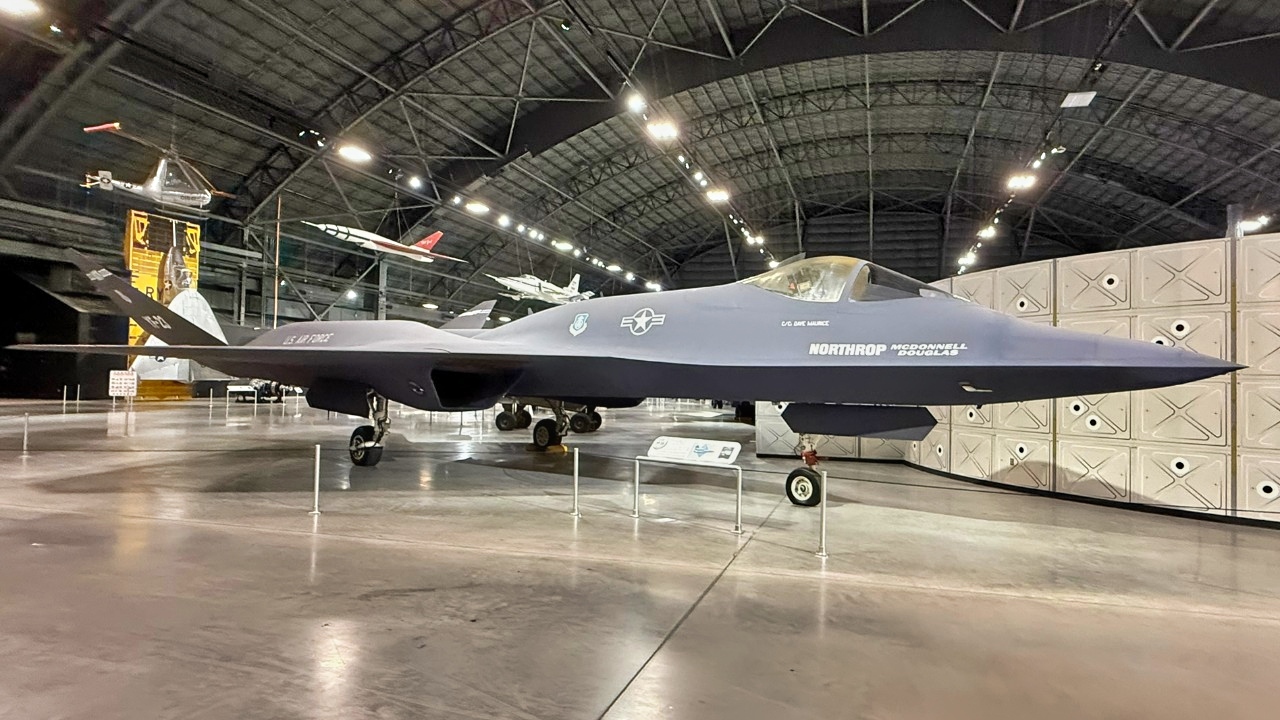
YF-23 National Security Journal Photo. Taken by Harry J. Kazianis at U.S. Air Force Museum on 7/19/2025.

YF-23 National Security Journal Photo. Taken by Harry J. Kazianis at U.S. Air Force Museum on 7/19/2025.

YF-23 National Security Journal Photo. Taken by Harry J. Kazianis at U.S. Air Force Museum on 7/19/2025.
Then cover the hot end with a shingled aft deck and slim slot-like nozzles to reduce infrared signature and mask exhaust from look-up radars. The result was a big fighter that aimed to be hard to find, hard to track, and already gone when an opponent finally sorted the picture.
Two prototypes flew with different engines—one with Pratt & Whitney’s YF119, the other with General Electric’s variable-cycle YF120—giving the team data on both powerplants. Internally, the YF-23 carried weapons in bays, kept antennas and apertures flush, and treated every panel line like a potential radar edge case.
The airplane was a systems argument as much as a shape: win by first look, first shot, first kill, and conserve energy doing it.
What It Demonstrated In Flight Test
During the 1990–91 demo/validation window, the YF-23 showed what its lines promised.
It supercruised, climbed hard, and presented a remarkably clean radar/IR picture for a fighter its size. Pilots praised the high-speed handling and the jet’s stability at altitude. The airplane could cover ground quickly without lighting the burners, which mattered for both survivability and tanker math.
If you were building a force to kill from the edge of the fight—intercepting before the merge, punching corridors through an adversary’s air umbrella—the YF-23 looked like a tailor-made tool.
The YF-22’s Counterargument
Lockheed’s YF-22 took a different path: agility-first while still meeting signature and supercruise goals.
Its engines breathed through more conventional inlets; its stealth treatment emphasized a faceted, Raptor-like fuselage; and it came with two-dimensional thrust-vectoring nozzles. In flight test, the YF-22 didn’t just supercruise; it also put on a show—high-alpha authority, crisp pitch/yaw control, and, crucially, a successful live missile-launch demonstration from the internal bay during the evaluation window.
On paper, the Air Force sought both stealth and maneuver; in person, the YF-22 convincingly demonstrated the latter while maintaining sufficient stealth.
Why The F-22 Raptor Won
There wasn’t a single silver bullet; it was a stack of judgments made in a specific moment.
Demonstrated Risk vs. Promised Growth. The Air Force saw the YF-22 actually fire from its bay and exercise thrust vectoring in the envelope. The YF-23 emphasized that those items were solvable later—its bet was stealth and speed first. In a short competition, “we did it” beat “we’ll add it.”

YF-23 at Western Museum of Flight. Image Credit: Harry J. Kazianis/National Security Journal.

YF-23 Black Widow Fighter in California. Image Credit: National Security Journal/Harry J. Kazianis.

YF-23 Side Profile. Image Credit: National Security Journal.
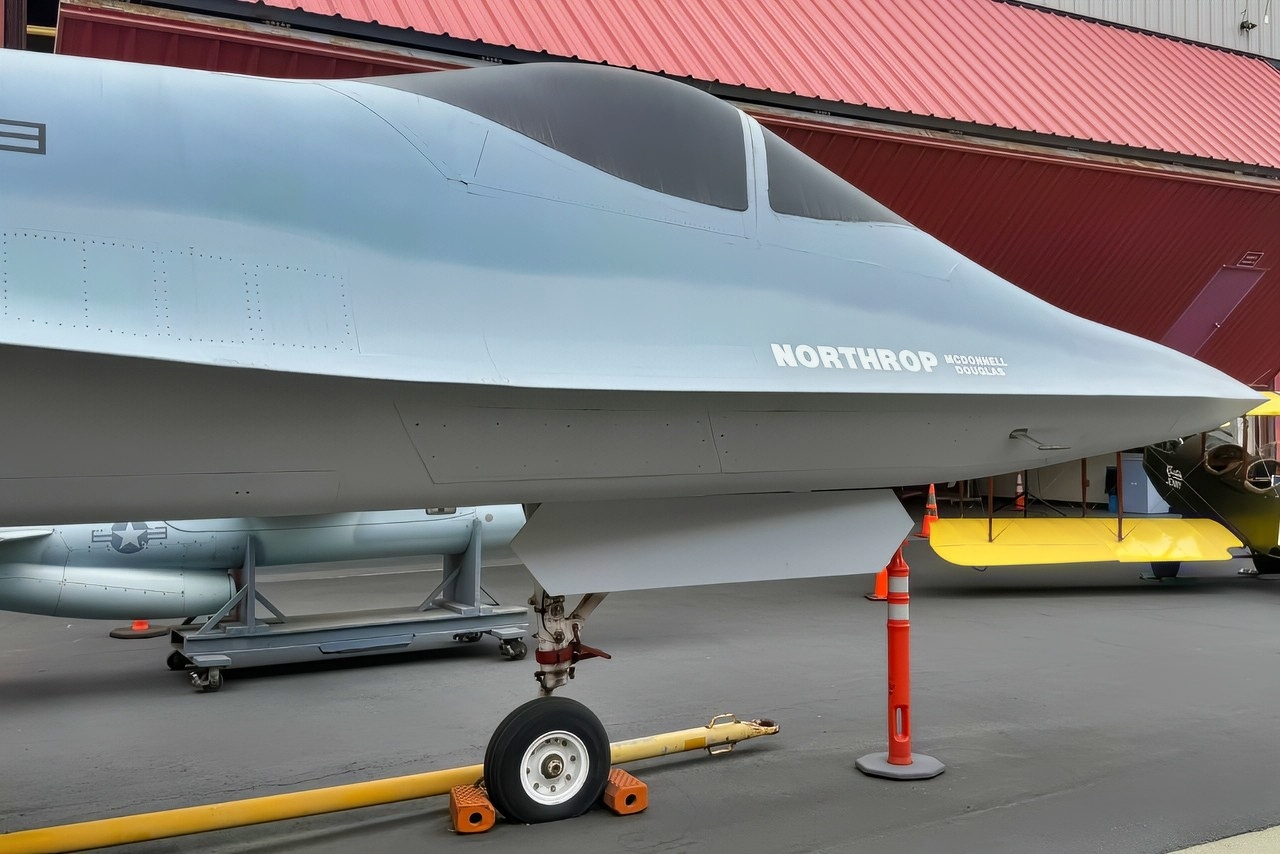
YF-23 Black Widow II Fighter In California. Image Credit: Harry J. Kazianis/National Security Journal.
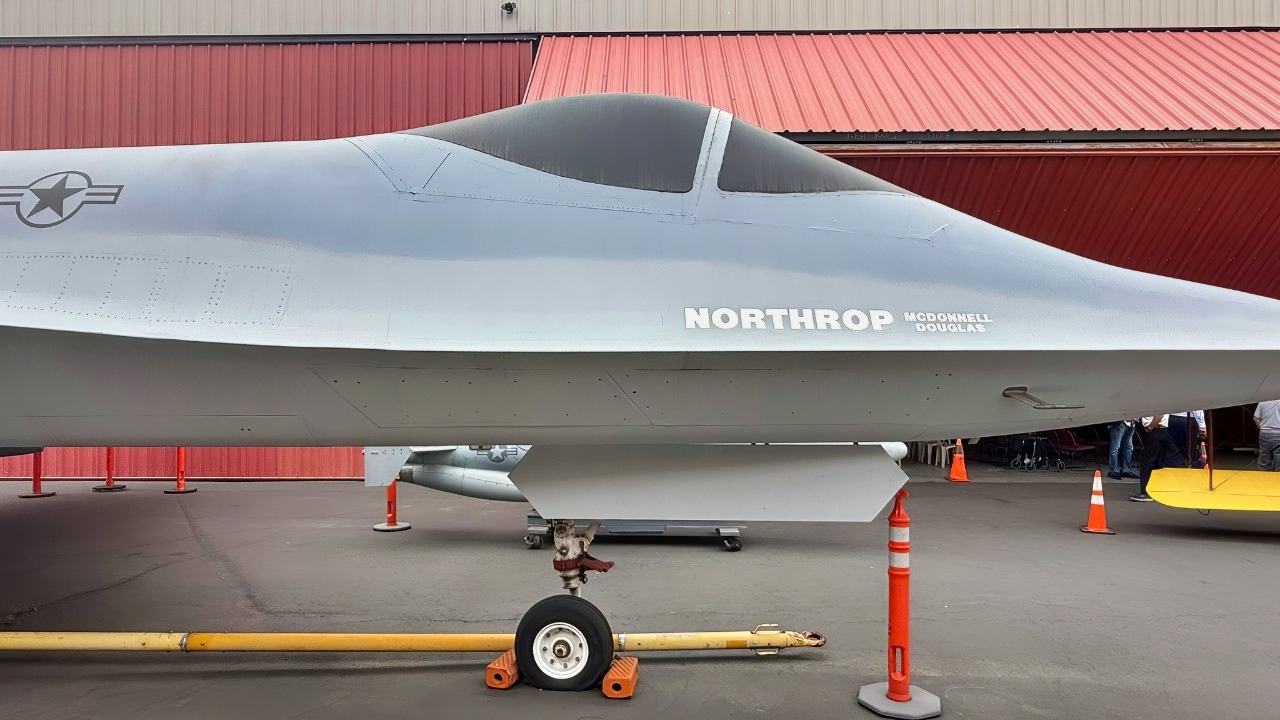
YF-23A Black Widow II on Display at Museum. Image Taken by National Security Journal on August 19, 2025.
Agility Bias. Air dominance doctrine still valued post-merge maneuver. Even if BVR kills were the goal, planners wanted a margin if a fight collapsed into the visual arena. The YF-22’s control at high angle-of-attack and its TVC pitch authority scratched that itch.
Industrial And Program Risk. Northrop was simultaneously living the realities of the B-2’s early production and cost scrutiny; Lockheed’s team had momentum and a supply chain story that looked more comfortable to decision-makers under post–Cold War budget pressure.
Schedule Confidence. The Air Force believed the YF-22 path would transition to engineering and manufacturing development with fewer unknowns in flight controls, weapons separation, and carrier-less—but still demanding—maintainability concerns.
Add those together and the service chose the Raptor. History vindicated a lot of that call: the F-22 grew into a superb air-dominance machine. But that doesn’t mean the other path was wrong; it means the Air Force picked the risk profile it preferred at the time.
Why People Still Love The YF-23
Enthusiasts—and a fair number of engineers and operators—admire the YF-23 for reasons that stand up, even decades later. I have to admit, when I saw both YF-23 planes with my own eyes I was beyond excited.
Stealth Emphasis Done Right. The platform, inlets, and shielded exhaust represented a coherent low-observable philosophy from nose to nozzle. Many still argue the YF-23 offered lower all-aspect signatures, especially in the rear quarter.
Energy Management. Supercruise plus reduced drag meant time on the clock—loiter where it matters, respond farther out, and leave when you choose. In an era of long-range missiles and wide-area sensors, that kind of kinematic efficiency is a weapon.
Infrared Discipline. The “buried” hot section was forward-leaning. With modern IRSTs and datalinked cueing proliferating, the YF-23’s IR stealth looks prescient.
Range And Volume. The big wing and fuselage hinted at more gas and more growth, which matters in real campaigns where tankers are vulnerable and weapons evolve.
In short, the YF-23 felt like a machine designed for the campaign, not the demonstration—quietly lethal over weeks and months, not just impressive in a test card.
Why Others Say The Air Force Chose Wisely
The Raptor’s supporters have equally solid points.
Agility Saves Lives. When deconfliction breaks and missiles miss, nose authority and post-stall control can win the next 30 seconds—the most important 30 seconds of a pilot’s life. The YF-22 showed that in a way the YF-23 didn’t during the window that counted.
Weapons Separation Proof. Live firings from the internal bay are non-trivial. The YF-22 checked that box. The YF-23 team argued it was a matter of sequence and time, but demonstrations reduce risk better than PowerPoints.

YF-23 Fighter at USAF Museum. Image by Harry J. Kazianis/National Security Journal.
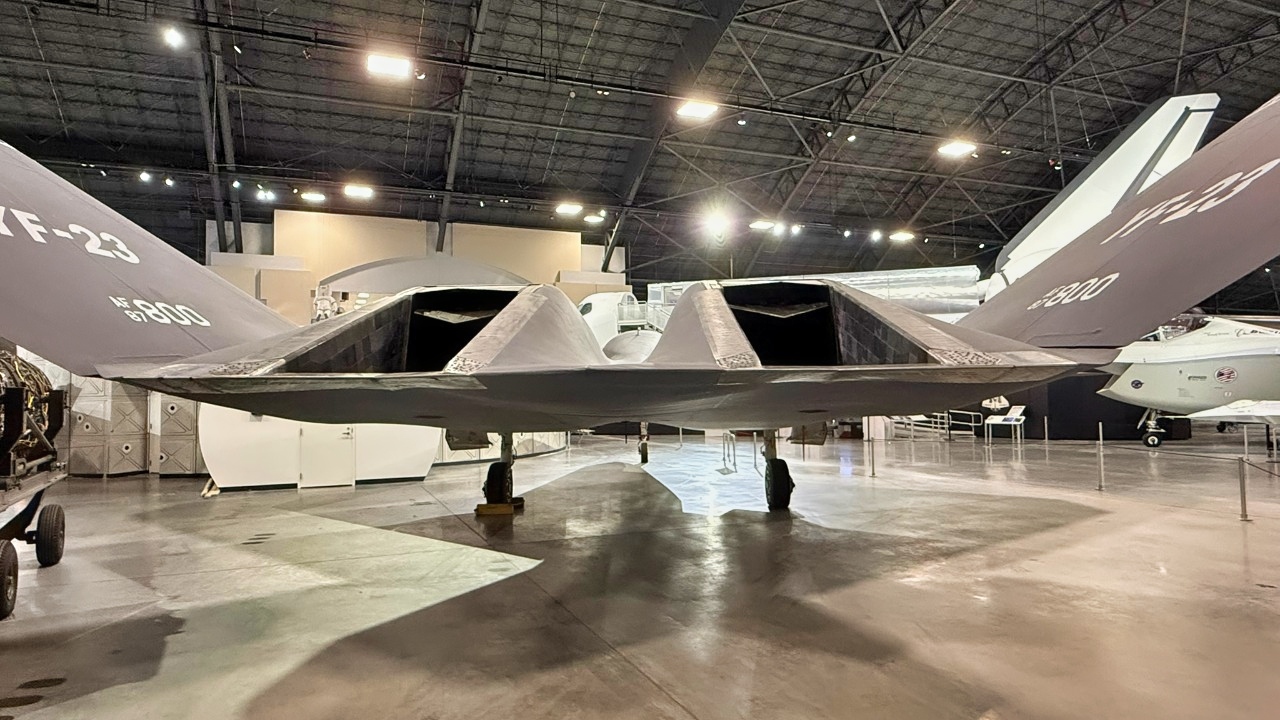
Back of YF-23 Fighter. Image Credit: National Security Journal.
Program Execution. The Air Force needed not just a brilliant airframe but an industrial plan that could survive budget drawdowns and political scrutiny. The Raptor team sold deliverability alongside performance.
Doctrine Fit. For a service still shaped by F-15 culture, the F-22 looked like a natural heir—stealthier, faster, and vastly more agile, with cockpit fusion that let pilots exploit all three.
Seen from that angle, the choice reads less like a snub and more like picking the jet that matched institutional preferences and demonstrated less near-term risk.
What “Balanced” Really Means
Two truths can be held at once. First, the F-22 was an outstanding choice that grew into perhaps the most dominant air-to-air fighter of its era. Second, the YF-23 could plausibly have delivered a different, equally valid flavor of overmatch—leaning even harder into stealth, range, and speed while accepting less post-stall drama. If your concept of operations prefers to set the terms at long range and avoid merges altogether, the YF-23 feels like the right tool. If your doctrine insists on every-option superiority, including the knife fight that sometimes still happens, the YF-22 looked safer.
In a way, the decision reduced strategic diversification. A world with both lines—one agility-max, one stealth-and-speed-max—would have given combatant commanders two distinct levers to pull. Budget reality gave them one.
Why The Museum Jet Matters
Standing near the museum YF-23’s like I did, you can see the future paths we didn’t take—low signature across more bands, IR masking as a first-class design driver, and kinematic efficiency as strategy, not just performance. Those ideas didn’t vanish. They’ve echoed into later programs, into how we think about sensors and emissions control, and into the modern obsession with collaborative tactics that keep the crewed jet at the edge of the storm while unmanned teammates take higher risk.
The airplane on static display isn’t a failure; it’s a mile marker. It reminds you that competitions are decided by capability, risk, timing, and taste—and that a great machine can still finish second.
RIP YF-23 Black Widow II
The YF-23 was the fast, quiet future—a fighter that tried to win before the other side could even take a clean shot. The YF-22 was the everything fighter—stealth plus the agility to dominate the scraps that still happen. The Air Force chose the latter, and history justifies much of that call. But if you spent two days in Dayton staring at the YF-23’s shadow-cut lines, you’d be forgiven for thinking we also left something powerful on the table: a fleet that might have fought farther out, faster, and with fewer tells, night after night.
Man, what could have been.
About the Author: Harry J. Kazianis
Harry J. Kazianis (@Grecianformula) is Editor-In-Chief and President of National Security Journal. He was the former Senior Director of National Security Affairs at the Center for the National Interest (CFTNI), a foreign policy think tank founded by Richard Nixon based in Washington, DC. Harry has over a decade of experience in think tanks and national security publishing. His ideas have been published in the NY Times, The Washington Post, The Wall Street Journal, CNN, and many other outlets worldwide. He has held positions at CSIS, the Heritage Foundation, the University of Nottingham, and several other institutions related to national security research and studies. He is the former Executive Editor of the National Interest and the Diplomat. He holds a Master’s degree focusing on international affairs from Harvard University.
More Military
The A-12 Avenger II Stealth Bomber: What Navy Aircraft Carriers Almost Had
America’s Big Boeing X-32 Stealth Fighter Mistake Still Stings
The B-52J Bomber Might Never Fly: Here’s Why
K3: The New Tank That Looks Like the B-21 Raider Stealth Bomber


