


Would 750 F-22 Raptor Fighters Built Have Resulted in Fewer F-47 NGAD Warplanes Needed Today?
Key Points and Summary
-Even if the U.S. Air Force had built its originally planned fleet of 750 F-22 Raptors, the need for the next-generation F-47 fighter would still be urgent.
-While a larger F-22 fleet would provide a numerical advantage, the platform itself is now an aging, 20-year-old design with alarmingly low readiness rates.
-This aging fleet would still be outmatched by emerging sixth-generation threats from China and Russia.
-The F-22’s shorter combat range compared to China’s J-20 further highlights the necessity for a technological leap forward, proving that time and adversary advancements make the F-47 indispensable.
The F-22 Raptor Question
One of the worst disservices even foisted upon the United States Air Force was then-US Secretary of Defense (SECDEF) Robert Michael Gates’s incredibly short-sighted decision back in 2009 to kill the F-22 Raptor after only 187 airframes were built out of the 381 planned for America’s (and the world’s) first 5th-generation stealth fighter jet. (With Gates having been a former USAF officer himself, you’d logically think he would’ve known better.) As a result, the last F-22 rolled off the Lockheed Martin Skunk Works division production lines in 2011.
Upon further review, even that 381 figure constituted less than half the number of the Raptors that the Air Force had initially planned to purchase: a whopping 750 of these warbirds.
That presents us with a fascinating hypothetical “What if” scenario: if the Air Force had attained its original 750 F-22 goal, would we still need the F-47 Next Generation Air Dominance (NGAD) 6th-generation fighter today?

F-22 Raptor. Image Credit: Creative Commons.
Bottom Line Up Front (BLUF): Time Marches On
The short answer is “Yes.” Time marches on, and as top-notch as the USAF’s two stealth fighters are—both the F-22 and the F-35 Lightning II from the same manufacturer—they’re nonetheless already starting to show their age.
It’s been 27 years since the F-22 made its maiden flight and 20 years since it made its operational debut. In turn, it’s already been 19 years since the F-35A made its maiden flight and nine years since its official operational debut.
According to the World Directory of Modern Military Aircraft (WDMMA), the USAF’s current stealth fighter tally consists of 183 F-22As and 302 F-35As.
By comparison, the People’s Republic of China’s own primary 5th-generation jet fighter, the Chengdu J-20 Weilong (“Mighty Dragon;” NATO reporting name “Fagin”), first flew in January 2011 and was officially introduced in March 2017. An estimated 250+ of these have been built thus far. And the PRC’s other 5th-generation fighter, the Shenyang J-35, is barely four years old (two years old, when you factor in the F-35A variant).
Moreover, the “Fagin” has a combat range advantage over the Raptor: 1,100 nautical miles versus 750 nautical miles, a 31.8 percent differential.
On-Paper Numbers vs. Real Readiness Numbers
Even more concerning than the age of the USAF stealth jets is the readiness rate. As noted by John A. Tirpak in a February 18, 2035, article for Air & Space Forces Magazine titled “Air Force Mission Capability Rates Reach Lowest Levels in Years”: “F-22 readiness fell from 52 percent to just 40.19 percent; it had been at 57.4 percent two years ago. The Air Force sought to divest its 32 least-capable F-22s in recent years, but Congress has blocked that move until at least 2028.”
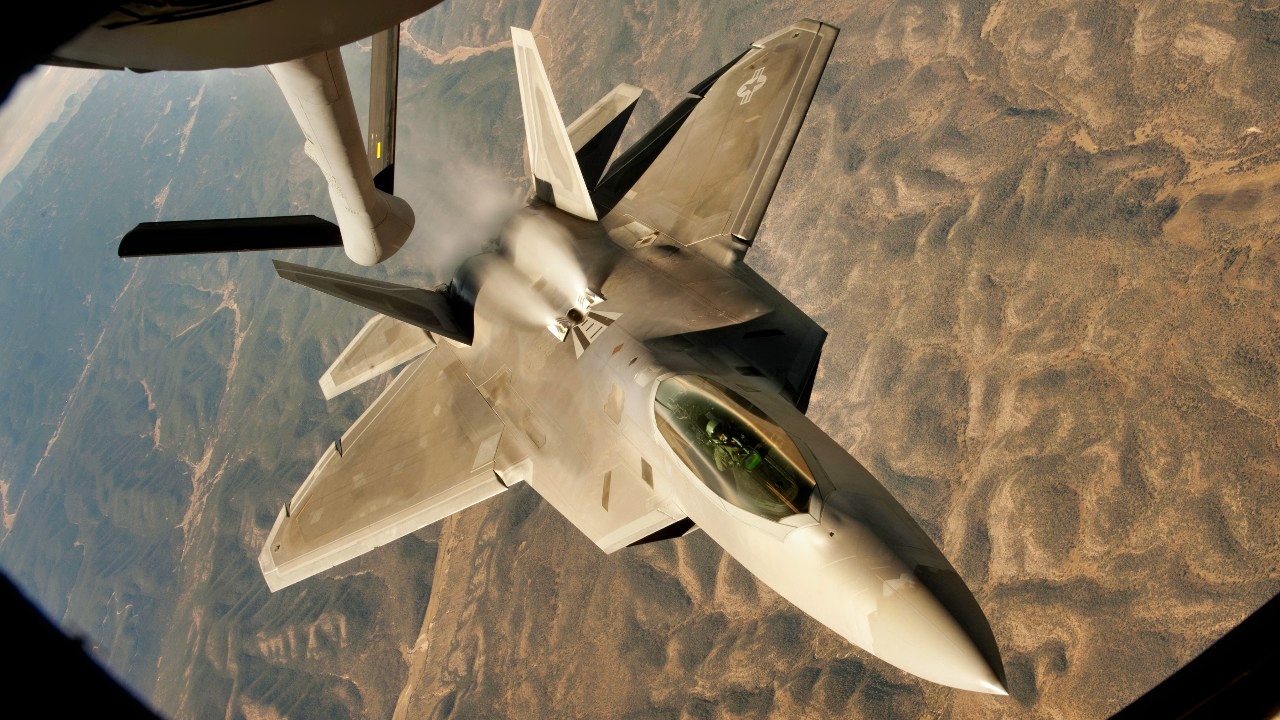
A U.S. Air Force F-22 Raptor backs away from a KC-135 Stratotanker after conducting an in-flight refueling during a training mission over central New Mexico on Oct. 23, 2013. The Raptor is assigned to the 49th Fighter Wing at Holloman Air Force Base, N.M. The Stratotanker is assigned to McConnell Air Force Base, Kan. DoD photo by Airman 1st Class John Linzmeier, U.S. Air Force. (Released)
NOTE: Those “32 least capable F-22s” are the ones designated for the trainer role, which in turn reduces the number of frontline Raptors from 183 to 151—and that’s even before you factor in that godawful 40.19 percent readiness rate! So then, by extrapolation, if the airframes originally planned 750 F-22s had actually been built—and assuming that the number of trainer-only specimens didn’t increase proportionately—that would mean only 301 of them would currently be “fit to fight” (so to speak).
(Meanwhile, the F-35 readiness rate isn’t much better, with a mission capable [MC] rate of 51.5 percent.)
The Air Force has 301 readily available fighting Raptors, which would barely outnumber the combination of the PRC’s 250+ J-20s and 8+ J-35s/J-35As and Russia’s 32+ Sukhoi Su-57 “Felon” stealth fighters.
Time Marches On, Part Deux
Though the 5th-generation fighters—and to a lesser extent, 4.5-generation fighters such as the Boeing F-15EX Eagle II (only eight of which are currently operational, with an MC rate of 83.13 percent)—are the current rage, that doesn’t mean the UAF can afford to slack off and rest on its laurels.
This would be true even if the F-22 and F-35 were to hypothetically and miraculously attain a 100 percent MC rate.
After all, the PRC and the Russian Federation alike are already hard at work on their own 6th-generation warbirds.
In the case of China, we’re talking about the Chengdu J-36 fighter and the Xi’an H-20 bomber; the former already made its first flight in prototype form on December 26, 2024, whilst the latter may have already made its first test flight the following month.
As for Russia, they’re working on both the Su-75 “Checkmate” fighter and the Tupolev PAK DA (Perspektivnyi aviatsionnyi kompleks Dal’ney aviatsii) Poslannik (“Envoy;” NATO reporting name “Flatback”).
Granted, neither of these warplanes has gotten off the ground (that we are aware of) in the figurative or literal sense, thanks to a shortage of funding and spare parts due to Western sanctions imposed as punishment for Putin’s invasion of Ukraine. However, until either one of these projects is finally cancelled, the USAF brass can’t afford to mentally write them off.
Even if the USAF had all 750 F-22s, it would still be downright negligent to pass up on the F-47 NGAD.
Let’s just hope the F-47 doesn’t also end up getting prematurely shortchanged by another future myopic SECDEF cut from the same cloth as Robert Gates.
About the Author: Christian D. Orr, Defense Expert
Christian D. Orr is a Senior Defense Editor. He is a former Air Force Security Forces officer, Federal law enforcement officer, and private military contractor (with assignments worked in Iraq, the United Arab Emirates, Kosovo, Japan, Germany, and the Pentagon). Chris holds a B.A. in International Relations from the University of Southern California (USC) and an M.A. in Intelligence Studies (concentration in Terrorism Studies) from American Military University (AMU).
More Military
China’s Military Has 1 Goal: Beat America In a War
Confirmed: The U.S. Navy Still Loves the Aircraft Carrier


