

War in the Middle East Expands, with Egypt, Kuwait, and Bahrain Struck: On Friday, the conflict in the Middle East continued to escalate, with more countries becoming involved.
According to CNBC, Iran’s army said on Friday that it has launched strategic strikes on U.S. military assets at Ahmad al-Jaber Air Base in Kuwait and Sheik Isa Air Base in Bahrain.
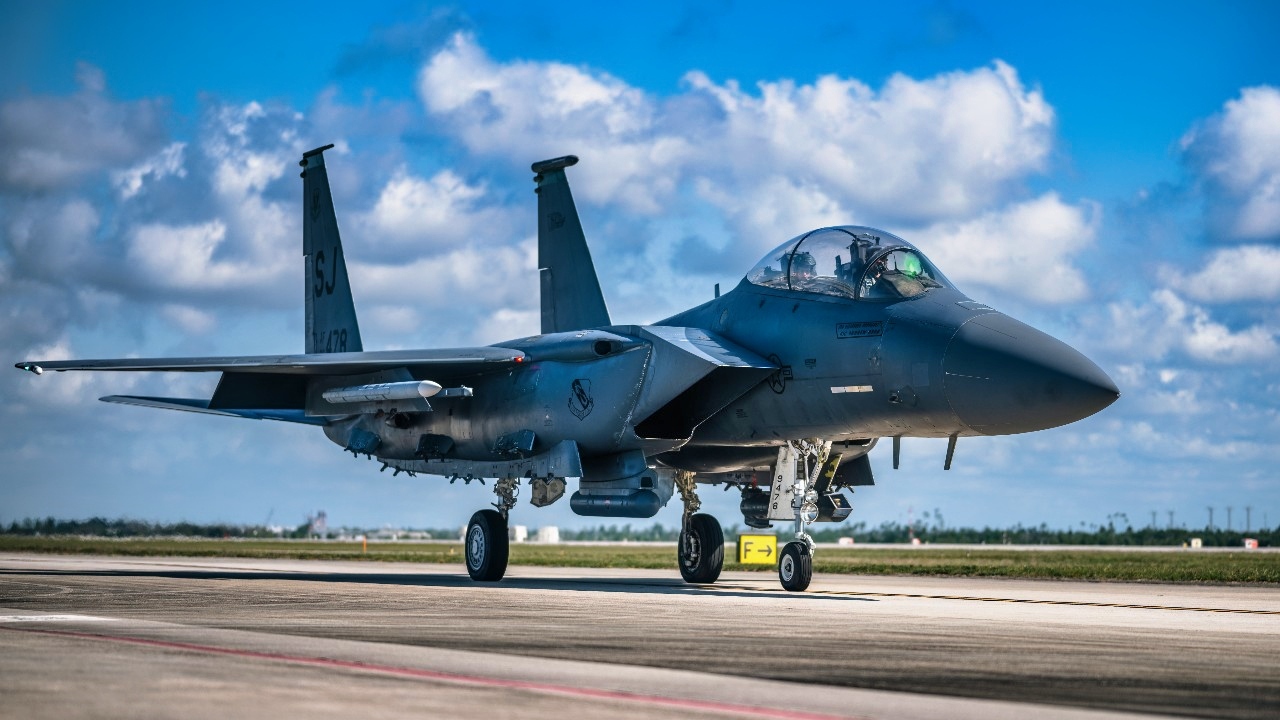
A U.S. Air Force F-15E Strike Eagle assigned to the 335th Fighter Squadron, Seymour Johnson Air Force Base, North Carolina, taxis during Checkered Flag 25-2 at Tyndall AFB, Florida, May 14, 2025. Checkered Flag, one of the Department of Defense’s largest air-to-air exercises, integrates fourth and fifth-generation aircraft to enhance mobility, deployment, and employment capabilities. (U.S. Air Force photo by Airman 1st Class Zeeshan Naeem).

Image Credit: US Air Force.
Iranian state media claimed that Iran targeted “aircraft shelters, satellite communication systems and equipment storage facilities” at the base in Kuwait, with “power generators, navigation systems and support buildings” among the targets in the Bahrain strike.
In addition, Egypt, a country that had not been involved in the current conflict up until now, reported that a drone had struck two ships at the Port of Damietta on the Mediterranean coast, where a liquefied natural gas (LNG) hub is located. The port is not far from the Suez Canal.
The two ships that were struck are a regasification ship and a storage vessel, in a strike that took place Wednesday but was not immediately publicized. There were no confirmed injuries or deaths in the strikes.
Bahrain and Kuwait, as well as U.S. interests there, had been attacked previously, including in early June. But this week marks the first time that Egypt has suffered a strike during this year’s conflict.
Egypt Responds
Egypt’s cabinet, through the Middle East News Agency, announced that a “preliminary investigation” had found that a drone was responsible for the fire on the vessel. No one, however, has claimed responsibility for the attack, although CNBC noted that the attack came as Iran was attacking energy infrastructure around the Middle East region.
One of the vessels, the Energos Winter, is owned by the Connecticut-based American company Energos Infrastructure, although it’s being leased by Egyptian Natural Gas Holding Company, the New York Times said. Video later surfaced on social media of the ship being hosed down, presumably after the attack.
The Times also reported that, because Egypt is not a major exporter of natural gas, the attack on its own is unlikely to have significant consequences for global energy markets.
And while Iran has not officially claimed responsibility for the attack, The Times cited two unnamed Iranians as stating that the attack on the Egyptian port was meant to show that “global shipping and energy supplies could be more deeply disrupted” in the event of an Iranian escalation.
Iranian Claims of a “False Flag”
Reuters quoted a social media post from Iranian Foreign Minister Abbas Araqchi, not only denying that Iran was responsible for the strike on Egypt, but implying that Israel had staged the attack.
“We must all be vigilant against Israeli plots and false-flag operations,” the foreign minister said.
A New Saudi Coalition
CNBC also placed the attacks in the context of the Houthis’ maritime embargo on Saudi oil. The attack on Egypt’s Mediterranean port, assuming it is by Iran or an Iranian proxy, shows that one potential workaround of that embargo, involving retrieving cargo on the Mediterranean coast, may not be safe either.
Reuters noted this as well, stating that the Suez Canal is “one of the last major export routes” available for Saudi oil, following the Houthis’ blockade.
As a result of this, the Times reported that Saudi Arabia announced on Thursday that it is forming a military coalition to protect shipping in the region, in response to the Houthis’ blockade of their oil shipments. The alliance, the announcement said, is “purely defensive” and is not meant to target any particular other nation.
Thirteen countries have agreed to join the Saudis in the Multinational Maritime Defense Alliance, while representatives from more than 40 countries participated in the official meeting.
In addition to the Saudis themselves, Al-Jazeera listed the participating countries as Bahrain, Bangladesh, the Comoros, Djibouti, Egypt, Jordan, Kuwait, Pakistan, Qatar, Somalia, Sudan, Turkey, and Yemen, with Yemen presumably the internationally recognized, non-Houthi government of that country.
The Al Jazeera story noted that neither the United Arab Emirates nor Oman is included on the list of countries in the alliance, although the Saudis stated that “the door remains open” for additional countries to join the coalition at a later time.
About the Author: Stephen Silver
Stephen Silver is an award-winning journalist, essayist, and film critic, and contributor to the Philadelphia Inquirer, the Jewish Telegraphic Agency, Broad Street Review, and Splice Today. The co-founder of the Philadelphia Film Critics Circle, Stephen, lives in suburban Philadelphia with his wife and two sons. For over a decade, Stephen has authored thousands of articles that focus on politics, national security, technology, and the economy. Follow him on X (formerly Twitter) at @StephenSilver, and subscribe to his Substack newsletter.


Hujjatullah M.H.B. Sahib
July 31, 2026 at 1:57 pm
These developments can only be described as ground-breaking. There are some justifications for Iran to restrict Hormuz and for Houthis to similarly restrict the Bab al Mandeb but beyond these understandable restrictions to also place the Suez is unwarranted and may be ruinous of the world economy. But are the Iranians evidently responsible for the attacks near Suez in the first place ? Similarly, the Saudi defensive alliance is also welcome as this may serve as a stabilizing arrangement and may help keep at least the Suez in unhindered open access !