


Key Points and Summary – USS Kentucky (BB-66) was conceived first as a Montana-class super-battleship and then reordered as an Iowa-class fast battleship, meant to outgun Japan’s Yamato while keeping pace with carrier task forces.
-Laid down in 1942, her construction stalled repeatedly as wartime priorities shifted to carriers and landing ships.
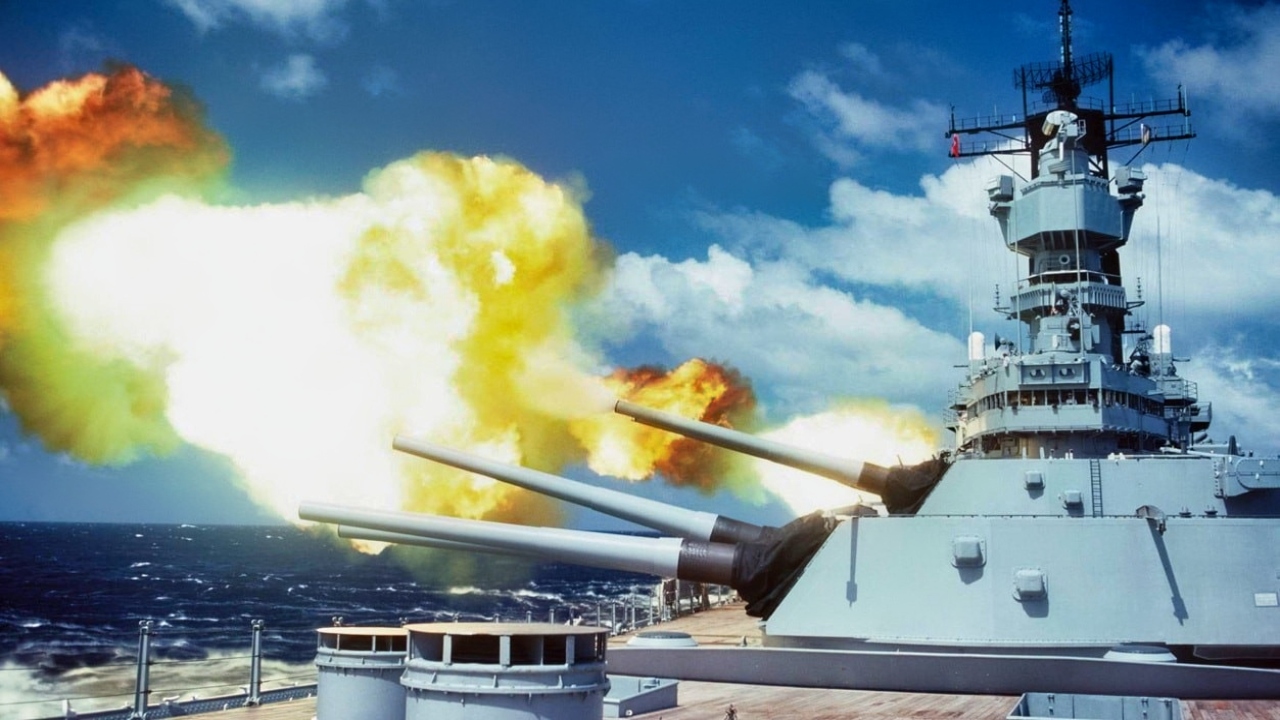
Iowa-Class Battleship. Image Credit: Creative Commons.
-By the time her incomplete hull was launched in 1950, the battleship era was effectively over.
-Missile-conversion schemes—Terrier or even Polaris—were judged too costly, and Kentucky was scrapped in 1958. Yet she didn’t vanish entirely: her bow saved USS Wisconsin after a collision, and her engines powered fast support ships for decades.
The Battleship That Died in Drydock: Inside Iowa-Class USS Kentucky’s Fate
The Iowa-class battleships are some of the most iconic naval vessels in modern history.
They were renowned for their service in WWII and the Cold War.
Only four ships of the class were ever completed, but two more were under construction before their cancellation.
One of these ships was the USS Kentucky (BB-66). Laid down during WWII, Kentucky was originally planned as a Montana-class battleship, but after the project was discontinued, she was reordered as an Iowa-class battleship.

Iowa-Class Battleship. Image Credit: Creative Commons.
Unfortunately, the war ended before her completion, and the U.S. Navy had no more need for large battleships. She was sold for scrap in 1958.
History of the USS Kentucky
Kentucky’s origins date back to the late 1930s, when the US Navy was planning new capital ships under the restrictions of the Washington and London Naval Treaties. With the passage of the Second Vinson Act of 1938, the US was granted permission to construct larger ships as part of the war effort, including battleships.
Initially, BB-66 was intended to be the second ship of the Montana-class, a proposed series of super-battleships designed to outgun and out-armor the Iowa-class. The Montana-class was envisioned to carry 12 16-inch guns in 4 turrets, compared to the Iowa-class’s nine guns in 3 turrets, and to feature heavier armor for slugfests against Japanese Yamato-class battleships. However, these ships would be slower, making them less suitable for escorting fast carrier task forces.
By 1940, the Navy’s priorities shifted. After the Battle of Midway, the Navy realized that it needed faster battleships, not heavier ones. The Two-Ocean Navy Act of 1940 authorized a massive expansion of the fleet, and the urgent need for fast battleships to escort the new Essex-class aircraft carriers led to the cancellation of the Montana-class. BB-65 (Illinois) and BB-66 (Kentucky) were reordered as Iowa-class ships for better speed to keep up with carrier fleets.
Design and Specs
The USS Kentucky mirrored the rest of her Iowa-class sisters. She had a displacement of about 55,000 tons at full load, a length of 887 feet, and an armament of nine 16-inch/50-caliber Mark 7 guns, twenty 5-inch/38-caliber guns, and extensive anti-aircraft batteries.

Iowa-Class Battleship. Image Credit: Creative Commons.
Her armor belt was up to 12.1 inches thick, with turret faces up to 19.5 inches, and she was designed to carry three floatplanes for reconnaissance. These features made her a formidable ship on paper, but the realities of war and technology would prevent her completion.
Construction began at the Norfolk Naval Shipyard on March 7, 1942, during the peak of wartime shipbuilding. However, her progress was repeatedly interrupted. In June 1942, work was suspended after only the bottom structure was completed because the drydock was needed for landing ship tank production.
Construction resumed in December 1944, but progress remained slow due to shifting priorities. By February 1947, work was halted again, with the ship about seventy-two percent complete. In January 1950, the incomplete hull was launched, not for service, but to clear the dock for other ships. By then, the war had been over for five years, and the Navy was downsizing. Kentucky never advanced beyond a partially completed hull and superstructure.
Why the U.S. Scrapped Kentucky
Ultimately, the Navy decided against completing Kentucky for several reasons. The most decisive was the rise of aircraft carriers. Various naval battles during the war in the Pacific demonstrated that maritime air power, not big guns, would shape future warfare. Carriers could strike hundreds of miles away, while battleships were limited to line-of-sight gunnery. As a result, the Navy prioritized building Essex-class carriers and their escorts over finishing additional battleships.
The second factor was the post-war drawdown. Following Japan’s defeat in 1945, the United States drastically reduced military spending. Completing Kentucky would have required significant resources at a time when the Navy was scrapping ships and mothballing others. The Iowa-class ships already in service were more than sufficient for peacetime needs; however, these ships would eventually be temporarily shelved until later in the Cold War.
Naval Warfare Outpaced the Battleship
By the late 1940s, guided missiles and jet aircraft were emerging as the future of naval warfare. Battleships were increasingly seen as vulnerable and outdated. Several proposals were floated to convert Kentucky into a guided-missile battleship, designated BBG-1, equipped with RIM-2 Terrier missiles and advanced radar systems.
Since construction on the ship was around 75 percent complete, adding these systems would have been relatively easy. Another plan envisioned fitting her with Polaris ballistic missiles. However, these conversions were deemed too costly and complex compared to building purpose-designed missile cruisers.
Finally, the decision was made to scrap the incomplete battleship. Kentucky’s incomplete hull served as a parts depot. In 1956, her bow was removed and grafted onto the USS Wisconsin after a collision. Her engines were later installed in fast combat support ships USS Sacramento and USS Camden, extending their utility well beyond Kentucky’s scrapping.
In this way, parts of Kentucky lived on, even though the ship herself never did.
About the Author: Isaac Seitz
Isaac Seitz, a Defense Columnist, graduated from Patrick Henry College’s Strategic Intelligence and National Security program. He has also studied Russian at Middlebury Language Schools and has worked as an intelligence Analyst in the private sector.


