

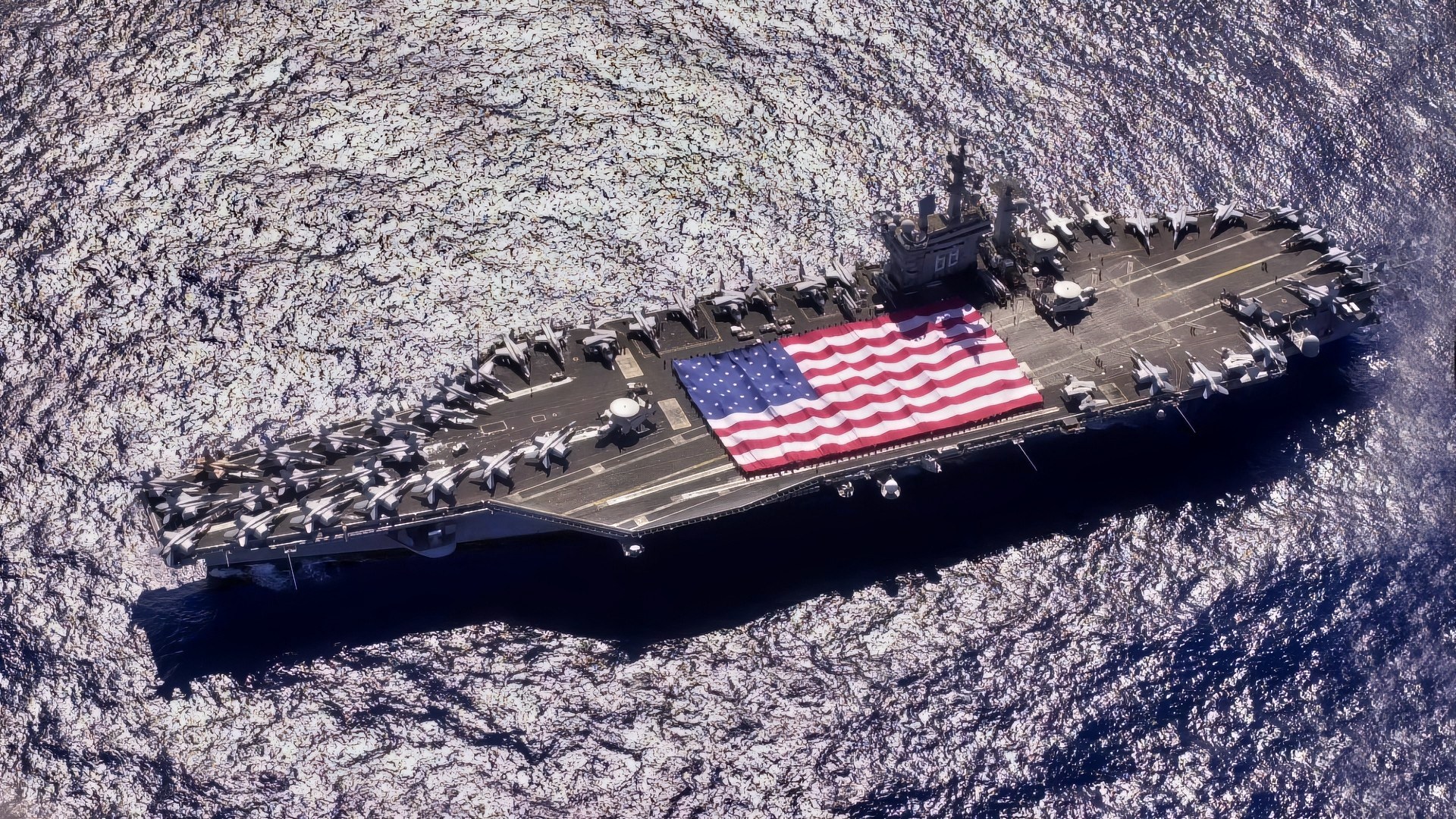
Key Points and Summary – China has developed a multi-layered strategy to threaten U.S. aircraft carriers that goes far beyond its famous “carrier-killer” missiles.
-The diverse and innovative threats include advanced quiet submarines, a new hybrid missile-torpedo weapon, and swarms of kamikaze sea drones.
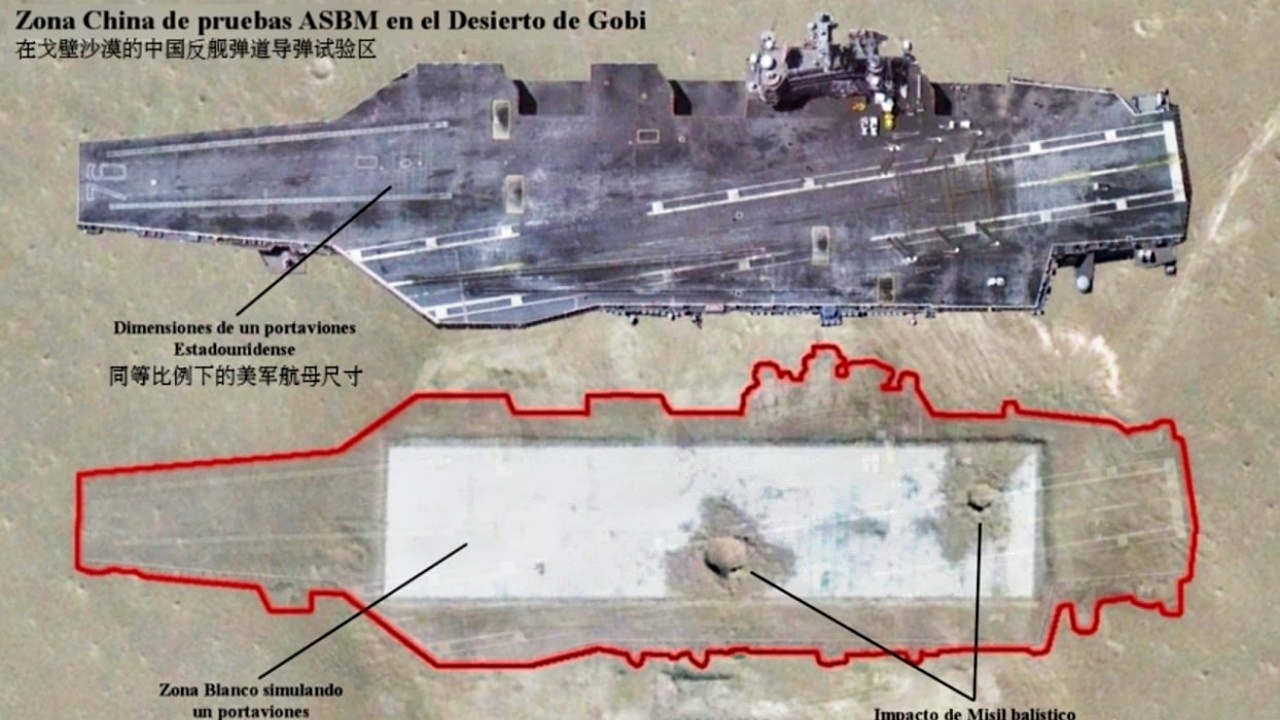
DF-26 China Missile Attack on Fake Aircraft Carrier Cut Out. Image Credit: Chinese Weibo Screenshot.
-China is also pioneering unconventional methods, such as using satellites to track a carrier’s wake pattern and cyber attacks to sabotage ships in port.
-This array of asymmetric tactics is designed to overwhelm a carrier strike group’s defenses, creating a formidable challenge to U.S. naval power in the Pacific.
China Has Ways to Take Out U.S. Aircraft Carriers That Are Creative and Innovative
China has one main way to destroy U.S. aircraft carriers, and that means missiles and plenty of them. They can be launched by land, deployed by ships, or dropped by airplanes. The People’s Republic aims to keep the U.S. Navy carrier force down and out. This occurs by creating an overwhelming arc of projectiles that implements the Chinese strategy of anti-access/area denial.
American carrier strike groups must stay out of the range of the DF-17, DF-21D, and DF-26 carrier-killing missiles. This hurts the Navy’s ability to project power and makes it more challenging to keep the East and South China Seas open to navigation for the protection of international trade and commerce.
Torpedoes From Submarines
Carrier-killing missiles are not the only way that China could destroy a carrier. The Chinese have a formidable attack submarine force that includes quiet nuclear-powered hunter-killers, such as the Type 093B Shang II-class, and stealthy diesel-electrics, like the Yuan-class, equipped with Stirling air-independent propulsion (AIP) engines.

China UUV Drones. Image Credit: X Screenshot.
These subs deploy the Yu-10 advanced heavyweight torpedo. This is similar to the American Mk-48, featuring excellent guidance and tracking capabilities that can create a powerful explosion capable of taking down a carrier. Of course, there would need to be multiple hits, and the subs would have to first sneak through the U.S. Navy’s best active and passive sonars, towed arrays, sonobuoys, and anti-submarine aircraft. This protective bubble is one of the best in the world, but China believes its advanced subs can sneak through the strike group’s screen.
The Hybrid Missile Torpedo Weapon Is Fearsome
There is also a relatively new Chinese “hybrid missile torpedo weapon.” The projectile begins as a ship-launched ballistic missile and then transitions into a torpedo during its latter phase. The rocket first flies at MACH 2 at 32,000 feet then swoops down to sea level and transforms into a torpedo.
New Ways to Discover and Track Carriers
China also has an innovative way to detect and track carriers that would enable them to be sunk by fighter jets, surface warships, or submarines. American carriers leave “fingerprints” due to their wake patterns.

USS John Finn (DDG 113) arrives Nov. 15 at the Port of Hueneme for routine Combat System Assessment Team (CSAT) repairs and training. The ship is one of four in the fleet with an Optical Dazzling Interdictor, Navy — also known as ODIN. The ODIN laser weapon system stuns enemy drones threatening surface ships. The destroyer also has two helicopter hangars, big enough to hold an MH-60R Seahawk Romeo multi-mission helicopter and the MH-60S Knighthawk Sierra helicopter. (U.S. Navy Photo by Dana Rene White/Released)
These can be discovered through open-source satellite data freely available to intelligence agencies and think tanks. Rapid cycling computer algorithms discover a carrier’s wake, and an intel analyst can tell where the aircraft carrier is on the map in the Indo-Pacific. One can’t see the wake pattern with the naked eye, but a system developed at a university research center can be used for early detection of a carrier’s whereabouts. Once identified, the Chinese missiles and torpedoes could hit paydirt and destroy a carrier.
Suicide Sea Drones
China has many sea drones in development, and some are already on active duty.
These could be laden with explosives and aimed at carrier strike groups for a kamikaze strike. Unmanned sea gliders that can dive below depths and then return to the surface are becoming more prevalent. China calls its drone ocean glider the Sea Wing, and it could sneak into the confines of a carrier strike group and cause problems.
Minelaying Drones Are a Big Worry
The People’s Liberation Army Navy (PLAN) also has a large AJX002 underwater minelaying drone. Sea mines are another way that China could destroy a carrier or at least create a denial of access and no-go parts of the ocean. The strike group would not be able to patrol in mined waters without a minesweeper. The AJX002 has a range of 1,000 nautical miles.

(Oct. 17, 2017) The aircraft carrier USS Nimitz (CVN 68) transits the Arabian Gulf, Oct 17, 2017. Nimitz is deployed in the U.S. 5th Fleet area of operations in support of Operation Inherent Resolve. While in this region, the ship and strike group are conducting maritime security operations to reassure allies and partners, preserve freedom of navigation, and maintain the free flow of commerce. (U.S. Navy photo by Mass Communication Specialist Seaman David Claypool/Released)
Cyber Attacks for Sabotage
China could also use cyber attacks against U.S. Navy shipping while carriers are at port. There are already reports of cyber operations targeting civilian maritime vessels while they are docked. Malware can be inserted into a ship’s computer systems with a “remote access trojan.”
Then, China could sabotage the maintenance efforts while the carrier was at port and prevent it from conducting refueling or repairs. This would keep the carrier out of action – not destroying it – but incapacitating it.
Other types of sabotage could include an explosives-laden small craft that could make a suicide attack on a carrier at port, similar to the strike on the USS Cole in 2000. This would be a low probability event, but it is plausible in wartime. The Chinese would examine many ways to disable or even sink a carrier.
China Has Aircraft Carriers Top of Mind if War Breaks Out
You can bet that China has even more ideas to destroy American aircraft carriers that it is not making public. A damaged or sunk U.S. flat-top could change the type of warfare in China’s favor. This would be a public relations disaster for the U.S. military and ordinary Americans, and the media may pressure the president to end a fight with Beijing if the worst happened. The Navy must plan for the contingency that it could lose a carrier.
Torpedoes have been improved with quieter and more deadly submarines. The missile-to-torpedo projectile is troubling. Early detection has improved with the ability to analyze a carrier’s wake and pinpoint its location for an accurate missile launch. The Chinese could use a kamikaze drone.
Hackers are salivating at the prospect of penetrating U.S. Navy cyber defenses and sabotaging repair and maintenance periods.
Drones that emplace sea mines are another problem to ponder.
The U.S. flat-top force must examine these unconventional methods and defend against them.
The Americans don’t seem to be training on these types of contingencies, and countering the sneaky tactics must now be a priority.
The Chinese are exploring asymmetric means to counter with innovative maneuvers that could potentially sink or damage an aircraft carrier.
It will take imaginative and expert officers and sailors to predict these kinds of operations conducted by the Chinese in a war on carriers that could alter the balance in the Indo-Pacific.
About the Author: Brent M. Eastwood
Brent M. Eastwood, PhD is the author of Don’t Turn Your Back On the World: a Conservative Foreign Policy and Humans, Machines, and Data: Future Trends in Warfare plus two other books. Brent was the founder and CEO of a tech firm that predicted world events using artificial intelligence. He served as a legislative fellow for US Senator Tim Scott and advised the senator on defense and foreign policy issues. He has taught at American University, George Washington University, and George Mason University. Brent is a former US Army Infantry officer. He can be followed on X @BMEastwood.
More Military
It’s Official: Boeing Strike Is Delaying New F-15EX Eagle II Fighter Jets
‘Brink of Nuclear War’ if U.S. Sends Tomahawks to Ukraine?
China’s Sixth-Generation White Emperor Fighter Simply Summed Up in 1 Word
A Russian Pilot Defected with a Mach 2.3 MiG-29 Fulcrum Fighter Jet


