


Synopsis: The X-20 Dyna-Soar was a Cold War-era attempt to build a reusable, piloted, winged spaceplane that could ride a booster into space, “skip” along the edge of the atmosphere at hypersonic speed, and return for a gliding landing.
-Though it never progressed beyond mock-ups before cancellation in 1963, the program helped push early thinking on re-entry shapes, guidance, hypersonic aerodynamics, and thermal management.

X-37B. Image Credit: Creative Commons.
-The concept envisioned high-speed surveillance and even strike missions, foreshadowing later debates about military spacepower. Its legacy lives on in how it influenced later winged-entry and orbital vehicle designs.
Mach 20 in the 1960s: The X-20 Dyna-Soar Spaceplane Was Almost Real
The idea of a possible manned space plane capable of Mach 20 in the 1960s was sufficient to bewilder the brightest minds in development, yet a mock-up with these ambitions did exist until 1963. The X-20 Dyna Soar never materialized beyond an initial mock-up phase, yet it is remembered for its influence and defining ambition.
The intention was to engineer a reusable, piloted, winged spaceplane capable of launching from a rocket, gliding through space, and re-entering at unprecedented speeds.
The National Museum of the United States Air Force published an image or rendering of the Dyna-Soar as a reusable spacecraft designed as a “delta-wing boost glider that rides into space on a modified Titan booster.”
Soaring Ambitions
It was called Dyna-Soar, an abbreviation for “Dynamic Soaring,” and early conceptual work advanced understanding of hot-structure technology, re-entry shapes, on-board guidance, and hypersonic design theory, the Air Force write-up explains. Subsequent winged-entry designs were all inspired or at least influenced by the Dyna-Soar.
The X-20 was a concept decades ahead of its time, which many experts maintain could have become the first hypersonic space vehicle.
The idea for this emerged during the earliest days of the Cold War in the 1950s, and its technology would arguably be considered cutting-edge by today’s standards, something which is rather staggering given that it emerged generations ago.
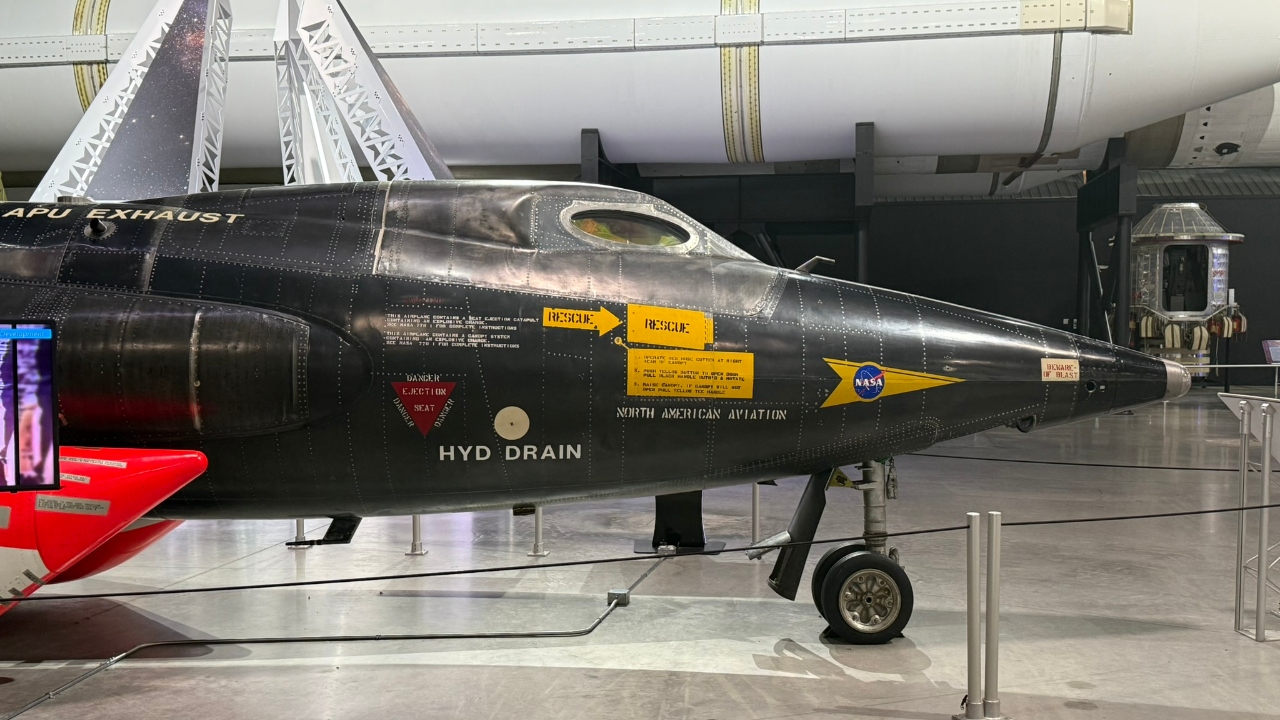
X-15 Harry J. Kazianis National Security Journal Photo.

X-15 Long Shot and Engine Photo. Image Credit: National Security Journal.

North American X-15 Head On. Image Credit: National Security Journal.
“After launch, the X-20 would soar along the blurred line between Earth’s atmosphere and the vacuum of space, bouncing along the heavens by using a lifting-body design and hypersonic speeds to skip along the upper reaches of the atmosphere. It would circle the globe, releasing its payload over Soviet targets miles below, before making its way back to American territory to come in for a gliding landing, not entirely unlike the Space Shuttle decades later. The X-20 was a 1950s science fiction fever dream born of the nuclear age and the earliest days of the Cold War… and according to experts at the time, it very likely would have worked,” a write-up in SandBoxx explains.
The write-up from SandBoxx analyzes an artistic rendering of the space vehicle and provides technical details on its construction plans.
“To manage the incredible heat of re-entry, the X-20 would use super alloys like the heat resistant Rene 41 in its frame, with molybdenum, graphite and zirconia rods all used for heat shielding on the underside of the craft,” the essay states.

X-37B Orbital Test Vehicle concludes its sixth successful mission. Image Credit: Creative Commons.
Perhaps the most phenomenal element of this is its “ahead of its time” analysis of thermal management and hypersonic flight; this concept is, of course, a fundamental focus in ongoing efforts to engineer hypersonic weapons capable of maintaining flight trajectory, guidance, and precision at hypersonic speeds.
1950s Space War
The concept at the time was to engineer a manned space vehicle capable of launching global surveillance and strike missions at hypersonic speeds beyond Earth’s atmosphere.
The idea of a Mach 20 Dyna-Soar also foreshadows the creation of the Space Force, as it envisions leveraging space for potential deterrence or combat operations.
For decades, the US has regarded space exploration through an ethical lens, viewing the domain as a scientific, timeless, and valuable sanctuary for collaborative, multinational exploration and discovery.
Rivals of the US, however, did not share this view and instead spent decades weaponizing space and engineering technologies, including anti-satellite weapons and other offensive and defensive spacewar innovations.

X-37B. Image Credit: Creative Commons.
In response to the fast-growing, serious threat posed by the rival weaponization of space, the US formed its Space Force and has, in recent years, been preparing to prevail in a potential space war.
The X-37B, for example, is a mysterious yet successful manned space vehicle engineered by NASA for scientific exploration and later transferred to the US Air Force for potential military use.
It seems entirely reasonable to posit that indeed the X-37B was heavily influenced, if not specifically inspired by the X-20 Dyna-Soar.
About the Author: Kris Osborn
Kris Osborn is the President of Warrior Maven – Center for Military Modernization. Osborn previously served at the Pentagon as a highly qualified expert in the Office of the Assistant Secretary of the Army—Acquisition, Logistics & Technology. Osborn has also worked as an anchor and on-air military specialist at national TV networks. He has appeared as a guest military expert on Fox News, MSNBC, The Military Channel, and The History Channel. He also has a Masters Degree in Comparative Literature from Columbia University.


Krystal cane
February 16, 2026 at 2:12 pm
Is the message this is like 50 years ago You guys have no clue what you’re talking about. And the GOP is full of child predators?