

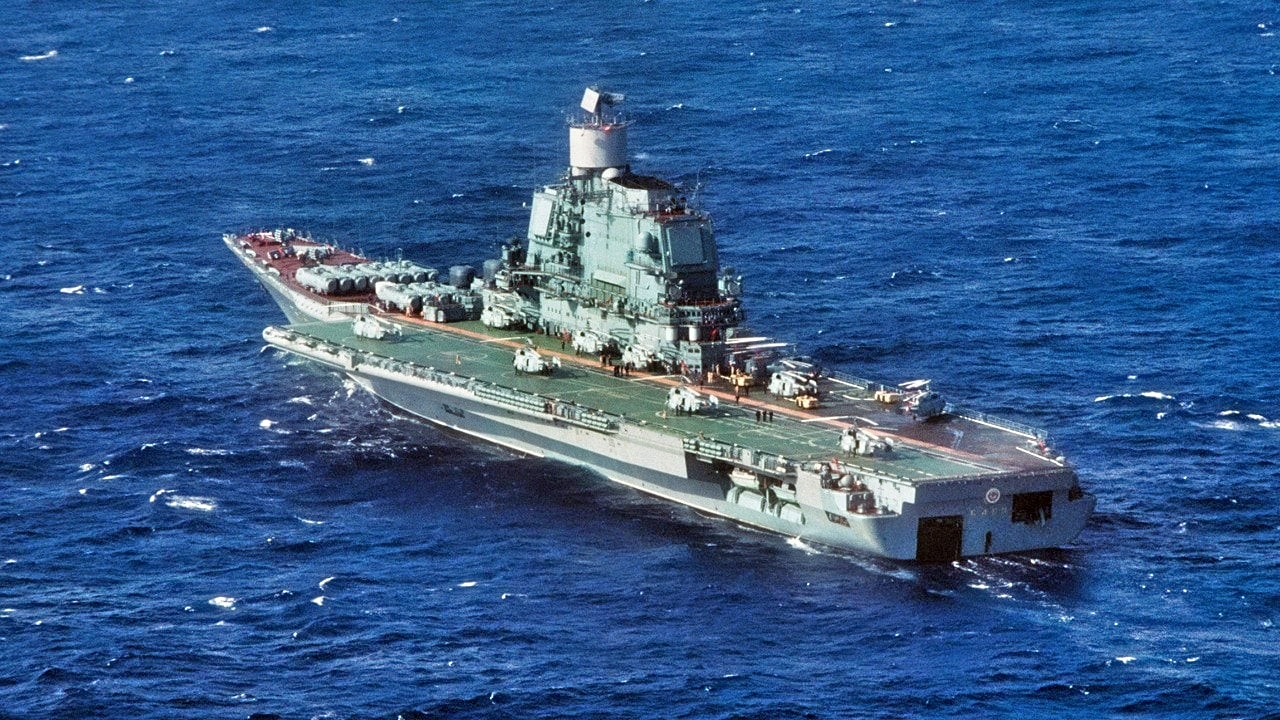
The Soviet Kiev-class carried P-500 Bazalt anti-ship cruise missiles. After the USSR’s collapse, Kyiv and Minsk were sold to China and converted into museum ships and tourist attractions. Baku was renamed Admiral Gorshkov, reconstructed, and commissioned into the Indian Navy in 2013 as INS Vikramaditya.
The Kiev-Class Aircraft Carrier Failure
The Project 1143 Krechyet aircraft carriers, more commonly known as the Kiev-class, are a unique class of Soviet-built aircraft carriers. Because of the USSR’s geopolitical position, the Kiev-class was not technically designated as aircraft carriers, but as heavy aviation cruisers. Despite possessing less hangar and deck space than American supercarriers, the ships made up for it with a large arsenal of weaponry, which made them less reliant on escort ships. After the fall of the USSR, most Kiev-class ships were decommissioned, although one ship was sold to India in 2004, where it remains active to this day.
Development of the Russian Kiev-Class Aircraft Carrier
When designing its aircraft carriers, the Soviets had very different design goals than their American counterparts. For much of the Cold War, Soviet naval doctrine focused primarily on sea denial rather than power projection.

Admiral Kuznetsov Russia Aircraft Carrier. Image Credit: Creative Commons.
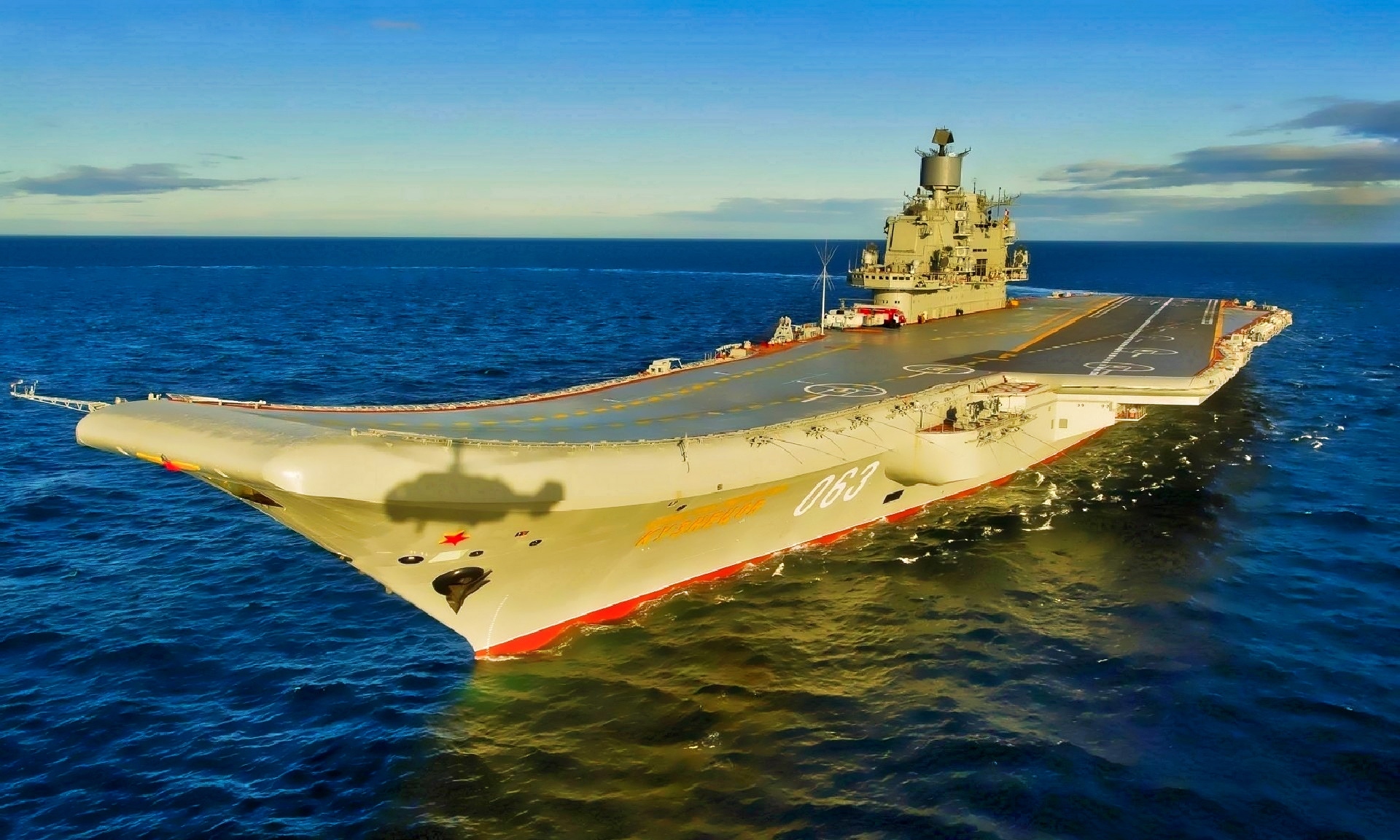
Admiral Kuznetsov Aircraft Carrier. Image Credit: Creative Commons.

Sukhoi Su-33 launching from the Admiral Kuznetsov.

Sukhoi Su-33 launching from the Admiral Kuznetsov.
The mission of the Soviet Navy was not to strike targets deep inland from the sea, as the United States Navy envisioned for its carrier groups, but to defend the Soviet coastline, protect ballistic missile submarine bastions, and neutralize NATO naval forces, particularly American carrier strike groups.
In this strategic context, aircraft carriers were seen less as instruments of offensive power and more as supporting assets within a broader naval system dominated by submarines, missile‑armed surface combatants, and land‑based aviation.
Because the Black Sea was the location of the USSR’s largest warm water ports, the Soviets had to account for geopolitical considerations when designing the Kiev-class. Under the Montreux Convention of 1936, aircraft carriers were restricted in their passage through the Turkish Straits, while cruisers were not.
By classifying the Kiev‑class ships as cruisers rather than carriers, the Soviet Union ensured unrestricted access between the Black Sea and the Mediterranean. Because the USSR could not get away with simply naming the Kiev-class cruisers, this legal distinction forced the USSR to fundamentally constrain its design options.
Design of the Kiev-Class
In terms of size and appearance, the Kiev‑class ships were imposing, but were dwarfed by their American counterparts. With a full‑load displacement of approximately 40,000 tons, they were significantly larger than most contemporary cruisers but smaller than American supercarriers.
The ships measured roughly 273 meters in length and had a beam of approximately 49 meters. Propulsion was provided by steam turbines driving four shafts, giving the ships a top speed of around 30 knots and allowing them to operate alongside other major fleet units.
Because of their unconventional classification, the Kiev-class sported an asymmetrical layout. Rather than a full‑length flight deck, the design placed the flight deck and hangar facilities along the port side, while the starboard side was dominated by missile launchers, guns, sensors, and superstructure.
This design was the result of the ship’s dual identity as both carrier and cruiser. The flight deck could not support conventional takeoff and landing operations and lacked catapults or arresting gear. Instead, it was optimized for vertical and short-takeoff-and-landing aircraft.
Air Wing
The aviation complement of the Kiev class consisted primarily of Yak‑38 V/STOL attack aircraft and a large number of helicopters.
The Yak‑38 (NATO designation: “Forger”) was the Soviet Union’s first operational carrier‑based fixed‑wing aircraft.
While technologically ambitious, it proved deeply flawed. The aircraft had limited range, a small payload, and poor performance in hot weather or rough seas. Its operational radius was so restricted that its usefulness in offensive missions was severely constrained, and its ability to challenge NATO carrier aircraft was minimal. As a result, the aviation component of the Kiev class often served more as a defensive or symbolic capability than as a decisive combat arm.
Helicopters formed a far more important part of the ship’s operational role. Ka‑25 and later Ka‑27 helicopters were used extensively for anti‑submarine warfare, search and rescue, and logistical support.
In this role, the Kiev class performed more effectively, contributing to Soviet efforts to detect and track NATO submarines in blue‑water environments.
Armament
Armament is not usually the first thing one thinks of when considering aircraft carriers, but because the Kiev-class ships were not true carriers, the Soviets could fit them with all sorts of offensive weaponry.
Unlike Western aircraft carriers, which relied primarily on escorts for protection and offensive firepower beyond aviation, Kiev‑class ships carried an array of heavy weapons integrated directly into the hull. Most notably, they were equipped with long‑range P‑500 Bazalt anti‑ship cruise missiles, designed to destroy large surface targets such as NATO aircraft carriers.
In addition to their offensive missile armament, Kiev‑class ships were heavily defended. They carried multiple surface‑to‑air missile systems, close‑in weapon systems, and naval guns, providing layered protection against aircraft and incoming missiles.
This emphasis on self‑defense reflected Soviet expectations that such ships might operate in contested environments without the extensive escort screen typical of U.S. carrier groups. The result was a vessel that could fight independently to a far greater degree than most Western carriers, albeit at the cost of flight deck space and aviation capacity.
Aircraft Carrier Operation and Retirement
The lead ship, Kiev, entered service in 1975 and deployed widely, including to the Mediterranean Sea, where it frequently encountered NATO forces. Minsk followed in 1978 and saw similar service. Novorossiysk, commissioned in 1982, had a relatively short and troubled career marked by maintenance problems.
The final ship, Baku, commissioned in 1987, incorporated improved electronics and air‑defense systems, making it the most advanced of its kind.
The collapse of the Soviet Union brought an abrupt end to the class’s active service. Budget constraints, changing strategic priorities, and the obsolescence of the Yak‑38 led to the decommissioning of all four ships during the 1990s.
Their post‑service fates varied. Kiev and Minsk were sold to China and converted into museum ships and tourist attractions. Novorossiysk was scrapped. Baku, renamed Admiral Gorshkov, underwent an extensive reconstruction and was eventually commissioned into the Indian Navy in 2013 as INS Vikramaditya, transformed into a conventional aircraft carrier with a ski‑jump and modern fixed‑wing aircraft.
About the Author: Isaac Seitz
Isaac Seitz, a Defense Columnist, graduated from Patrick Henry College’s Strategic Intelligence and National Security program. He has also studied Russian at Middlebury Language Schools and has worked as an intelligence Analyst in the private sector.


