


Summary and Key Points: Forty-eight new F-35A Lightning II fighters slated for Japan would deepen U.S. fifth-generation airpower on China’s doorstep and tighten the allied web stretching from Japan down toward the Philippines and beyond.
-Misawa’s location offers faster response times, more operational flexibility, and more survivable combat options, especially when stealth aircraft can operate without relying as heavily on vulnerable tanker support.

U.S. Air Force Maj. Melanie “Mach” Kluesner, the pilot for the F-35A Demonstration Team, performs aerial maneuvers in a USAF F-35A Lightning II during the first day of the airshow at Jacksonville Naval Air Station, Florida, on 18 October, 2024. The Demo Team performs at various airshows across the globe to display the power, agility, and lethality of America’s 5th generation fighter jet. (U.S. Air Force photo by Senior Airman Nicholas Rupiper)
-The move also complements Japan’s growing F-35 fleet and its evolving “mini-carrier” concept, adding sea-based launch options and expanding the geography of allied airpower.
-The real multiplier is networking—shared data links and coordinated basing that enable massed effects.
48 New F-35As Are Headed to Japan: China Is the Reason
48 new F-35A Lightning II stealth fighters will soon be based in Japan. And, clearly, the reason is China.
The location of those fighters is one the U.S. military is clearly familiar with. US forces first arrived at Japan’s Misawa Air Base in 1945 following the end of WWII, and have maintained a presence ever since, so it makes sense that the US would now be adding more F-35s to the area.

U.S. Air Force Airman 1st Class Jacob Taylor, a dedicated crew chief assigned to the 48th Fighter Wing, communicates with an F-35 Lightning II pilot,during Point Blank 22-3, at Royal Air Force Lakenheath, England, June 23, 2022. Point Blank is a recurring joint training exercise designed to enhance tactical proficiency and interoperability with NATO allies and partners. (U.S. Air Force photo by Senior Airman Koby I. Saunders)
The tactical and strategic advantages are multifaceted, as the move not only puts more F-35s within reach to potentially defend Taiwan, but also positions 5th-generation attack air power to attack mainland China if needed, without necessarily requiring a non-stealthy tanker to extend range.
The F-35 can hit ranges up to 1,000 to 1,300 miles, so operating land-based F-35As from Japanese islands and coastal areas massively extends the “reach” of 5th-generation aircraft in the Pacific theater.
The advantages of Japan-based F-35s extend well beyond the clear value of proximity, including massive networking benefits.
The Japanese Self-Defense Forces have, in recent years, invested billions of dollars to acquire F-35 aircraft and now regularly operate Vertical Take-Off-and-Landing F-35Bs from amphibious ships and small mini-carriers in the Pacific.
Photographs of Japan’s mini-carriers were released by the JMSDF in 2024, showing a redesigned or refitted helicopter-carrying amphibious assault ship.
Called the “JS Kaga,” the newly configured amphibious carrier is designed to transport F-35s, troops, helicopters, and other power-projection and attack-enabling assets.
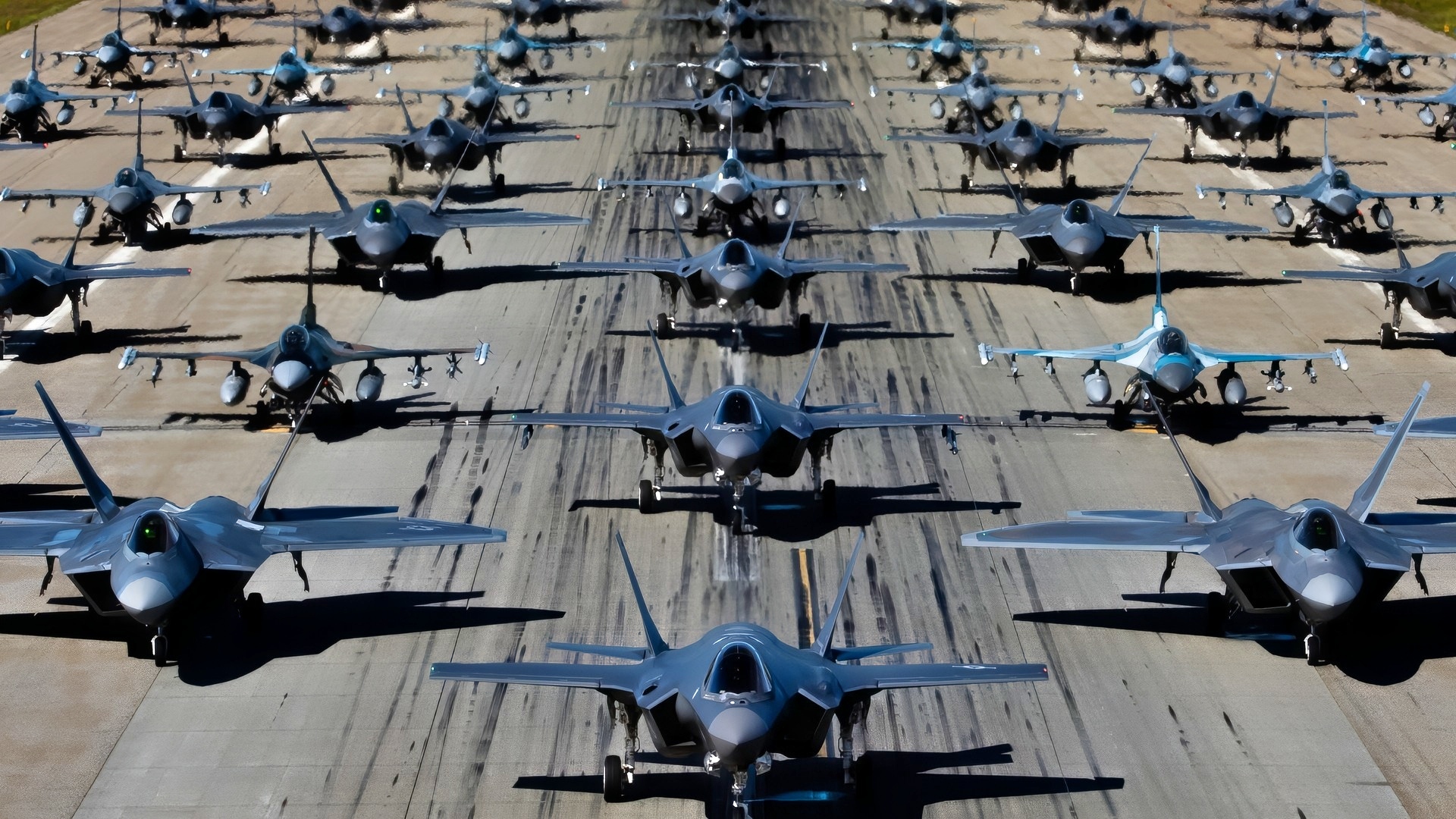
The 354th Fighter Wing conducts a 75-fighter jet formation at Eielson Air Force Base, Alaska, Aug. 12, 2022, in honor of the U.S. Air Force’s 75th Anniversary. This capabilities demonstration included F-35A Lightning II, F-16 Fighting Falcon and F-22 Raptor aircraft from across Pacific Air Forces. (U.S. Air Force photo by Senior Airman Gary Hilton)
The vessel operates with a maximum displacement of 27,000 tons at full load and an 814-ft flight deck, a ship vastly smaller than US Navy carriers, which displace more than 100,000 tons.
US-Japanese F-35 Fighters
Flying operational F-35Bs from Japanese ships has been in development for several years, as the US Marine Corps conducted a joint US-Japanese multinational exercise in which Marine Corps F-35Bs landed on Japanese warships.
This clearly seems to have been a precursor to what is happening now with Japan’s growing fleet of “mini-carriers.”
The ability to fortify a Japanese maritime force of F-35s with US Air Force F-35As could prove decisive in any potential engagement in the Pacific, as it could allow a greater ability to mass 5th-gen air power in large, impactful formations across a perimeter in the Pacific spanning from Japan to the Korean Peninsula all the way down through the Philippines and Australia.
This could, in effect, almost encircle the Chinese coastline with F-35s, or at least form a semi-circular extended air-boundary sphere from which to defend against or attack PLA air and ground forces.
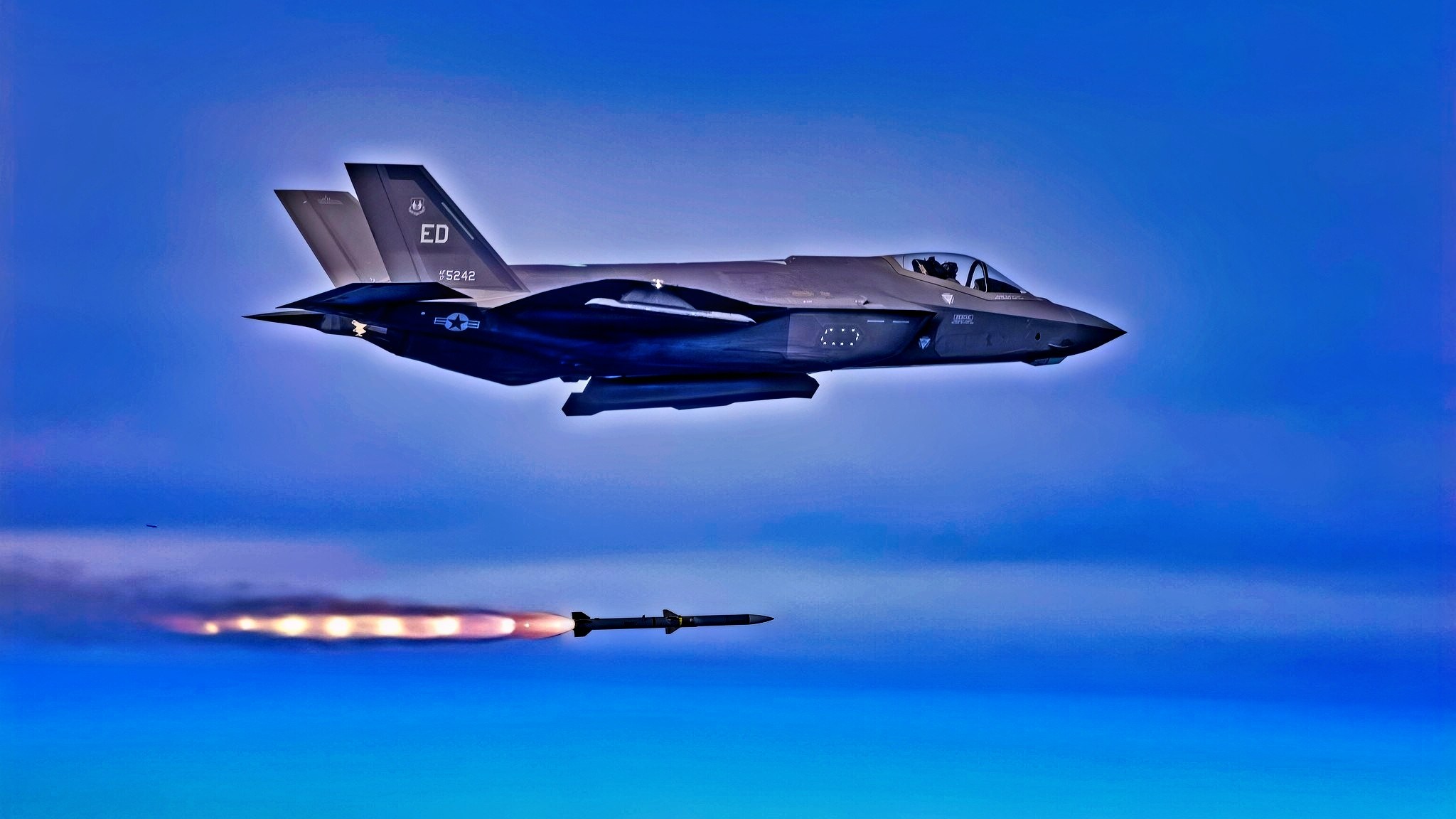
An F-35A with the 461st Flight Test Squadron, 412th Test Wing, conducts a TR-3 AIM-120 live fire mission over the Pacific Test Range on January 22, 2025. The F-35 Integrated Test Force at Edwards is responsible for developmental testing of all three F-35 aircraft variants across the joint-services. (Courtesy Photo)
Japan Mini-Carrier Advantage
This capacity is quite significant because the US and its Japanese allies could potentially operate with a decisive 5th-generation air advantage.
China operates the J-20, but it is a land-launched platform incapable of projecting power from the ocean; the J-20 may also be more vulnerable to F-35s and F-22s, depending on the range and fidelity of its sensors and the range and accuracy of its weapons systems.
Regardless, the US and its allies are increasingly in a position to deploy a large force of F-35s to counter or contain China from the air. This kind of tactical thinking is likely a significant reason why the Japanese MOD is both acquiring F-35s and building mini-carriers.
Given this threat scenario, it makes sense that the Japanese JMSDF and the US would be rapidly acquiring F-35Bs and F-35Cs for the region.

A U.S. Air Force F-35A Lightning II assigned to the 60th Fighter Squadron, flies overhead after conducting a live weapons drop at Camp Shelby, Miss., Oct 25, 2023. During the exercise, pilots tested various munitions including the GBU-12s, GBU-31v1s, and 362 rounds of 25mm Training Munitions from the gun.
All F-35s operate with a secure, high-speed data link called the Multi-Function Advanced Data Link (MADL), which enables networking across all countries operating F-35s.
This enables a multinational, large-scale, semi-circle-like formation of F-35s involving the US Navy, South Korea, and even Australia and Singapore further south.
The additional bases being added in the Philippines might also provide an opportunity for the US and its allies to deploy F-35s there and “fill in” a gap in the semi-circle between Japan, Australia, and Singapore.
About the Author: Kris Osborn
Kris Osborn is the President of Warrior Maven – Center for Military Modernization. Osborn previously served at the Pentagon as a highly qualified expert in the Office of the Assistant Secretary of the Army—Acquisition, Logistics & Technology. Osborn has also worked as an anchor and on-air military specialist at national TV networks. He has appeared as a guest military expert on Fox News, MSNBC, The Military Channel, and The History Channel. He also has a Masters Degree in Comparative Literature from Columbia University.


