
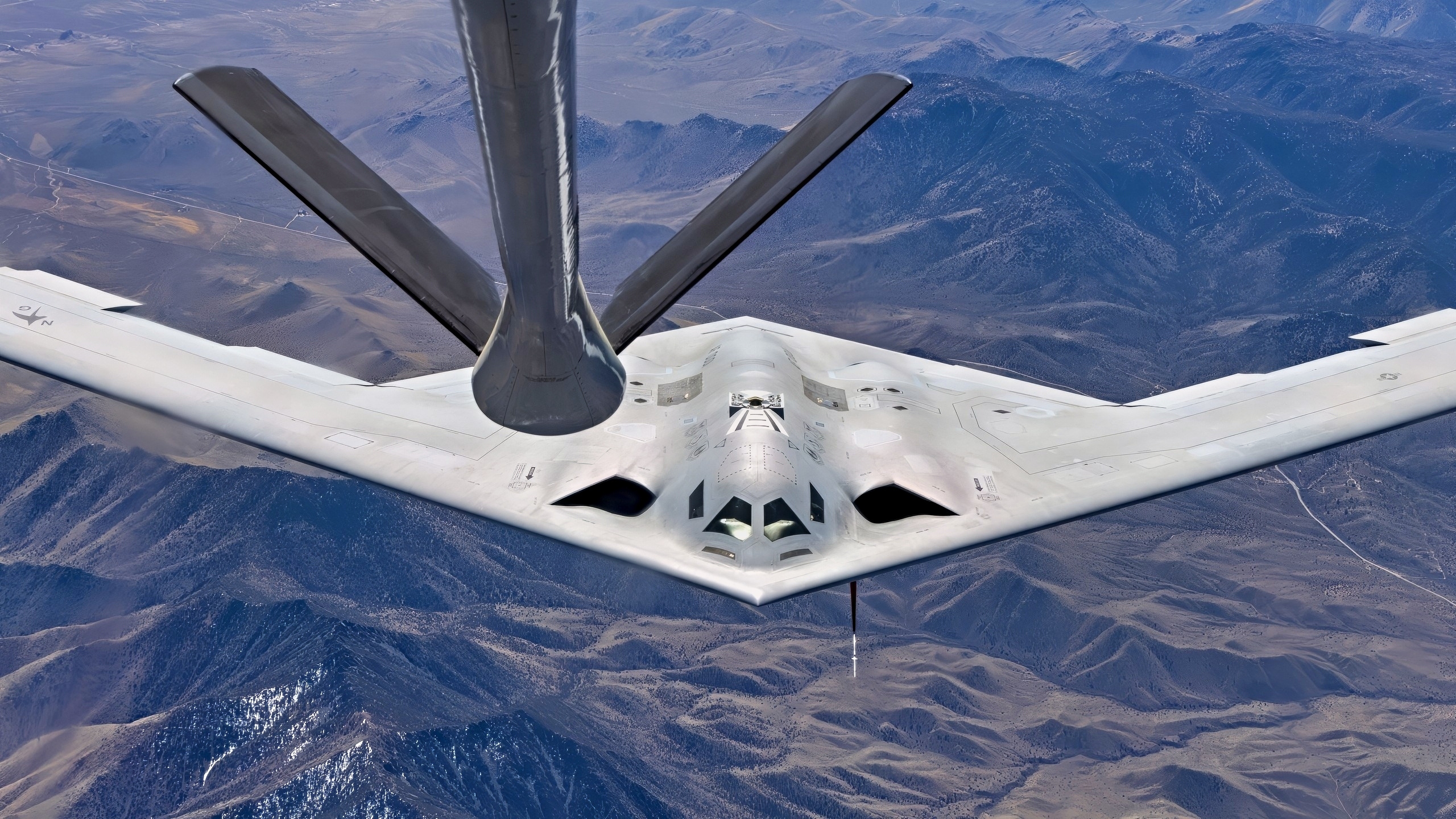
The U.S. Air Force and Northrop Grumman this week released the first official image of the B-21 Raider conducting aerial refueling with a KC-135 Stratotanker – a major milestone that indicates the program is moving beyond early flight testing. Aerial refueling is an important test point, proving that the bomber can operate globally and sustain long-duration missions. Northrop itself described the milestone as extending the aircraft’s global reach and enabling longer, more efficient sorties.
While the press release gained headlines for the first photograph of the aircraft being refueled and for revealing additional details about the top of the plane, the focus on expanded production capacity and the ability to scale the B-21 program faster than previous bomber efforts was also interesting to read. Northrop Grumman made a point to reference expanded production capacity, and while there has yet to be an official commitment to increase the overall buy, senior officials and analysts have long argued that the Air Force should not stop at 100 aircraft. In fact, pressure is only increasing on the Air Force to increase the buy to 145 aircraft. If that happens, it would be remarkable in several ways.
Meet the B-21 Raider
The B-21 is the first new U.S. bomber design in more than three decades, and it exists for a specific reason: the United States expects to fight in contested airspace again. Developed under the Long Range Strike Bomber program launched in 2011 and awarded to Northrop Grumman in 2015, the aircraft is designed to penetrate advanced air defense systems and deliver both nuclear and conventional weapons.
It is intended to replace the B-1B Lancer and B-2 Spirit, and eventually supplement or replace the aging B-52 Stratofortress.
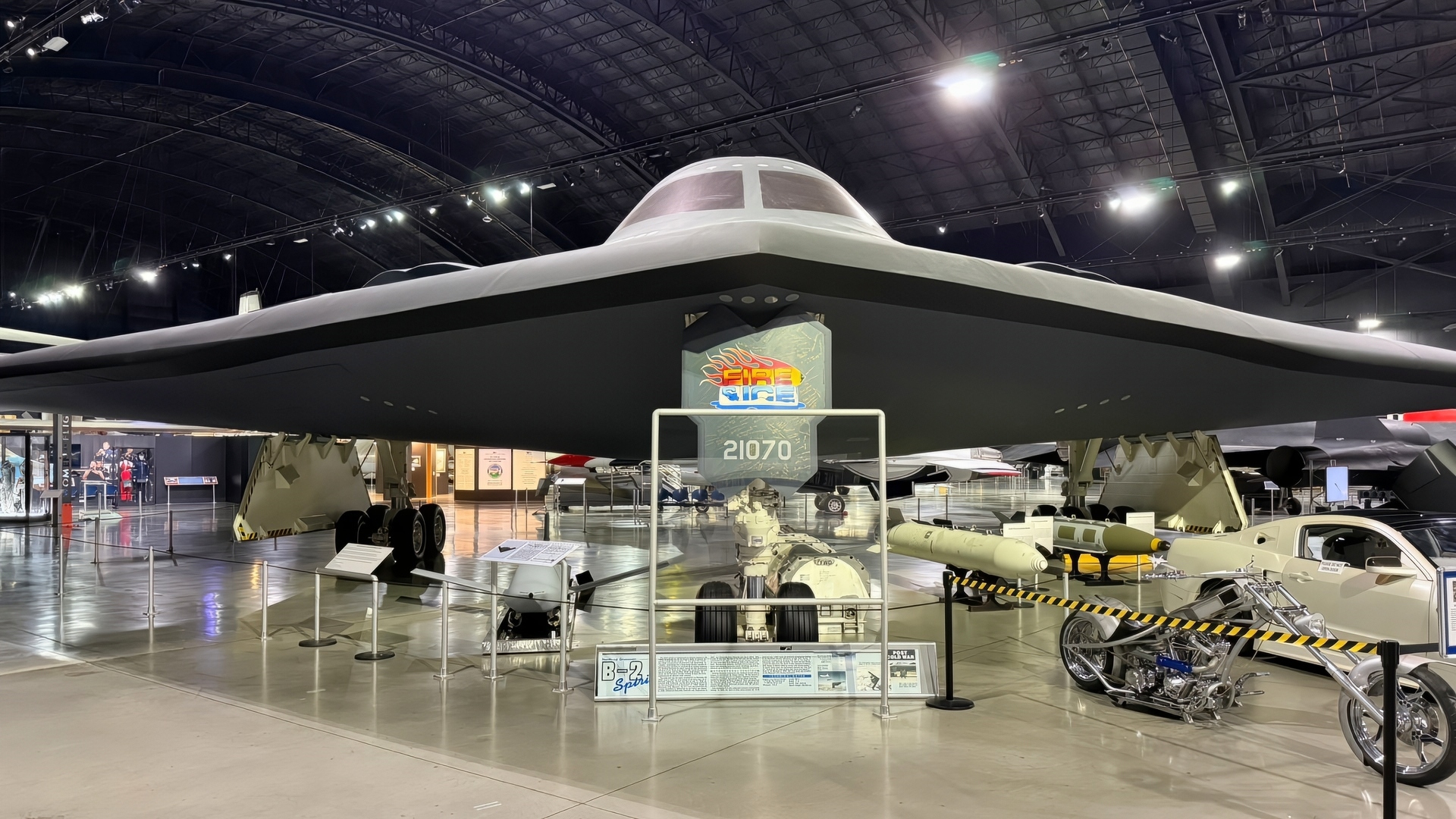
B-2A Spirit On Display. Image by Editor Harry J. Kazianis/National Security Journal.
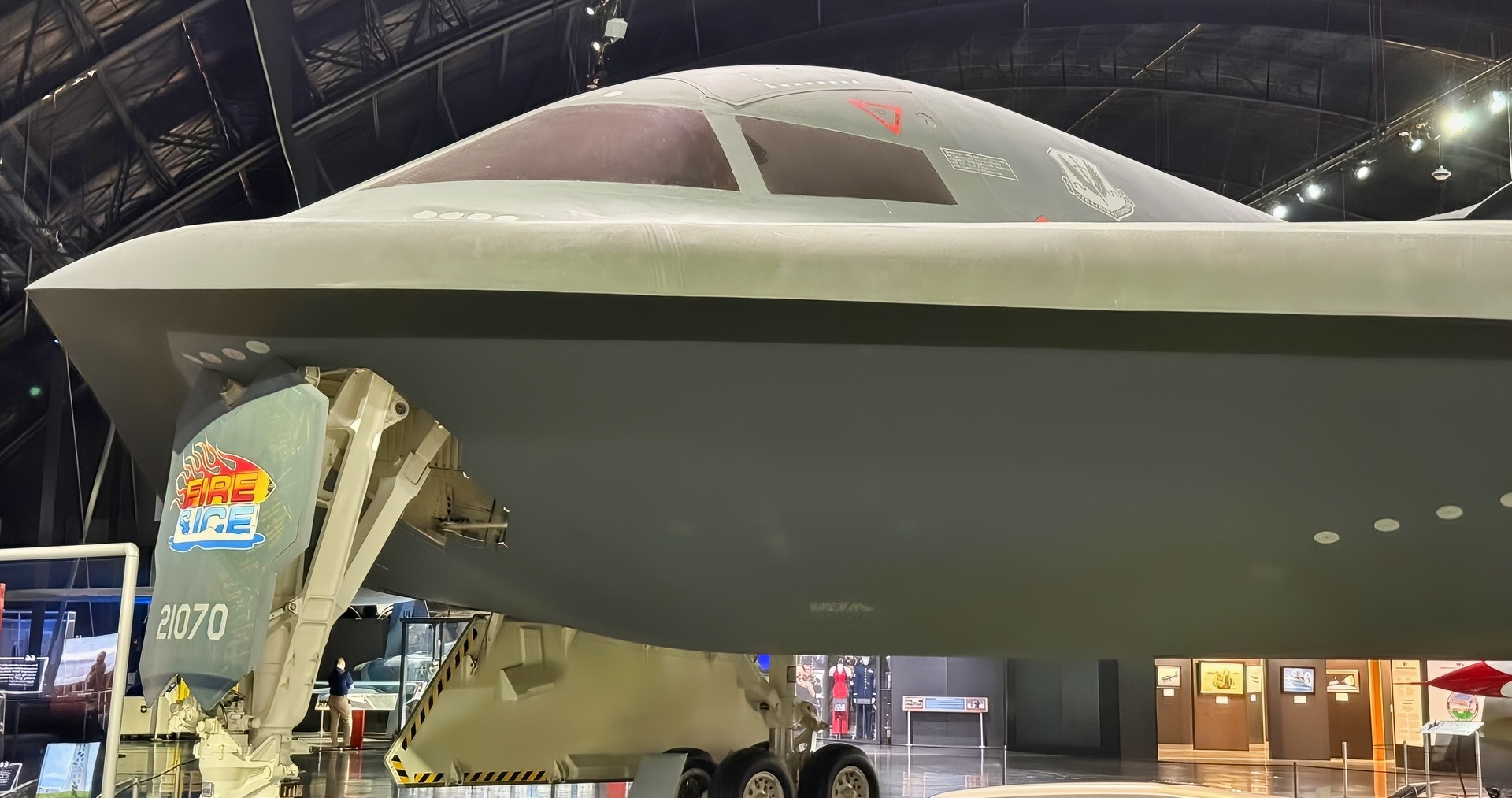
B-2A Spirit Stealth Bomber USAF Museum. Image Credit: Harry J. Kazianis/National Security Journal.
The next-generation bomber has been built from the ground up for operations in heavily defended environments – particularly in the Indo-Pacific, where Chinese air defense systems are designed to deny access to U.S. aircraft. The design clearly reflects that mission; it is a stealthy “flying wing” platform with nuclear capabilities, it is built with open architecture to make future upgrades simpler, and it has the ability to carry long-range standoff weapons like the AGM-181 nuclear cruise missile and JASSM-ER.
The Program Is Moving Fast
The B-21 program is moving quickly compared to many other programs and seems to be avoiding the kind of delays that have become commonplace. The aircraft was unveiled in December 2022 and flew for the first time in November 2023.
There are now multiple test aircraft in flight testing, and the recent refueling trials confirm that the Air Force is pushing ahead on schedule. But historically, bomber programs like this have struggled with delays and production limits. The B-2 program, for example, was cut to just 21 aircraft after the Cold War, largely because of its cost and shifting strategic priorities.
The B-21 process so far has been different. Northrop has invested more than $5 billion in digital engineering tools and manufacturing infrastructure to ensure the process is as streamlined as it can be.
The Mighty B-2 Spirit Stealth Bomber. Image Credit: National Security Journal.
“To date, the company has invested more than $5 billion in the B-21 program’s digital and manufacturing infrastructure. Our investments in manufacturing capacity are accelerating production, providing flexibility to support future fleet growth and ensuring long-term U.S. Air Force strike dominance,” the latest release explained.
The result is an aircraft that is already in low-rate production and preparing for its first delivery in 2027.
And not only is production moving quickly, but it is also expanding. The company has increased its manufacturing capacity specifically to allow for higher production rates and flexibility in fleet size, potentially accommodating a large future order if it is made. In fact, Northrop has indicated that the infrastructure is now in place to scale the B-21 fleet if required.
Will 100 Raiders Be Enough?
Today’s U.S. bomber fleet sits somewhere around 140 aircraft, including roughly 45 B-1Bs, 19 B-2s, and roughly 75 B-52s. But that doesn’t mean there are 140 aircraft available to fly right now – or, indeed, that every aircraft will be suitable for the next fight. The B-1B is heavily worn from decades of use and has faced persistent readiness issues, and the B-2, while stealthy, is extremely maintenance-intensive and exists only in small numbers. The B-52, though reliable, is not survivable in contested airspace without significant support.
The current force is not designed for a peer conflict. It is a mixed fleet of aircraft built for different eras, with only a small portion capable of penetrating modern air defenses. The B-21 is intended to solve that, and a fleet of 100 almost replaces the entirety of the current fleet. A larger purchase would replace it, and then some.
At present, the Air Force’s official plan calls for “at least 100” B-21s. That number has increasingly been questioned, and while the analysts largely led the charge for a larger order, military officials have begun to follow suit. Gen. Anthony J. Cotton, the head of U.S. Strategic Command, has publicly said the Air Force should increase the planned fleet from 100 to around 145 aircraft, noting many of the problems explained above. Speaking at the McAleese and Associates annual Defense Programs Conference, Cotton said that the Air Force should also reassess the number of AGM-181 Long Range Stand-Off weapons.
“I, as a customer, want to see increased rates,” he said of the B-21 specifically, adding that the program’s existing production rate was agreed upon “when the geopolitical environment was a little bit different than what we face today.”
What he means is this: the U.S. is no longer planning for a single major conflict, but the possibility of simultaneous challenges from China and Russia, with vastly greater geographic and operational demands. 145 aircraft may even be a conservative estimate, with some analysts arguing for a much larger purchase. Studies from the likes of the Mitchell Institute have suggested the U.S. may need a B-21 bomber force in the range of 225 aircraft to sustain operations across multiple theaters.
This Would Be Unprecedented
A fleet of 145 B-21s or more would effectively be a full replacement of the existing fleet, even though some older platforms are expected to fly alongside it for the next several decades.
The Air Force would, for the first time, transition from a mixed fleet of legacy and niche platforms to a force built almost entirely around a single, penetrating stealth bomber. That has never happened before, not because the technology didn’t exist – the B-2 could have done it – but because it wasn’t strategically necessary. Even at the height of the Cold War, the United States relied on a mix of aircraft types with different roles and survivability levels.
The transition would be enormous, but it’s important to note that it’s going to take time. The Air Force has said it expects initial operational capability later this decade, but building out a fleet of 145 aircraft would likely extend well into the 2030s or beyond, depending on production rates and funding. During that time, the United States would gradually phase out aircraft that are no longer required, allowing the B-21 to serve alongside powerhouses like the B-52 until at least 2050, and gradually form a bomber force around the most advanced bomber the world has ever seen.
About the Author: Jack Buckby
Jack Buckby is a British researcher and analyst specializing in defense and national security, based in New York. His work focuses on military capability, procurement, and strategic competition, producing and editing analysis for policy and defense audiences. He brings extensive editorial experience, with a career output spanning over 1,000 articles at 19FortyFive and National Security Journal, and has previously authored books and papers on extremism and deradicalization.


zhduny
April 17, 2026 at 12:28 am
B-21 program will bankrupt the war dept and the US Treasury.
Thus, now is the time, for smart nations to decouple from the USA.
B-21, along with its fuel tanker nannies flying with gay abandon over the Pacific and Atlantic, will be confidently spotted by various birds in the sky.
(Birds in the sky = overhead satellites.)
It would be very like – WAVING YOR UNDERPANTS WHILE STICKING THEM AT THE END OF A FLAGSTAFF.
The b-21 program was conceived around the time George bush was president. Yeah, this era witnessed impressive US technological military prowess while rivals or peers were truly left behind in its wake.
But it wasn’t until Obama’s era that it was at last approved.
But today, US rivals or peers have advanced by leaps and bounds the b-21 is now quickly becoming obsolete and irrelevant.
So quickly, that the head of US Space Force, once spoke of the need to carry out a preemptive strike in space if hostilities on the ground cannot be avoided between US and it’s peers.
Fred Adams
April 17, 2026 at 2:22 pm
ZHDUNY – unsupported assertions, bad analogies.
Scott
April 19, 2026 at 2:40 pm
Finally production run will be 576 airframes. Allowing a return to 24 active medium bomber Squadrons. With ability to scale manufacturing to equal SAC’s historic capacity of 42 Active ling range bomber squadrons.
Alex FITCH
April 21, 2026 at 10:08 am
How in heck can that plane recover from a spin ?
Catapult
April 21, 2026 at 10:17 am
But a big question remains. Remember when the ultra-expensive B-70 supersonic bomber program was cancelled? Remember why? Because ICBMs are far cheaper, easier to produce and have a fraction of a bomber’s time-on-target. So why are manned (and unmanned) bombers suddenly in vogue again?
Lawrence Jones Jr
April 21, 2026 at 5:47 pm
We’ve seen this movie before. DoD wanted over 100 B2s, got 21. It’ll be the same story with the B-21.
1KoolKat
April 22, 2026 at 5:53 am
After 3 decades of “strategic nuclear generational neglect,” the U.S. now faces an unprecedented geopolitical shift: for the first time in history, the U.S. must deter two nuclear peer adversaries (Russia and China) simultaneously, while both are in the midst of “breathtaking” expansions of their own.
By not investing incrementally for over 30 years, the U.S. has reached a point where a single failure on the B-21, Sentinel, or Columbia production lines could create a “deterrence gap” that adversaries will exploit.