

The USS Gerald R. Ford (CVN-78) reached a historic milestone on Wednesday, April 15. After leaving Naval Station Norfolk on June 24, 2025, the carrier hit 295 days deployed, setting the longest post-Vietnam aircraft carrier deployment in modern U.S. Navy service, according to USNI News data. That means that by the time the Ford-class aircraft carrier comes into port in Norfolk, Virginia, it will have been on deployment for almost a year.
Ford easily surpassed Abraham Lincoln’s pandemic-era benchmark and set a new record following a deployment that took the ship from the Mediterranean to the Caribbean, then back across the Atlantic and into the eastern Mediterranean and the Red Sea for operations tied to Venezuela and later to Iran.
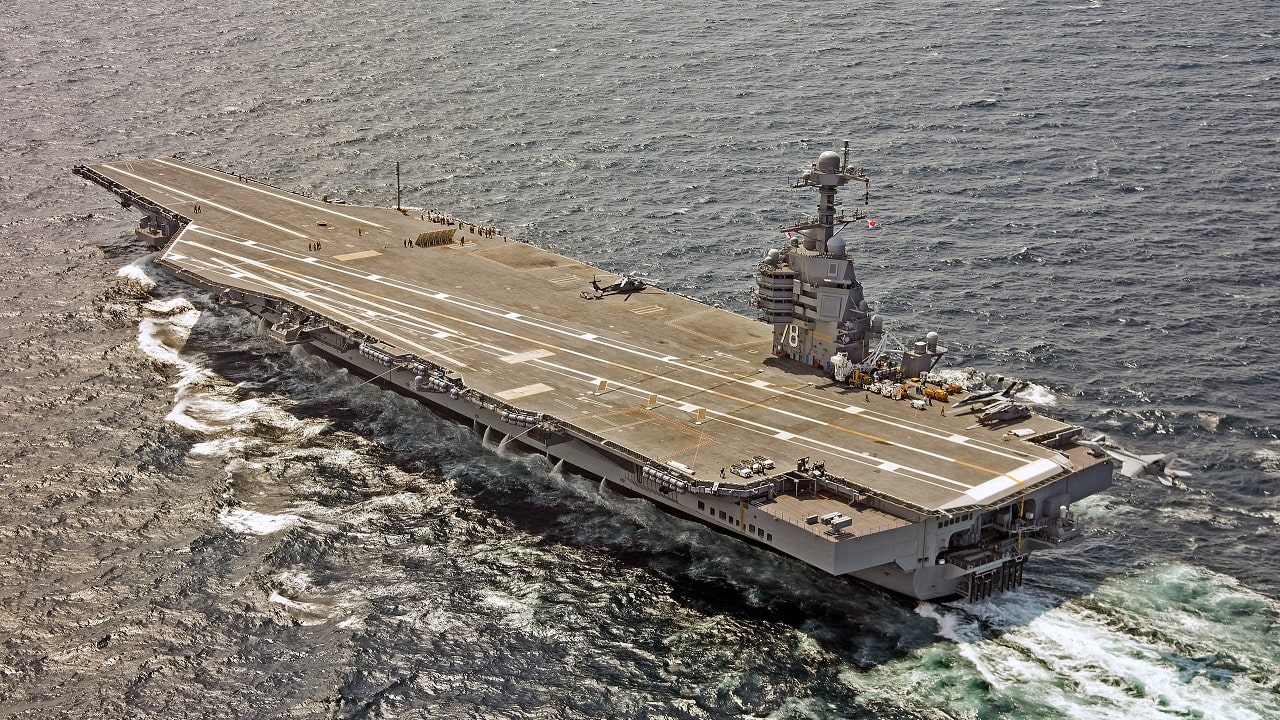
Ford-Class Aircraft Carrier in Test Run. Image Credit: Creative Commons.

ATLANTIC OCEAN (Sept. 21, 2024) The world’s largest aircraft carrier, USS Gerald R. Ford (CVN 78), sails in formation with the Japan Maritime Self Defense Force (JMSDF) Kashima-class training ship, JS Kashima (TV-3508), middle, and Hatakaze-class guided missile destroyer JS Shimakaze (TV-3521) while conducting routine operations in the Atlantic Ocean, September 23, 2024. The U.S. Navy and JMSDF continue to train together to improve interoperability and strengthen joint capabilities. For more than 60 years, the U.S.-Japan Alliance has been the corner stone of stability and security and is crucial to the mutual capability of responding to contingencies at a moment’s notice. (U.S. Navy photo by Mass Communication Specialist 2nd Class Jacob Mattingly)
It is the kind of incredible deployment one might expect of a carrier being squeezed for a last tour, pushed to its limits, knowing that maintenance won’t be necessary by the end.
But the Ford is the lead ship of the Ford class, commissioned on July 22, 2017, and meant to represent the Navy’s next generation of nuclear carrier operations. It is the newest and most powerful aircraft carrier, built around major design changes that include Electromagnetic Aircraft Launch Systems (EMALS) and Advanced Arresting Gear (AAG), redesigned weapons handling, and significantly higher electrical output.
CVN-78 is designed to prove that the class can sustain operations without creating a bigger repair burden later, and this extended deployment is certainly putting the ship to the test.
What the Ford-Class Aircraft Carrier Is Supposed to Be
While the Ford has now proven it is capable of long deployments, and it was designed to reduce the maintenance burden, it was certainly not built to operate quite like this.
Under the Navy’s Optimized Fleet Response Plan, carriers are meant to operate on a structured cycle that includes a maintenance period before and after deployment. Planned Incremental Availability (PIA) – the scheduled maintenance period for carriers – is a crucial part of that cycle, typically lasting several months and covering repairs, inspections, and modernization work that cannot be handled at sea or during short port visits.
Ford’s current deployment has broken that pattern; by the time it passed the 295-day mark this week, the ship had already exceeded the standard deployment window by several months, while still operating in high-tempo environments. So, not only is the ship operating outside its deployment window, but it is also under strain. That places pressure on the crew and continuous stress on systems that are not designed to run indefinitely without overhaul.
The ship was already under strain before its more recent deployment to assist in the Iran conflict, too.
Reports throughout early 2026 pointed to persistent problems with the ship’s sewage and plumbing systems, which had already been flagged as a design concern before it sailed. On a carrier with more than 5,000 personnel aboard, everything from plumbing to ventilation is critical – and if they don’t work properly all or the vast majority of the time properly, then they can cause problems that make the ship less efficient in combat.
When those systems begin to fail, they place accumulated strain on the ship and prevent it from achieving its full potential.
The Navy had already scheduled Ford’s next major maintenance period well before this deployment reached record length.
On July 18, 2025, the Norfolk Naval Shipyard confirmed that the FY-26 Planned Incremental Availability (PIA) for USS Gerald R. Ford (CVN-78) was already in active planning, with a project team assembled and working through early coordination at an Integrated Project Team Development event in Washington, D.C.
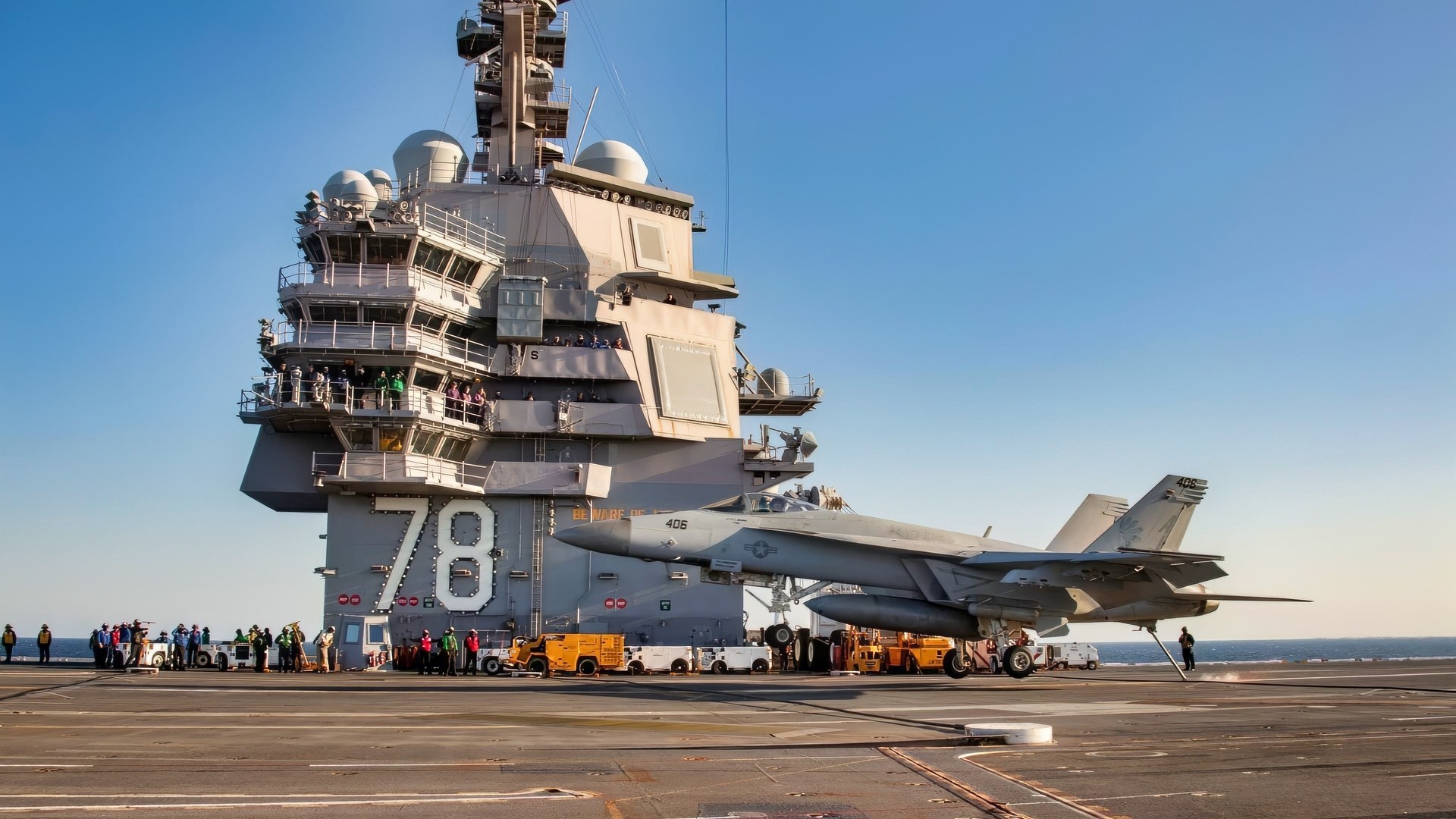
USS Gerald R. Ford Training. Image Credit: U.S. Navy.
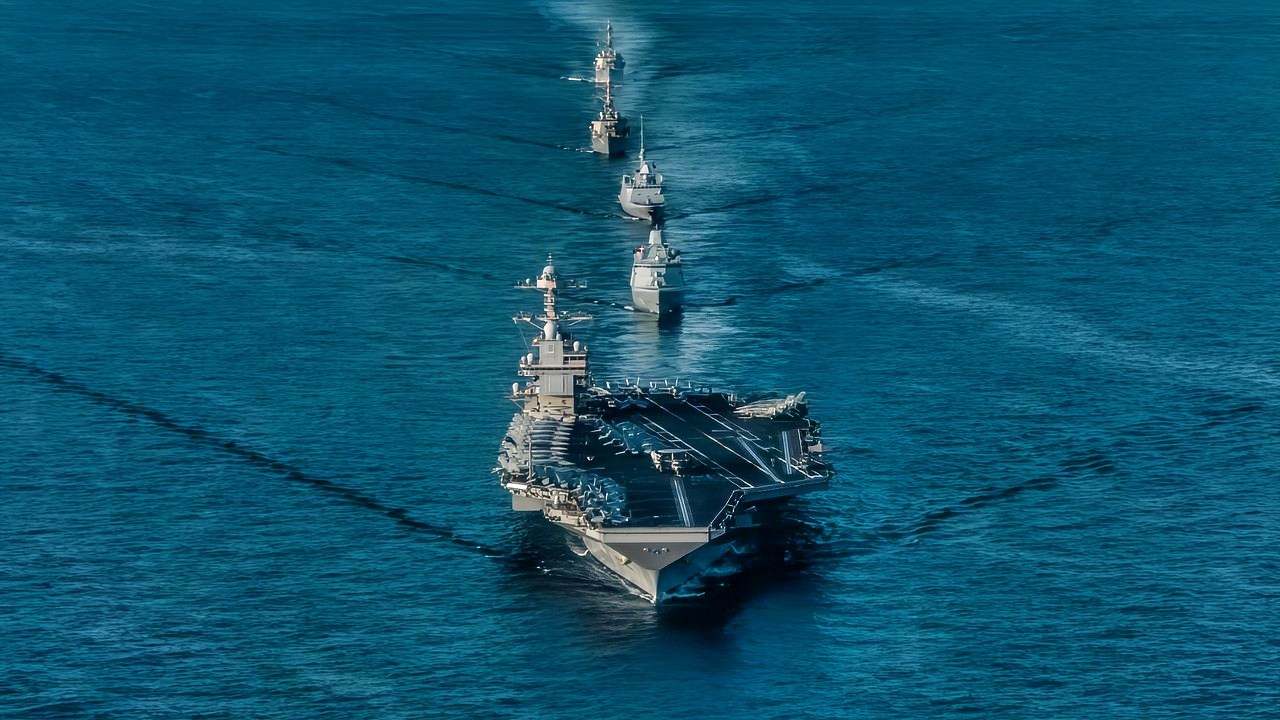
USS Gerald R. Ford Aircraft Carrier Training. Image Credit: U.S. Navy.
The event brought together shipyard leadership, ship’s force, regional maintenance commands, and contractors to prepare for what will be the first time a Ford-class carrier undergoes a major availability at a public shipyard.
And here’s an important point: the FY-26 PIA was being prepared before the deployment extended into late 2025 and early 2026, and before the ship was redirected multiple times across theaters and forced into emergency repairs following the March fire. None of that additional wear was part of the original maintenance planning baseline.
The Fire, Croatia, and What Wasn’t Fixed
On March 12, 2026, the Ford hit the news when a fire broke out in the ship’s laundry space while operating in the Red Sea.
The fire triggered a major damage control response, displaced many sailors from their berthing areas, damaged systems, and injured hundreds of sailors who were treated for smoke inhalation.
Despite ongoing operations in Iran, the carrier was forced to withdraw and divert north. It first stopped at Naval Support Activity Souda Bay, a major naval base in Crete, Greece, for initial assessments. It then continued to the Port of Split, Croatia, and arrived on March 28 for additional work.
The repairs conducted in Croatia reportedly focused on addressing fire damage and restoring affected berthing spaces.
The repairs are also understood to have included work on electrical systems that had been exposed to heat and water during firefighting efforts. After the work was complete, Ford departed Split in early April and returned to operational status immediately. Importantly, what didn’t happen in Croatia was a full maintenance.
It did not enter drydock, it did not undergo a full inspection of its systems, and it did not receive the kind of depot-level work that is normally conducted during a Planned Incremental Availability. Had that occurred – and it would have needed to dock at Norfolk Naval Shipyard – the process would have taken months. Given the extent of the damage and strain on its systems, it wouldn’t be hard to imagine that process taking a year or longer. In a statement, the Navy confirmed that the ship “completed scheduled repairs and received supplies to sustain operations.”
Where the Strain Is Building on This Aircraft Carrier
The unrelenting strain placed on the USS Gerald R. Ford aircraft carrier continues to build.
The longer a ship is at sea, the greater the likelihood that repairs will be necessary, and systems will degrade or fail. What’s more, lead ships like CVN-78 are typically expected to arrive back at port with unexpected maintenance requirements.
Given that a PIA is not merely a cosmetic upgrade, it’s not hard to envision the next maintenance phase for the ship being extensive.
During a PIA, the Navy tackles the kind of work that cannot easily be done at sea. Inspection and repair of piping systems will occur, maintenance of electrical distribution networks will take place, preservation work to prevent corrosion will be carried out, and propulsion and support systems will be examined to ensure they are in full working order.
PIAs are designed to maintain carrier service life and address material condition issues that always accumulate between deployments – and without them, the problems only risk worsening. That may not only extend the required maintenance period but also lead to critical failures requiring the full replacement of parts.
The plumbing failures reported during the early days of deployment will be among the first problems to be fixed.
Early reports described problems with the ship’s toilets that affected hundreds of fixtures during the early days of deployment – a problem that has not been fully resolved after hundreds of days of use. And while repair work was conducted on its electrical systems in Croatia, that kind of damage is likely to require follow-on work in a shipyard, where systems can be fully opened up and replaced if necessary.
Importantly, though, none of this suggests the Ford is close to failure. It does, however, point to a ship operating with a growing list of deferred work – and when it finally enters its FY-26 availability, that backlog will all be addressed at once.
About the Author: Jack Buckby
Jack Buckby is a British researcher and analyst specializing in defense and national security, based in New York. His work focuses on military capability, procurement, and strategic competition, producing and editing analysis for policy and defense audiences. He brings extensive editorial experience, with a career output spanning over 1,000 articles at 19FortyFive and National Security Journal, and has previously authored books and papers on extremism and deradicalization.


Fred Adams
April 17, 2026 at 2:28 pm
Seems to be poor design spec if there is a need for months-long maintenance periods every year. These are war fighting machines and must be available at all times, perhaps with slightly degraded capabilities. Or, we must have 15% to 20% more of them.
The idea of a war machine being out of operation for “months” is ridiculous.