


The U.S. Navy reports that the long-anticipated MQ-25 Stingray carrier-launched refueler drone has finally completed its first operational test flight, something of great consequence for air attack campaigns given the risks and problems associated with the Air Force’s fleet of large, non-stealthy fixed-wing tanker aircraft.
MQ-25: Fixed-Wing Tankers That Are a Game Changer
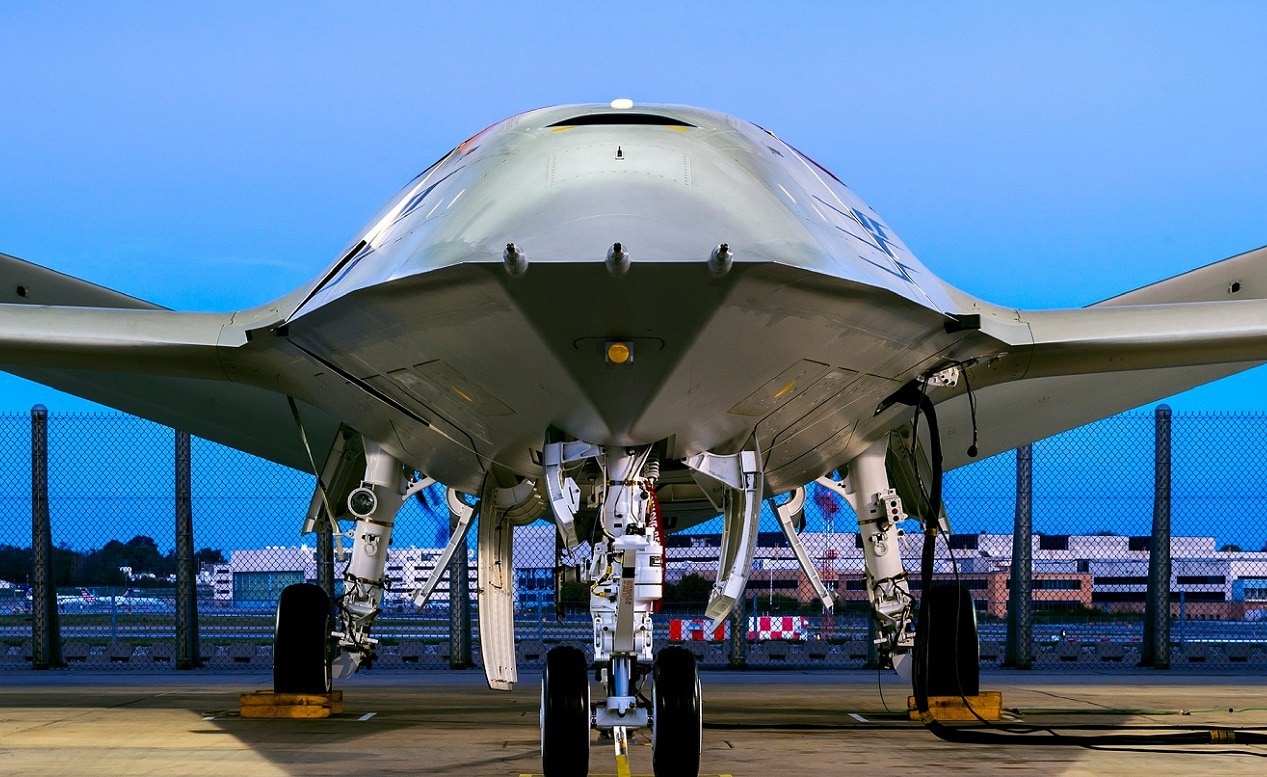
MQ-25. Image Credit: Creative Commons.
The largest problem with large fixed-wing tankers is quite self-evident, as they simply operate with a survivability problem. KC-46 aircraft and legacy Air Force tankers are large, non-stealthy, and easily seen by enemy ground radar in any kind of contested warfare environment.
As “manned” aircraft, large fixed-wing tankers place airmen at great risk as well, given the capabilities of today’s advanced ground-based air defenses.
While not formally designated as a stealth drone, the MQ-25 configuration does include a somewhat stealthy-looking, rounded, blended wing-body.
An unmanned, carrier-launched refueler fundamentally changes the Navy’s concept of operations, extending attack range, doubling the range of carrier-launched jets, and opening the prospect of extending air attacks with greater dwell time over targets.
The Arrival of the MQ-25 Stingray
Both anticipated and significant, given the way it can massively extend the combat reach of carrier-launched fighter jets, yet beyond this, the prospect of launching Combat Collaborative
Aircraft from carriers is forward-thinking and equally significant because it means carrier-launched drones can potentially be refueled in the air, thereby extending mission effectiveness.
CCAs Support
When supported by the MQ-25, these CCAs can perform a much wider range of missions beyond refueling to include forward surveillance, aerial “node” relay sensing, ammunition and supply delivery across domains in high-threat environments, and even strike missions when directed by a human in a manned jet or ship-based command and control center.
The arrival of the Stingray could not be soon enough for a variety of pressing reasons, such as the existence of China’s high-touted “carrier killer” DF-21D and DF-26 long-range anti-ship missiles.
The intent of these weapons is to hold carriers at risk for destruction from shore at unprecedented ranges up to or greater than 1,000 miles offshore. Should a carrier need to operate 1000 miles from the area over which it seeks to project power, deck-launched attack aircraft may need to refuel to make the journey, attack, and return safely.
F-35C
Should an F-35C, for example, operate with a combat radius of 500-600 miles, it would need to turn around before reaching its target area if carriers need to project power from beyond the 1,000-mile strike range of China’s anti-ship missiles.
This is where the MQ-25 Stingray comes in: it could enable an F-35C to travel 1,000 miles to its objective over land from offshore, conduct its mission with sufficient dwell time, and return to the carrier. Operating the MQ-25, a Carrier Air Wing can still project massive power with an air attack campaign from previously impossible ranges offshore.
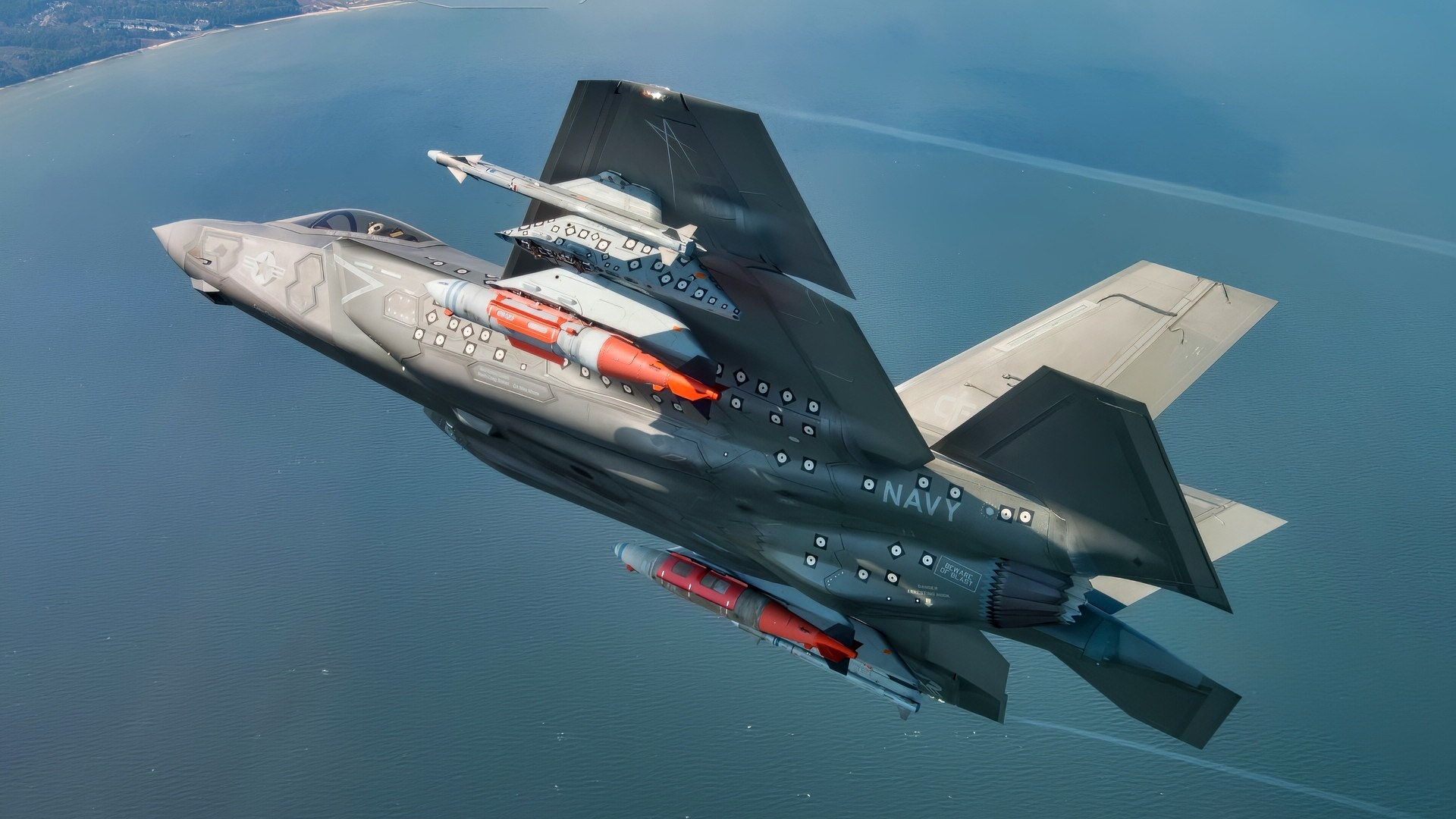
The final SDD Test flight CF-2 Flt 596 was piloted by BAE Test pilot Peter Wilson, April 11, 2018, from the F-35 Pax River Integrated Test Force. The F-35C completed a mission to collect loads data while carrying external 2,000-pound GBU-31 Joint Direct Attack Munitions (JDAM) and AIM-9X Sidewinder heat-seeking missiles. (Photo courtesy of Lockheed Martin)
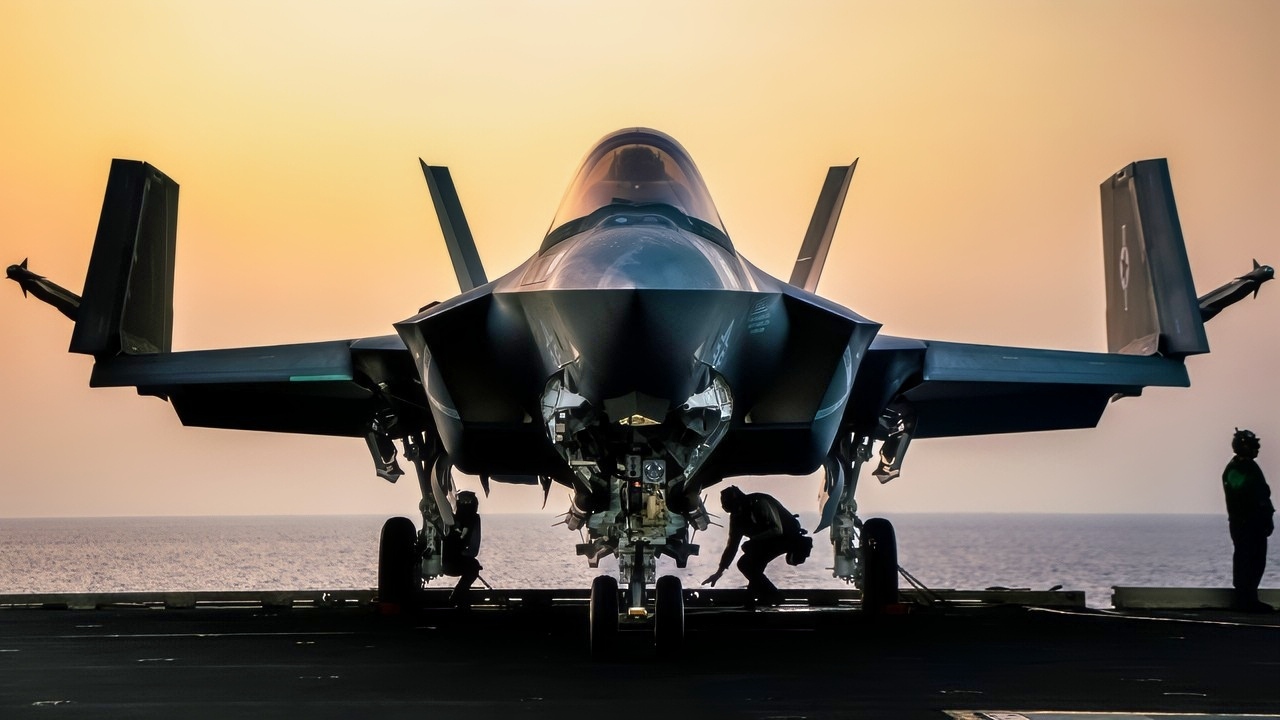
U.S CENTRAL COMMAND AREA OF RESPONSIBILITY (April 24, 2025) U.S. Sailors conduct pre-flight safety checks on an F-35C Lightning II, attached to Strike Fighter Squadron (VFA) 97, on the flight deck of the Nimitz-class aircraft carrier USS Carl Vinson (CVN 70) in the U.S. Central Command area of responsibility. (Official U.S. Navy photo)
This kind of capacity could help alter the balance of power in the Pacific in favor of US carriers, as they could hold mainland China at great risk without placing themselves within striking range of China’s “carrier-killer” anti-ship missiles.
What the MQ-25 Stingray Offers
The Stingray offers yet another advantage in high-threat maritime warfare because it appears somewhat stealthy.
With a blended, rounded wing-body fuselage configuration and a horizontal shape, absent protruding vertical structures, the MQ-25 would certainly be much less vulnerable to enemy radar detection.
This means not only that it can reach at-sea locations much less accessible to land-launched refuelers, but also that it is much more survivable than large, fixed-wing tanker aircraft, which are likely to be extremely vulnerable to incoming enemy fire.
Carrier-Launched Drones
The US Navy has spent many years pushing the envelope of technological possibility in an effort to successfully navigate an unmanned system carrier-deck launch and landing, and the service’s efforts now appear to be culminating in the successful launch and recovery of the MQ-25 Stingray from the USS George H.W. Bush several years ago.
Landing a drone on a carrier first emerged roughly 10 years ago when, after much research, development, and testing, the Navy successfully launched a Northrop Grumman X-47B demonstrator drone from a carrier deck.
Navy engineers and weapons developers explained that it required years of advanced computing and engineering, as specialized algorithms had to be developed to enable an unmanned system to endure and navigate the variables and complexities of a carrier landing. While the task has historically been quite challenging for manned fighter jets seeking to land on a carrier.

PHILIPPINE SEA (Dec. 11, 2023) An F-35C Lightning II, assigned to the “War Hawks” of Strike Fighter Squadron (VFA) 97, recovers aboard Nimitz-class aircraft carrier USS Carl Vinson (CVN 70). Vinson, the flagship of Carrier Strike Group ONE, is deployed to the U.S. 7th Fleet area of operations in support of a free and open Indo-Pacific. (U.S. Navy photo by Mass Communication Specialist 2nd Class Benjamin Ringers)
Engineers can adapt quickly, even in turbulent sea states, changing wind conditions, combat complications, darkness, or under sustained enemy fire.
These tasks require human judgment and capabilities, as well as the ability to respond quickly to rapidly changing maritime combat conditions.
They are, therefore, much more difficult for a drone to perform, yet the Navy has made great progress and now has a carrier-based drone command-and-control headquarters and drones capable of landing with little to no human intervention.
About the Author: Kris Osborn, Warrior Maven President
Kris Osborn is the President of Warrior Maven – Center for Military Modernization. Osborn previously served at the Pentagon as a highly qualified expert in the Office of the Assistant Secretary of the Army—Acquisition, Logistics & Technology. Osborn has also worked as an anchor and on-air military specialist at national TV networks. He has appeared as a guest military expert on Fox News, MSNBC, The Military Channel, and The History Channel. He also has a Master’s Degree in Comparative Literature from Columbia University.


