

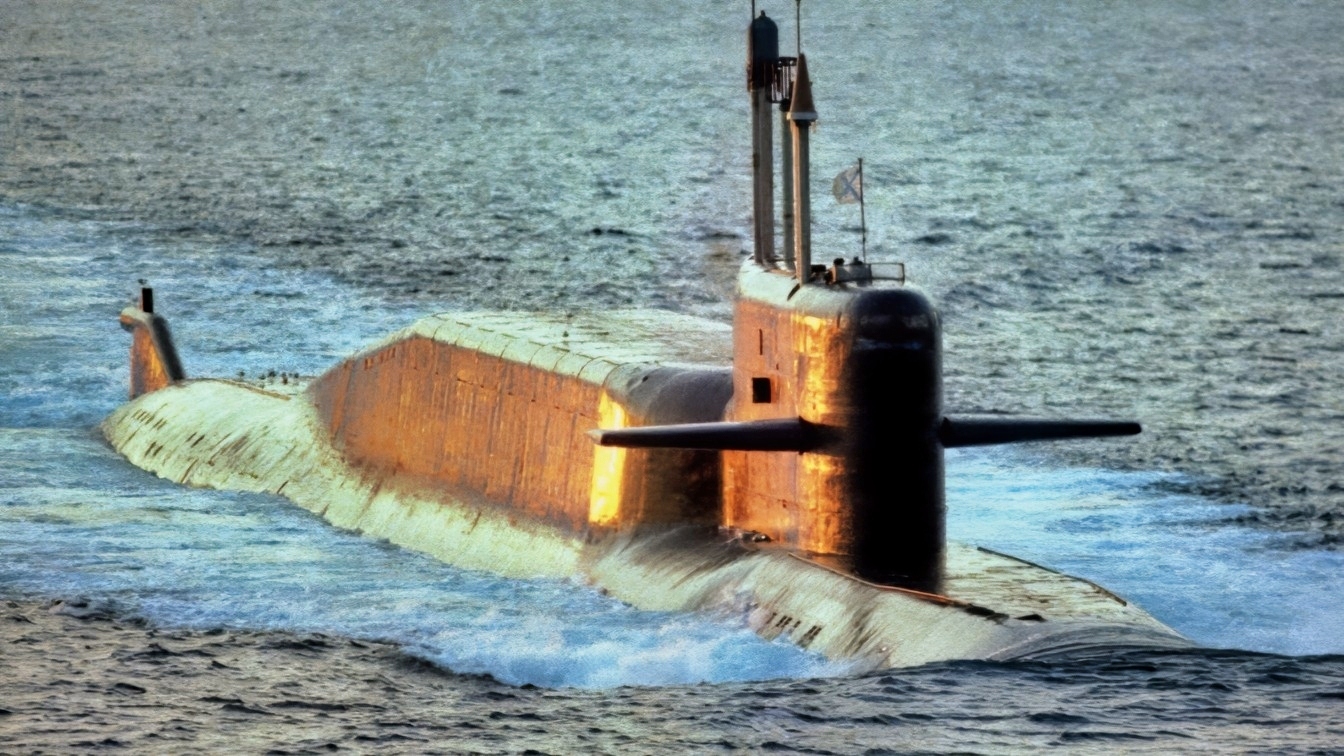
On December 29, 2011, a Russian Delta IV submarine called the Yekaterinburg caught fire in the PD-50 dry dock at Roslyakovo, near Severomorsk in the Murmansk region. Sparks from welding on the hull ignited wooden scaffolding around the submarine, which spread to the rubber acoustic coating on the boat itself. Russian firefighters fought the blaze for nearly 24 hours using helicopters and tugboats; eventually the Russian Navy had to partially submerge the entire submarine to extinguish the fire. Russian officials told the public there were no missiles aboard the Yekaterinburg during the fire. That was later revealed to be a lie.
Russia’s Delta IV Submarine, Explained
Since the collapse of the Soviet Union, the Russian Navy has sought to enhance its submarine fleet, particularly its ballistic missile submarines.
The Russian submarine, known as the Project 667B Delfin/Murena (NATO reporting name Delta), was designed to carry the R-29 Vysota family of nuclear ballistic missiles.
Built concurrently with the Typhoon-class submarines, the Delta-class submarines have formed the backbone of the Soviet and Russian strategic submarine fleet since their introduction in 1973. The Soviets viewed the Delta-class as an improvement over the Yankee-class submarines.
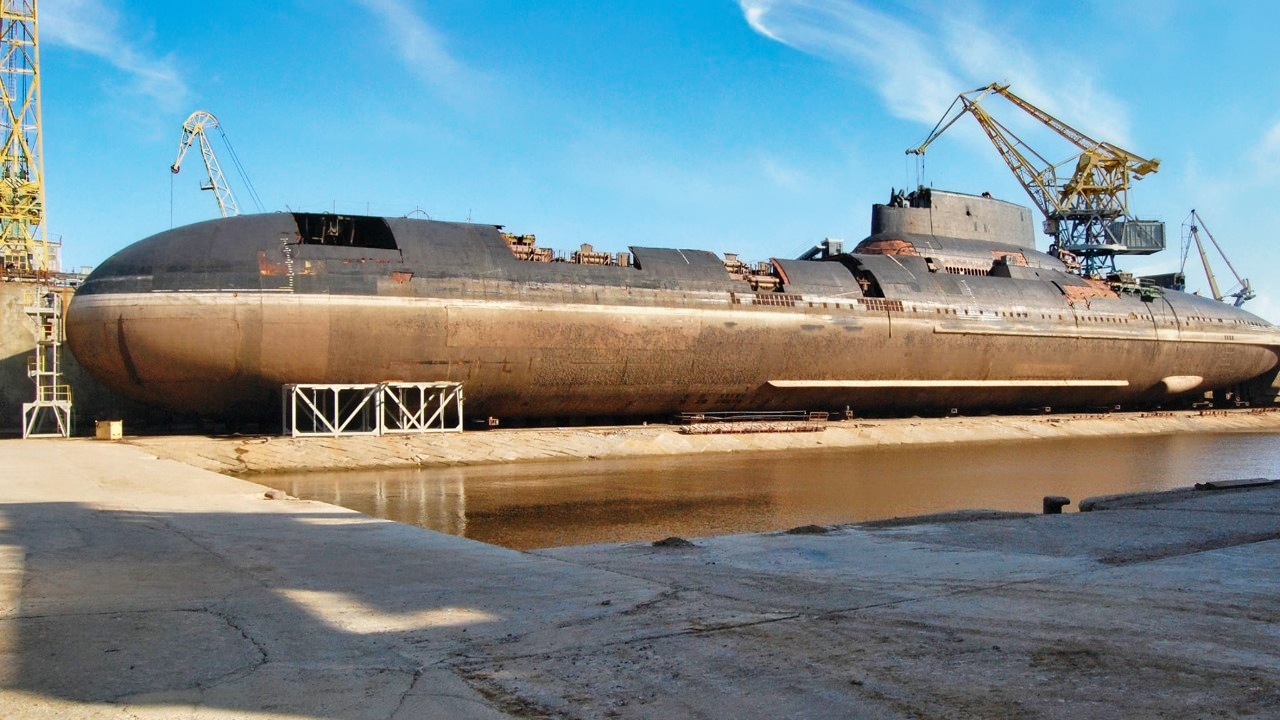
Typhoon-Class Submarine. Image Credit: Creative Commons.

Typhoon-Class. Image Credit: Creative Commons.
Seven Delta IV-class submarines were built; six are still in service in the Russian Navy. The submarines, based at the Sayda Guba Naval Base, are part of the Northern Fleet.
The Severodvinsk Shipyard built these vessels between 1981 and 1992. The last vessel was K-407 Novomoskovsk. The Delta IV class design resembles that of the Delta III class, featuring a classic Russian double-hulled configuration with missile silos housed within the inner hull.
Six are missile subs (Boomers), while one, the Delta IV Stretch-class/PODMOSKOVYE special-missions submarine, has had its missiles removed and now houses a midget submarine.
Meet The Delta IV (Delfin) Missile Submarine
The R-29 Vysota missiles, along with the R-29/SS-N-8 Sawfly, the R-29R/SS-N-18 Stingray, and R-29RM/SS-N-23, provided the boats with much-needed standoff distance, offering a range of 4,785 miles, and allowed the Soviet, now Russian, Navy to conduct deterrence patrols from within the Arctic Ocean.
The submarines were upgraded as the Project 667BD Murena-M (NATO reporting name Delta II), the Project 667BDR Kalmar (NATO reporting name Delta III), and culminating in the Project 667BDRM Delfin (NATO reporting name Delta IV). The first three models are all no longer in service.
The huge submarines are 167 meters long and have an operational diving depth of 320 meters (1,050 ft), with a maximum depth of 400 meters (1,300 ft).
The propulsion system enables submerged speeds of 24 knots (44 km/h) using two VM-4 pressurized water reactors rated at 180 MW. It features two GT3A-365 turbines, each rated at 27.5 MW.
The Delta IV’s Shlyuz navigation system is also quite advanced. Each ship in this series is equipped with the Skat-VDRM hydroacoustic system, along with several anti-hydroacoustic devices.
Murmansk Dry Dock Fire Of The Yekaterinburg
The Delta IV missile submarine Yekaterinburg caught fire while in the PD-50 dry dock on December 29, 2011, in Roslyakovo, near Severomorsk, about 900 miles north of Moscow.
It reportedly started when welding sparks ignited wooden scaffolding around the submarine, which then spread to the submarine’s flammable rubber coating.
As the fire raged nearly out of control, Russian officials were forced to partially submerge the boat to put the fire out after nearly 24 hours. Russian firefighters were seen on television using helicopters and tug boats to fight the fire. About 10 sailors were treated for smoke inhalation, according to the Russian Navy.
The Russian government initially reported that no missiles were on board the boat, but this was later revealed to be false as 16 R-29R nuclear missiles and a full complement of torpedoes were on board. The damage done to the submarine reportedly cost over a million rubles.
Had the missiles exploded due to the fire, it would have been catastrophic not only to the port of Murmansk but also to much of the surrounding region.
The Yekaterinburg was later repaired and returned to service in 2014, but it was retired in late 2021.
Russia currently has no immediate plans to decommission any of its presently active Delta IV vessels. Still, the new Borei line of strategic submarines will eventually replace all of Russia’s remaining Delta and Typhoon models. However, for now, Moscow needs the firepower for its navy, as the Borei-class ballistic missile submarines are being produced slowly.
The Borei-class submarines are considerably stealthier than their Soviet-era predecessors,” according to the Nuclear Threat Initiative.

Russia’s Borei-Class Submarine. Image Credit: Creative Commons.

Borei A-Class. Image Credit: Creative Commons.
Despite being smaller than the Typhoons, the Boreis are considered the most advanced SSBNs Russia has ever built.
They have new electronics and control systems, as well as a pump-jet propulsion system, which makes it significantly quieter than its predecessors.
Despite being replaced by the newer Borei-class missile submarine, the Delta IV class remains a highly capable Cold War-era platform, a dangerous deterrent due to its massive nuclear payloads and advanced stealth coatings.
The Delta IV-class continues to serve as a backbone to Russia’s Northern Fleet and will operate for the foreseeable future.
About the Author: Steve Balestrieri
Steve Balestrieri is a National Security Columnist. He served as a US Army Special Forces NCO and Warrant Officer. In addition to writing on defense, he covers the NFL for PatsFans.com and is a member of the Pro Football Writers of America (PFWA). His work was regularly featured in many military publications.


