


The U.S. Navy’s obsession with $13 billion nuclear-powered supercarriers has become a slow-motion strategic disaster that the aircraft carrier lobby refuses to admit. Modern anti-access/area-denial systems fielded by China, Russia, Iran, and North Korea have fundamentally upended the supercarrier-centric doctrine the U.S. military has relied on for decades—and the better path forward may be smaller nuclear-powered drone motherships built around the unmanned revolution that the rest of the world has already embraced.
America’s Aircraft Carrier Obsession is Becoming a Strategic Disaster
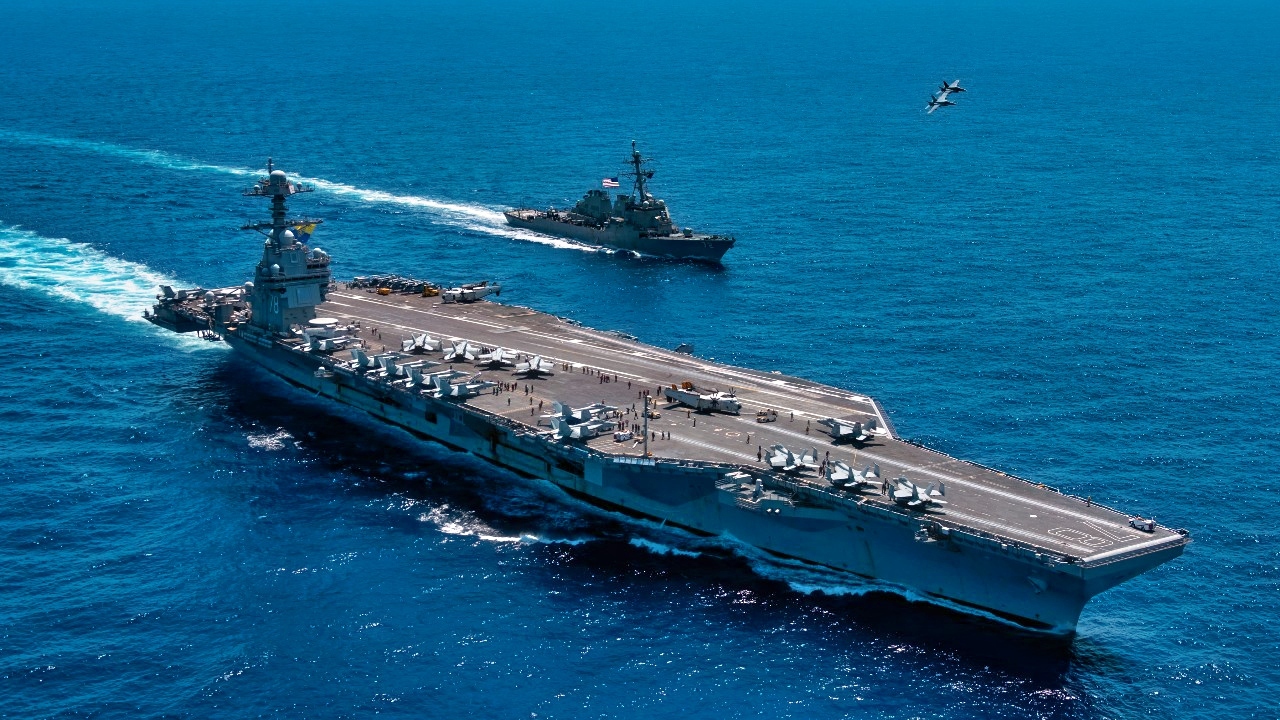
An F/A-18F Super Hornet, attached to the “Blacklions” of Strike Fighter Squadron (VFA) 213 and a F/A-18E Super Hornet, attached to the “Golden Warriors” of Strike Fighter Squadron (VFA) 87 fly over the world’s largest aircraft carrier, USS Gerald R. Ford (CVN 78), the Arleigh Burke-class guided-missile destroyer USS Mahan (DDG 72), April 11, 2025. The Gerald R. Ford Carrier Strike Group is underway in the Atlantic Ocean completing integrated naval warfighting training. Composite Training Unit Exercise (COMPTUEX) is the Joint Force’s most complex integrated training event and prepares naval task forces for sustained high-end Joint and combined combat. Integrated naval training provides America’s civilian leaders and commanders highly-capable forces that deter adversaries, underpin American security and economic prosperity, and reassure Allies and partners. (U.S. Navy photo by Mass Communication Specialist 2nd Class Maxwell Orlosky
There’s a real question about whether the United States has made a bad, long-term investment in nuclear-powered aircraft carriers. Quite clearly, aircraft carriers no longer pack the punch they once did, thanks to the advent of increasingly advanced and powerful anti-access/area-denial (A2/AD) systems, of the kind that China, Russia, Iran, and North Korea employ today.
Yet another argument has arisen that still misses the mark.
Some analysts have finally accepted that the aircraft carrier, under current strategic conditions, is nowhere near as useful as it once was. So, those analysts are arguing the United States should build smaller, non-nuclear carriers instead.
Certainly, that’s a step in the right direction. Non-nuclear carriers, at least on paper, are easier to maintain and build. They’re also cheaper than the nuclear-powered systems that have become ubiquitous in America’s fleet.
The US Navy could more reliably expand its carrier fleet if these cheaper, less complex systems became viable alternatives to its current nuclear-powered platforms. Plus, losing these systems in combat would not be anywhere near as big of a problem for the US Navy as losing one of America’s iconic nuclear-powered supercarriers would be.
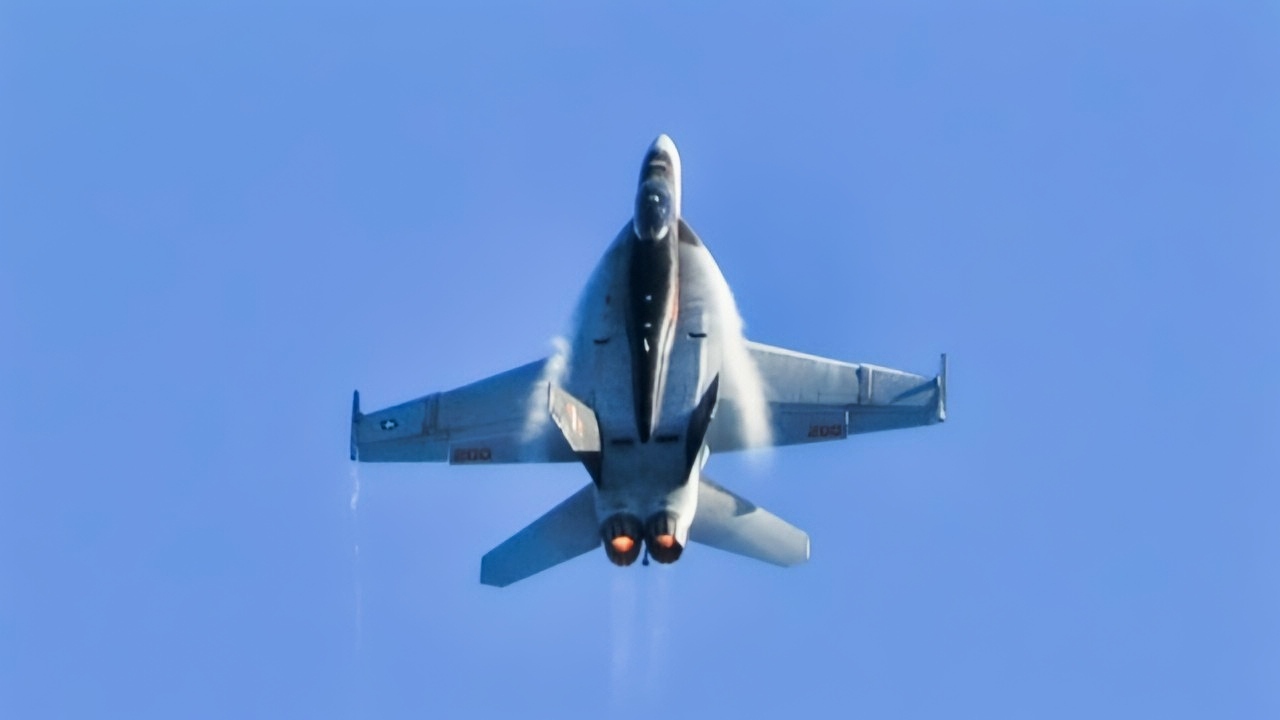
A U.S. Navy F/A-18E Super Hornet aircraft assigned to Strike Fighter Squadron (VFA) 147 performs maneuvers above the aircraft carrier USS Nimitz (CVN 68) during the departure of Carrier Air Wing (CVW) 11 Dec. 10, 2013, in the Pacific Ocean. CVW-11 fixed wing aircraft flew off the Nimitz to return home after being deployed to the U.S. 5th, 6th and 7th Fleet areas of responsibility. (U.S. Navy photo by Mass Communication Specialist Seaman Apprentice Kelly M. Agee/Released)
Scrapping non-nuclear carriers would be infinitely easier than decommissioning nuclear-powered platforms, too.
Why the Aircraft Carrier Lobby Still Defends the Supercarrier
Of course, the carrier clique that dominates the US Navy today will not countenance such a possibility as non-nuclear, smaller aircraft carriers being built over the monstrosities they prefer.
Proponents of nuclear-powered supercarriers insist that their preferred platforms, despite the money and time spent building them, are well worth the exorbitant cost.
These voices argue that nuclear-powered carriers can carry larger, more capable air wings of more than 75 aircraft and can operate at higher sortie rates (more than 160 sorties per day) than can smaller, non-nuclear carriers.
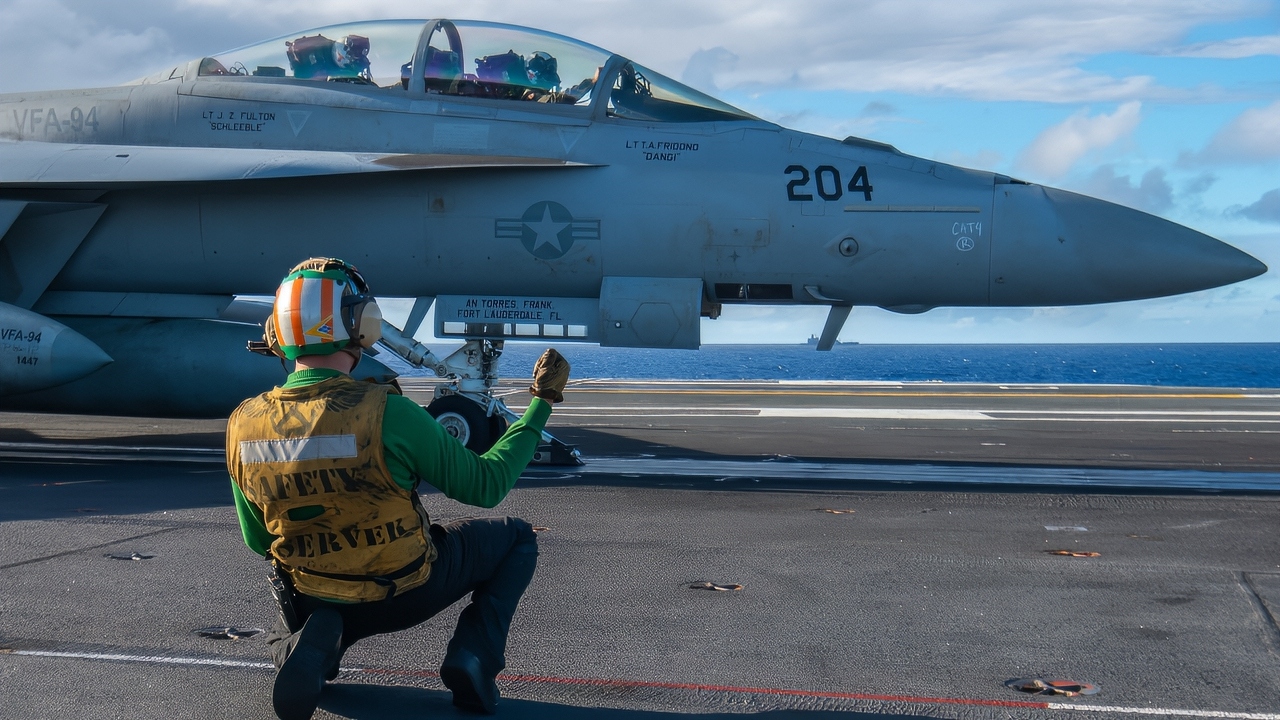
(Dec. 31, 2022) An F/A-18E Super Hornet assigned to the “Mighty Shrikes” of Strike Fighter Squadron (VFA) 94 prepares to launch from the aircraft carrier USS Nimitz (CVN 68) to participate in a long-range maritime strike demonstration. Nimitz is in 7th Fleet conducting routine operations. 7th Fleet is the U.S. Navy’s largest forward-deployed numbered fleet, and routinely interacts and operates with 35 maritime nations in preserving a free and open Indo-Pacific region. (U.S. Navy photo by Mass Communication Specialist 2nd Class Justin McTaggart)
Nuclear carriers do not require fuel stops. Thus, the carriers can remain on station for months at a time. What’s more, studies have shown that the infrastructure required for an aircraft carrier–catapults, defensive systems, radars–means that a smaller, non-nuclear carrier is not as cheap as its supporters claim.
Essentially, pro-nuclear-powered carrier people oppose what they view as using many finite resources to build a system that is subpar compared to their preferred system.
America’s Expeditionary Model is Breaking Down
One of the core tenets of US naval doctrine centers on the use of large, nuclear-powered carriers for their power-projection capacity. Unlike conventional, smaller carriers, America’s expensive supercarriers don’t require forward bases from which to operate.
This model, while costly, is in keeping with the current expeditionary force model of the US military. American warships must operate far from home and often in unfriendly territory. While there might be friendly bases nearby, US forces cannot always rely on that prospect.
Nuclear-powered supercarriers give the US Navy the option to operate in contested, distant territories effectively.
At least they used to give US naval planners that option.

An F/A-18C Hornet, assigned to the “Stingers” of Strike Fighter Squadron 113, transits over the haze of southern Afghanistan. VFA 113, part of Carrier Air Wing 14 aboard the aircraft carrier USS Ronald Reagan is supporting Operation Enduring Freedom. The mission of CVW 14 is to protect the people of Afghanistan and to support coalition forces. Ronald Reagan is currently deployed to the U.S. 5th Fleet area of operations. Operations in the U.S. 5th Fleet area of operations are focused on reassuring regional partners of the United States’ commitment to security, which promotes stability and global prosperity.
Again, the advent of sophisticated A2/AD has fundamentally upended that model. Although the rise of A2/AD does not mean that conventional, smaller aircraft carriers are preferable. What it means is that the entire notion of aircraft carriers needs to be fundamentally rethought among US naval strategists.
How does the US Navy, an expeditionary force, project its power into distant, often hostile territories without needlessly risking itself?
The Real Answer: Nuclear-Powered Drone Motherships
Since the Navy seems incapable of dropping its abiding obsession with aircraft carriers, a better use of resources, money, and time would be in creating smaller, nuclear-powered drone motherships. A revolution in unmanned warfare is erupting across the world’s battlefields. But the US keeps ignoring these radical changes, even though they have been underway for years.
The longer that the US resists modifying its force structure and doctrine to accommodate these shifts in modern warfare, the more likely it is that the US military will suffer a catastrophic defeat at the hands of those militaries globally that have embraced these changes.
Drone motherships could be either fully or almost completely automated. What’s more, while large enough to carry drone swarms, they would be smaller than most manned warships– especially supercarriers.
To ensure these ships can conduct near-continuous operations, the Navy should install nuclear reactors. But these ships could even be equipped with small, modular nuclear reactors if necessary to keep costs down and shorten the production cycle.
The Navy’s Future Depends on Embracing the Drone Revolution
America has made aircraft carriers, especially nuclear-powered supercarriers, the centerpiece of its naval power projection. Yet, these systems are increasingly obsolete, thanks to the advent of A2/AD.
Building a conventional, smaller aircraft carrier to augment its surface warfare force is not the best path forward. The better way is for the Navy to build small, nuclear-powered drone motherships. These systems would be cheaper, easier to maintain, and more relevant to the modern battlefield than anything that the Navy is currently designing.
Oh, and the longer America waits to embrace the drone revolution at sea, the greater the chance it will be defeated.
About the Author: Brandon J. Weichert
Brandon J. Weichert is the Senior National Security Editor. Recently, Weichert became the editor of the “NatSec Guy” section at Emerald. TV. He was previously the senior national security editor at The National Interest. Weichert hosts The National Security Hour on iHeartRadio, where he discusses national security policy every Wednesday at 8 p.m. Eastern. He hosts a companion show on Rumble entitled “National Security Talk.” Weichert consults regularly with various government institutions and private organizations on geopolitical issues. His writings have appeared in numerous publications, among them Popular Mechanics, National Review, MSN, and The American Spectator. His books include Winning Space: How America Remains a Superpower, Biohacked: China’s Race to Control Life, and The Shadow War: Iran’s Quest for Supremacy. Weichert’s newest book, A Disaster of Our Own Making: How the West Lost Ukraine, is available for purchase at any bookstore. Follow him via Twitter/X @WeTheBrandon.


